¶ Ecotones and Forest Edges in the TEIKEI Ecosystem
Introduction and Overview › Glossary for the Networking Language · 9 min read
¶ Concept and Basic Idea
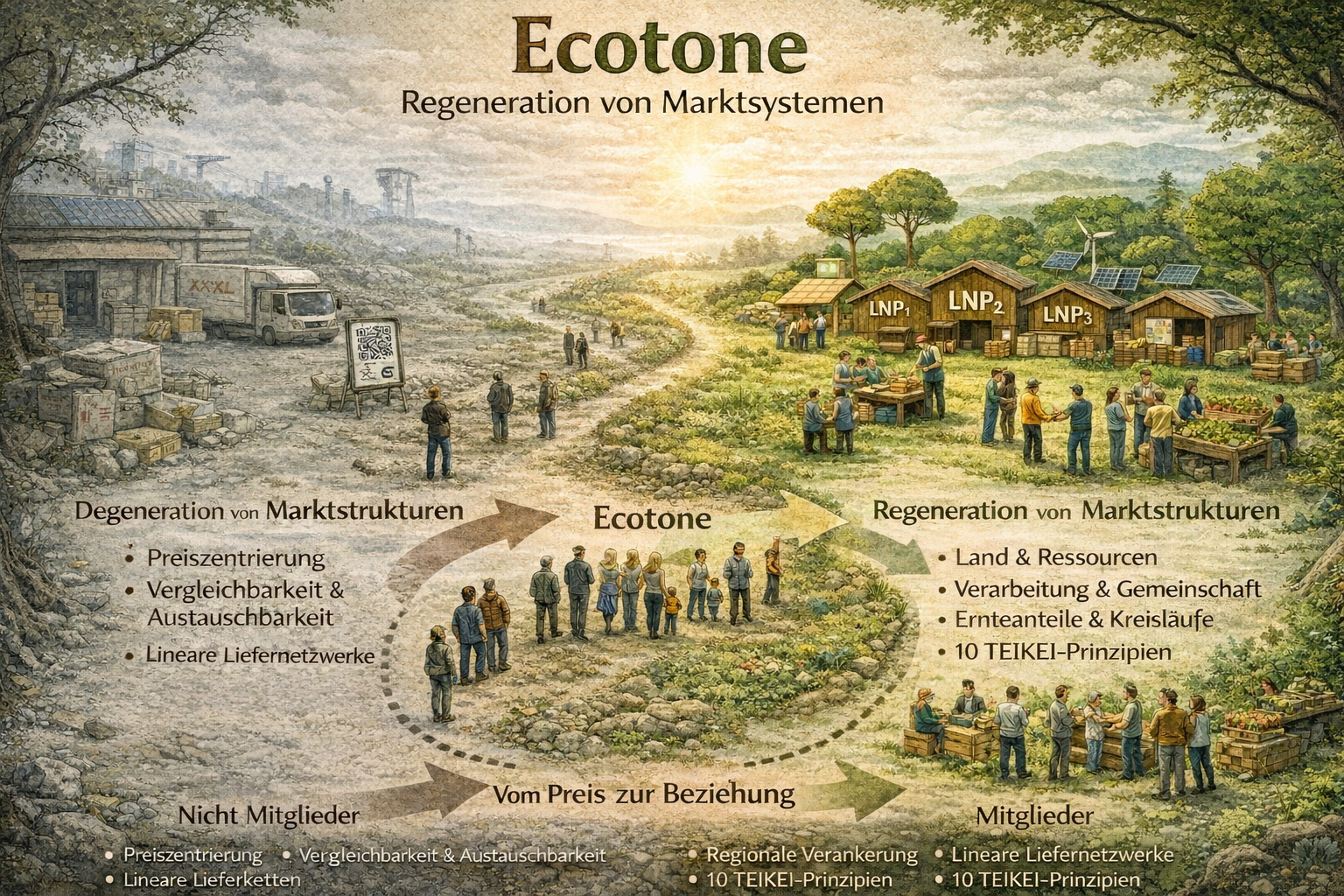
In ecology, an ecotone refers to a transitional space between two different habitats, such as between forest and meadow, river and land, or coast and sea. These forest edges are not incidental border zones. They are often among the most vibrant, diverse, and fertile areas of an entire ecosystem.
At TEIKEI, this concept helps us understand the places and processes where two different economic logics meet:
- the linear, price-driven market logic
- the community-based Agora logic of TEIKEI
Ecotones are the in-between spaces where it is decided: Does mere contact become a sustainable relationship? Does a purchase turn into participation? Can market movement evolve into community-based provision?
¶ Why the Concept Matters for TEIKEI
TEIKEI is not just another shop. With TEIKEI, we are attempting to build a different logic of provision. It is not primarily based on maximum transaction speed, but on relationships, planning, shared responsibility, transparency, and long-term sustainability.
This is precisely why the edges to the existing market are so important. Here, it becomes clear: Do people perceive TEIKEI merely as an alternative sales interface—or do they actually grow into a different form of provision and co-responsibility?
In the TEIKEI context, ecotones are therefore not a decorative metaphor. They describe the real transition zones where the system opens up, translates, explains, connects, challenges, invites, and transforms.
¶ The Forest Edge as a Conceptual Figure
The forest edge is neither forest nor meadow. It is not unambiguous. Precisely for this reason, it is rich. There, light and shadow, protection and openness, stability and movement come together.
From this, we derive a central insight for TEIKEI:
The enclosed inner space is not the only place of development. The greatest learning and transformation processes often arise at the contact surfaces with the outside world.
This means:
- Where people first encounter TEIKEI, much is possible.
- Where different logics meet, friction and insight emerge simultaneously.
- Where transitions are well-designed, a degenerative pattern can be transformed into a regenerative one.
¶ The Two Systems Between Which Ecotones Emerge
¶ 1. Degenerative Market Logic
The degenerative market logic is characterized by:
- price-centricity
- comparability and interchangeability
- linear supply chains
- anonymization of relationships
- outsourcing of risk to producers or weaker links in the chain
- separation of purchase, origin, responsibility, and impact
This logic may appear efficient, but it often creates disconnection. It reduces food to a commodity and relationships to transactions.
¶ 2. Regenerative Agora Logic
The regenerative Agora logic of TEIKEI is characterized by:
- relationships instead of mere price consideration
- planning instead of spontaneous sales logic
- shared responsibility
- transparency in logistics, financing, and roles
- local anchoring through pickup locations and communities
- cycles instead of purely linear processing
Here, the goal is not just to distribute a product but to build a sustainable structure of provision.
¶ What an Ecotone Is in the TEIKEI Cosmos
An ecotone in the TEIKEI cosmos is a transitional space. A person, a group, or a process is not yet fully anchored in the Agora logic—but no longer entirely in the old market logic either.
Such spaces are open, sensitive, and full of potential. They require attention, design, and clarity.
Ecotones are particularly relevant where the following questions arise:
- How does interest turn into trust?
- How does a purchase become a relationship?
- How does an individual order become an ordering community?
- How does provision become co-responsibility?
- How does a platform become an Agora?
¶ Key Ecotones in the TEIKEI Ecosystem
¶ 1. The First Contact
The first contact can arise in many ways:
- a product recommendation
- a search query
- a social media post
- an invitation from friends
- an encounter with a pickup location
- a graphic or story about regenerative market structures
This is the outermost forest edge. Here, TEIKEI is not yet visible as a structure for many people. It initially appears as an offer, a product, or an interesting initiative.
The crucial task in this ecotone is not persuasion but readability. People must be able to recognize that something different is happening here than in ordinary online commerce.
¶ 2. The Moment of Purchase
The moment of purchase is a highly sensitive transitional space between two logics:
- on one side, the expectation of a typical shop process
- on the other side, entry into a community-based provision structure
Here, it is decided: Is TEIKEI misunderstood as a mere ordering system? Or does it become visible during the ordering process that every order is embedded in planning, delivery quantities, pickup locations, delivery cycles, and community responsibility?
This forest edge is particularly important. Here, the language of the market often still dominates, while the reality of TEIKEI is already more strongly shaped by community logic.
¶ 3. The Pickup Location
The pickup location is one of the most important ecotones in the entire system.
Here, digital structure becomes physical reality. Products, people, roles, communication, and responsibility meet concretely. The pickup location is neither just a logistics point nor a mere social gesture. It is an interface, a contact surface, and a translation space all at once.
At the pickup location, it becomes clear:
- that provision is not anonymous
- that coordination is community-driven
- that food requires handover, time, and care
- that community has an organizational form
The pickup location is thus a true forest edge in the TEIKEI cosmos: There, the inner Agora structure becomes visible to outsiders and experiential for participants.
¶ 4. The Organizers
Organizers of pickup locations are bridge figures. They connect system parts that would otherwise easily become disconnected:
- producers and members
- platform and local reality
- scheduling logic and relationship logic
- information and handover
- responsibility and everyday life
In the ecological image, they do not correspond to the center of a system but rather to a key function at transitions. They act like mediators between spaces. Without them, much remains theoretical. Through them, transitions become walkable.
¶ 5. The Delivery Quantity Situation
Even when delivery quantities are not met, this is an ecotone. Here, it becomes visible: TEIKEI does not serve a purely individual instant logic but works with community sustainability.
This transitional space is delicate because it can cause frustration. At the same time, it reveals something essential: provision is tied to real bundling, coordination, and co-responsibility.
If this ecotone is poorly designed, rejection arises. If it is well-designed, understanding of the system’s inner architecture emerges.
¶ 6. The Handover and Redistribution
If a member cannot pick up an order themselves, responsibility for redistribution within the community arises—and again, a forest edge appears. Precisely there, the logic shifts:
- away from the expectation of an anonymous seller
- toward responsibility within a network
Such moments are not merely organizational exceptions. They show that provision in TEIKEI is relationally organized.
¶ 7. The Reusable and Refill Logic
Another particularly exciting ecotone lies where industrial packaging and end-consumer logic meet community-organized circular logic.
Especially in reusable systems and community refilling, it becomes visible that the transition is not only economic but also material. Containers, labeling, traceability, handover locations, and community responsibility together form a forest edge between old market release and new circular practice.
¶ 8. Crises, Errors, and Tensions
Crises are also ecotones. In the case of delivery problems, quality deviations, failures, or misunderstandings, it becomes clear: Is the system only built for smooth operations—or can it collectively hold and process tensions?
Such moments are not mere disruptions. They are transitional spaces in which the system’s trust is tested.
¶ What Happens at Ecotones
At ecotones in the TEIKEI cosmos, five things primarily happen:
¶ 1. Translation
Terms, processes, and expectations must be translated from one logic to another. Without translation, misunderstandings arise.
¶ 2. Visibility
What is taken for granted in the core system becomes visible at the edge for the first time. Roles, rules, dependencies, and values come to the fore.
¶ 3. Selection
Not every person, not every initiative, and not every expectation automatically fits into the Agora logic. Ecotones are therefore also places of clarification.
¶ 4. Relationship
Where transitions are well-designed, trust, recognition, and connection emerge. Transactions can become relationships.
¶ 5. Regeneration
When it succeeds in creating new forms of connection at a forest edge, this not only affects the edge but the entire system. Good ecotones renew the center.
¶ Ecotones Are Not Marketing Zones
It is important to us: We do not reduce ecotones to mere capture zones. It is not about smoothly funneling people away from other platforms. That would only be a refined form of the old market logic.
A true TEIKEI ecotone is not a funnel. It is a transitional space that enables orientation, makes responsibility readable, and offers relationships without pandering.
The goal is not takeover but a coherent transition.
¶ How to Recognize a Strong Ecotone
A strong ecotone in the TEIKEI cosmos has the following characteristics:
- It is clearly readable.
- It does not artificially blur differences.
- It makes the special logic of TEIKEI understandable.
- It does not immediately overwhelm with the entire system.
- It invites deeper engagement.
- It combines information with experience.
- It enables participation without deception.
¶ How to Recognize a Weak Ecotone
A weak ecotone often becomes apparent when people enter the system with false expectations and are then irritated by fundamental aspects.
Typical signs:
- TEIKEI is misunderstood as a normal shop.
- Community obligations appear surprising rather than self-evident.
- Delivery quantities, pickup logistics, or deadlines seem like obstacles rather than system elements.
- Organizational roles remain invisible.
- The transition from market logic to Agora logic is not explained.
¶ The Forest Edge as a Design Task
For us at TEIKEI, this results in a practical task: We do not only cultivate the center of the system. We also consciously design the edges.
This particularly concerns:
- language
- images
- ordering processes
- community pages
- pickup location communication
- emails
- wizard processes
- entry pages
- explanatory graphics
- role descriptions
The better these forest edges are designed, the more easily people can grow into the ecosystem in a connectable way.
¶ Ecotones and Recursive Network Economy
The concept of the ecotone fits particularly well with the recursive network economy. For there, too, stability does not arise solely from a center but through feedback, resonance, and distributed responsibility.
In this sense, ecotones are not outer edges of a fixed core but productive contact zones where the network expands, tests, corrects, and renews itself.
They are places of feedback between:
- inside and outside
- structure and experience
- planning and encounter
- provision and culture
- digital infrastructure and real community
¶ Concluding Thought
In ecological terms, forest edges are not residual areas. They are zones of heightened vitality. We can understand the transitions to the outside world in the TEIKEI cosmos in the same way.
Where market logic and Agora logic meet, there is not only friction but also a treasure. If these spaces are designed with clarity, responsibility, and good form, the most fertile areas of the entire system emerge from them.
Ecotones are therefore not just a helpful concept for TEIKEI. They are a key to understanding where transformation actually happens.
¶ Related Terms
← Letter E · All Terms A–Z
By the TEIKEI editorial team, with AI support (ChatGPT)
Created on April 19, 2026 · Last updated on October 10, 2026
Questions or feedback? support@teikei.us