¶ Agora 4.0 – The Next Development Stage of TEIKEI Agora
TEIKEI Agora is currently primarily visible as a space for community-supported ordering, coordination, distribution, and participation.
With Agora 4.0, a new level is opening up.
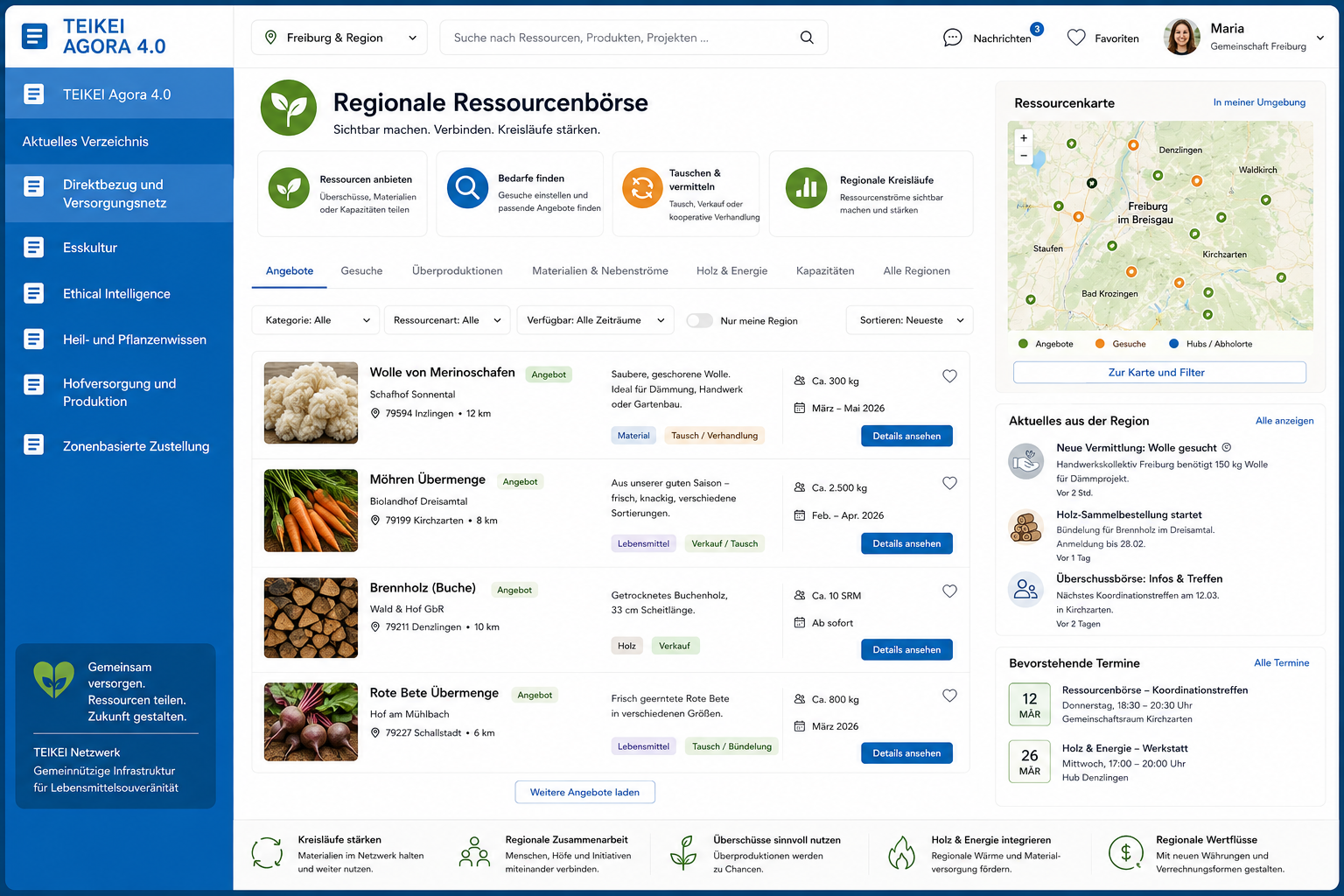
The platform is no longer merely seen as a place for products, but as a regional infrastructure for relationships, supply, resource flows, and cooperative development. It continues to connect harvest shares, communities, and logistics—while expanding this logic with new tools that enable regions to better visualize and shape their own cycles.
Agora 4.0 thus represents the transition from an ordering and distribution platform to a more comprehensive tool for recursive network economics.
¶ What Agora 4.0 Is About
The core idea of Agora 4.0 is simple:
Not only finished products should appear on the platform, but also what otherwise remains invisible in a region.
This includes surpluses, residual materials, available capacities, exchange materials, seasonal special quantities, local energy sources, and new forms of regional negotiation.
This transforms the Agora from merely a marketplace for food into an infrastructure where regions can learn to better recognize, coordinate, and share their own potentials.
¶ From Product Logic to Resource Logic
In the current logic, products take center stage:
Olive oil, fruits, harvest shares, delivery quantities, and the associated communities.
Agora 4.0 complements this product logic with a resource logic.
Resources here are not just goods in the traditional sense. They include materials, material flows, surpluses, by-products, or usable qualities that often remain invisible or unmarketable in the existing system.
Examples include:
- Wool from a sheep farm that cannot be meaningfully used locally
- Particularly large harvests of carrots, beets, or other field crops
- Wood from agricultural or farm-adjacent production
- Seasonal surpluses that do not fit into normal distribution
- Materials that could be valuable for other farms, workshops, initiatives, or regions
This expands the platform with a new level of visibility:
Not just "What is being sold?"
but also "What is available?", "What is needed?", and "What can be connected?"
¶ The Regional Resource Exchange
A possible name for this area is:
¶ Regional Resource Exchange
The Regional Resource Exchange is a part of Agora 4.0 where agricultural operations, processing farms, storage locations, and associated initiatives can offer resources or make needs visible.
Importantly:
This is not necessarily about classic sales logic.
Instead, the platform can enable various forms of provision:
- Offer as exchange material
- Offer as a basis for negotiation
- Cooperative transfer within a network
- Community-organized bundling
- Regional mediation between providers and users
- Advance notification of surplus quantities or special items
For example, a farm could report that large quantities of wool are available.
Another location might need this wool for insulation, gardening, art, crafts, or further processing.
The Agora thus becomes a mediation space between available resources and real needs.
¶ Making Overproduction Visible
A central element of Agora 4.0 is the ability to treat overproduction not as a problem, but as an opportunity for connection.
If a farm has had a particularly good season and has more carrots, beets, pumpkins, apples, or other products available, these quantities should not remain invisible or subject solely to the pressure of classic sales logic.
Instead, they can be made visible at the regional level in the Agora.
This requires its own input logic, for example with the following details:
- Type of resource or product
- Estimated quantity
- Period of availability
- Condition or quality level
- Desired form of transfer
- Region or pickup radius
- Indication of whether sale, exchange, bundling, or open negotiation is desired
This creates a new space between agriculture, community, crafts, processing, and regional self-organization.
¶ Wood and Energy Supply as New Product Fields
Another development step in Agora 4.0 is the opening to new product and supply fields.
Wood is particularly relevant here.
If agricultural operations, farm communities, or associated businesses can provide their own wood, the Agora could also serve as a coordinating space for this in the future. Not as an arbitrary expansion of trade, but as a meaningful step toward regional basic supply.
Wood can take various forms:
- Firewood
- Timber
- Scrap wood
- Landscape management wood
- Material for workshops, initiatives, or community construction projects
This touches on the topic of energy supply.
In the long term, the platform could help make regional energy and material flows visible and connect them with real needs. This would further develop the Agora toward a deeper supply architecture where food, materials, heat, and regional infrastructure are no longer considered separately.
¶ Regional Currency Components
Another possible building block of Agora 4.0 is regional currency components.
This does not mean simply introducing a new currency.
Rather, it means that the platform could include tools to represent regional value flows differently than exclusively through classic monetary payment.
This could later include:
- Regional credit logics
- Cooperative accounting between participants
- Time or participation shares
- Purpose-bound regional credits
- Hybrid models between euro payments and regional balancing logic
Such components can be particularly useful where regions want to strengthen their own cycles and where not every service needs to be immediately accounted for in normal market logic.
This area requires special care, clear rules, and good legal embedding.
It should therefore be understood as a development field, not as a prematurely finished module.
¶ Who Can Participate in Agora 4.0
Agora 4.0 is not only aimed at classic product providers.
Potential participants include:
- Agricultural operations
- Farms with by-products and residual materials
- Processing businesses
- Pickup locations and hubs
- Regional initiatives
- Craft and construction contexts
- Communities with specific needs
- Coordinators at the regional level
This allows the Agora to grow beyond mere order processing into a platform that helps regions organize their own material and supply flows.
¶ The Quality Implemented with Agora 4.0
Agora 4.0 is not simply about "more features."
The real quality lies deeper.
It is about the platform not only organizing transactions but also creating relationships between existing possibilities and real needs.
This quality can be described in five points:
-
Visibility
Previously invisible resources, surpluses, and potentials become recognizable. -
Regionality
Offers and needs can be located in the region tree and meaningfully connected. -
Cooperation
Not just purchase, but also exchange, transfer, bundling, and negotiation become possible. -
Circularity
Materials and by-products are more likely to remain in the network rather than being discarded or treated in isolation. -
Supply Intelligence
The Agora becomes a tool that helps regions better understand and organize themselves.
¶ Possible Building Blocks of the Platform
For later technical implementation, Agora 4.0 could include the following modules, among others:
¶ 1. Resource Offers
A dedicated area for materials, surpluses, by-products, and special quantities.
¶ 2. Resource Requests
Regions, businesses, and initiatives can post specific needs.
¶ 3. Negotiation Mode
Not every entry requires a fixed price. Free negotiation, exchange, or cooperative mediation are also possible.
¶ 4. Regional Matching Logic
Offers and requests are matched by region, distance, time period, and type of resource.
¶ 5. Expanded Roles for Businesses
Businesses can make themselves visible in the region tree not only as product providers but also as resource holders.
¶ 6. Documentation of Material Flows
The platform can show in the long term which materials are available in a region, where they flow, and where bottlenecks or potentials lie.
¶ Agora 4.0 as the Next Step
Agora 4.0 is not a departure from the existing platform.
It is its next stage of maturity.
What began today with harvest shares, communities, delivery logistics, and regional development can evolve into a more comprehensive infrastructure:
for food, materials, surpluses, energy approaches, cooperation, and regional value creation.
Thus, the Agora increasingly becomes a place where not only orders are placed,
but where regions learn to shape their supply, relationships, and resources together.
¶ Open Development Questions
For the further development of Agora 4.0, the following questions are particularly important:
- Which types of resources should be represented first?
- What roles do price, exchange, and free negotiation play respectively?
- How are quality, responsibility, and liability described?
- Which regional levels in the region tree are meaningful for this logic?
- How can wood, energy, and material flows be integrated without overloading the platform?
- Which currency components are culturally, technically, and legally viable?
¶ Outlook
Agora 4.0 describes a future in which TEIKEI Agora not only organizes supply but also builds regional intelligence.
It makes visible what is there.
It connects what can complement each other.
And it creates a space where individual farms, communities, and regions can form a more vibrant supply network.
One level up: Development of the Agora
Author: Felix Schröder, with the help of AI (ChatGPT)
Creation: written by Felix Schröder › formatted in Markdown by ChatGPT › published by Felix Schröder › layout adjusted by Claude
Created: 2026-04-18 · Last updated: 2026-05-08 · Questions or feedback? support@teikei.us