¶ Infrastructure
Agora and Agora Marketplace › Architecture of the Agora · 5 min read
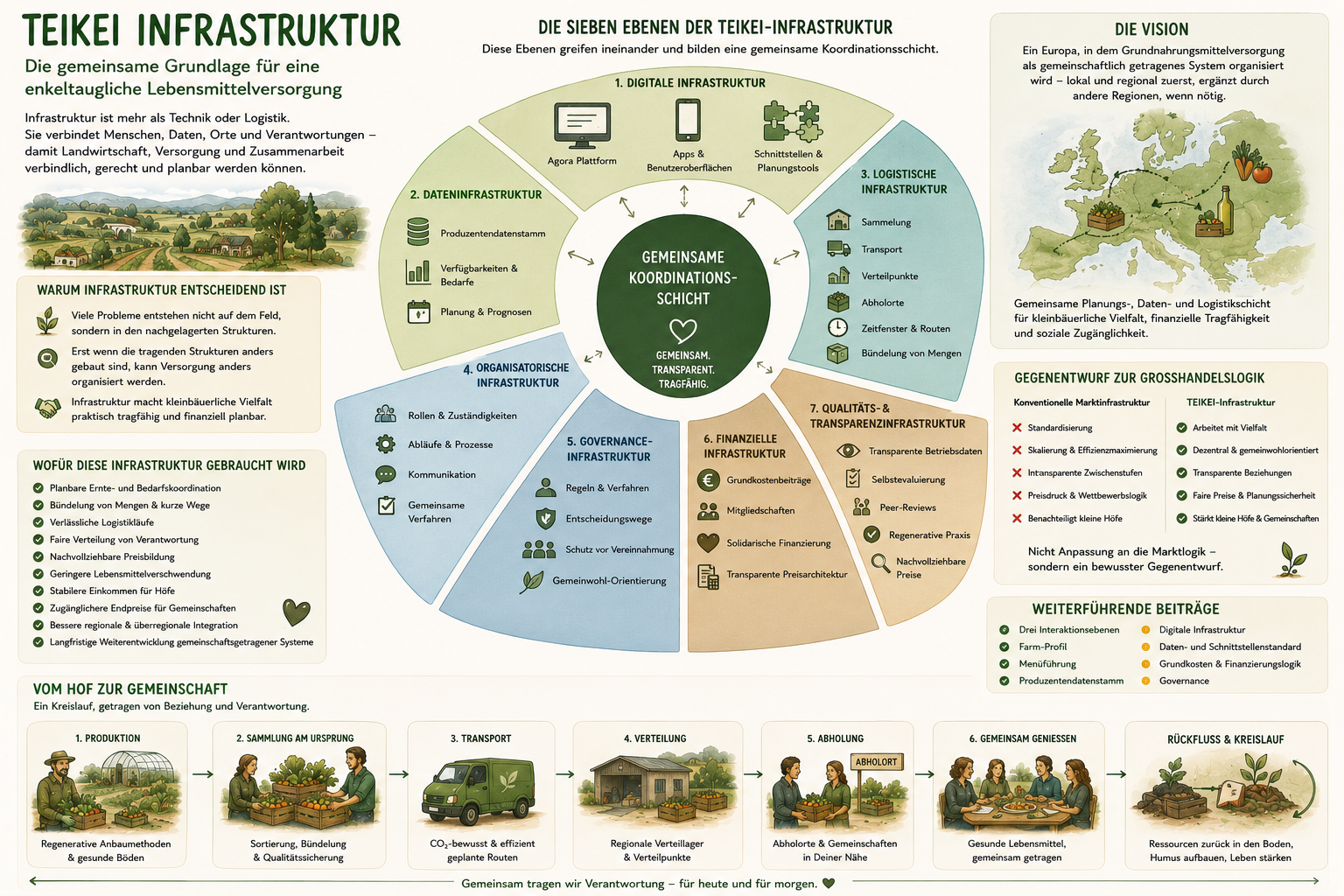
In the TEIKEI context, infrastructure means far more than just technology or logistics. Infrastructure is the shared foundation on which agriculture, supply, pricing, planning, and collaboration can be reliably organized in the first place.
It encompasses not only digital tools but also data standards, organizational processes, roles, decision-making pathways, logic layers for ordering and distribution, as well as the physical structures of collection, storage, transport, and pickup.
Thus, in the TEIKEI understanding, infrastructure is not a neutral background layer but a central lever for the question of how food supply is organized and whom it serves.
¶ Why infrastructure is crucial
Many problems of small-scale farming do not arise solely in the field but in downstream structures. Production often exists, yet the connecting infrastructure is missing: data is inconsistent, logistics are geared toward standardized wholesale goods, quantities are difficult to bundle, and small farms bear high risks with little predictability.
That is why TEIKEI does not focus solely on cultivation methods or individual products but on the infrastructure itself. Only when the supporting structures are built differently can supply be organized differently.
Infrastructure is thus the prerequisite for ensuring that small-scale agricultural diversity is not only valued in principle but also practically viable.
¶ What infrastructure includes
The TEIKEI infrastructure consists of several interconnected layers:
- digital infrastructure
- data infrastructure
- logistical infrastructure
- organizational infrastructure
- governance infrastructure
- financial infrastructure
- quality and transparency infrastructure
These layers cannot be understood in isolation. They interact and form a shared coordination layer for supply.
¶ Digital infrastructure
The digital infrastructure comprises the tools and systems through which information becomes visible, plannable, and coordinatable. This includes platforms like the Agora, user interfaces for communities, planning tools, interfaces between actors, and systems for managing orders, quantities, and delivery logistics.
The digital layer is not about technologization for its own sake. It aims to translate complexity in a way that keeps farms, communities, organizers, and other participants capable of action.
¶ Data infrastructure
A central element is the data infrastructure. It creates the foundation for turning individual farm data, needs, and product availability into a plannable supply.
A key component here is the producer master data. It translates farm data into logistics-capable supply planning and makes visible what is available, when, in what quantity, and under what conditions.
In the TEIKEI context, data infrastructure does not mean control but coordination capability.
¶ Logistical infrastructure
Infrastructure also includes all physical and organizational processes that bring products from the farm to the communities. This includes:
- collection structures at the origin
- distribution warehouses
- transport logistics
- regional distribution points
- pickup locations
- coordinated delivery times
- bundling of quantities and routes
The logistical infrastructure aims to make small-scale farming connectable without forcing it into the norms of wholesale trade.
¶ Organizational infrastructure
Beyond technology and logistics, clear organizational structures are needed. These include roles, responsibilities, recurring processes, communication pathways, and shared procedures.
Organizational infrastructure ensures that not everything depends on individuals but that tasks can be reliably distributed, developed, and transparently managed.
Especially in community-based structures, this layer is crucial to prevent engagement from turning into overload.
¶ Governance infrastructure
TEIKEI understands infrastructure also as a question of power and decision-making structures. Who decides? Who bears responsibility? How are rules developed? How is it prevented that central tools are privatized or co-opted for individual interests?
Governance infrastructure thus refers to the rules, procedures, and bodies through which the shared infrastructure is protected, developed, and aligned with the common good.
It is particularly important when infrastructure is not to be sold, privatized, or dominated by capital-driven interests.
¶ Financial infrastructure
A different supply architecture requires a different financing logic. Therefore, infrastructure includes not only how products are paid for but also how basic costs are covered.
Basic cost contributions, solidarity-based financing models, and transparent pricing architectures are part of this financial infrastructure. They ensure that not every single box must finance the entire system and that agriculture, logistics, and coordination become more predictable.
¶ Quality and transparency infrastructure
Infrastructure is also the foundation for ensuring that quality is not left to chance. Transparent operational data, documented self-evaluations, peer reviews, criteria for regenerative practices, and traceable price components also belong to a resilient infrastructure.
This makes infrastructure the place where trust is not merely claimed but practically secured.
¶ The vision behind the infrastructure
The vision behind this infrastructure is a Europe in which the supply of staple foods is not primarily organized through speculative market mechanisms, price pressure, and non-transparent intermediaries but as a planned, community-supported system.
The principle applies: local and regional first, supplemented by other regions when products are not available within one's own climate zone. The infrastructure connects these levels without displacing local supply.
It creates a shared planning, data, and logistics layer that makes small-scale farming financially viable, logistically feasible, and socially accessible.
¶ Infrastructure as a counter-design to wholesale logic
Conventional market infrastructure is geared toward standardization, scaling, and efficiency maximization. Small-scale diversity usually only fits in if it adapts or submits.
The TEIKEI infrastructure pursues a different approach. It does not seek to reduce diversity for the sake of wholesale logic but to create an infrastructure that can work with diversity.
Thus, it is not an add-on system at the margins but a deliberate counter-design to a market architecture that structurally disadvantages small farms.
¶ What this infrastructure is needed for
A resilient infrastructure enables, among other things:
- plannable harvest and demand coordination
- better bundling of quantities
- reliable logistics runs
- fair distribution of responsibility
- traceable price formation
- reduced food waste
- more stable incomes for farms
- more accessible final prices for communities
- better integration of regional and supra-regional supply
- long-term development of community-supported systems
Infrastructure is thus not a side issue but the prerequisite for turning many individual relationships into a resilient supply architecture.
¶ Positioning in the TEIKEI context
In the TEIKEI context, infrastructure is the space between farm and community, between production and supply, between idea and reliability. It connects people, processes, data, places, and responsibilities.
Without this infrastructure, many good approaches remain separate. With it, individual farms, communities, organizers, distribution points, and regions can grow into a learning, coordinated, and common-good-oriented supply system.
¶ Further information & understanding contexts
↑ One level up: Architecture of the Agora
Compiled by the TEIKEI editorial team with AI support (ChatGPT)
Created on March 30, 2026 · Last updated on May 8, 2026
Questions or suggestions? support@teikei.us