¶ Contribution Rounds and Membership Models in Transition to Agora
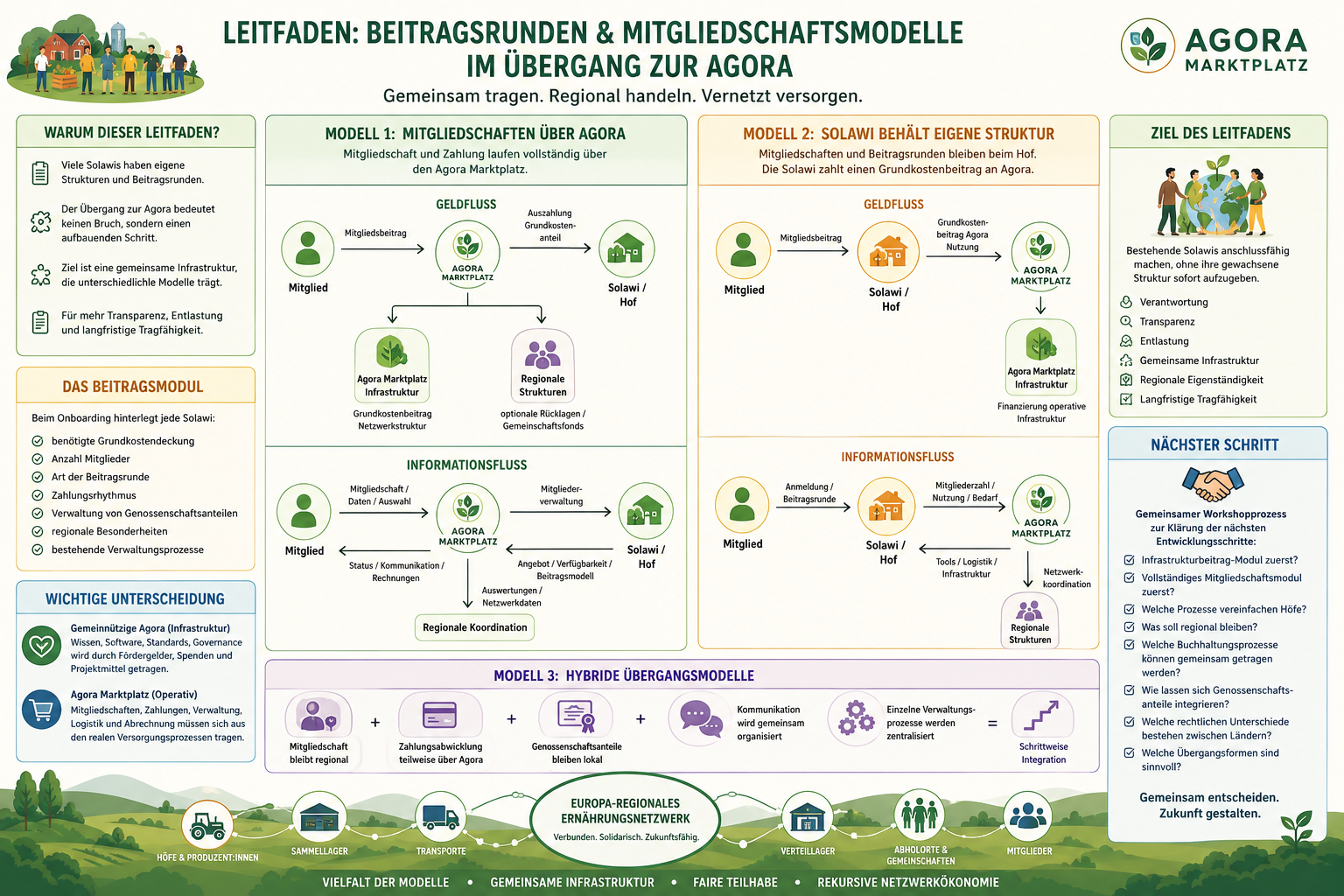
¶ What This Page Covers
Many existing CSA initiatives already have their own structures:
- their own websites
- their own membership processes
- their own contribution rounds
- their own accounting
- their own management of cooperative shares
- their own communication workflows
The transition to the Agora Marketplace therefore does not simply mean a technical change.
It affects fundamental organizational questions:
- How are memberships managed?
- How are basic costs covered?
- Which contributions remain regional?
- Which contributions finance shared infrastructure?
- Which processes stay with the farm?
- Which processes are organized collectively?
This page collects possible models and development paths.
It serves as a basis for workshops, technical development, and joint decision-making processes.
¶ Starting Point
Many CSA initiatives already work with contribution rounds or solidarity-based financing models.
There are different forms of these:
- fixed membership fees
- flexible contribution rounds
- self-assessment
- bidding rounds
- solidarity-based tiered contributions
- cooperative shares
- one-time admission fees
- regional association memberships
These differences must remain representable in the Agora Marketplace.
The goal is not to standardize the farms.
The goal is a shared infrastructure that can support different models.
¶ The Contribution Module
A contribution module is needed for onboarding existing CSA initiatives.
This module describes:
- how membership is organized
- how basic costs are financed
- which contribution logic is used
- which payments are automated
- which processes remain regional
The farm or CSA specifies, among other things:
- required basic cost coverage
- number of members
- type of contribution round
- payment rhythm
- management of cooperative shares
- regional particularities
- existing administrative processes
This creates a shared technical foundation, even though the models can remain different.
¶ Possible Development Directions
¶ 1. Memberships Managed Entirely Through the Agora Marketplace
In this model, memberships are concluded directly through the Agora Marketplace.
Members join the network through the respective farm or initiative.
Management is handled centrally through the Agora Marketplace.
This can include, among other things:
- membership management
- payment processing
- contribution rounds
- invoices
- communication
- management of cooperative shares
- shared accounting processes
The distribution of contributions is stored in the system.
As soon as contributions are received, the corresponding shares can be automatically allocated to the participating farms and structures.
This could simplify many administrative processes.
¶ Money Flow
¶ Information Flow
¶ 2. The CSA Retains Its Existing Structure
In this model, the existing membership processes remain with the farm or regional structure.
The CSA continues to manage:
- memberships
- contribution rounds
- accounting
- cooperative shares
- communication
The Agora Marketplace provides complementary infrastructure.
The farms or initiatives contribute a basic cost fee to the shared infrastructure of the Agora Marketplace.
This contribution can be based on, for example:
- number of active members
- use of the infrastructure
- regional scope
- actual use of individual modules
This allows the shared infrastructure to be financed without immediately centralizing all existing processes.
¶ Money Flow
¶ Information Flow
¶ 3. Hybrid Transition Models
Intermediate forms are possible.
For example:
- membership remains regional
- payment processing runs partly through Agora
- cooperative shares remain local
- communication is organized collectively
- individual administrative processes are centralized
This can create a gradual transition.
¶ Simplified Overview of the Transformation Process
¶ Important Distinction
This page is about the Agora Marketplace.
Not about the non-profit Agora infrastructure.
The non-profit Agora develops:
- knowledge
- software
- standards
- documentation
- governance
- funding structures
- shared foundations
This level will be supported in the future primarily through:
- grants
- donations
- development budgets
- project funds
The Agora Marketplace, on the other hand, organizes operational supply.
This includes, among other things:
- memberships
- payment flows
- administration
- logistics
- accounting
- operational infrastructure
The financing of this operational level must be sustainable in the long term from the actual supply processes themselves.
¶ Goal of the Transformation Guide
The transformation guide aims to help existing CSAs not be displaced but made connectable.
At the center is the question:
How can an existing CSA gradually become part of a larger Europe-regional food network without having to immediately abandon its established structure?
This is not just about technology.
It is also about:
- responsibility
- transparency
- organizational relief
- shared infrastructure
- regional autonomy
- long-term sustainability
¶ Next Development Step
The next step is not a finished model.
A joint workshop process is needed.
The following questions must be weighed together, among others:
- Should an infrastructure contribution module be developed first?
- Or a complete membership module first?
- Which processes actually simplify farms?
- Which processes should remain regional?
- Which accounting processes can be shared?
- How can cooperative shares be integrated?
- What legal differences exist between countries?
- Which transition forms make sense?
The answers to these questions will significantly shape the further development of the Agora Marketplace.
One level higher: Fair Costs, Basic Costs, and Shared Financing
Author: Felix Schröder, with help from AI (ChatGPT)
Created: written by Felix Schröder › formatted in Markdown by ChatGPT › published by Felix Schröder › layout adjusted by Claude
Created: 2026-05-17 · Last updated: 2026-05-26 · Questions or feedback? support@teikei.us