¶ Intensive Horse Keeping and Soil Compaction
¶ What This Page Is About
This page describes intensive horse keeping from the perspective of soil, vegetation, water, biodiversity, and regenerative land development.
At its core is the question:
What happens to soils when horses are kept for long periods on areas that are too small or too heavily used – and what does a horse pasture need to not weaken but instead strengthen soil, plants, animals, and the ecosystem?
Horse keeping can have very different effects.
Well-managed, spacious, and site-appropriate horse keeping can be part of a vibrant cultural landscape.
Too confined, permanent, or poorly managed horse keeping can heavily stress soils.
Particularly problematic are small paddocks, heavily frequented turnout areas, wet standing areas, feeding spots, watering points, entrances, and paths.
There, soils can become so compacted over years that water barely infiltrates, plants struggle to root, and soil life is weakened.
¶ Basic Understanding
Horses are animals of movement.
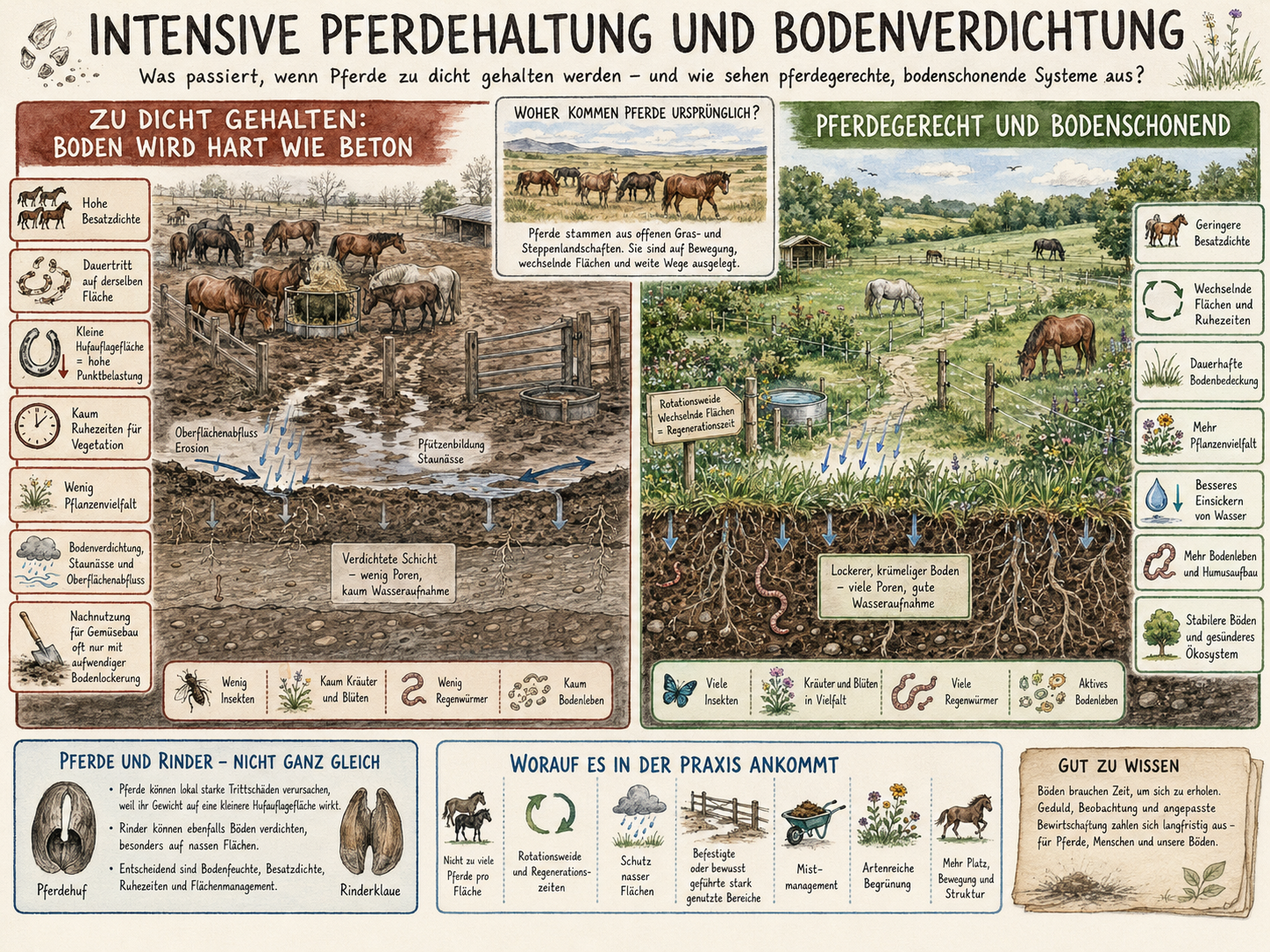
They originally come from open landscapes, steppes, grasslands, and semi-open spaces where they could move over greater distances.
Their bodies are adapted to movement, fiber foraging, slow grazing, and wide spaces.
Confined keeping changes this basic situation.
When horses are kept on small areas, movement, weight, hoof pressure, feeding, and excretions are concentrated in a few spots.
This creates strong localized stress on the soil.
This is particularly critical when:
- the area is small
- many horses stand there at the same time
- the soil is wet
- plants can barely regrow
- there are no rest periods
- feeding spots are always in the same place
- paths and entrances are permanently stressed
- the soil cannot regenerate
¶ The Central Question
The central question is not:
Are horses good or bad for soils?
But rather:
Under what conditions can horse keeping be soil-compatible, animal-friendly, and ecologically meaningful?
This includes further questions:
- How large is the area in relation to the number of horses?
- How long do the horses stay on the area?
- Is there enough movement and area rotation?
- Are there rest periods for vegetation and soil?
- Is the soil dry, wet, clayey, sandy, or compacted?
- Is there plant cover?
- Are there deep roots?
- Are there hedges, trees, shade, and windbreaks?
- Are feeding spots, watering points, and paths well managed?
- Is manure regularly removed or sensibly composted?
- Is the area understood as an ecosystem or just as a turnout space?
¶ Why Horses Can Heavily Stress Soils
Horses have hard hooves.
The animal's weight is transferred to the soil through relatively small contact areas.
This creates high localized pressure.
When this pressure repeatedly affects the same spots, soil pores can be compressed.
The soil then loses air, structure, and water permeability.
Areas particularly affected are:
- Paddocks
- Entrance areas
- Feeding spots
- Watering points
- Shelters
- Paths
- Winter turnout areas
- Wet depressions
- Heavily used grazing areas
The wetter the soil, the more sensitive it is to compaction and trampling damage.
¶ What Soil Compaction Means
Soil compaction occurs when the pores in the soil are compressed.
A compacted soil has less air and water space.
This has many consequences:
- Water infiltrates poorly.
- Puddles and mud form more easily.
- Roots penetrate the soil poorly.
- Oxygen is lacking.
- Soil life is weakened.
- Earthworms and microorganisms find worse conditions.
- Plants grow more weakly.
- Biodiversity decreases.
- The soil dries poorly after wetness.
- In dry periods, it can become as hard as concrete.
Such soils often appear dead, hard, smooth, or smeared.
For later vegetable cultivation, agroforestry, or TEIKEI farming, such areas often first need to be regenerated over a longer period.
¶ Why Horse Areas Often Become Particularly Difficult
Intensively used horse areas can be more difficult to regenerate than some other pasture areas.
This is not only due to the animal itself but also to typical use.
Common issues include:
- Small standing areas with high stress
- Permanent paddocks without vegetation rest
- Muddy areas in winter
- Overgrazed grass swards
- Trampling damage
- Open soil spots
- Localized nutrient concentration
- Compacted paths
- Low plant diversity
If no regeneration occurs over years, the area can lose its natural structure.
Then simply reseeding is often not enough.
The soil must first be reopened, revitalized, and rooted through.
¶ Difference from Cattle Pastures
Horses and cattle affect areas differently.
Cattle are heavier but have different hoof shapes and often different grazing behavior.
Horses frequently move along certain paths, repeatedly stand in the same spots, graze grass very short, and can exert strong localized pressure with hard hooves.
Cattle can also compact soils, especially when wet, with high stocking density, or poor pasture management.
The difference is not that cattle are fundamentally unproblematic.
The difference lies in:
- Hoof and claw shape
- Movement patterns
- Grazing behavior
- Standing areas
- Area size
- Pasture management
- Moisture
- Stocking density
- Rest periods for plants
Horse areas become particularly problematic when many animals are kept permanently on small areas.
¶ Overgrazing
Horses can graze grass very short.
If plants do not get time to recover, they lose strength.
The roots become weaker.
The grass sward opens up.
Open spots form.
There, mud, erosion, compaction, and undesirable plants can more easily occur.
Overgrazing means:
- Plants are grazed too often
- Roots cannot recover
- Soil remains poorly covered
- Water hits the soil more directly
- Humus formation is hindered
- Biodiversity decreases
A horse area therefore needs clear rest periods.
¶ Mud and Open Soils
Mud is a clear warning sign.
It shows that soil structure, water management, and stress do not match.
Mud forms particularly where:
- Soil is compacted
- Water cannot infiltrate
- Plant cover is missing
- Horses frequently move or stand
- Feeding spots and watering points are concentrated
- Paths are not reinforced or managed
- Areas are overused when wet
Mud is not just impractical.
It means stress for soil, plants, water, and horses.
¶ Water Balance
Intensive horse keeping can significantly alter the water balance.
Compacted soils absorb water poorly.
Rain runs off superficially or remains as puddles.
In wet periods, mud forms.
In dry periods, the soil becomes hard.
This creates a disturbed cycle:
- Water infiltrates poorly.
- Soil life is weakened.
- Roots grow poorly.
- Plant cover decreases.
- The soil becomes even more susceptible to compaction.
- The area loses regenerative capacity.
A healthy water balance needs pores, roots, humus, soil life, and soil rest.
¶ Biodiversity
Intensively used horse areas are often species-poor.
When grass is kept very short, few flowers form, and open soil spots dominate, habitats for many species are lacking.
Affected are:
- Flowering plants
- Insects
- Wild bees
- Butterflies
- Beetles
- Soil organisms
- Birds
- Small animals
- Fungi
- Earthworms
However, a horse area can also be designed to be more biodiverse.
This requires:
- Rest areas
- Flower strips
- Hedges
- Trees
- Margins
- Unmown zones
- Species-rich meadows
- Structured edges
- Deadwood
- Water points
- Site-appropriate plants
¶ Manure and Nutrients
Horses return nutrients to the area through manure and urine.
This can be part of a cycle.
However, with intensive keeping, localized nutrient concentrations often occur.
Then there are areas with over-supply and others with deficiency.
It becomes problematic when:
- Manure is not regularly collected
- Nutrients are introduced into muddy areas
- Urine areas are repeatedly stressed
- Nutrients are leached
- No composting takes place
- Plants cannot absorb the nutrients
- The area is already compacted and biologically weakened
Manure is not waste.
It can be part of compost and humus formation.
But this requires good management.
¶ Horse Keeping and Compost
Horse manure can be valuable.
It contains organic matter, nutrients, and often bedding.
It can be processed into compost.
Good horse manure compost can help:
- Return organic matter
- Feed soil life
- Support humus formation
- Store nutrients
- Improve soil structure
Quality is important.
Uncontrolled stored manure can lose nutrients, leach, or cause odors.
Composting requires structure, moisture, oxygen, time, and care.
¶ What a Good Horse Area Needs
A soil-compatible horse area needs more than fencing and turnout space.
Important are:
- Adequate area
- Area rotation
- Rest periods
- Stable paths
- Well-placed feeding spots
- Well-managed watering points
- Dry standing areas
- Protection from mud
- Soil cover
- Root development
- Hedges and trees
- Shade
- Windbreaks
- Manure management
- Composting
- Biodiversity areas
- Site-appropriate pasture management
The more an area is stressed, the more important its design becomes.
¶ How Many Horses Fit on an Area?
There is no simple number that applies everywhere.
The appropriate number of horses depends on:
- Soil type
- Climate
- Precipitation
- Slope
- Vegetation
- Grazing system
- Season
- Supplementary feeding
- Duration of stay
- Rest periods
- Drainage
- Area size
- Care
- Keeping goals
A sandy area behaves differently than a heavy clay soil.
A dry site differently than a wet one.
A summer pasture differently than a winter paddock.
Therefore, the question should not only be about square meters.
The more important question is:
Can the area recover under this use?
If the answer is consistently no, the stress is too high.
¶ Movement Spaces Instead of Permanent Stress
Horses need movement.
But movement should not mean that the same soil areas are always destroyed.
Better are systems that enable movement and distribute stress.
These include:
- Paddock trails
- Rotational grazing
- Time-limited use
- Reinforced feeding areas
- Multiple feeding points
- Well-drained paths
- Rest areas
- Grazing rotation
- Seasonal adaptation
- Protection of sensitive areas when wet
The goal is:
Horses move.
The soil still gets rest.
¶ Paddock Trails
Paddock trails can be a better solution than small, heavily stressed turnout areas.
They enable movement along paths and areas.
They can distribute feed, water, shade, rest areas, and different stimuli.
This allows horses to move more naturally.
At the same time, a paddock trail must also be well planned.
Otherwise, only long compacted paths form.
Important are:
- Load-bearing subsoil
- Water management
- Changing areas
- Protection from mud
- Rest areas
- Natural edge structures
- Biodiversity zones
- Clear maintenance
¶ Trees, Hedges, and Shade
Horse areas need structure.
Trees and hedges can help:
- Provide shade
- Break wind
- Improve water balance
- Create habitats
- Promote biodiversity
- Structure the landscape
- Improve microclimate
- Stabilize soil
Toxic plants must be avoided, and young woody plants protected.
Structured horse areas are ecologically more valuable than bare, open, overused areas.
¶ Horses and Agriculture
Horses can also be part of agricultural systems.
Historically, horses were work and draft animals.
Today, they are often kept for leisure, therapy, education, landscape management, or special agricultural tasks.
Even then, the basic question remains:
How is the keeping integrated into soil, feed, manure, water, and landscape?
Horse keeping becomes more ecologically meaningful when it is not considered in isolation but as part of a farm cycle.
¶ Horses in Therapy and Education
Horses can play an important role for people.
In therapy, education, and encounter work, they can promote relationship, trust, movement, and perception.
However, such uses also require a good area foundation.
A social or therapeutic use does not automatically justify poor soil conditions.
Especially where horses help people, their environment should also be healthy, vibrant, and dignified.
¶ Regeneration of Former Horse Areas
Formerly intensively used horse areas often need several regeneration steps.
Possible measures include:
- Reducing or pausing use
- Checking soil compaction
- Observing water management
- Relieving muddy areas
- Building organic matter
- Sowing deep-rooting plants
- Using cover crops
- Applying compost
- Keeping soil covered
- Planting hedges and trees
- Introducing grazing rest
- Relocating feeding spots
- Specifically reinforcing paths
- Creating biodiversity areas
- Long-term observation
For severe compaction, professionally supervised deep loosening can be useful.
However, this should not be done in isolation.
Without roots, humus formation, and soil life, compaction can return.
¶ Preparation for Vegetable Cultivation or TEIKEI Farming
If a former horse area is later to be used for vegetable cultivation, agroforestry, or TEIKEI farming, special caution is needed.
Such areas are often not immediately suitable.
Beforehand, the following should be checked:
- Soil compaction
- Humus content
- Water absorption
- Nutrient status
- Possible over-supply from manure and urine
- Soil life
- Plant population
- Contamination risks from previous use
- Drainage and waterlogging
- Root depth
The first step is not immediate cultivation.
The first step is assessment.
After that, a transformation guide can be created.
¶ What Would Be Problematic?
Horse keeping is particularly problematic when:
- Many horses stand on a small area
- The soil is permanently open or muddy
- No area rest is possible
- Feeding spots always remain in the same place
- Entrances and paths are not managed
- Manure is not used sensibly
- Water does not infiltrate
- Hedges, trees, and flowering areas are missing
- The area cannot develop biodiversity
- Horse keeping is considered separately from soil and landscape
Then the use harms the ecosystem.
¶ What Would Be Better?
Better would be horse keeping that considers soil, animal, and landscape together.
This includes:
- Appropriate animal numbers
- Adequate area
- Grazing rotation
- Good path management
- Reinforced or relieved hotspots
- Feeding points in changing locations
- Manure collection and composting
- Species-rich rest areas
- Woody plants and shade
- Flower strips and margins
- Soil cover
- Protection of wet areas
- Reduced stress in winter
- Long-term regeneration
The goal is not just clean horse keeping.
The goal is an area that remains vibrant.
¶ TEIKEI Perspective
From a TEIKEI perspective, horse keeping is a question of area responsibility.
Horses can be valuable for people, farms, and landscapes.
But every keeping needs a foundation that considers soil, water, plants, animals, and the ecosystem.
An area should not just be used.
It should remain vibrant in the long term.
If horse keeping compacts soils, increases water runoff, weakens biodiversity, and reduces soil life, change is needed.
If horse keeping is well managed, it can be part of a diverse landscape.
¶ Connection to Inventory Assessment
This page belongs to the area:
Inventory assessment of agriculturally used areas
There, existing area uses are considered.
For intensive horse keeping, the central question is:
What traces has the use left in the soil – and what steps does the area need to again support water, roots, soil life, and biodiversity?
¶ Classification
This page does not replace soil science investigation, animal husbandry advice, or legal review.
Horse areas differ greatly.
Decisive are:
- Location
- Soil type
- Water balance
- Season
- Number of horses
- Area size
- Duration of stay
- Grazing system
- Feeding
- Manure management
- Previous use
- Care
- Regional conditions
For concrete decisions, on-site observation, spade tests, soil analysis, compaction checks, and professional support are needed.
¶ Key Point
Horse keeping shows how strongly animal husbandry can shape an area.
If horses are kept too densely, for too long, or on unsuitable soils, living soil can become a hard, compacted area.
If horse keeping is well planned, it can combine movement, relationship, landscape management, manure cycles, and biodiversity.
The decisive question is:
Is an area only used as turnout space?
Or is it designed so that horses, soil, water, plants, and the ecosystem can all remain healthy?