¶ Maize Cultivation, Energy Crops, and Monoculture Crop Rotations
¶ What This Page Is About
This page describes maize cultivation, energy crops, and monoculture crop rotations from the perspectives of soil, water, biodiversity, pesticide use, genetic engineering, landscape, and long-term regeneration.
The central question is:
What happens to a landscape when large areas are dedicated to maize, energy crops, and few crop rotation elements over years—and what are the consequences for soil, water, biodiversity, animals, humans, and future land use options?
Maize is not inherently problematic.
Maize cultivation becomes problematic primarily when it is practiced on a large scale, as a monoculture, input-dependent, and with little regard for soil life, water, biodiversity, and landscape structure.
This page is an inventory.
It identifies typical damages, potential health risks from pesticide exposure, and the reasons why such areas can be major levers for regenerative transformation.
¶ Basic Understanding
In Europe, maize is used for, among other things:
- Animal feed
- Silage
- Biogas
- Starch
- Industrial processing
- Partially for human consumption
Energy crops are cultivated to provide biomass for energy production.
Both uses can generate high amounts of biomass.
At the same time, they can become problematic when large areas are subjected to a similar logic over years:
- Few crops
- Narrow crop rotations
- High nutrient input
- High biomass removal
- Little soil cover during critical phases
- Heavy machinery use
- Herbicide use
- Low plant diversity
- Little habitat for insects, birds, and soil organisms
- Strong dependence on inputs
The problem does not lie in a single plant.
The problem lies in a system that simplifies landscapes and treats soils like production surfaces.
¶ Why These Areas Are a Major Lever
Maize and energy crop areas are widespread in many regions of Europe.
When such areas are managed differently, it can have a significant impact.
Especially where today’s landscapes are cleared, uniform, and low in biodiversity, changes can make a big difference:
- More soil cover
- Less erosion
- More humus buildup
- Better water absorption
- More flowering areas
- More hedges and field margins
- Greater root diversity
- More soil life
- Less leaching
- More habitat for insects and birds
- Less dependence on chemical control
- Stronger regional fertility
The greatest impact often occurs where large areas currently contribute little ecologically.
¶ The Central Question
The central question is not:
Should maize disappear entirely?
Rather:
How can an area shaped by maize cultivation, energy crops, or monoculture crop rotations become more diverse, better rooted, more water-retentive, and more alive?
To answer this, several levels must be considered:
- Soil
- Water
- Humus
- Erosion
- Nutrients
- Pesticides
- Biodiversity
- Genetic engineering
- Machinery impact
- Landscape structure
- Regional food supply
- Long-term fertility
¶ Typical Problem Areas
Maize cultivation and energy crops become particularly critical when several factors coincide:
- Repeated maize cultivation on the same area
- Narrow crop rotations
- Long periods of bare soil
- Soil cultivation during erosion-prone periods
- Heavy harvesting equipment on wet soils
- High slurry or fertilizer applications
- High biomass removal
- Herbicide use against weeds
- Lack of cover crops
- Lack of undersown crops
- Lack of hedges, margins, and flowering areas
- Large-scale landscape homogenization
- Focus on mass production rather than ecological carrying capacity
Such systems can be productive in the short term.
In the long term, they can severely weaken soil, water, and biodiversity.
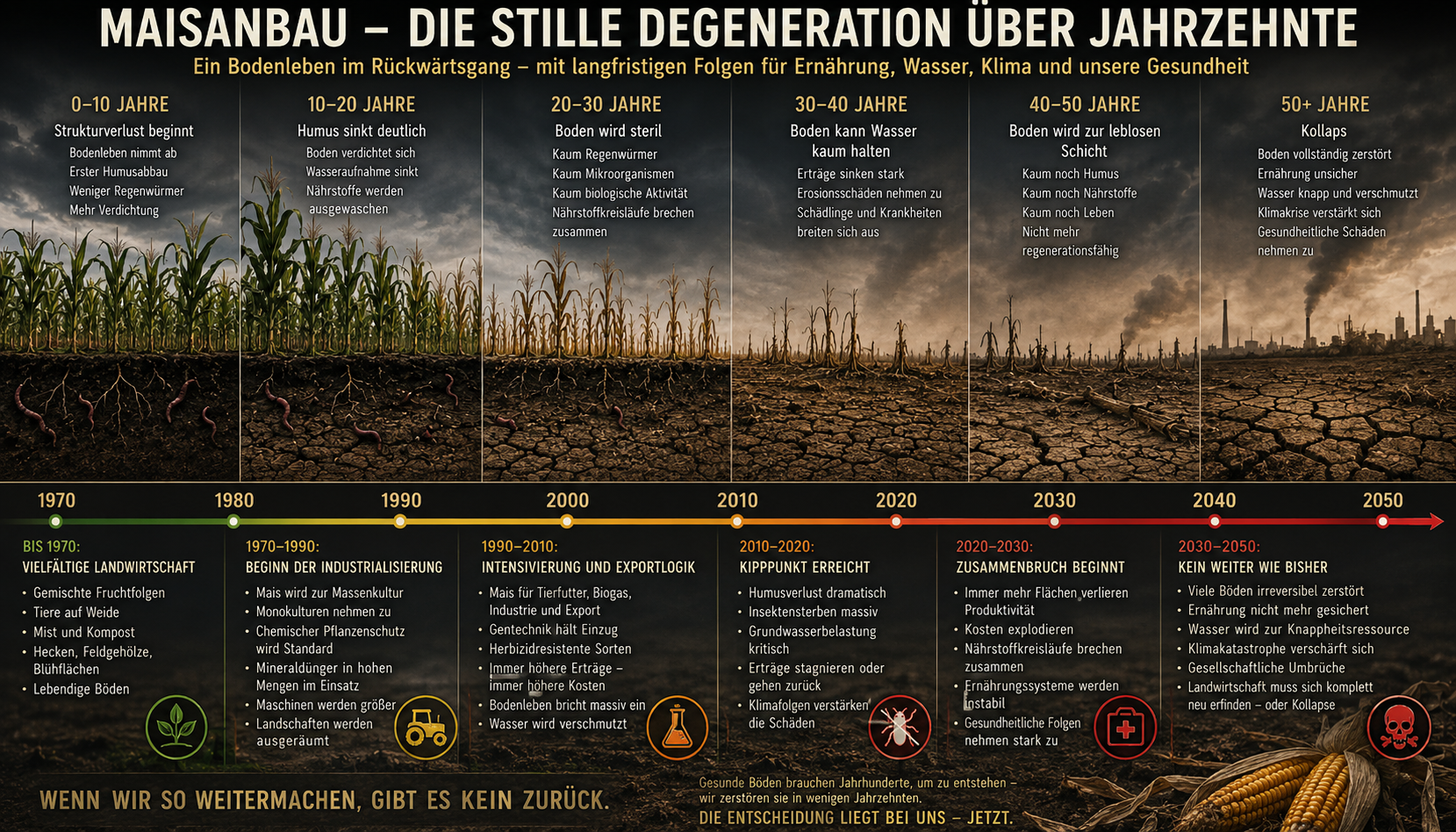
¶ Soil Loss and Humus Depletion
Maize can produce a lot of biomass.
However, if this biomass is largely removed, a lot of organic material leaves the field.
This particularly affects silage maize and energy crops, where large parts of the plant are harvested.
If little organic matter returns, an imbalance arises.
Possible consequences include:
- Less humus
- Less food for soil organisms
- Weaker crumb structure
- Reduced water-holding capacity
- Poorer nutrient storage
- Higher susceptibility to compaction
- More erosion
- Less biological activity
A soil can continue to yield high harvests for a while while internally degrading.
This is particularly dangerous because the loss often only becomes visible when the regenerative capacity is already severely weakened.
¶ Bare Soil and Erosion
Maize covers the soil slowly in early growth phases.
Between the rows, the soil often remains bare for long periods.
During heavy rainfall, water can then hit the soil surface unhindered.
On slopes, this can be particularly severe.
Possible consequences include:
- Loss of fertile topsoil
- Loss of humus
- Loss of phosphorus and other nutrients
- Soil sealing
- Rill and gully erosion
- Entry of soil material into water bodies
- Long-term weakening of the area
Erosion is not just a visual problem.
It is the loss of the most fertile soil layer.
¶ Water Balance
Monoculture maize and energy crop areas can strain the water balance.
Problems arise particularly where:
- Soil remains bare for long periods
- Little humus is present
- Compaction impedes infiltration
- Wheel tracks channel water away
- Large fields have few buffering structures
- Hedges and tree rows are missing
- Water quickly drains from the landscape
A weakened soil absorbs water less effectively.
During heavy rainfall, water runs off the surface.
In dry periods, there is a lack of water in the soil.
This creates a double vulnerability:
- Too much water becomes a problem during rain
- Too little water remains in the soil during dry phases
¶ Nutrient Losses
Maize has a high nutrient demand.
Depending on the system, nitrogen, phosphorus, potassium, and other nutrients are applied in large quantities.
It becomes problematic when nutrients do not match the needs of the plants, the soil, and the weather.
Possible consequences include:
- Nitrate leaching
- Phosphorus runoff with soil particles
- Nutrient inputs into water bodies
- Groundwater contamination
- Nitrous oxide emissions under unfavorable conditions
- Dependence on external fertilization
- Long-term nutrient imbalances
The combination of high nutrient input, bare soil, weak soil structure, and a lack of living plant cover after harvest is particularly critical.
¶ Pesticides in Maize Cultivation
In maize cultivation, herbicides are primarily used.
They serve to suppress weeds so that maize can grow with minimal competition.
Additionally, insecticides, seed treatments, and fungicides may be relevant.
Which active substances are actually used depends on the country, approval status, year, farm, seed, soil, pest pressure, and plant protection strategy.
The following table is therefore not a complete global approval list.
It shows a long working list of active substances that have historically, regionally, or currently been used in maize cultivation.
Many of these active substances are banned, restricted, or approved only for specific applications in individual countries.
For specific statements about a farm or an area, the actual applications, invoices, field records, approvals, and residue analyses must always be checked.
¶ Pesticides in Maize Cultivation Sorted by Possible Health Effects
| Health Effect / Risk Area | Active Substances That May Fall into This Category | Typical Role in Maize Cultivation | Classification |
|---|---|---|---|
| Acute severe poisoning, high risk of death | Paraquat, Phorate, Terbufos, Carbofuran, Methomyl, Chlorpyrifos, Diazinon, Diquat, Naled | Total herbicides, soil insecticides, or insecticides; partly historical or relevant outside the EU | Particularly critical in case of inhalation, ingestion, or skin contact with concentrates. Paraquat is especially dangerous due to severe lung damage. Organophosphates and carbamates can cause severe neurological poisoning. |
| Cholinesterase inhibition and acute neurological poisoning | Chlorpyrifos, Chlorpyrifos-methyl, Diazinon, Phorate, Terbufos, Naled, Carbofuran, Carbaryl, Methomyl | Insecticides against soil and foliar pests; many historically relevant | Can lead to salivation, sweating, nausea, vomiting, diarrhea, constricted pupils, muscle tremors, cramps, breathing difficulties, confusion, and in extreme cases, death. |
| Developmental and nervous system risks, especially for children and pregnancy | Chlorpyrifos, Chlorpyrifos-methyl, Diazinon, Naled, Imidacloprid, Clothianidin, Thiamethoxam, Thiacloprid, Acetamiprid, Glyphosate, Atrazine | Insecticides, seed treatments, herbicides | Particularly relevant in case of occupational exposure, drift, contaminated dust, or repeated contact. Some substances are discussed or regulated for neurodevelopmental risks. |
| Suspected cancer risks or carcinogenic classifications in certain assessments | Glyphosate, Alachlor, Acetochlor, Atrazine, Simazine, Cyanazine, Propazine, Pendimethalin, Linuron, Diuron, Mancozeb, Captan, Folpet, Propiconazole | Primarily herbicides and fungicides; some historically or regionally relevant | Classifications vary by substance and authority. For glyphosate, there are differing assessments between IARC and several national regulatory authorities. For some older herbicides, drinking water or long-term exposure was particularly relevant. |
| Endocrine effects, hormonal disruptions, or corresponding suspicions | Atrazine, Terbuthylazine, Simazine, Acetochlor, S-Metolachlor, Metolachlor, Alachlor, Flufenacet, Propiconazole, Tebuconazole, Mancozeb, Thiacloprid | Primarily herbicides and fungicides | Concerns possible disruptions to hormonal systems, reproduction, thyroid, or development. Not all substances are equally assessed; specific classifications must be checked. |
| Reproductive or developmental risks | Mancozeb, Thiram, Propiconazole, Tebuconazole, Flutriafol, Thiacloprid, Bromoxynil, Glufosinate-ammonium, Alachlor, Acetochlor | Fungicides, herbicides, insecticides | Relevant in case of repeated occupational exposure or inadequate protection. Some substances are no longer approved or are heavily restricted in the EU due to these risks. |
| Respiratory irritation, asthma, allergic reactions | Pyrethrins, Deltamethrin, Cypermethrin, Lambda-Cyhalothrin, Beta-Cyfluthrin, Esfenvalerate, Bifenthrin, Chlorpyrifos, Glyphosate formulations, Pendimethalin, Captan, Folpet | Primarily insecticides, some fungicides and herbicide formulations | Spray mist, dust, or concentrates can irritate the respiratory tract. Pyrethrins and pyrethroids can cause allergic or neurological symptoms in sensitive individuals. |
| Skin and eye irritation, corrosive or contact problems | Glyphosate formulations, 2,4-D, Dicamba, MCPA, Bentazon, Pendimethalin, Nicosulfuron, Rimsulfuron, Foramsulfuron, Mesotrione, Tembotrione, Topramezone, Pyridate, Saflufenacil, Diquat, Paraquat, Pyrethroids, Azoxystrobin, Pyraclostrobin, Tebuconazole, Captan, Folpet | Broad spectrum of herbicides, insecticides, and fungicides | Contact with concentrates, spray solution, or contaminated clothing can irritate skin and eyes. Formulations can be more hazardous than the pure active substance. |
| Liver, kidney, or organ stress from higher or chronic exposure | Alachlor, Acetochlor, Atrazine, Paraquat, Diquat, Mancozeb, Thiram, Chlorpyrifos, Diazinon, Carbofuran, Glyphosate formulations | Herbicides, insecticides, and fungicides | Particularly relevant in case of repeated exposure, accidents, improper storage, or contaminated water. |
| Parkinson’s or neurodegenerative risk discussions | Paraquat, Chlorpyrifos, Rotenone, Maneb, Mancozeb, Diquat | Historically or regionally relevant pesticides; not all typical in today’s European maize cultivation | Links to neurodegenerative diseases are discussed for some substances. The evidence varies by substance. |
| Risks to bees, insects, and non-target organisms with indirect effects on human livelihoods | Imidacloprid, Clothianidin, Thiamethoxam, Thiacloprid, Acetamiprid, Lambda-Cyhalothrin, Deltamethrin, Cypermethrin, Beta-Cyfluthrin, Esfenvalerate, Bifenthrin, Spinosad, Spinetoram, Indoxacarb, Chlorantraniliprole, Cyantraniliprole, Emamectin-benzoate, Abamectin, Bacillus thuringiensis | Insecticides, seed treatments, biological insecticides, or genetically engineered Bt systems | Not only direct human health is relevant. When pollinators, beneficial insects, and food chains are weakened, this affects food supply, ecosystems, and landscape stability in the long term. |
| Groundwater and drinking water relevance with possible chronic exposure | Atrazine, Terbuthylazine, Simazine, Cyanazine, Alachlor, Acetochlor, Metolachlor, S-Metolachlor, Dimethenamid-P, Flufenacet, Bentazon, Isoxaflutole, Glyphosate, AMPA, degradation products of nicosulfuron, metabolites of various herbicides | Primarily herbicides and their degradation products | Critical are mobile active substances and metabolites that can enter groundwater. Contamination depends heavily on soil, application, precipitation, and distance to water bodies. |
| Impact on aquatic organisms and water ecosystems | Pendimethalin, Pyrethroids, Chlorpyrifos, Diazinon, Tefluthrin, Imidacloprid, Clothianidin, Thiamethoxam, Terbuthylazine, S-Metolachlor, Dimethenamid-P, Mesotrione, Tembotrione, Topramezone, Azoxystrobin, Pyraclostrobin, Trifloxystrobin, Boscalid, Fluxapyroxad, Copper compounds | Herbicides, insecticides, and fungicides | Water contamination affects not only aquatic animals but also drinking water, food chains, landscape functions, and regional health. |
| Resistance development with increasing chemical dependence | Glyphosate, Atrazine, Terbuthylazine, Mesotrione, Tembotrione, Topramezone, Nicosulfuron, Rimsulfuron, Foramsulfuron, Dicamba, 2,4-D, Pyrethroids, Strobilurins, Triazoles, SDHI fungicides | Herbicides, insecticides, and fungicides | Resistance is not a direct poisoning but a systemic risk. When weeds, insects, or fungi become resistant, the need for additional agents, higher active substance combinations, or more aggressive interventions often increases. |
¶ Long List of Active Substances by Main Groups
This list complements the health-sorted table.
It is intended as a working list for the inventory.
| Active Substance | Group | Typical Role in Maize Cultivation | Status / Classification |
|---|---|---|---|
| Glyphosate | Herbicide | Total herbicide before sowing, after harvest, or in herbicide-resistant systems outside Europe | Widely used; cancer assessment disputed among authorities; strong effect on accompanying vegetation |
| Atrazine | Herbicide, Triazine | Historically widespread in maize | Banned in the EU; groundwater and endocrine issues |
| Terbuthylazine | Herbicide, Triazine | Weed control in maize | Groundwater and metabolite issues |
| Simazine | Herbicide, Triazine | Historically in arable farming systems | Banned or restricted in many regions |
| Cyanazine | Herbicide, Triazine | Historically in maize cultivation | No longer approved in many countries |
| Propazine | Herbicide, Triazine | Historically in maize/sorghum systems | Persistence and water issues |
| Acetochlor | Herbicide, Chloroacetamide | Pre-emergence against grasses and weeds in maize | Toxicologically and groundwater-critical |
| Alachlor | Herbicide, Chloroacetamide | Historically in maize, sorghum, soy | Not approved in the EU; cancer and drinking water issues |
| Metolachlor | Herbicide, Chloroacetamide | Pre-emergence against grasses | Groundwater-relevant degradation products |
| S-Metolachlor | Herbicide, Chloroacetamide | Pre-emergence in maize | Groundwater and metabolite issues |
| Dimethenamid-P | Herbicide, Chloroacetamide | Pre-emergence against grasses and weeds | Irritant; water risk |
| Flufenacet | Herbicide, Oxyacetamide | Regionally in mixtures or adjacent arable systems | Groundwater metabolites; toxicologically critical |
| Pendimethalin | Herbicide, Dinitroaniline | Pre-emergence against grass weeds and weeds | Persistent; very toxic to aquatic organisms |
| Prosulfuron | Herbicide, Sulfonylurea | Post-emergence against broadleaf weeds in maize | Resistance risk |
| Rimsulfuron | Herbicide, Sulfonylurea | Post-emergence against grasses and weeds | Resistance risk |
| Nicosulfuron | Herbicide, Sulfonylurea | Common post-emergence active substance in maize | Resistance risk; non-target plants |
| Foramsulfuron | Herbicide, Sulfonylurea | Post-emergence in maize | Resistance risk |
| Iodosulfuron | Herbicide, Sulfonylurea | Possible in mixtures | Resistance risk |
| Thifensulfuron-methyl | Herbicide, Sulfonylurea | Broadleaf weeds | Resistance risk |
| Tritosulfuron | Herbicide, Sulfonylurea | Weed control in maize and cereals | Resistance risk |
| Thiencarbazon-methyl | Herbicide | Maize, often in combinations | Resistance risk |
| Mesotrione | Herbicide, HPPD inhibitor | Typical maize active substance against broadleaf weeds | Risks to aquatic organisms; non-target plants |
| Tembotrione | Herbicide, HPPD inhibitor | Post-emergence in maize | Water and resistance risks |
| Topramezone | Herbicide, HPPD inhibitor | Post-emergence in maize | Water and resistance risks |
| Isoxaflutole | Herbicide, HPPD inhibitor | Pre-emergence/early post-emergence in maize | Groundwater relevance |
| Sulcotrione | Herbicide, HPPD inhibitor | Maize herbicide | Water risk |
| Dicamba | Herbicide, Synthetic auxin | Broadleaf weeds, partly maize | Drift can damage neighboring crops |
| 2,4-D | Herbicide, Synthetic auxin | Broadleaf weeds | Drift and exposure risks |
| MCPA | Herbicide, Synthetic auxin | Regionally in arable systems | Irritant; water risk |
| Clopyralid | Herbicide, Synthetic auxin | Broadleaf weeds | Persistence in plant material/compost possible |
| Fluroxypyr | Herbicide, Synthetic auxin | Regionally in maize mixtures | Irritant; drift problem |
| Bromoxynil | Herbicide, Nitrile | Historically and regionally in maize | Toxicologically critical; restricted in many regions |
| Bentazon | Herbicide | Broadleaf weeds | Groundwater relevance |
| Pyridate | Herbicide | Broadleaf weeds, possible in maize | Irritant; water risk |
| Saflufenacil | Herbicide, PPO inhibitor | Pre-emergence/burn-down, partly in maize systems | Irritant; water risk |
| Pyroxasulfone | Herbicide | Pre-emergence against grasses and weeds | Groundwater and resistance issues |
| Clomazone | Herbicide | Pre-emergence, regional | Volatility/drift can damage plants |
| Linuron | Herbicide | Historically in maize and other crops | No longer approved in the EU |
| Diuron | Herbicide | Historically in various systems | Persistence; water risk |
| Paraquat | Total herbicide | Historically or outside EU | Highly acutely toxic; severe lung damage possible |
| Diquat | Total herbicide | Historically/regionally | Acutely toxic; water risk |
| Glufosinate-ammonium | Total herbicide | Glufosinate-resistant systems outside EU | Reproductive toxicity discussion; no longer approved in EU |
| Tefluthrin | Insecticide, Pyrethroid | Soil insecticide against wireworms | Very toxic to aquatic organisms and insects |
| Lambda-Cyhalothrin | Insecticide, Pyrethroid | Against pests | Very toxic to aquatic organisms and insects |
| Deltamethrin | Insecticide, Pyrethroid | Against pests | Very toxic to aquatic organisms and insects |
| Cypermethrin | Insecticide, Pyrethroid | Against pests | Neurotoxic; water and insect risks |
| Beta-Cyfluthrin | Insecticide, Pyrethroid | Against insects | Neurotoxic; water risk |
| Esfenvalerate | Insecticide, Pyrethroid | Against pests | Risk to aquatic organisms and non-target insects |
| Bifenthrin | Insecticide, Pyrethroid | Soil and foliar pests, more relevant outside EU | Very toxic to aquatic organisms |
| Chlorpyrifos | Insecticide, Organophosphate | Historically against soil and foliar pests | Neurotoxic; developmental risks; no longer approved in EU |
| Chlorpyrifos-methyl | Insecticide, Organophosphate | Historically | Neurotoxic; no longer approved in EU |
| Diazinon | Insecticide, Organophosphate | Historically/regionally | Cholinesterase inhibition |
| Phorate | Insecticide, Organophosphate | Soil insecticide, outside EU | Highly toxic; neurotoxic |
| Terbufos | Insecticide, Organophosphate | Soil insecticide, outside EU | Highly toxic; neurotoxic |
| Naled | Insecticide, Organophosphate | Not typical in European maize, but regionally relevant | Cholinesterase inhibition |
| Carbofuran | Insecticide, Carbamate | Historically against soil pests | Highly acutely toxic; wildlife risk |
| Carbaryl | Insecticide, Carbamate | Historically/regionally | Cholinesterase inhibition |
| Methomyl | Insecticide, Carbamate | Regionally against insects | Highly toxic; bee risk |
| Imidacloprid | Insecticide, Neonicotinoid | Seed treatment/soil pests, historically | Very critical for pollinators; largely banned in EU open fields |
| Clothianidin | Insecticide, Neonicotinoid | Seed treatment in maize, historically | Very critical for pollinators |
| Thiamethoxam | Insecticide, Neonicotinoid | Seed treatment, historically | Very critical for pollinators |
| Thiacloprid | Insecticide, Neonicotinoid | Regionally/historically | Reproductive toxicity classification; no longer approved in EU |
| Acetamiprid | Insecticide, Neonicotinoid | Regionally against sucking insects | Possible risks to non-target insects |
| Spinosad | Insecticide, Spinosyn | Against certain insects | Bee risk with direct exposure |
| Spinetoram | Insecticide, Spinosyn | Regionally/outside EU | Bee and water risks |
| Indoxacarb | Insecticide, Oxadiazine | Against caterpillars | No longer approved in EU |
| Chlorantraniliprole | Insecticide, Diamide | Against European corn borer and caterpillars | Consider effects on aquatic organisms and non-target arthropods |
| Cyantraniliprole | Insecticide, Diamide | Against various insects | Consider effects on aquatic organisms and pollinators |
| Emamectin-benzoate | Insecticide, Avermectin | Against caterpillars, regionally | Very toxic to aquatic organisms |
| Abamectin | Insecticide/Acaricide | More for specialty crops, regionally | Very toxic to aquatic organisms |
| Bacillus thuringiensis | Biological insecticide | Against caterpillars; also Bt maize trait | Selective, but effects on certain non-target butterfly larvae must be considered |
| Azoxystrobin | Fungicide, Strobilurin | Foliar diseases, also possible in maize | Water risk; resistance risk |
| Pyraclostrobin | Fungicide, Strobilurin | Foliar diseases, also possible in maize | Very toxic to aquatic organisms |
| Trifloxystrobin | Fungicide, Strobilurin | Foliar diseases, regionally | Water and resistance risks |
| Picoxystrobin | Fungicide, Strobilurin | Foliar diseases, regionally/historically | Water and resistance risks |
| Tebuconazole | Fungicide, Triazole | Seed or foliar fungicide | Reproductive/endocrine discussion; water risk |
| Propiconazole | Fungicide, Triazole | Historically in many crops | No longer approved in EU; reproductive/endocrine concerns |
| Prothioconazole | Fungicide, Triazole | Foliar and seed treatment | Resistance management needed |
| Difenoconazole | Fungicide, Triazole | Regionally | Water risk |
| Triticonazole | Fungicide, Triazole | Seed treatment | Water risk |
| Flutriafol | Fungicide, Triazole | Regionally | Developmental/reproductive concerns depending on classification |
| Metalaxyl-M / Mefenoxam | Fungicide, Phenylamide | Seed treatment | Resistance risk |
| Fludioxonil | Fungicide, Phenylpyrrole | Seed treatment | Water risk; persistence questions |
| Sedaxane | Fungicide, SDHI | Seed treatment | SDHI resistance risk; long-term ecological questions |
| Carboxin | Fungicide, SDHI | Seed treatment, historically | Resistance development relevant |
| Fluxapyroxad | Fungicide, SDHI | Foliar fungicide, regionally | Persistent; water risk |
| Boscalid | Fungicide, SDHI | Broad fungicide, regionally | Persistence; resistance risk |
| Pydiflumetofen | Fungicide, SDHI | Broad fungicide, regionally | Persistent; long-term ecological questions |
| Mancozeb | Fungicide, Dithiocarbamate | Historically in many crops | No longer approved in EU; reproductive and thyroid concerns |
| Thiram | Fungicide, Dithiocarbamate | Seed treatment, historically | No longer approved in EU; toxicologically critical |
| Captan | Fungicide | Seed/foliar, regionally/historically | Irritant; possible cancer discussion |
| Ziram | Fungicide, Dithiocarbamate | Historically/regionally | Irritant; water risk |
| Folpet | Fungicide | More for specialty crops, regionally possible | Irritant; water risk |
| Copper compounds | Fungicide/Bactericide | Not typical in maize, but relevant in agricultural systems | Accumulation in soil; toxic to soil and aquatic organisms under contamination |
¶ Why This List Is Important
This list does not mean that every maize field is treated with all these active substances.
However, it shows how strongly an industrial maize and energy crop system can be embedded in a chemical control logic.
What is particularly critical is not just the individual active substance.
Critical is the combination of:
- Monoculture crop rotation
- Large-scale cultivation
- High weed and pest pressure
- Chemical control
- Soil compaction
- Nutrient surpluses
- Bare soil surface
- Low biodiversity
- Dependence on seed, fertilizer, and pesticide systems
The more uniform the system becomes, the greater the need for external control often grows.
A regenerative inventory therefore asks not only:
Which agents were used?
But:
Why does the system need so much control in the first place?
¶ Genetic Engineering in Maize Cultivation
Genetically modified maize is globally relevant primarily in two directions:
- Bt maize
- Herbicide-tolerant maize
Bt maize produces certain insecticidal toxins from Bacillus thuringiensis, which are intended to target pests like the European corn borer.
Herbicide-tolerant maize is modified to withstand certain herbicides.
This allows a herbicide to be applied to the field while the crop continues to grow.
In Europe, the cultivation of genetically modified maize lines is highly restricted and politically controversial.
Worldwide, however, genetically modified maize plays a major role.
¶ Ecological Risks of Genetically Modified Systems
The crucial question is not only:
Is a single genetically modified maize line approved?
Rather:
What systemic effects arise from large-scale use?
Possible risks and open questions include:
- Resistance development in target insects against Bt toxins
- Increase in herbicide-resistant weeds
- Higher herbicide pressure in herbicide-tolerant systems
- Displacement of non-genetically modified varieties
- Cross-pollination with related plants, depending on region and plant species
- Effects on non-target organisms
- Changes in soil and insect ecology
- Dependence on patented seeds
- Concentration of seed and pesticide power in a few companies
- Long-term consequences that are difficult to fully predict
With genetically modified systems, it is therefore not just about the plant.
It is about seeds, chemicals, cultivation methods, control, ownership, landscape, and long-term effects.
¶ What We Do Not Know for Certain
Many ecological consequences only become apparent over long periods.
Assessment is particularly difficult when multiple factors interact simultaneously:
- Genetically modified seeds
- Herbicide use
- Insecticide pressure
- Monoculture crop rotations
- Soil cultivation
- Climate stress
- Loss of biodiversity
- Resistance development
- Landscape simplification
Therefore, when it comes to genetically modified maize systems, caution should be exercised:
Not all consequences are fully known.
Long-term effects depend heavily on the specific system.
But one thing is clear:
The larger the areas, the more uniform the crop rotations, and the stronger the chemical control logic, the greater the risk of systemic consequences.
¶ Biodiversity
Large-scale maize cultivation and uniform energy crop areas can be low in biodiversity.
This is especially the case when:
- Large fields are created without interruption
- Few crop species are cultivated
- Marginal structures are missing
- Herbicide use strongly reduces weeds
- Flowering plants are absent
- Harvest times leave little habitat
- Soil life receives little variety of organic material
Biodiversity needs structure.
This includes:
- Field margins
- Flowering strips
- Hedges
- Tree rows
- Wet areas
- Different crops
- Cover crops
- Fallow land
- Old grass strips
- Marginal areas
- Smaller fields
- Different heights and flowering times
The more uniform the area, the lower its habitat value usually is.
¶ Landscape Structure
Monoculture crop rotations do not just change individual fields.
They change landscapes.
When large areas are dominated by a few crops, cleared agricultural landscapes emerge.
Typical characteristics include:
- Large fields
- Few hedges
- Few tree structures
- Few refuges
- Little flowering
- Little shade
- Strong wind
- Rapid water runoff
- Low ecological connectivity between habitats
Such landscapes may appear productive.
But they are often more vulnerable to drought, heavy rainfall, pest pressure, and biodiversity loss.
¶ Energy Crops and Land Use Competition
Energy crops are often cultivated to provide biomass for energy production.
This can be part of an energy transition.
At the same time, an important land use question arises.
Agricultural land is limited.
It can be used for:
- Food
- Feed
- Energy
- Biodiversity
- Water retention
- Humus buildup
- Landscape management
- Regional supply
When large areas are primarily used for energy biomass, the question must be asked:
Which use best strengthens soil, water, food supply, and biodiversity in the long term?
This question is particularly important in regions with high land use pressure.
¶ Monoculture Crop Rotations
A crop rotation describes which crops are cultivated in sequence on an area.
Monoculture crop rotations occur when few crops are repeatedly cultivated.
This can be short-term predictable and economically attractive.
However, long-term problems can arise:
- Specific disease pressure
- Pest pressure
- One-sided nutrient removal
- Weak soil structure
- Low root diversity
- Less soil life
- Greater dependence on plant protection
- Less adaptability to weather extremes
More diverse crop rotations can help reduce such risks.
¶ What Would Be Problematic?
Maize cultivation, energy crops, and monoculture crop rotations are particularly problematic when:
- The same crop is cultivated very frequently
- Soil remains bare for long periods
- Cover crops are missing
- Slopes are cultivated without protection
- Crop residues and biomass are heavily removed
- Little organic matter is returned
- Heavy machinery is used under unfavorable soil conditions
- Nutrients are not integrated into cycles
- Landscape structures are missing
- Biodiversity has little space
- Cultivation is highly dependent on external inputs
- Chemical control replaces ecological stability
- Genetically modified systems lead to even greater dependence on seed and herbicide logic
Then the area is weakened, even if it yields high short-term harvests.
¶ What Would Be Better?
Better would be a development that integrates maize and energy crops into more diverse farm and landscape systems.
This includes:
- More diverse crop rotations
- Cover crops
- Undersown crops
- Winter soil cover
- Reduced erosion
- Organic matter return
- Compost and manure management
- Humus buildup
- Diverse root systems
- Smaller field structures
- Hedges and tree rows
- Flowering areas
- Riparian buffer strips
- Agroforestry elements
- Reduced soil compaction
- Adapted nutrient management
- Site-appropriate crop selection
- Less chemical control
- More ecological self-regulation
The goal is not just yield.
The goal is an area that sustainably supports soil, water, biodiversity, and supply in the long term.
¶ Paths to Regeneration
An area strongly shaped by maize cultivation, energy crops, or monoculture crop rotations can be gradually regenerated.
Possible steps include:
- Inventory of land use history
- Soil analysis
- Spade test
- Compaction assessment
- Observation of water runoff and erosion
- Review of previously used pesticides
- Examination of possible residues and legacy issues
- Humus buildup planning
- Crop rotation expansion
- Cover crop establishment
- Undersown crop testing
- Organic matter return
- Compost or manure use
- Flowering strips and margins creation
- Hedges and tree structures planning
- Reduction of wheel tracks and machinery impact
- Special protection for slopes
- Riparian buffer relief
- Long-term development documentation
Regeneration does not mean changing everything immediately.
It begins with a clear view of the area’s condition.
¶ Major Levers for More Diversity
Especially in large-scale maize cultivation and energy crops, there are major levers for biodiversity.
Particularly effective measures can include:
- Flowering strips along large fields
- Hedge connections between habitats
- Perennial margins
- Tree rows against wind and erosion
- Species-rich cover crops
- Riparian buffer strips
- Smaller management units
- Unmowed refuge areas
- Later or staggered maintenance of marginal areas
- Agroforestry integration
- Crop rotations with legumes
- Perennial clover-grass phases
These measures can make landscapes significantly more vibrant.
¶ Connection to the Inventory
This page belongs to the section:
Inventory of Agriculturally Used Areas
There, existing land uses are examined.
For maize cultivation, energy crops, and monoculture crop rotations, the central question is:
What ecological consequences has the previous use had—and what steps can make the area more diverse, better rooted, more water-retentive, and more fertile again?
¶ TEIKEI Perspective
From a TEIKEI perspective, such areas are important because they shape large parts of Europe’s agricultural landscapes.
If these areas are viewed only as production surfaces, soil, water, biodiversity, and landscape structure often remain secondary.
Community-supported agriculture asks differently:
- What does the area need?
- Which crop fits the location?
- How can soil be built up?
- How can water be retained?
- How can biodiversity return?
- How can farms remain economically viable?
- What transition can be supported collectively?
Maize, energy crops, and monoculture crop rotations clearly show:
The greatest impact often occurs where large areas become more diverse again.
¶ Classification
This page does not replace cultivation advice, soil analysis, toxicological assessment, or farm planning.
Maize cultivation and energy crops vary greatly depending on location, farm, climate, soil type, slope, technology, crop rotation, and nutrient management.
Pesticide risks depend heavily on the active substance, formulation, concentration, protective clothing, weather, drift, distance to water bodies, frequency of application, and exposure route.
For concrete decisions, the following are needed:
- Soil analysis
- Humus assessment
- Spade test
- Erosion assessment
- Water observation
- Nutrient balance
- Crop rotation planning
- Field records
- Review of used plant protection products
- Residue or water analyses if