¶ How TEIKEI Olive Calculates Harvest Shares
TEIKEI Olive does not calculate harvest shares based solely on the actual expected olive oil quantity for a given year.
The calculation combines multiple levels:
- the harvest from the main fields
- the additional carrying capacity provided by support fields
- the planned harvest shares within the communities
- the stable delivery quantity for members
- the farm's basic cost coverage
- possible surpluses or shortfalls
- the distribution among different regions
This creates a structure that can handle fluctuating harvests while strengthening long-term relationships between producers, communities, and logistics.
¶ Basic Idea
Olive trees do not yield the same amount every year.
One year can be abundant, another weak. For members, however, it is important that harvest shares can be planned as reliably as possible. For producers, it is important that the farm's reality does not depend solely on harvest failure or surplus each year.
TEIKEI Olive therefore works with a ratio of Main Fields and Support Fields.
The Main Fields form the central basis of the harvest.
The Support Fields expand the supporting framework.
Together, they enable more stable planning of harvest shares.
¶ Main Fields
Main Fields are the primary fields of a producer.
They form the direct agricultural basis for the harvest shares. From them, it is calculated how much olive oil is available for the communities under normal conditions.
The calculation includes, among other things:
- average annual yield
- expected harvest of the current year
- number of trees
- yield per tree
- size of the producer's own fields
- available oil quantity in liters
- critical basic costs of the farm
The Main Fields show how many harvest shares can be supported by the producer's own agricultural basis.
¶ Support Fields
Support Fields are additional fields or tree groups included in the calculation.
They can help stabilize the delivery quantity if the harvest on the main fields is lower. In good years, they can provide additional quantities that flow into further distribution as support olive oil or surplus.
Support Fields thus fulfill several functions:
- they increase harvest security
- they stabilize the planned delivery quantities
- they enable the expansion of harvest shares
- they create flexibility in fluctuating harvests
- they make visible which additional areas or trees are needed for a certain number of harvest shares
The ratio between Main Fields and Support Fields is important here.
Support Fields do not replace the main fields. They complement them to make the supply more sustainably supported by the community.
¶ The Ratio Between Main Fields and Support Fields
The calculation does not work with an isolated harvest quantity.
Instead, the following questions are asked:
- How much do the main fields contribute?
- How much additional security do the support fields provide?
- How many harvest shares can be reliably formed from this?
- How large can the planned delivery quantity be?
- Where do surpluses arise?
- Where do gaps occur?
The ratio between Main Fields and Support Fields is therefore a central control element.
If only the main fields are considered, the delivery quantity can fluctuate significantly. If support fields are meaningfully included, a more stable basis is created for the communities and the farm.
¶ From Yield to Harvest Share
The calculation follows this simplified process:
-
The expected total harvest is recorded.
-
The harvest from Main Fields and Support Fields is considered together.
-
From this, it is derived how many harvest shares are fundamentally possible.
-
The planned harvest shares of the regions are compared.
-
The delivery quantity per region is calculated.
-
The farm's basic cost coverage is checked.
-
It becomes visible whether a gap, a need for adjustment, or a surplus arises.
-
The distribution between harvest shares and support olive oil is adjusted.
This logic connects material flow and cash flow without mixing them.
The liters of olive oil show what quantity is actually available.
The harvest shares show what quantity is supported by the community.
The basic cost coverage shows what farm reality must be financially supported.
¶ Stable Delivery Quantities
One goal of the calculation is a delivery quantity that is as stable as possible.
Members should be able to understand what quantity of olive oil a harvest share roughly comprises. At the same time, the planning must remain open enough that a poor harvest year is not artificially concealed.
Therefore, the calculation distinguishes between:
- average harvest
- actual harvest
- possible number of harvest shares
- planned number of harvest shares
- missing quantity
- additional support quantity
- surplus quantity
In a weaker year, it can become visible how much oil is missing to fully fill all planned harvest shares.
In a stronger year, it can become visible how much additional oil is available as support olive oil or can be used for the further expansion of harvest shares.
¶ Surpluses and Support Olive Oil
If the harvest is larger than needed for the planned harvest shares, an additional quantity is created.
This quantity can be distributed as support olive oil.
This is important because surpluses are not considered outside the relationship with the farm. They remain part of the shared agricultural reality.
Support olive oil can help:
- cover additional farm costs
- compensate for harvest failures in other years
- gradually integrate new communities
- prepare the expansion of further harvest shares
- strengthen the connection between harvest, logistics, and community
This creates a balance between stability and flexibility.
¶ Expansion of Harvest Shares
The calculation also shows how many additional trees or areas would be needed to support more harvest shares.
For this, it is not only asked how much is currently being harvested.
The following questions are also asked:
- How many harvest shares should be supported in the long term?
- How many liters of olive oil are needed for this?
- How many trees are needed at average yield?
- How many support trees are required?
- What delivery quantity is realistic?
- Which basic costs must be covered in the process?
The expansion of harvest shares is thus not thought of as an abstract increase but as a concrete question of agricultural sustainability.
¶ Basic Cost Coverage of the Farm
An important part of the calculation is the basic cost coverage.
The farm needs a reliable foundation to support its work. This foundation does not depend solely on how many liters of olive oil are harvested in a year.
The consideration includes:
- work in the fields
- care of the trees
- harvest
- pressing
- storage
- quality assurance
- communication
- coordination
- long-term farm development
- risks of fluctuating harvests
The harvest shares should make this farm reality visible and sustainably supported by the community.
¶ Distribution Among Regions
TEIKEI Olive works with multiple regions and communities.
Therefore, the available quantity is not only calculated in total but also distributed among regions. This makes it visible which region supports how many harvest shares and what liter quantity results from this.
The calculation can, for example, distinguish between:
- harvest shares in Germany
- harvest shares in Switzerland
- support olive oil for Germany
- support olive oil for Switzerland
- total quantity of the harvest
- total quantity of the planned delivery
This makes it understandable how the shared harvest is supported by different communities.
¶ Why This Calculation Is Important
The calculation of harvest shares is more than just quantity planning.
It makes visible how TEIKEI Olive distributes responsibility:
- Producers gain more planning security.
- Members better understand what a harvest share supports.
- Communities can plan their delivery quantities more realistically.
- Surpluses are consciously integrated.
- Fluctuations in the harvest are not hidden.
- The expansion of new harvest shares is tied to real fields, trees, and yields.
Thus, TEIKEI Olive becomes a concrete example of how community-supported supply can be calculated and organized.
¶ Simplified Diagram
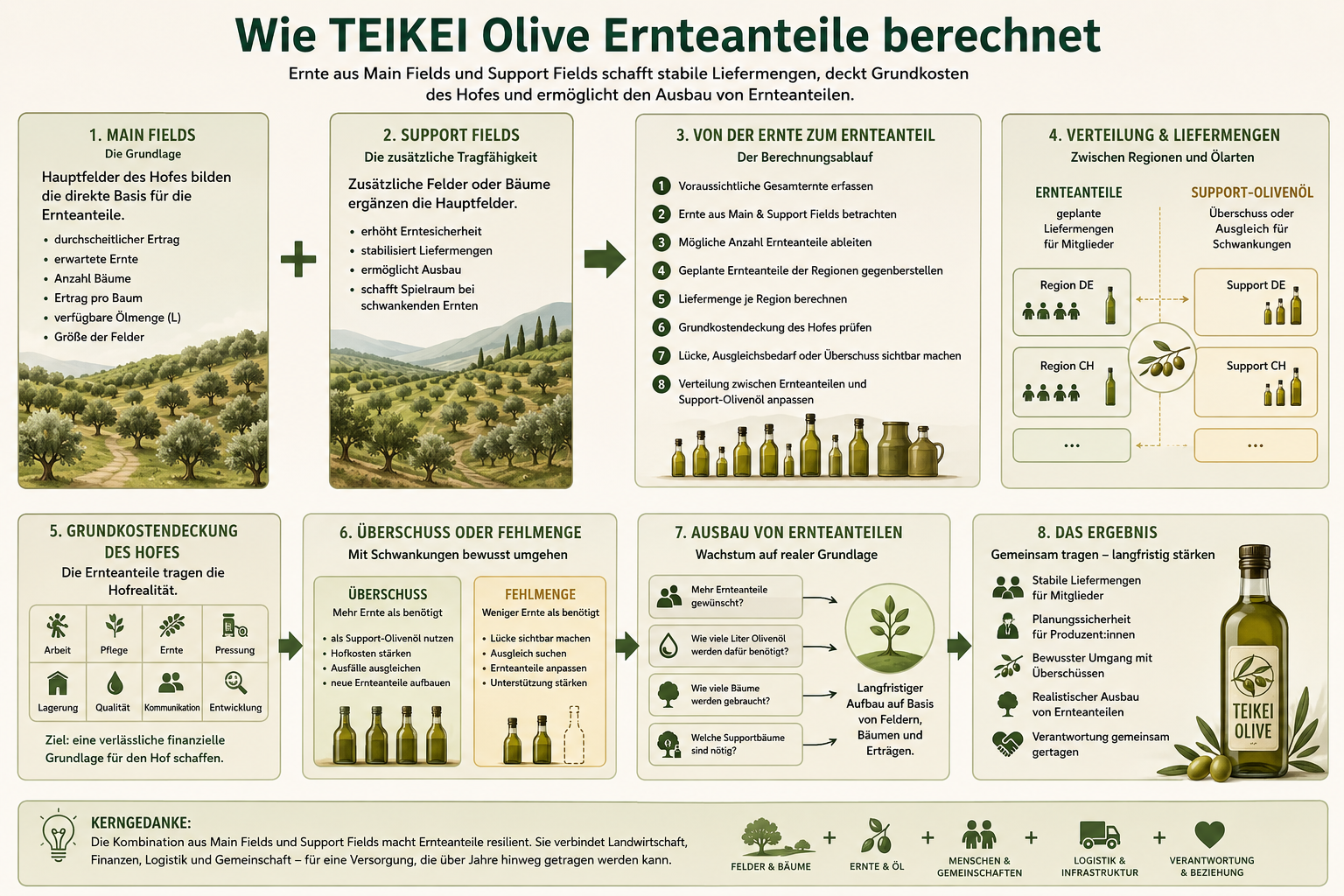
One level up: TEIKEI Olive
Author: Felix Schröder, with the help of AI (ChatGPT)
Creation: written by Felix Schröder › formatted in Markdown by ChatGPT › published by Felix Schröder › layout adjusted by Claude
Created: 2026-05-13 · Last updated: 2026-05-13 · Questions or feedback? support@teikei.us