¶ Recursive Network Economics
Recursive network economics forms the theoretical and structural foundation of TEIKEI.
It describes an economic understanding that does not unfold linearly,
but rather through relationships, feedback, and responsibility continuously reshapes itself.
At its core is not growth at any cost,
but the question of how provision, collaboration, and decision-making can be organized
so that they remain sustainable in the long term—for people, communities, and ecological systems.
¶ The Core: A Different Framework for Trade
Recursive network economics does not simply mean that trade becomes friendlier, more transparent, or more ecological.
The crucial difference lies deeper:
TEIKEI provides a framework in which economic exchange can take place without this framework itself being oriented toward extraction, control, or growth.
The Agora is not a classic marketplace.
It is a community-supported coordination infrastructure.
It enables trade, but it does not follow the usual commercial logic.
This means:
- Farms do not remain mere suppliers
- Members do not remain mere buyers
- Pickup points do not remain mere distribution points
- Logistics do not remain mere services
- The Agora does not remain merely a digital tool
All these elements become part of a shared context in which provision is organized, responsibility is made visible, and feedback becomes possible.
The statement could therefore be:
TEIKEI changes the framework of trade.
The Agora does not extract from relationships but creates a nonprofit space in which provision, responsibility, and feedback can be collectively supported.
¶ What Does "Recursive" Mean?
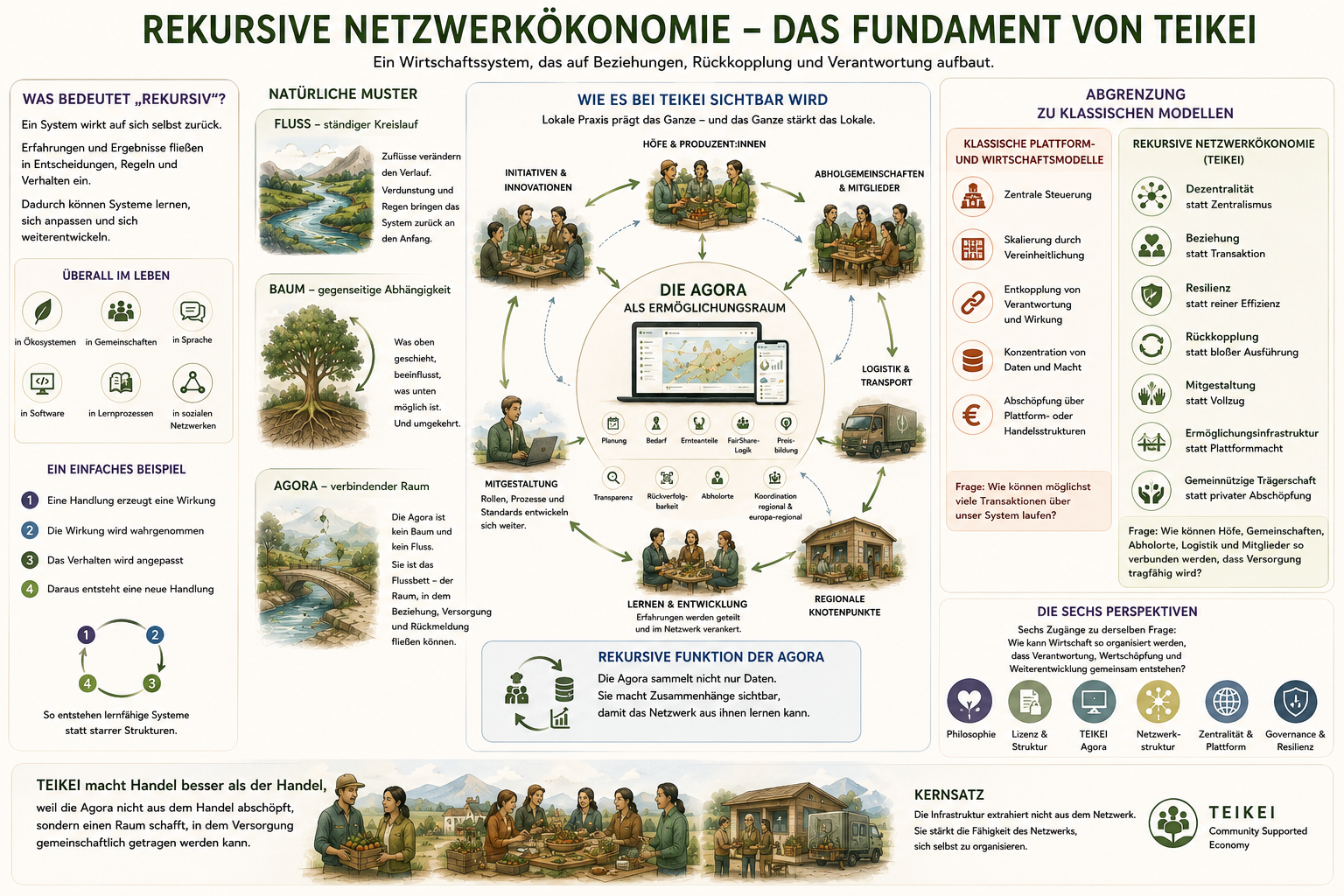
Recursive means that a system reacts to the effects of its own actions.
Experiences, feedback, and results flow back into decisions, rules, or behavior.
This allows systems to learn, adapt, and evolve.
¶ Recursive processes can be found everywhere:
- in ecosystems
- in communities
- in language
- in software
- in learning processes
- in social networks
¶ A Simple Example
- An action produces an effect
- The effect is perceived
- Behavior is adjusted
- A new action emerges
This is how learning systems are created instead of rigid structures.
¶ Recursive Effect
Recursion is not only evident in information flows, learning processes, or organizational forms.
It is also evident in the impact of decisions.
Every action changes conditions.
Every decision opens up new possibilities.
Every transaction generates further transactions.
Effect does not end with its immediate result.
It continues through chains of impact.
¶ An Example
When money is used to protect rainforest, this can have an important effect.
At the same time, someone receives this money.
What happens with this money afterward is also part of the effect.
The money can enable further regenerative developments.
But it can also finance activities that cause new ecological or social damage elsewhere.
The first action alone does not describe the overall effect.
What matters is the entire chain of impact.
¶ Why This Is Important
Many systems consider only immediate results.
Recursive network economics, on the other hand, considers the follow-up effects.
It does not only ask:
- What was achieved?
- What was paid?
- What was protected?
But also:
- What subsequent actions become possible as a result?
- Which structures are strengthened?
- What relationships emerge?
- Which future developments become more likely?
¶ Recursive Effect in the TEIKEI Network
This perspective fundamentally changes the view of the economy.
An order is not just an order.
An investment is not just an investment.
A subsidy is not just a subsidy.
Every action influences what possibilities for action subsequently arise.
Therefore, TEIKEI does not only aim to enable individual good transactions.
TEIKEI tries to create framework conditions in which as many subsequent transactions as possible also contribute to the regeneration of soil, community, knowledge, infrastructure, and provision.
The quality of a system is therefore not only evident in individual successes.
It is evident in the chains of impact that the system produces.
¶ Recursion as a System-Within-System Logic
In the TEIKEI context, recursive does not only mean that a single process learns from its own experiences.
It also means that different levels are interconnected:
- a farm
- a community
- a pickup point
- a food region
- the Agora
- the TEIKEI network
Each of these levels has its own reality.
A farm works with soil, plants, weather, care, harvest, and long-term development.
A community works with people, needs, pickup, communication, and mutual responsibility.
A food region connects farms, processing sites, storage, shops, initiatives, and members.
The Agora makes these connections visible and organizable.
The network becomes recursive where these levels do not stand separately side by side but interact with each other.
What is learned in a community can improve the Agora.
What a farm reveals about its limits or potentials can change planning.
What emerges in one region can serve as orientation for other regions.
This does not create a centrally controlled system but a learning context of independently effective parts.
¶ The Five Functions of a Living Network
A living network needs more than individual tasks.
It needs different functions that work together.
Simply put:
¶ 1. Doing
Someone has to do the concrete work.
Farms cultivate.
People harvest, process, store, transport, and distribute.
Members pick up, contribute, and provide feedback.
Without this practical level, everything remains just an idea.
¶ 2. Coordinating
To turn many individual actions into a sustainable context, coordination is needed.
Quantities must be planned.
Delivery dates must fit.
Pickup points must be prepared.
Payments, information, and responsibilities must come together.
This coordination is not domination.
It is the joint ordering of what is happening anyway.
¶ 3. Supporting
A network needs tools, knowledge, and self-help assistance.
This includes:
- instructions
- standards
- templates
- digital tools
- contact points
- experiential knowledge
- shared documentation
This support should strengthen local autonomy and not replace it.
¶ 4. Looking Ahead
A living network must perceive what is changing.
For example:
- climate changes
- new legal requirements
- new producers
- changing needs of members
- technical possibilities
- risks in logistics or financing
- new forms of regional collaboration
This function asks:
What is coming our way?
What do we need to learn?
What development becomes possible?
¶ 5. Holding the Purpose
Every network needs a shared orientation.
This level asks:
Are we still acting in accordance with our core values?
Are we truly strengthening farms, members, regions, and ecological systems?
Or are we unconsciously adopting old commercial logics again?
This function protects the identity of the network.
It ensures that efficiency does not become more important than relationships, speed more important than responsibility, and growth more important than sustainability.
The Agora touches all five functions.
It does not just organize orders.
It can help make work visible, facilitate coordination, share knowledge, perceive future questions, and review the shared direction.
¶ Why the Agora Is the Decisive Component
The Agora is not just software.
It has grown from practice.
TEIKEI has worked for many years with the means that were available.
At the beginning, there were no ready-made models, perfect processes, or general principles that only needed to be implemented.
At the beginning, there were concrete paths:
- getting to know farms
- enabling harvests
- informing members
- bundling quantities
- organizing payments
- coordinating deliveries
- setting up pickup points
- solving problems
- maintaining trust
Many of these steps were initially done simply as they were possible.
From this lived practice, the need arose to digitally map the recurring paths.
Not because there was a software idea first, but because real work, real responsibility, and real needs became visible.
That is why the Agora is close to the need.
It did not emerge at a desk.
It grew from the experience that provision only becomes sustainable when the flow of goods, money, information, and responsibility are thought of together.
At the same time, a digital infrastructure changes the network.
When paths are digitally mapped, they become more efficient.
Processes become clearer.
Information becomes more quickly accessible.
Quantities, payments, and responsibilities can be better coordinated.
But this also creates new dynamics.
What is once mapped in the system is more easily repeated.
What is not mapped can fade from view.
What is technically simple is sometimes done faster than what is humanly or agriculturally sensible.
Digital infrastructure is therefore never neutral.
It helps decide what reality becomes visible.
What can be recorded becomes controllable.
What is not recorded easily disappears from shared perception.
That is why with the Agora, it is not only important what functions it has.
It is also important what reality it maps:
- farm reality
- harvest
- soil
- production possibilities
- costs
- needs
- responsibility
- logistics
- relationships
- feedback
- limits
- potentials
A recursive Agora must avoid the network adapting to the limits of the software.
The software must learn from the reality of the network.
This means: The Agora has already shown that it works because it emerged from lived practice.
And precisely for this reason, its further development must be carefully accompanied.
The more efficient a system becomes, the more important the question becomes whether it still serves the life from which it emerged.
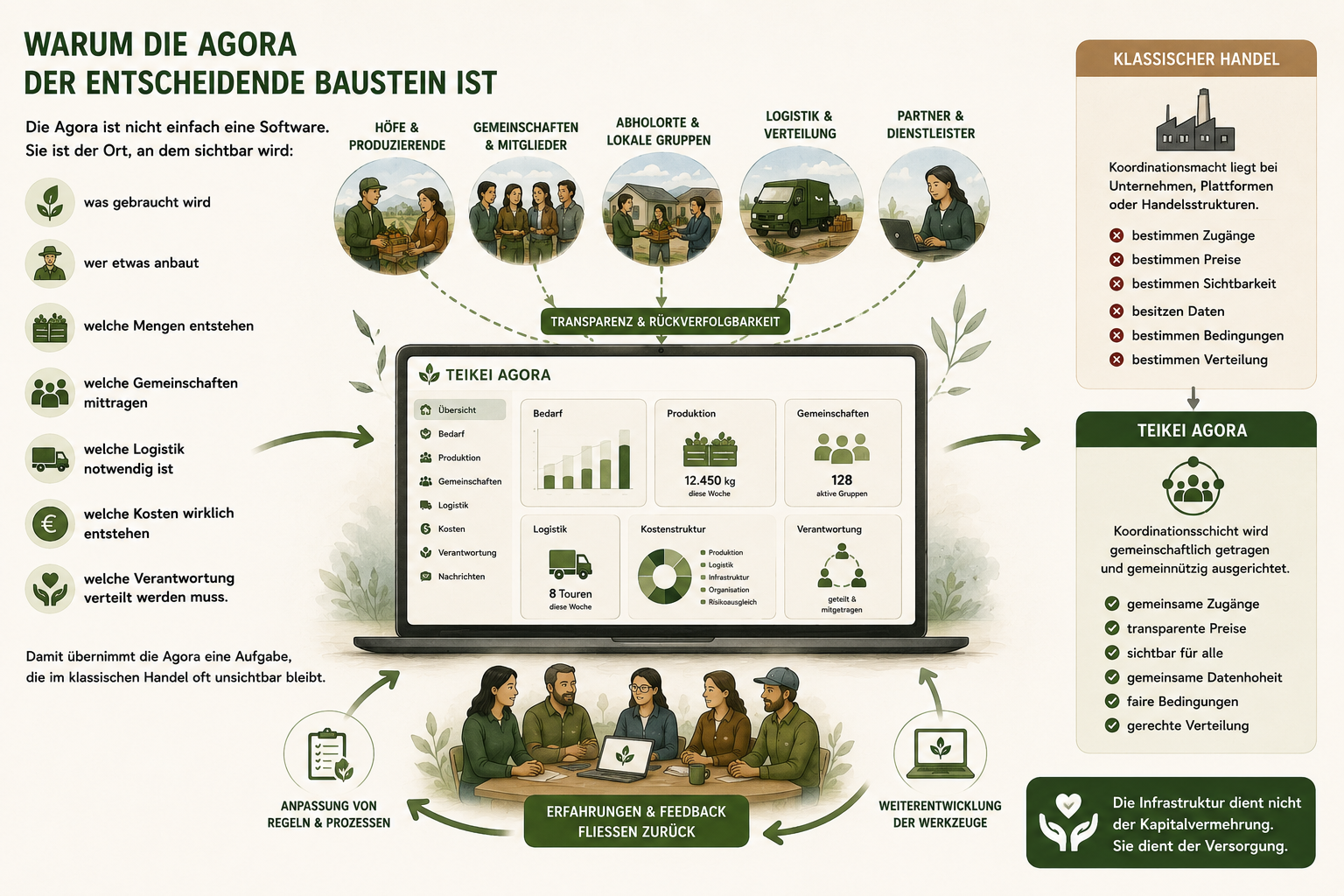
The Agora is the place where it becomes visible:
- what is needed
- who is producing
- what quantities are available
- which communities are contributing
- what logistics are necessary
- what costs actually arise
- what responsibility must be distributed
Thus, the Agora takes on a task that often remains invisible in conventional trade.
In conventional trade, this coordination power is usually held by companies, platforms, or trade structures.
They determine access, prices, visibility, data, conditions, and distribution.
At TEIKEI, this coordination layer should be community-supported and nonprofit-oriented.
This is where the structural difference lies:
The infrastructure does not serve capital accumulation.
It serves provision.
¶ Why Nonprofit Status and Governance Are Central
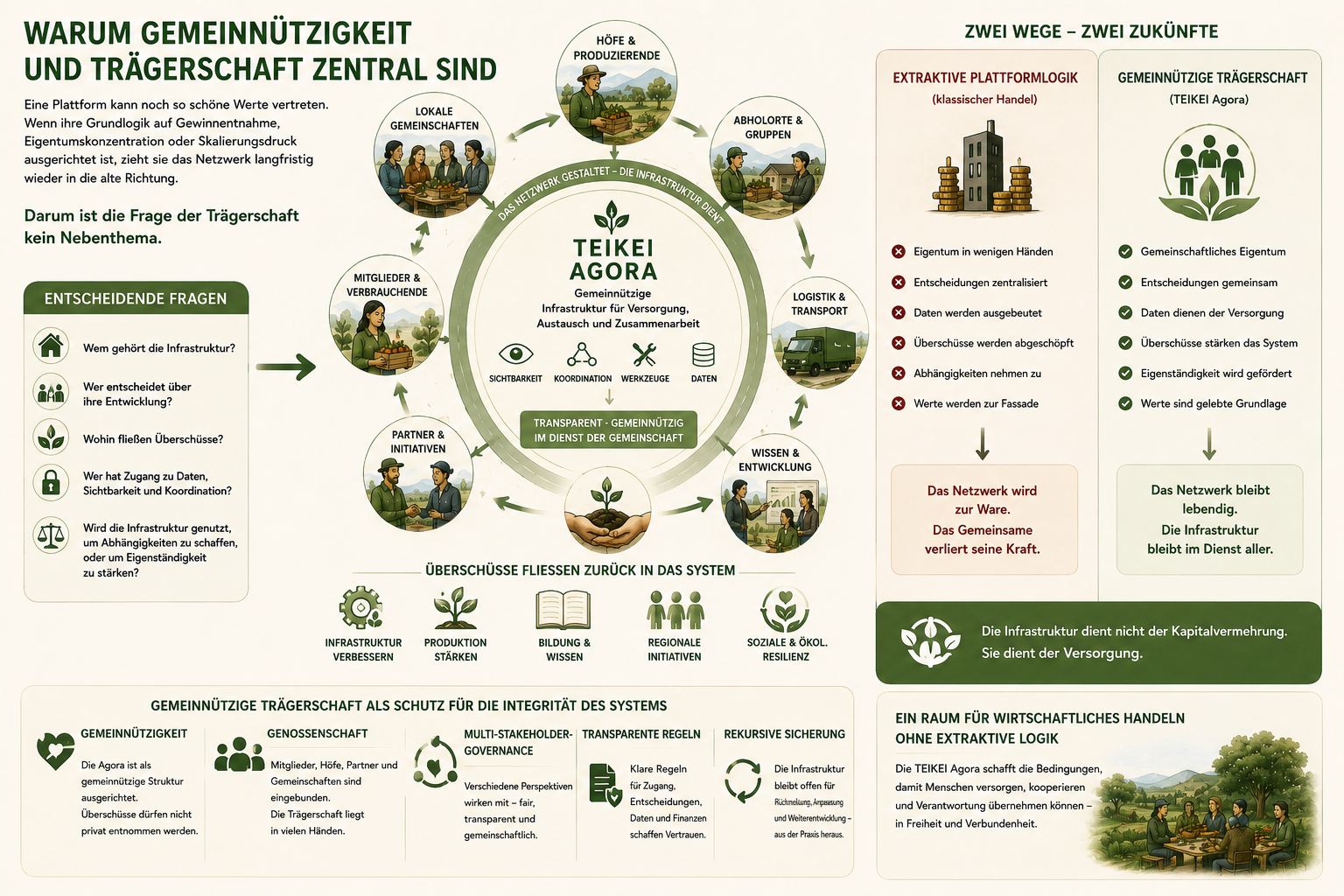
A digital infrastructure can espouse as many beautiful values as it wants.
If its underlying logic is oriented toward profit extraction, ownership concentration, or scaling pressure, it will pull the network back in the old direction in the long term.
That is why the question of governance is not a side issue.
The decisive factors are:
- Who owns the infrastructure?
- Who decides on its development?
- Where do surpluses flow?
- Who has access to data, visibility, and coordination?
- Is the infrastructure used to create dependencies or to strengthen autonomy?
In recursive network economics, the Agora must be built in such a way that it does not itself become the new center of power.
It should enable a space in which others can engage economically without having to submit to an extractive logic of digital dependency.
Nonprofit status, cooperatives, multi-stakeholder governance, and transparent rules are therefore not just legal forms.
They are protective mechanisms for the integrity of the system.
¶ Recursive Systems Follow Natural Patterns
Recursive network economics is oriented toward patterns found everywhere in living systems.
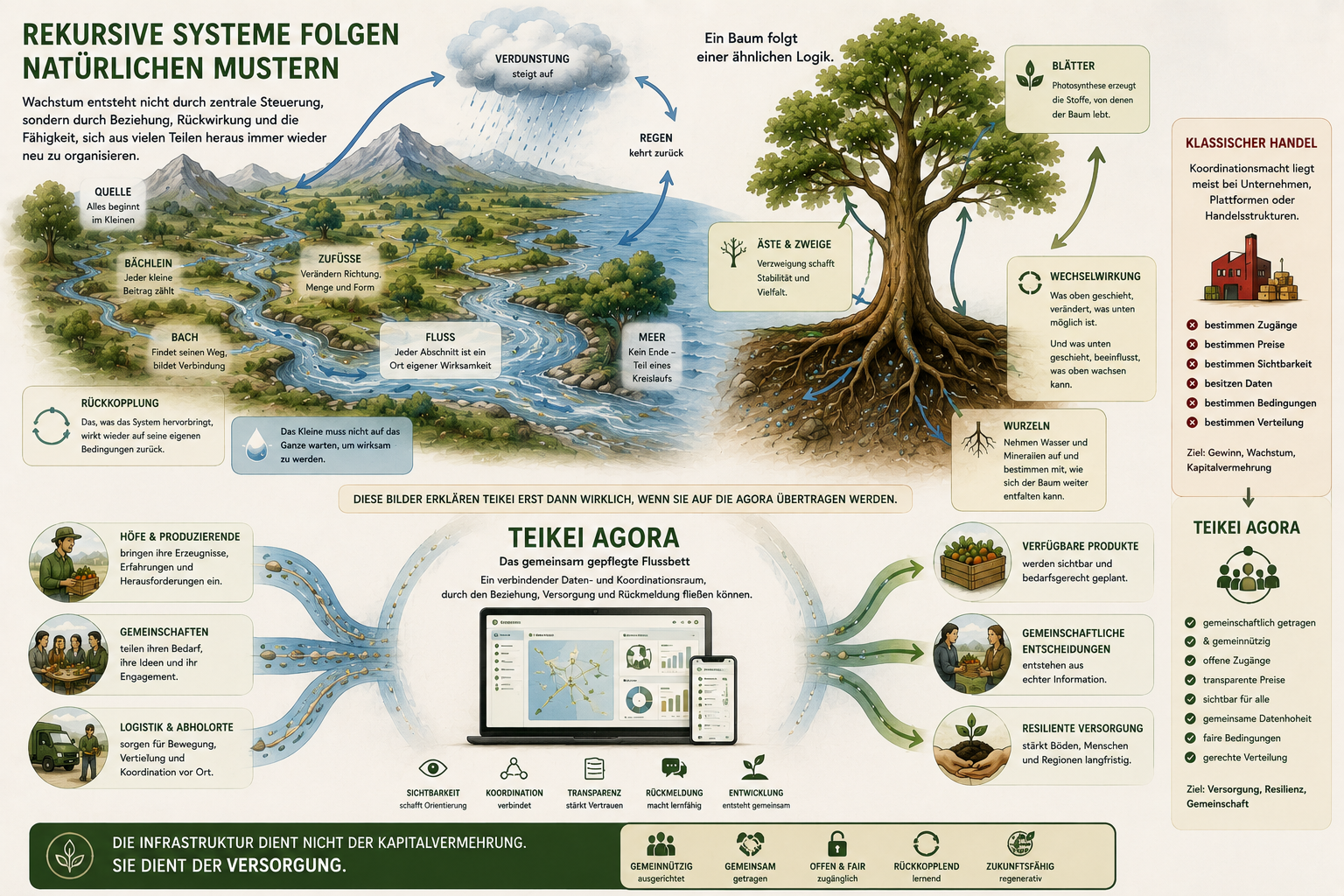
Growth does not arise through central control but through relationships, feedback, and the ability to continuously reorganize from many parts.
A river illustrates this logic clearly.
It begins as a spring, becomes a stream, brook, and river, takes in tributaries, branches out, and finds its way through different landscapes.
Each individual section is not just a transit point but a place of its own effectiveness.
Each tributary changes the direction, volume, speed, and shape of the further course.
The small does not have to wait for the large to become effective.
Even the small watercourse contributes to the shape of the whole.
At the same time, the river does not simply end in the sea.
Through evaporation, the water rises again, condenses into clouds, and returns as rain to new landscapes and the source.
Here, the actual feedback becomes visible:
What the system produces affects its own conditions in return.
A tree follows a similar logic.
It grows as a trunk, branches into limbs, twigs, and leaves, and simultaneously forms a root system that supports and nourishes it.
The leaves produce substances through photosynthesis that the tree lives on.
The roots absorb water and minerals and help determine how the tree can further develop.
What happens above changes what is possible below.
And what happens below influences what can grow above.
These images are helpful, but they only truly explain TEIKEI when applied to the Agora:
The Agora is not the tree.
It is also not the river.
It is rather the collectively maintained riverbed, the connecting structure, the data and coordination space through which relationships, provision, and feedback can flow.
¶ How This Becomes Visible in TEIKEI
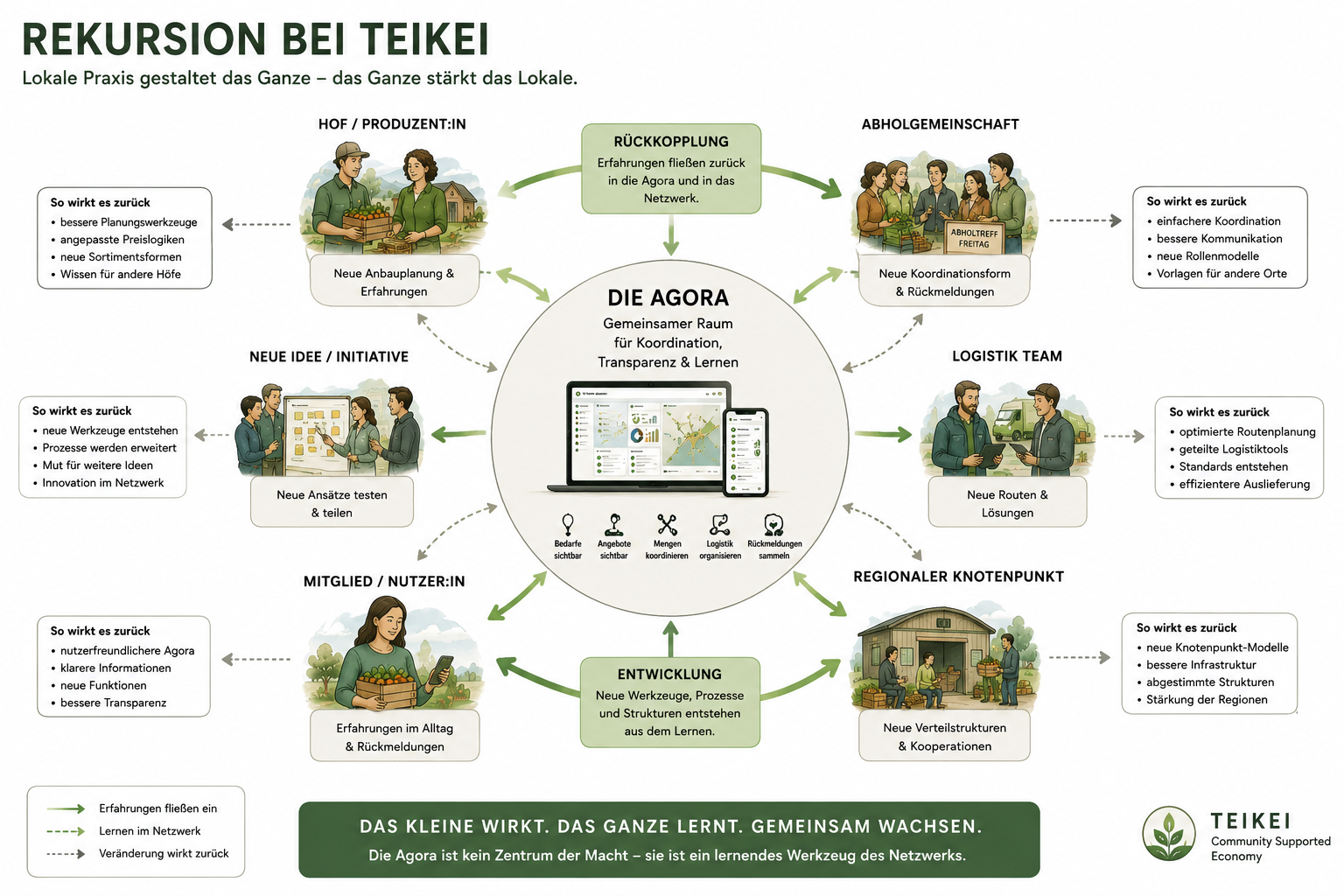
Recursive network economics becomes visible in TEIKEI where local practice is not just executed but becomes the starting point for the further development of the whole.
When new forms of coordination, logistics, pricing, or collaboration emerge in a community, these experiences are not confined to the local space.
They flow back into:
- the further development of the Agora
- role models
- processes
- shared standards
- pricing logics
- logistics structures
- decision-making paths
The small does not wait for the large to become effective.
It acts in its own place—and precisely thereby shapes how the whole develops further.
The Agora thus does not become a central control instance but a learning infrastructure of the network.
¶ Connecting Different Time Rhythms
Recursive network economics must connect different time rhythms.
A farm works in harvest years, care cycles, and long-term soil development.
An olive grove, an orchard, or a vegetable field do not follow the rhythm of an order form.
They follow weather, water, soil, tree care, flowering, fruit formation, harvest windows, and regeneration.
Logistics work in different rhythms.
Here, it is about:
- transport windows
- bundling
- storage
- customs
- routes
- pallets
- delivery dates
- return of reusable systems
Pickup points have yet another reality.
They work with real people, opening hours, spontaneous cancellations, neighborhoods, communication, and local reliability.
Members live in everyday rhythms.
They plan families, work, income, vacations, nutrition, and personal possibilities.
The Agora must make these different rhythms visible without forcibly standardizing them.
This is a central difference from classic platform logic.
Not everything is standardized.
Not everything is accelerated.
Not everything is forced into a single grid.
The task of the Agora is to connect different rhythms in such a way that provision becomes possible and the uniqueness of the individual levels is preserved.
¶ Recursion Also Requires Letting Go
A living network does not only develop by adding new elements.
It also needs the ability to recognize what no longer serves its purpose.
Because every new tool, every new page, every new process, and every new role binds attention.
If a network becomes too full, it loses flexibility.
Then there is a risk that people only maintain structures instead of actively carrying responsibility.
That is why recursive network economics also includes the regular question:
- Which processes truly strengthen shared provision?
- Which workflows bind energy without making responsibility more visible?
- Which old commercial logics are creeping back in?
- Which functions only exist because the software suggests them?
- Which projects feel meaningful but no longer contribute to the actual task?
- Which rules do we still need?
- Which rules can be let go?
Recursive network economics therefore also means:
The network regularly creates space for new things to emerge.
Not everything that was once built must remain permanently.
What no longer serves the life of the network can be changed, simplified, or ended.
¶ From Concept to Small Experiment
Recursive network economics does not emerge at a desk.
It requires small, real experiments.
Not everything needs to be fully developed immediately.
Not every region needs the perfect structure from the start.
Not every process needs to work for all of Europe right away.
A sustainable beginning can be small:
- a concrete community
- a concrete farm
- a concrete flow of goods
- a clear flow of money
- a visible flow of information
- a manageable responsibility
- an honest evaluation
Only when it becomes visible what works on a small scale can a pattern emerge for other places.
This protects the network from being overwhelmed.
It does not have to prove everything at once.
It can learn, adapt, discard, improve, and pass on.
The small does not wait for the large.
It begins where people are ready to take responsibility concretely.
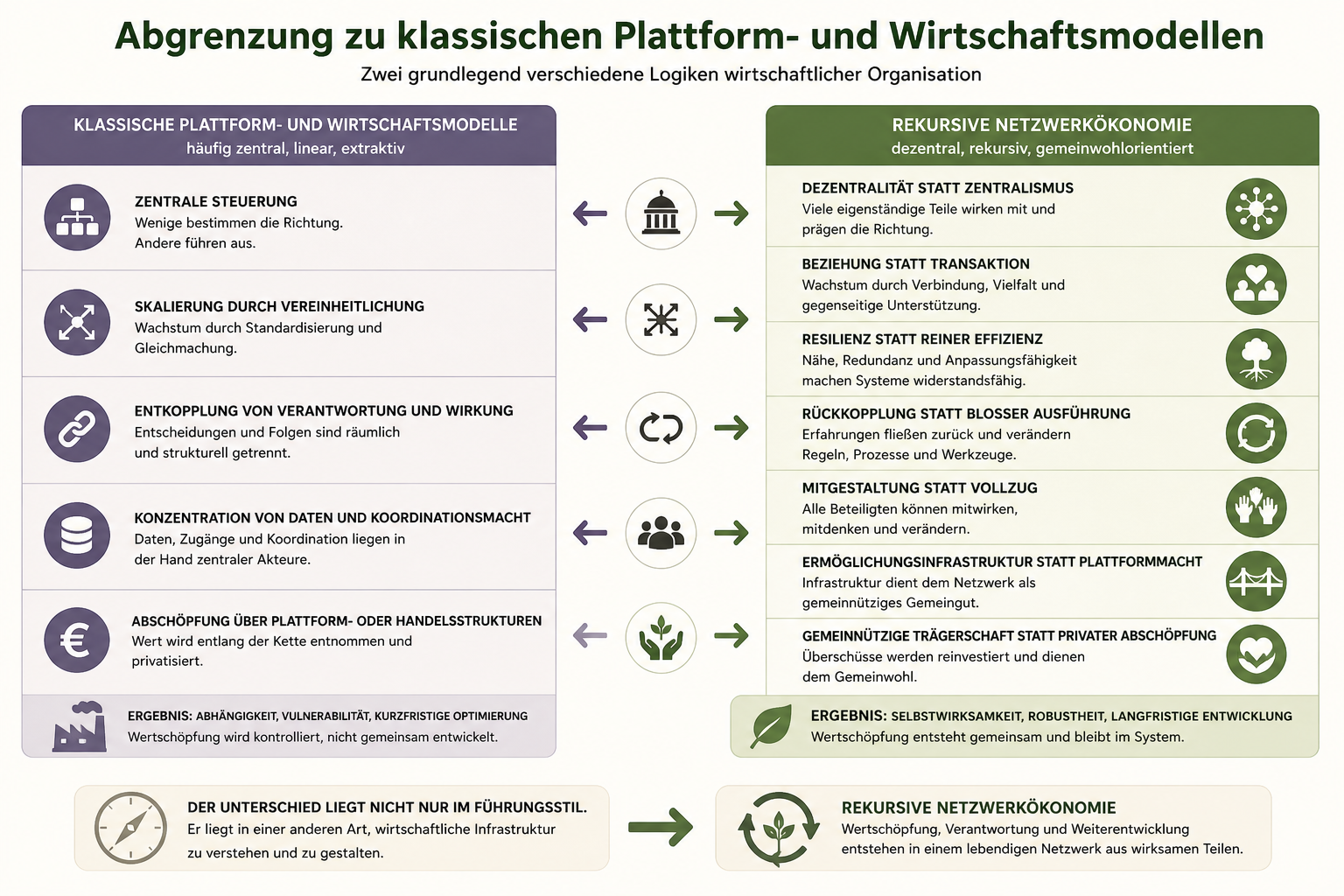
¶ Distinction from Classic Platform Logics and Economic Models
Classic economic logics are often based on:
- central control
- scaling through standardization
- decoupling of responsibility and effect
- concentration of data and coordination power
- extraction via platform or trade structures
Even there, good, reflective, or even holistic management can exist.
However, this does not yet change the underlying economic logic.
As long as a central entity sets the direction and other parts primarily execute it, the system remains essentially linearly organized.
The decisive question is not:
Can TEIKEI take over certain tasks of wholesale trade?
The decisive question is:
Can TEIKEI build new paths and structures without reproducing the constraints of wholesale trade?
Because if quantity, price, speed, and constant availability again determine everything, only a friendlier version of the same logic emerges.
TEIKEI does not simply optimize existing trade.
TEIKEI builds new paths.
This is important.
It is not about making an old system somewhat more transparent, ecological, or appealing.
It is about organizing provision from a different foundation.
This foundation is called:
- real relationships
- shared costs
- visible responsibility
- community planning
- feedback
- regional autonomy
- Europe-regional connection
- nonprofit infrastructure
In this sense, TEIKEI is not an improvement of the old framework.
TEIKEI is the construction of a different framework.
A quiet revolution in provision.
Not through demarcation alone, but through concrete new paths that people, farms, and regions can truly use.
Recursive network economics starts at a different point.
It does not only describe how an organization is managed but how value creation, responsibility, and development emerge in a learning network of independently effective parts.
It counters with:
- Decentralization instead of centralism
- Relationship instead of transaction
- Resilience instead of pure efficiency
- Feedback instead of mere execution
- Co-creation instead of compliance
- Enabling infrastructure instead of platform power
- Nonprofit governance instead of private extraction
The difference is not just in a different management style.
It lies in a different way of understanding economic infrastructure.
¶ The Agora as an Enabling Space
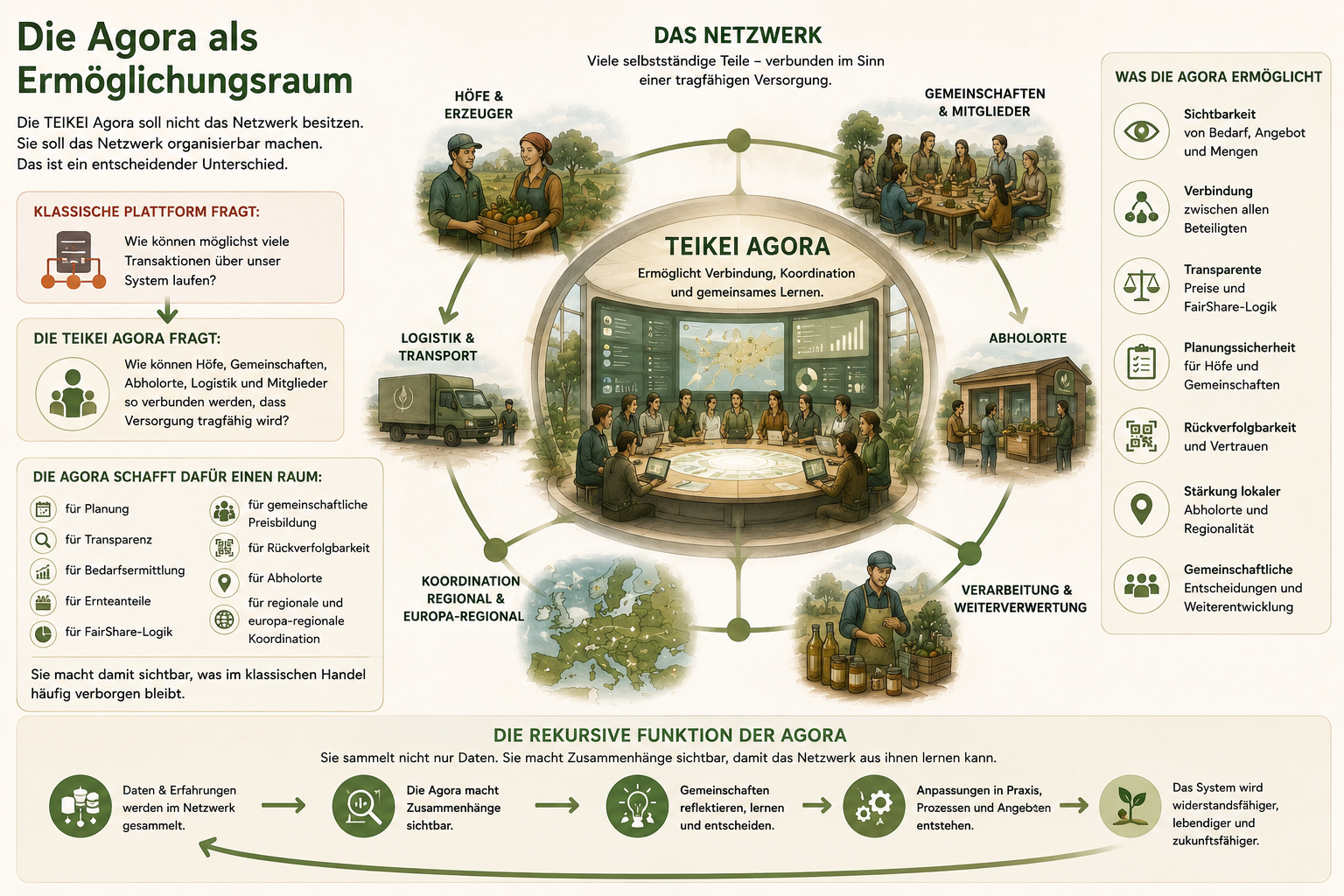
The Agora should not own the network.
It should make the network organizable.
This is a crucial difference.
A classic platform often asks:
How can as many transactions as possible run through our system?
The Agora asks:
How can farms, communities, pickup points, logistics, and members be connected in such a way that provision becomes sustainable?
The Agora creates a space for this:
- for planning
- for transparency
- for needs assessment
- for harvest shares
- for FairShare logic
- for community pricing
- for traceability
- for pickup points
- for regional and Europe-regional coordination
It thereby makes visible what often remains hidden in conventional trade.
This is where its recursive function lies:
It does not just collect data.
It makes connections visible so that the network can learn from them.
¶ The Producer Data Directory as a Concrete Building Block
A concrete building block of this logic is the shared producer data directory.
It does not serve to manage farms as interchangeable suppliers.
It makes visible:
- which farms work in which regions
- which people are behind the production
- what production possibilities exist
- what crops, areas, trees, or processing paths are available
- what rhythms the respective production follows
- what limits must be observed
- what potentials can be developed
- what local, regional, and Europe-regional connections are possible
This makes the producer data directory an important connection point between farm reality, food region, Agora, and network.
It helps to see not just products but the foundation of provision.
A farm does not appear as a delivery address.
It becomes visible as a living part of a provision context.
Further reading:
¶ The Six Perspectives of This Section
This section approaches recursive network economics from six perspectives that belong together in the TEIKEI context.
It is not just about individual subject areas but about six approaches to the same question:
How can the economy be organized so that responsibility, value creation, and development are not centrally predetermined but emerge jointly in a learning network?
¶ 1. Philosophy
The values and attitudes on which this understanding is based—solidarity, transparency, and shared responsibility.
¶ 2. License & Structure
The question of how openness, protection, and clear framework conditions can be combined so that collaboration becomes possible without centralizing control.
¶ 3. Agora
The practical translation of this logic into tools, processes, and infrastructure for provision, planning, and distribution.
¶ 4. Network Structure
The concrete shape of the network: nodes, roles, relationships, and provision spaces that are locally effective and at the same time connected Europe-regionally.
¶ 5. Centrality & Platform
The question of which central tools a network needs to coordinate itself without creating rigid dependencies or power concentration.
¶ 6. Governance & Resilience
How decisions, responsibility, and crisis capability can be organized so that the network learns from its own experiences and evolves.
¶ Overview of Pages
- Recursive Effect
- Philosophy
- License & Structure
- TEIKEI Agora
- Network Structure
- Centrality & Platform
- Governance & Resilience
¶ Why This Perspective Is Crucial
Recursive network economics is not an abstract theoretical model.
It is a practical orientation tool.
It helps to understand:
- why TEIKEI is structured the way it is
- why the Agora is not just software
- why the question of ownership and governance is central
- why certain decisions take time
- why participation is more important than speed
- why trade only changes when the framework of trade is built differently
- why digital infrastructure must be carefully accompanied
- why local practice is the foundation for the further development of the whole
And it makes visible that the economy can be thought of and lived differently.
¶ Condensed Core Statement
Recursive network economics means:
Every level of the network remains independently capable of action
and at the same time learns from the feedback of the other levels.
The Agora keeps this context visible without owning it.
Or, even more briefly:
The infrastructure does not extract from the network.
It strengthens the network's ability to organize itself.
And practically speaking:
People do not adapt to the digital infrastructure.
The digital infrastructure evolves from the reality of the participants.
¶ Invitation to Deepen
The following pages invite you to delve deeper—
step by step, perspective by perspective.
Not to understand everything immediately,
but to let connections grow.
Recursive network economics is not a finished system.
It is a shared learning process.
¶ Further Information & Understanding Contexts
One level up: 09 - Economy & Vision
Author: Felix Schröder, with the help of AI (ChatGPT)
Creation: written by Felix Schröder › formatted in Markdown by ChatGPT › published by Felix Schröder › layout adjusted by Claude
Created: 2026-02-05 · Last updated: 2026-10-11 · Questions or suggestions? support@teikei.us