¶ Terra Plena and the Humus Currency
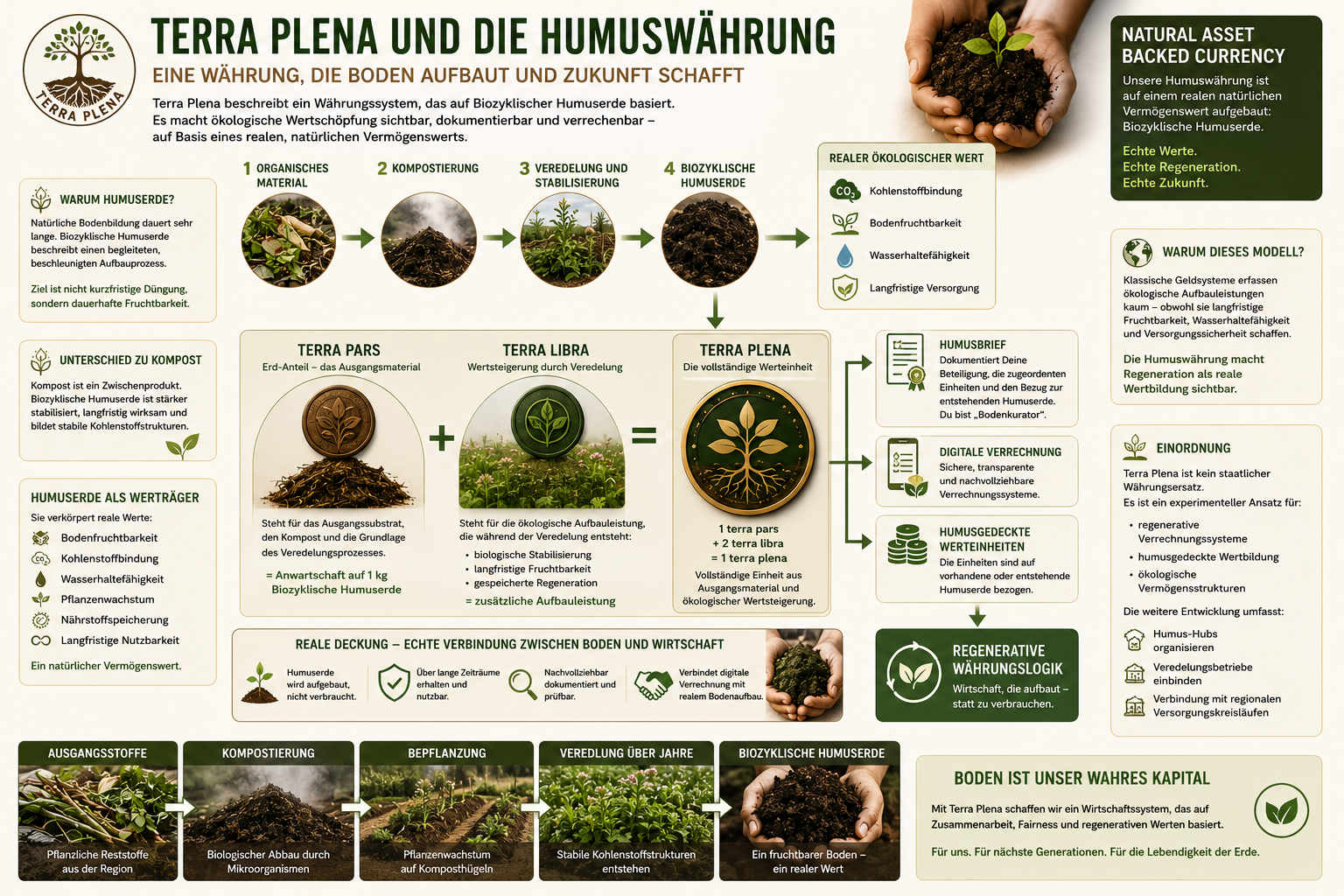
Terra Plena describes a currency system based on biocyclic humus soil.
The central idea is:
The ecological value creation that occurs during the formation of humus soil should not remain invisible but be documented and made accountable as a real economic foundation.
At its core is not abstract money creation,
but the transformation of organic material into long-term fertile soil.
¶ Basic Logic of the Terra Plena System
1. From Organic Material to Ecological Value
2. From Value to Value Unit
This is how it could work (an experimental approach, see "Classification" below):
- Starting point is organic material.
- It is composted.
- This is followed by refinement and stabilization.
- Biocyclic humus soil is created.
- It has a real ecological value: carbon sequestration, soil fertility, water retention capacity, and long-term supply.
- From the humus soil itself comes terra pars (the starting material).
- From the ecological value comes terra libra (the value increase).
- terra pars and terra libra together form terra plena. This results in the Humus Certificate, digital accounting, and humus-backed value units.
- The humus-backed value units lead to regenerative currency logic.
How to read the diagram: Diagram 2 continues Diagram 1. The two green boxes at the top of Diagram 2 are the same as boxes 4 and 5 in Diagram 1.
¶ Natural Asset Backed Currency
The Terra Plena project refers to the humus currency as:
Natural Asset Backed Currency
This means a currency whose foundation is a real natural asset.
In this case:
Biocyclic humus soil.
The currency should thus not exist merely symbolically but refer to actually existing soil fertility.
¶ The Basic Idea of Tokenization
In the Terra Plena system, humus soil is translated into digital value units.
This process is called tokenization.
The idea behind it:
The value increase that occurs during the refinement of compost into biocyclic humus soil should be documented in a traceable manner.
Different tokens are used for this purpose.
¶ Terra Pars
"terra pars" roughly means:
Earth share.
A terra pars token represents the initial value of the material needed to produce biocyclic humus soil.
It thus describes:
- the starting substrate
- the compost
- the basis of the subsequent refinement process
In the whitepaper, terra pars is described as an entitlement to one kilogram of biocyclic humus soil.
¶ Terra Libra
"terra libra" describes the value increase that occurs during refinement.
This refers to:
- the ecological construction performance
- the biological stabilization
- the long-term fertility
- the regeneration stored in the soil
terra libra thus does not represent the starting material,
but the additionally created value.
¶ Terra Plena
Only together do terra pars and terra libra form the complete value unit:
- 1 terra pars
- plus 2 terra libra
- result in 1 terra plena
Terra Plena thus describes the complete unit consisting of:
- starting material
- and ecological value increase
¶ The Humus Certificate
Those who join the system receive a so-called Humus Certificate.
This documents:
- the participation
- the assigned units
- the reference to the emerging humus soil
In the whitepaper, the participating person is referred to as a "soil curator."
¶ Real Backing
A central claim of the system is real backing.
The tokens should not exist freely detached,
but refer to existing or emerging humus soil.
The humus soil remains preserved over longer periods and can later be redeemed or used.
This creates a direct connection between:
- digital accounting
- real soil building
¶ Why This Model Was Developed
The Terra Plena documents argue that conventional monetary systems hardly capture ecological construction performance.
Soil building often does not appear as an asset increase there, even though it creates long-term fertility, water retention capacity, and supply security.
The humus currency therefore attempts to make ecological regeneration visible as real value creation.
¶ Classification
Terra Plena does not describe a state currency replacement.
It is an experimental approach for:
- regenerative accounting systems
- humus-backed value creation
- ecological asset structures
The following chapters describe:
- how humus hubs are organized
- the role of refinement operations
- how such systems could be connected with regional supply cycles
¶ Further Information & Understanding Contexts
- Biocyclic Humus Soil
- From Compost to Humus Soil
- Refinement Operations and Humus Hubs
- Integration into the TEIKEI Network
One level up: Humus Currency
Author: Felix Schröder, with the help of AI (ChatGPT)
Creation: written by Felix Schröder › formatted in Markdown by ChatGPT › published by Felix Schröder › display adjusted by Claude
Created: 2026-05-08 · Last updated: 2026-05-08 · Questions or suggestions? support@teikei.us