¶ Vision of a Multi-Level TEIKEI Clearing System
Imagine a multi-level complementary currency system within the TEIKEI network that financially and organizationally connects local communities, regional clusters, and the entire European network.
This complementary currency system is based on the TEIKEI Agora—the digital account and clearing system—and enables participants to be rewarded for their contributions, balance inequalities, and practice solidarity across all levels.
Below, we outline a visionary yet structurally coherent concept of how this three-tier system functions at the local, regional, and Europe-wide levels, and which challenges it addresses.
¶ Local Level: Complementary Currency Around Pickup Points
At the local level—at individual pickup points such as #TEIKEIPickup, #TEIKEIFarmPickup, or #TEIKEIShop—a community-internal complementary currency is used.
Here, people organize locally to collectively source food and share tasks. The complementary currency serves as an exchange and recognition unit for effort, organization, and access to food within the community.
¶ Key Elements at the Local Level
-
Agora Accounts for All Members
Each member of a TEIKEI community has a digital Agora account where internal credits are recorded.
These credits (also called "complementary currency") represent contributions made or claims to community services.Example:
An organizer receives 50 euros in internal credits for coordinating an order round, which are credited to their account. -
Credits for Engagement (Hour-Based Model)
Local tasks—from unpacking crates to distributing products, storage, and cleaning—are rewarded with complementary currency.Working hours are transparently recorded and converted into credits. For instance, one hour of assistance in distribution may be credited as a certain number of complementary currency units.
This hour-based model makes visible who contributes how much and directly rewards volunteer work on the person’s Agora account.
The platform already conceptually supports this: In internal discussions, it was proposed to remunerate hours worked and spaces provided at pickup points not in euros but in a local currency unit.
This local currency could symbolically be linked to regenerative projects (e.g., "Compost Meters"). -
Complementary Currency as a Local Payment Method
Members can use their earned credits to pay for a portion of their food costs with complementary currency.Part of the product price is thus covered by internal credits, with the remainder paid in euros. This hybrid payment model reduces the effective euro burden on members.
Particularly for people with low incomes, this provides access to high-quality TEIKEI food by allowing them to pay with work instead of money.
Those with limited financial means contribute more to community work and thereby "earn" their share of the products. -
Local Exchange Logic and Solidarity
Excess credits can be passed on or exchanged within the community.For example, if an organizer has accumulated more complementary currency than they need, they can transfer these credits to other members—perhaps in exchange for someone else providing transportation or covering a shift.
The complementary currency thus becomes a genuine local alternative currency based on trust and shared values.
It remains locally circulating and promotes solidarity: mutual aid and resource-sharing are facilitated without immediate euro transactions.
¶ Regional Level: Clearing Between Clusters and Delivery Communities
At the regional level, the complementary currency system expands from individual pickup points to clusters of communities or delivery networks.
Here, multiple nearby TEIKEI groups coordinate their goods flows, infrastructure, and support—and settle this cooperation using the internal clearing currency.
¶ Key Elements at the Regional Level
-
Cluster Accounts and Regional Clearing
Multiple pickup points or communities in a region can maintain a shared cluster account where regional credits are recorded.For example, if a TEIKEI farm or regional warehouse delivers goods to various communities, the proportional costs and efforts are recorded internally in complementary currency instead of settling each transaction in euros.
Example:
A delivery community organizes the transport of olive oil canisters for five neighboring villages.
Each community receives the goods and credits the delivery community with corresponding credits.The actual euro payment to the producer is made centrally, while the distribution of costs within the cluster is balanced via the internal credit system.
-
Infrastructure and Joint Projects
When multiple local groups jointly invest in infrastructure (e.g., a cold storage room, processing equipment, or a distribution vehicle), the complementary currency system can map contributions and usage shares.Each community makes a contribution—whether in euros, labor, or materials—and receives complementary currency credits on the regional account in return.
If a group then uses, for example, the shared cold storage, it "pays" for the usage in complementary currency to those who invested.
This ensures fair distribution of efforts and benefits without always requiring immediate euro settlements. -
Balancing Between Communities
Regional imbalances can be better absorbed.If one community has a surplus (e.g., undistributed food or available volunteer capacity) and supports another community with it, complementary currency flows as recognition.
Conversely, a community facing shortages can "afford" support by pledging regional credits in return.This trust-based exchange strengthens cohesion in the region.
Roles and services—from transportation to storage to communication—become transparently traceable. -
Example – Regional Delivery Community
Multiple TEIKEI pickup points collaborate to directly source a truckload of citrus fruits from the south.One group takes on the organization and pre-financing.
In the regional complementary currency system, they receive credits from the co-supplied locations once the delivery is distributed.The co-supplied communities settle these credits through their own contributions—such as organizing transport or future harvest efforts.
Without euro transactions, the burden is distributed reciprocally.
¶ European Level: Network-Wide Clearing and Balancing
In the third tier, the complementary currency system spans the entire TEIKEI network across Europe.
Here, the complementary currency functions as a clearing unit between regions and as a tool to balance surpluses or deficits and to recognize cooperation over long distances.
¶ Key Elements at the European Level
-
Network-Wide Credits
Each region (or national organization) has an account in the European clearing system.For example, if a Spanish TEIKEI community delivers surpluses to northern regions, it receives Europe-wide complementary currency credits in return.
These can later be used for support from the network—machinery, seeds, or helpers. -
Clearing Between Regions
Regions that receive more than they contribute build up a negative complementary currency balance.
Regions with surpluses accumulate credits.This balance is regularly evaluated and settled through real services or solidarity contributions—not through strict debt collection.
-
Cooperation and Knowledge Exchange
Even intangible contributions are included.If a regional group develops a new tool or knowledge that benefits everyone, this can be rewarded with complementary currency.
Other regions voluntarily transfer credits as recognition. -
Technical Implementation – Decentralized Tokens
The TEIKEI Agora is designed to allow local complementary currency tokens and an overarching token system to coexist in parallel.Each community uses its own token, which remains interoperable through a shared clearing system.
In the future, these tokens could be linked to real values—such as Humus Tokens for soil regeneration.
¶ Solutions to Current Challenges
Such a multi-level clearing system addresses key challenges in the network:
-
Balancing Inequalities
Contributions and benefits become visible and are fairly balanced. -
Access to High-Quality Food
Participation is enabled through engagement, not limited by purchasing power. -
Transparency in Division of Labor
Visible and invisible work are equally recognized. -
Fair Compensation Across Roles
Producers, organizers, logistics, IT, and pickup services are comparably rewarded. -
Strengthening Community and Resilience
The network becomes more crisis-resistant, more solidaristic, and sustainable in the long term.
This visionary outline demonstrates the potential of a multi-level TEIKEI clearing system.
It is not a rigid technical construct but a learning system that carries forward the core TEIKEI principles at the economic level—toward a network that collectively manages, shares, and supports one another.
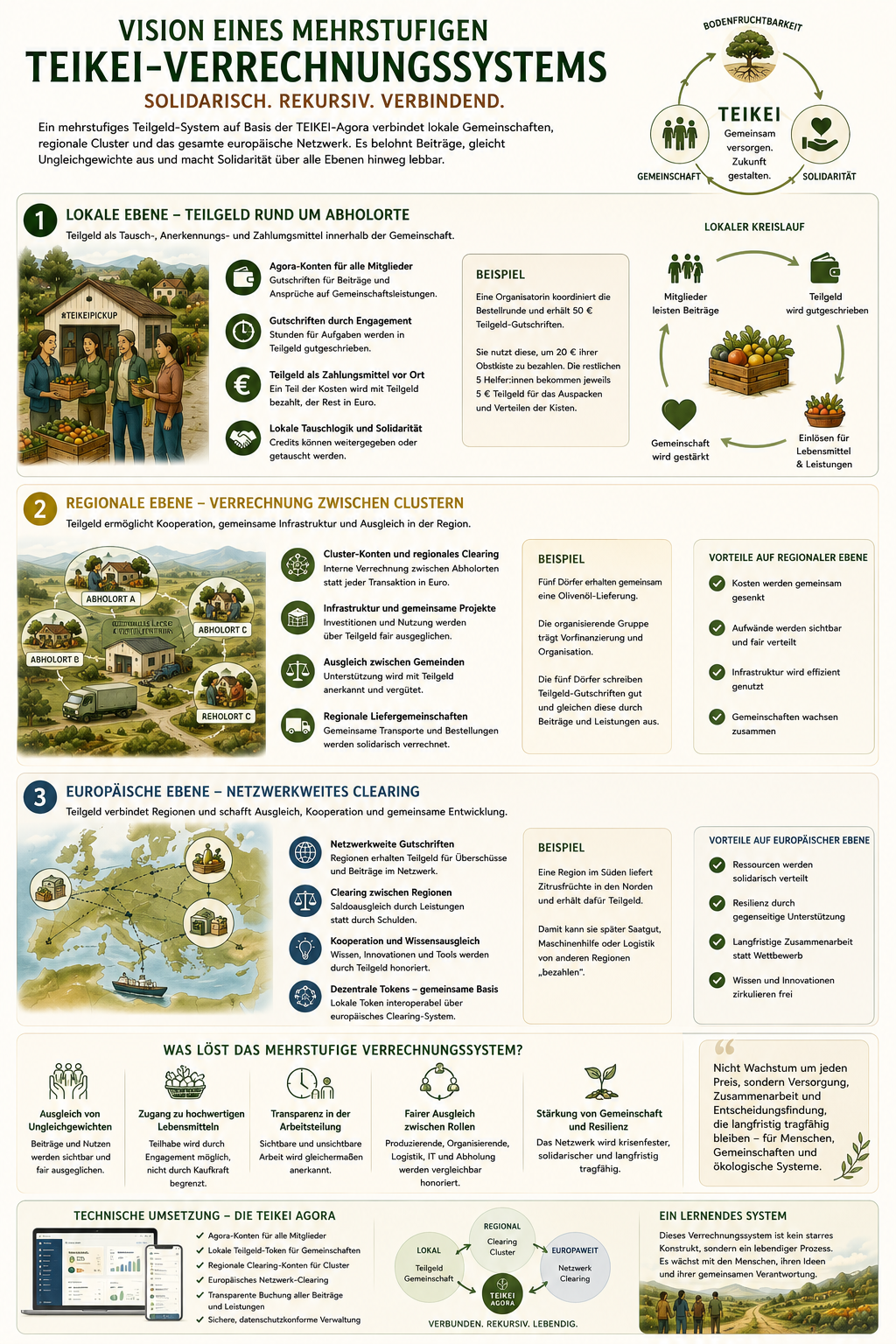
One level up: Clearing Systems
Author: Felix Schröder, with assistance from AI (ChatGPT)
Creation: written by Felix Schröder › formatted in Markdown by ChatGPT › published by Felix Schröder › layout adjusted by Claude
Created: 2026-01-30 · Last updated: 2026-05-08 · Questions or feedback? support@teikei.us