¶ Sustainable Food Systems
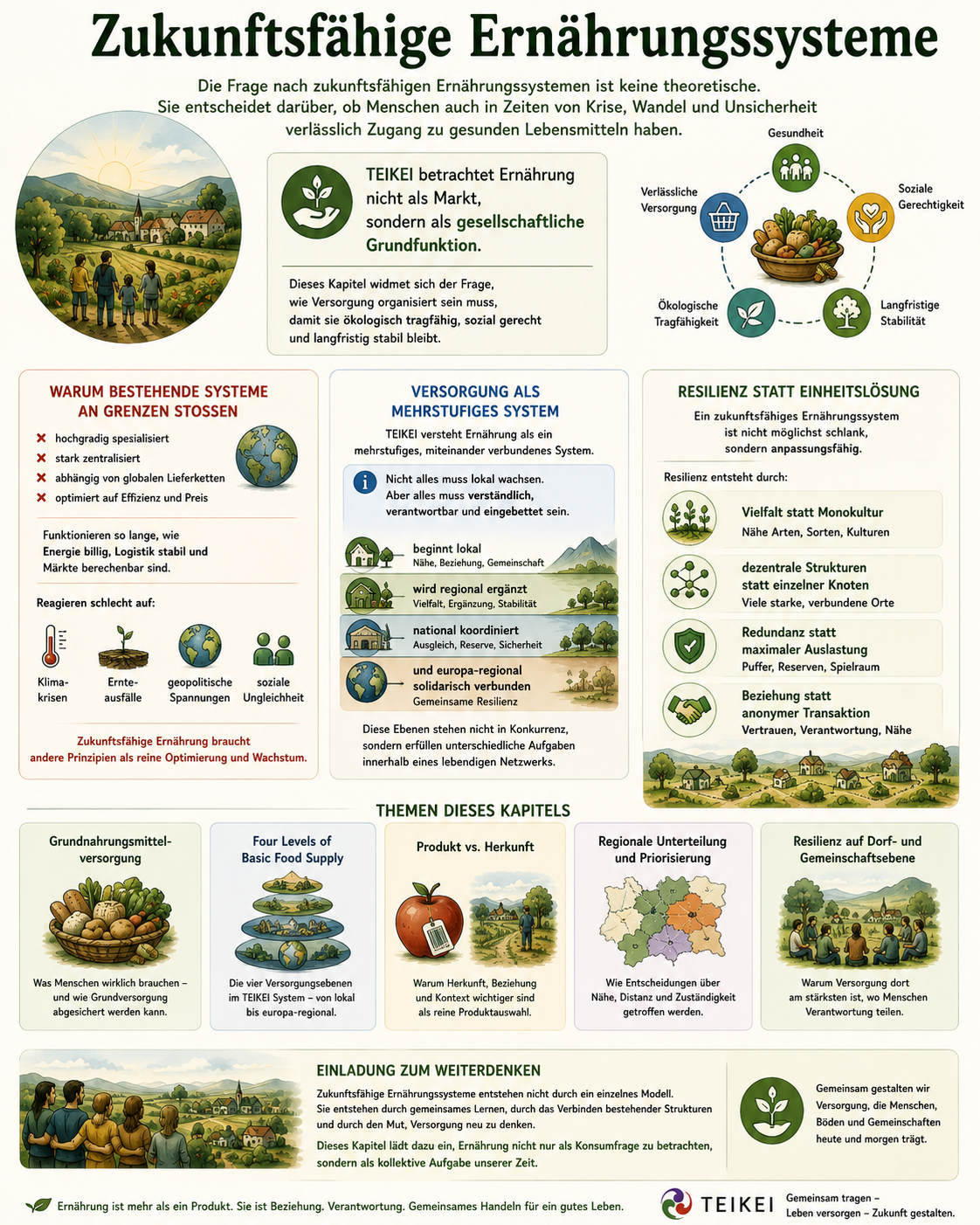
The question of sustainable food systems is not theoretical.
It determines whether people will continue to have reliable access to healthy food
in times of crisis, change, and uncertainty.
TEIKEI does not view food as a market,
but as a fundamental societal function.
This chapter explores the question
of how food supply must be organized
to remain ecologically viable, socially just,
and stable in the long term.
¶ Why Existing Systems Are Reaching Their Limits
Many of today’s food systems are:
- highly specialized
- strongly centralized
- dependent on global supply chains
- optimized for efficiency and price
These systems work as long as
energy is cheap, logistics are stable, and markets are predictable.
But they respond poorly to:
- climate crises
- crop failures
- geopolitical tensions
- social inequality
Sustainable food systems therefore require different principles
than mere optimization and growth.
¶ Food Supply as a Multi-Level System
TEIKEI understands food as a multi-level, interconnected system.
Not everything needs to be grown locally.
But everything must be understandable, accountable, and embedded.
Sustainable food supply:
- starts locally
- is supplemented regionally
- is coordinated nationally
- and connected in solidarity at a European-regional level
These levels do not compete with one another,
but fulfill different roles within a living network.
¶ Resilience Instead of a One-Size-Fits-All Solution
A sustainable food system is not as lean as possible,
but adaptable.
Resilience arises through:
- diversity instead of monoculture
- decentralized structures instead of single nodes
- redundancy instead of maximum utilization
- relationships instead of anonymous transactions
This chapter demonstrates
how such principles can be concretely conceived and organized.
¶ Success Stories & Best Practices
Sustainable food systems do not only need to be imagined.
In many places, new approaches are already being tested—some for decades and on a large scale.
In this section, we collect proven success stories and best practices from around the world.
The focus is on examples where agriculture, food supply, ecology, public infrastructure, or community organization have been interconnected in ways that extend their impact beyond individual farms or small pilot projects.
These could include, for example:
- cities and municipalities
- entire regions and landscapes
- larger agricultural cooperatives
- regional food supply systems
- public programs
- community-driven structures
- new forms of collaboration between agriculture, the public, and government
The goal is not to simply copy a model.
It is about making visible:
What already works?
Under what conditions does it work?
What can other regions learn from it?
This gradually builds a collection of real-world experiences showing that profound changes in food systems are not only possible but already happening in many places.
¶ Topics in This Chapter
The following subpages explore key aspects of sustainable food systems in depth:
-
Basic Food Supply
What people truly need—and how basic food security can be ensured. -
Four Levels of Basic Food Supply
The four supply levels in the TEIKEI system—from local to European-regional. -
Product vs. Origin
Why origin, relationships, and context matter more than just product selection. -
Regional Division and Prioritization
How decisions about proximity, distance, and responsibility are made. -
Resilience at the Village and Community Level
Why food supply is strongest where people share responsibility. -
Success Stories & Best Practices
Real-world examples from cities, regions, and larger food supply systems demonstrating which changes already work at scale today.
¶ An Invitation to Rethink
Sustainable food systems do not emerge from a single model.
They emerge through collective learning,
by connecting existing structures,
and by having the courage to rethink food supply.
This also means learning from one another.
Experiences from other cities, regions, and countries can reveal
which paths have already been taken,
what has worked,
and what conditions were necessary.
This chapter invites you to
view food not just as a question of consumption,
but as a collective challenge of our time.
One level up: 09 - Economy & Vision
Author: Felix Schröder, with assistance from AI (ChatGPT)
Created: written by Felix Schröder › formatted in Markdown by ChatGPT › published by Felix Schröder › layout adjusted by Claude
Date: 2026-02-05 · Last updated: 2026-10-12 · Questions or feedback? support@teikei.us