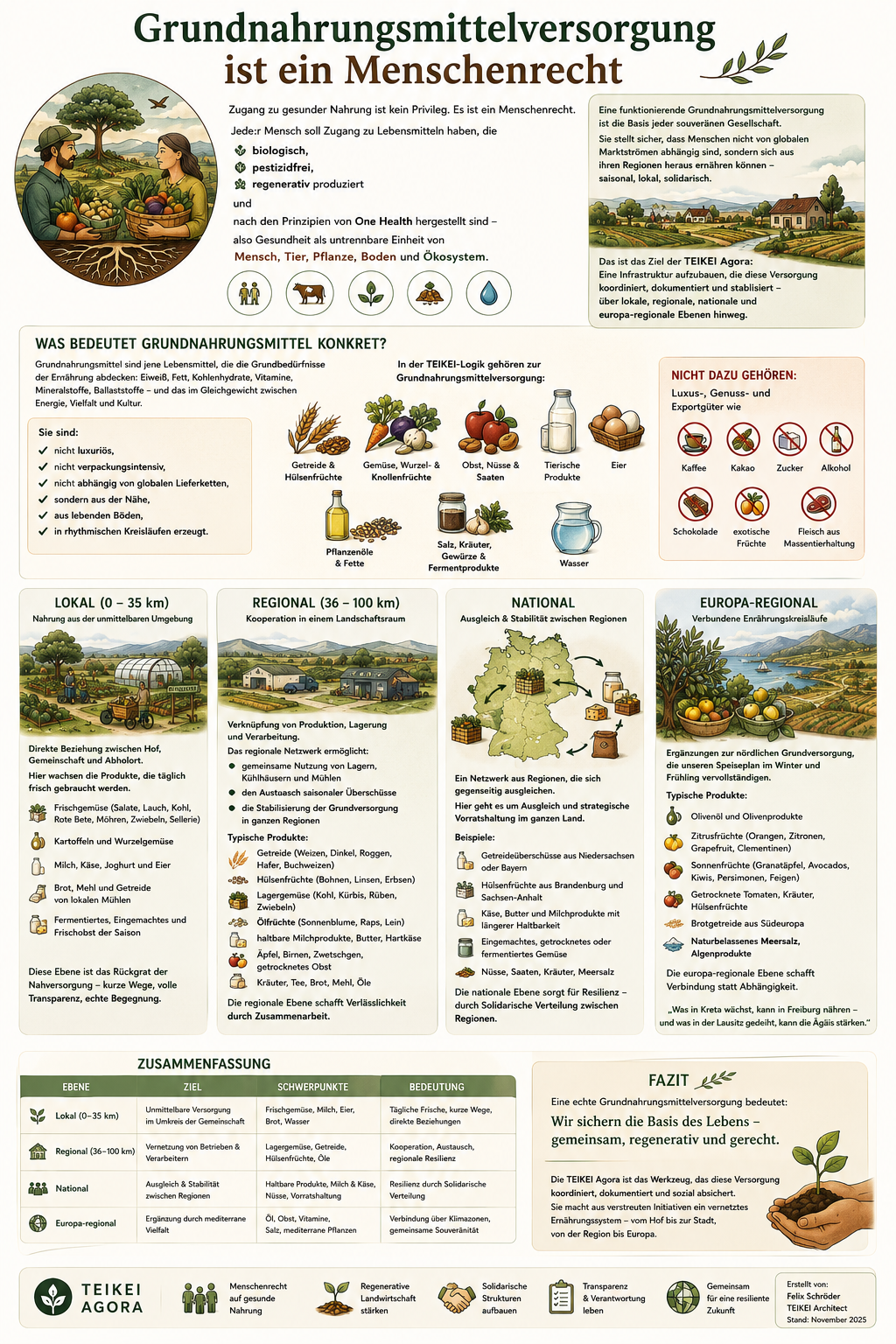
¶ 🌾 Basic Food Supply is a Human Right
Access to healthy food is not a privilege. It is a human right.
And this right means: Every person should have access to food that is
- organic,
- pesticide-free,
- regeneratively produced,
and - produced according to the principles of One Health—understanding health as an inseparable unity of people, animals, plants, soil, and ecosystems.
A functioning basic food supply is the foundation of every sovereign society.
It ensures that people are not dependent on global market flows,
but can nourish themselves from their own regions—seasonally, locally, and in solidarity.
This is the goal of the TEIKEI Agora:
To build an infrastructure that coordinates, documents, and stabilizes this supply—across local, regional, national, and European-regional levels.
¶ 🌿 What Does Basic Food Actually Mean?
Basic foods are those that cover the basic nutritional needs:
Protein, fat, carbohydrates, vitamins, minerals, fiber—and this in a balance between energy, diversity, and culture.
They are:
- not luxurious,
- not packaging-intensive,
- not dependent on global supply chains,
- but produced nearby, from living soils, in rhythmic cycles.
In the TEIKEI logic, basic food supply includes:
🌾 Grains & legumes
🥔 Vegetables, root & tuber crops
🍎 Fruit, nuts & seeds
🐄 Animal products
🥚 Eggs
🌻 Plant oils & fats
🧂 Salt, herbs, spices & fermented products
💧 Water
Not included are: luxury, indulgence, and export goods such as coffee, cocoa, chocolate, alcohol, sugar, exotic fruits, or meat from industrial livestock farming.
¶ 🌱 Local (0 – 35 km)
Local means: Food from the immediate surroundings—within the radius that people can reach by bicycle or cargo bike.
This is the level where the direct relationship between farm, community, and pickup location emerges.
Here, the products that are needed fresh daily are grown:
- Fresh vegetables (lettuce, leeks, cabbage, beets, carrots, onions, celery)
- Potatoes and root vegetables
- Milk, cheese, yogurt, and eggs
- Bread, flour, and grains from local mills
- Fermented, preserved, and seasonal fresh fruit
This level is the backbone of local supply—it secures basic food even when external supply chains are disrupted.
Here, self-determination begins: short distances, full transparency, real encounters.
¶ 🌾 Regional (36 – 100 km)
Regional means: Cooperation within a connected landscape area—multiple districts, valleys, or cities that complement each other.
Here, production, storage, and processing are interconnected.
The regional network enables:
- shared use of collection warehouses, cold storage, and mills
- exchange of seasonal surpluses
- stabilization of basic supply across entire regions
Typical products include:
- Grains (wheat, spelt, rye, oats, buckwheat)
- Legumes (beans, lentils, peas)
- Storage vegetables (cabbage, pumpkin, turnips, onions)
- Oilseeds (sunflower, rapeseed, flax)
- Long-lasting dairy products, butter, hard cheese
- Apples, pears, plums, dried fruit
- Herbs, tea, bread, flour, oils
The regional level creates reliability through collaboration.
It is the heart of the solidarity-based infrastructure: many small cycles supporting each other.
¶ 🧺 National
National means: A network of regions that balance each other out.
If one region experiences crop failures, another can help.
If potatoes are left over in the south, they are delivered to the north.
Here, the focus is on balancing and strategic stockpiling—securing basic food supplies across the entire country.
Examples:
- Grain surpluses from Lower Saxony or Bavaria
- Legumes from Brandenburg and Saxony-Anhalt
- Cheese, butter, and long-lasting dairy products
- Preserved, dried, or fermented vegetables
- Nuts, seeds, herbs, sea salt
The national level ensures resilience—not through centralization, but through solidarity-based distribution among regions.
¶ 🍋 European-Regional
European-regional means: Connected food cycles across climate zones—North and South, temperate and Mediterranean, farmland and islands.
Here, the supplements to northern basic supply emerge, completing our diet in winter and spring.
Typical products include:
- Olive oil and olive products
- Citrus fruits (oranges, lemons, grapefruits, clementines)
- Sun fruits (pomegranates, avocados, kiwis, persimmons, figs)
- Dried tomatoes, herbs, legumes
- Bread grains from Southern Europe
- Natural sea salt, algae products
The European-regional level creates connection instead of dependency.
It makes visible that the South is not the supplier of the North, but part of a shared food ecosystem.
“What grows in Crete can nourish Freiburg—
and what thrives in Lusatia can strengthen the Aegean.”
¶ 🌾 Summary
| Level | Goal | Focus Areas |
|---|---|---|
| Local (0–35 km) | Immediate supply within the community’s radius | Fresh vegetables, milk, eggs, bread, water |
| Regional (36–100 km) | Networking of farms & processors | Storage vegetables, grains, legumes, oils |
| National | Balancing & stability among regions | Long-lasting products, dairy & cheese, nuts |
| European-regional | Supplementation through Mediterranean diversity | Oil, fruit, vitamins, salt, Mediterranean plants |
¶ 🌱 Conclusion
A true basic food supply means:
We secure the foundation of life—together, regeneratively, and fairly.
The TEIKEI Agora is the tool that coordinates, documents, and socially secures this supply.
It transforms scattered initiatives into a networked food system—
from the farm to the city, from the region to Europe.
“Basic food is not a market commodity. It is the shared backbone of a society that can feed itself.”
Created by:
Felix Schröder, TEIKEI Architect
Status: November 2025
One level up: How It Works
Author: Felix Schröder, with assistance from AI (ChatGPT)
Creation: written by Felix Schröder › formatted in Markdown by ChatGPT › published by Felix Schröder › layout adjusted by Claude
Created: 2025-11-04 · Status: 2026-05-08 · Questions or feedback? support@teikei.us