¶ Why TEIKEI Olive?
Getting Started and Overview › Information Materials › TEIKEI Olive - Brief Description · 7 min read
¶ Argumentation Basis for Trade, Resale, and Interested Members
This page collects key arguments to explain TEIKEI Olive clearly.
It is aimed at people who want to pass on, present, mediate, or explain TEIKEI Olive in conversations with pickup locations, resale partners, institutions, and interested members.
The focus is not on olive oil as an individual product, but on the responsibility chain behind it: farms, soil, care, harvest, processing, logistics, financing, community, and long-term collaboration.
¶ Short and Clear: 7 Good Reasons for TEIKEI Olive Oil
¶ 1. Direct Sourcing from Small-Scale Farms
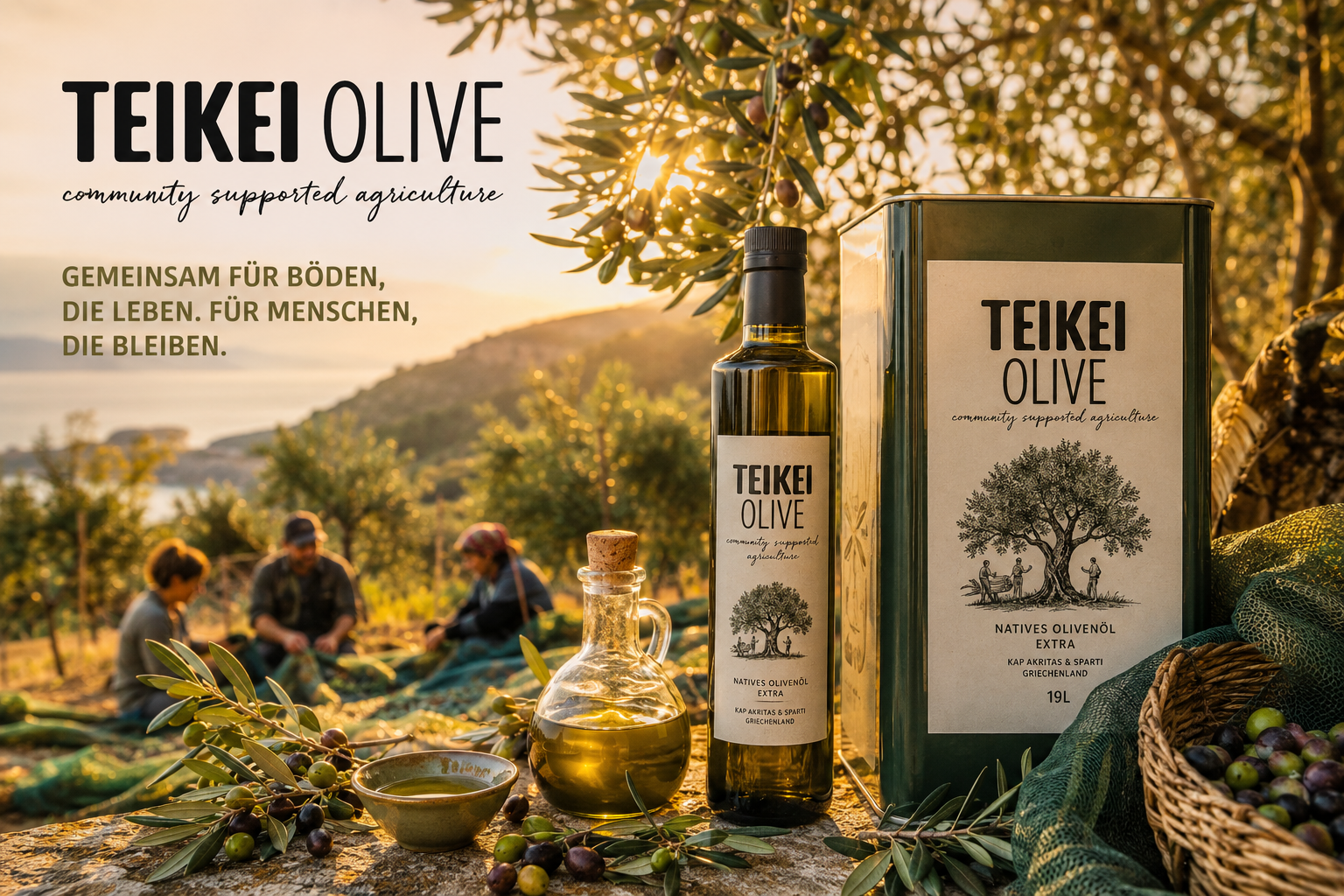
TEIKEI Olive connects people directly with small-scale farms in Greece.
The sourcing is based on long-term relationships, not anonymous trade chains. This makes it visible who produces the oil, where it comes from, and the work behind it.
¶ 2. Long-Term Partnership
TEIKEI Olive collaborates with farms over extended periods.
This creates reliability, planning security, and mutual responsibility. Pricing is based on the actual farm situation, harvest conditions, care efforts, quality, logistics, and community sustainability.
¶ 3. Transparency Back to the Origin
TEIKEI Olive makes origin visible.
Depending on the oil, information about the region, olive variety, harvest time, farm, family, or cooperative can be traced. Transparency here means not just a label, but a traceable relationship between origin and community.
¶ 4. Regenerative Agriculture as a Development Path
TEIKEI Olive views agriculture as a living development process.
Soil building, biodiversity, water management, tree care, landscape, and long-term farm development are part of agricultural reality. TEIKEI works to make this reality visible and collectively sustainable.
¶ 5. Organic Certification and Direct Responsibility
TEIKEI is no longer organically certified itself for cost reasons but makes the farms' organic certificates accessible (more on this under Organic Certification in the TEIKEI Network).
At the same time, the focus is not on marketing through a seal but on the concrete relationship with the farms, the traceability of the work, and the shared responsibility for quality, soil, and people.
An organic seal is currently not on the bottle; a labeling system that makes the farms' certification visible is in development.
¶ 6. Reusable Packaging, Refilling, and Community Logistics
TEIKEI Olive works with different containers and reusable solutions.
These include bottles, canisters, and larger barrels for refill stations or community use. The goal is a packaging and logistics structure that conserves resources and fits the real processes in communities.
¶ 7. Different Oil Characteristics and High Quality
TEIKEI Olive offers various oil characteristics that differ in harvest time, ripeness, flavor, and intensity.
This allows people to choose an oil that suits their cuisine, taste, and needs. The quality comes from the variety, harvest time, processing, storage, care, and the experience of the involved farms.
¶ Origin and Cultivation Method
TEIKEI Olive comes from Greece.
Well-known places of origin include:
- Cape Akritas – Marantos Family
- Sparti – Producer community in the hills of the Peloponnese
The olives are carefully harvested and processed. The focus is on quality, origin, relationships, and the further development of agricultural practices.
TEIKEI Olive supports farms not only in sourcing olive oil but also in questions of cultivation, quality assurance, care, economic stability, and community integration.
¶ Pricing and Community Responsibility
Pricing for TEIKEI Olive is not based solely on anonymous market prices.
It takes into account:
- the actual work of the farms
- harvest conditions and yield
- care efforts
- quality
- processing
- transport
- storage
- packaging
- coordination
- community sustainability
This creates a price that not only considers the oil but makes the entire responsibility chain visible.
For trade, resale, and pickup locations, this means: The price tells a story. It stands for a relationship, not just a product.
¶ Regenerative Approach
TEIKEI Olive works to further develop agriculture in a regenerative way over the long term.
This is about more than meeting minimum standards. Regenerative agriculture asks how soil, trees, water, biodiversity, landscape, and farm communities can become more vibrant.
In the TEIKEI context, this development can be described through an internal level system:
- Level 0: Entry level with organic certification
- Level 1: Interest, observation, and analysis of regenerative potential
- Level 2: Individual development path for the farm
- Level 3: Visible progress in soil building, biodiversity, water management, and farm development
The level system is not a sales argument. It serves to make development visible and to share responsibility collectively.
¶ The Oil Characteristics
TEIKEI Olive distinguishes between different oil characteristics.
| Name | Character | Harvest Time | Flavor | Special Features |
|---|---|---|---|---|
| Zeus’ Favorite | robust | October to early November | fruity-fresh, grassy, peppery | early harvest, intense freshness |
| Blossom Sparkle | medium | from November | full-bodied, round, grassy | balanced harmony between freshness and depth |
| Spring Gold | mild | December to January | fruity, mild, sometimes with ripe aromas | later harvest, mild character |
| Elysion | health-promoting | early harvest in October | intensely fresh, clearly bitter, noticeably sharp | single production from Cape Akritas, high polyphenol content |
The classification may vary slightly depending on the harvest year. Flavor, intensity, and availability depend on climate, harvest time, processing, and storage.
¶ Elysion: An Oil with Inner Strength
Elysion is an especially early-harvested olive oil made from Koroneiki olives from Cape Akritas in the southern Peloponnese.
It comes from Panagiotis Marantos and is produced as a single batch. The olives are harvested early, carefully selected, and processed directly on-site. The processing is exclusively mechanical, single-variety, and at low temperatures.
Due to the early harvest time, the oil has an intense freshness, clear bitterness, and noticeable sharpness. These sensory characteristics are typical of polyphenol-rich olive oils.
Elysion stands for:
- Single production from Cape Akritas
- Early harvest in October
- Koroneiki olives
- Cold-pressed processing on the day of harvest
- Full traceability back to the field
- Regular analytical testing
- Health-promoting polyphenol content
- Conscious use in small quantities
The slopes at Cape Akritas offer a special interplay of sea winds, calcareous soils, and stable temperatures. The olive trees grow there in a landscape shaped by traditional mixed cultivation, fig trees, carob trees, and Mediterranean dryness.
¶ Polyphenols and Legal Notice
Elysion is described as a polyphenol-rich and health-promoting olive oil.
According to the available data, the polyphenol content is at least 400 mg per kilogram. This information must be analytically tested and currently confirmed for each harvest.
For health-related claims, the following notice applies according to EU Regulation 432/2012:
Olive oil polyphenols contribute to the protection of blood lipids from oxidative stress.
The beneficial effect is obtained with a daily intake of 20 g of olive oil, provided this quantity contains at least 5 mg of hydroxytyrosol and its derivatives.
Health-related claims should only be used if the laboratory values for the respective batch are available and the legal requirements are met.
¶ Use of Elysion
Elysion is particularly suitable for cold applications.
It can be used pure, on bread, with yogurt or quark, over cooked vegetables, or as a conscious daily supplement. Due to its clear bitterness and noticeable sharpness, it is not a neutral cooking oil but a consciously used oil for people seeking an early, polyphenol-rich, and health-promoting olive oil.
Possible applications:
- one to two tablespoons pure
- on crispbread or sourdough bread
- over warm vegetables after cooking
- with potatoes, legumes, or salad
- in small quantities as a conscious olive oil ritual
Elysion should be stored in a cool, dark place and tightly sealed. High-quality olive oil may flocculate at low temperatures. This is not a defect but a natural behavior of the oil.
¶ Harvest Shares, Direct Orders, and Resale
TEIKEI Olive can be sourced and passed on in different ways.
¶ Harvest Shares
With a harvest share, part of the harvest is collectively supported.
This enables planning security for the farms and a reliable supply for members.
¶ Direct Orders
Direct orders are possible through the Agora marketplaces:
¶ Resale and Distribution
Resale partners, pickup locations, or institutions can source and distribute TEIKEI Olive on behalf of members or local communities.
Clear communication is important here:
- Where does the oil come from?
- Which farms are behind it?
- What responsibility chain is being supported?
- What costs and efforts are included?
- How are price, packaging, and returns handled transparently?
¶ Packaging and Logistics
TEIKEI Olive works with different containers depending on needs and structure.
Possible container sizes include:
- 0.5 l
- 3 l
- 5 l
- 10 l
- 17 l
- 19 l
- 250 ml canister for Elysion
Reusable and refill structures play an important role.
These include:
- Swing-top bottles
- Canisters
- Larger barrels
- Refill stations
- Return and refill processes
- Community pickup
- Direct delivery where it makes sense
The logistics aim to become more resource-efficient in the long term. It is being examined which transport routes, containers, and return processes are practically sustainable.
¶ Who This Argumentation Page Is Helpful For
This page can be used by:
- Pickup locations
- Organizers
- Resale partners
- Members
- Institutions
- Farm shops
- Gastronomy and community kitchens
- People who want to explain or pass on TEIKEI Olive
It helps to describe TEIKEI Olive not only through taste and quality but through the entire responsibility chain.
¶ Contact
For questions about TEIKEI Olive:
¶ In Short
TEIKEI Olive stands for olive oil from long-term relationships.
It connects small-scale farms, members, pickup locations, logistics, reusable structures, and community responsibility.
The oil is not just a food. It is part of a supply system that makes origin visible, strengthens farms, and views agriculture as a shared task.
Elysion complements this responsibility chain with an especially early, polyphenol-rich, and health-promoting olive oil from Cape Akritas.
↑ One level up: TEIKEI Olive - Brief Description
By Felix Schröder, with support from AI (ChatGPT)
Created on July 17, 2025 · Last updated on May 27, 2026
Questions or feedback? support@teikei.us