¶ Contribution Rounds in CSAs – Different Models
Introduction and Overview › Glossary for Networking Language · 13 min read
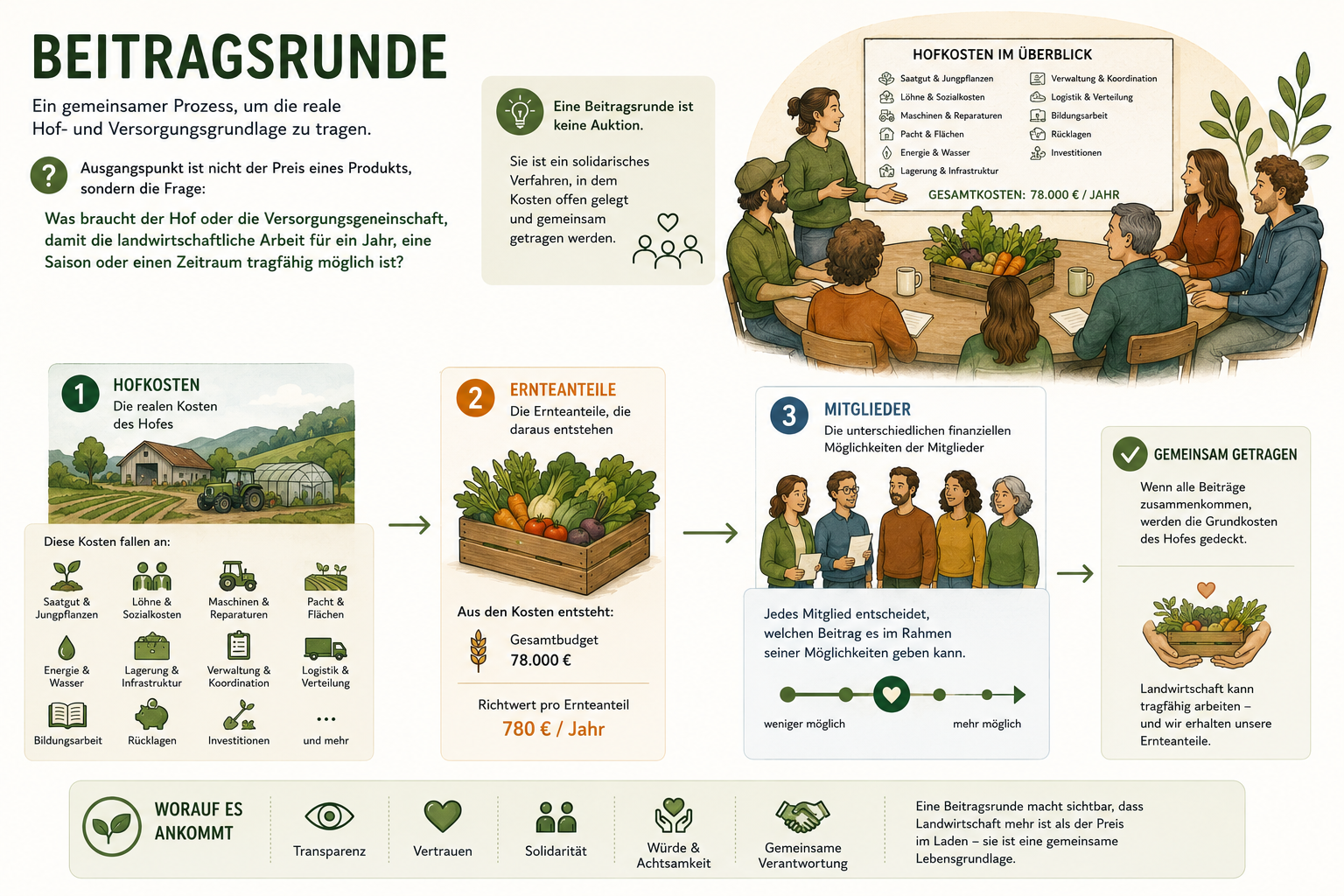
A contribution round is a solidarity-based process through which a CSA (Community-Supported Agriculture) or supply community makes its shared basic costs visible and collectively bears them.
The starting point is not the price of an individual product.
The starting point is the question:
What does the farm or supply community need to make agricultural work, supply, distribution, and collective support possible for a year, a season, or an agreed period?
To answer this, the expected costs are disclosed. From these costs, a reference value per harvest share can be derived.
However, this reference value is not a price.
It does not describe an individually purchased equivalent. It serves as a guide to make visible what level of collective cost coverage is necessary.
Members then decide what contribution they can make within their means.
The older term bidding round is still understood in many CSA contexts. For new texts, contribution round is clearer because it is not about auctioning harvest shares.
A contribution round is not an auction.
It is not an alternative pricing model.
It is a collective negotiation process about how the real foundation of the farm and supply system can be supported.
¶ Approach: Contributing Instead of Paying
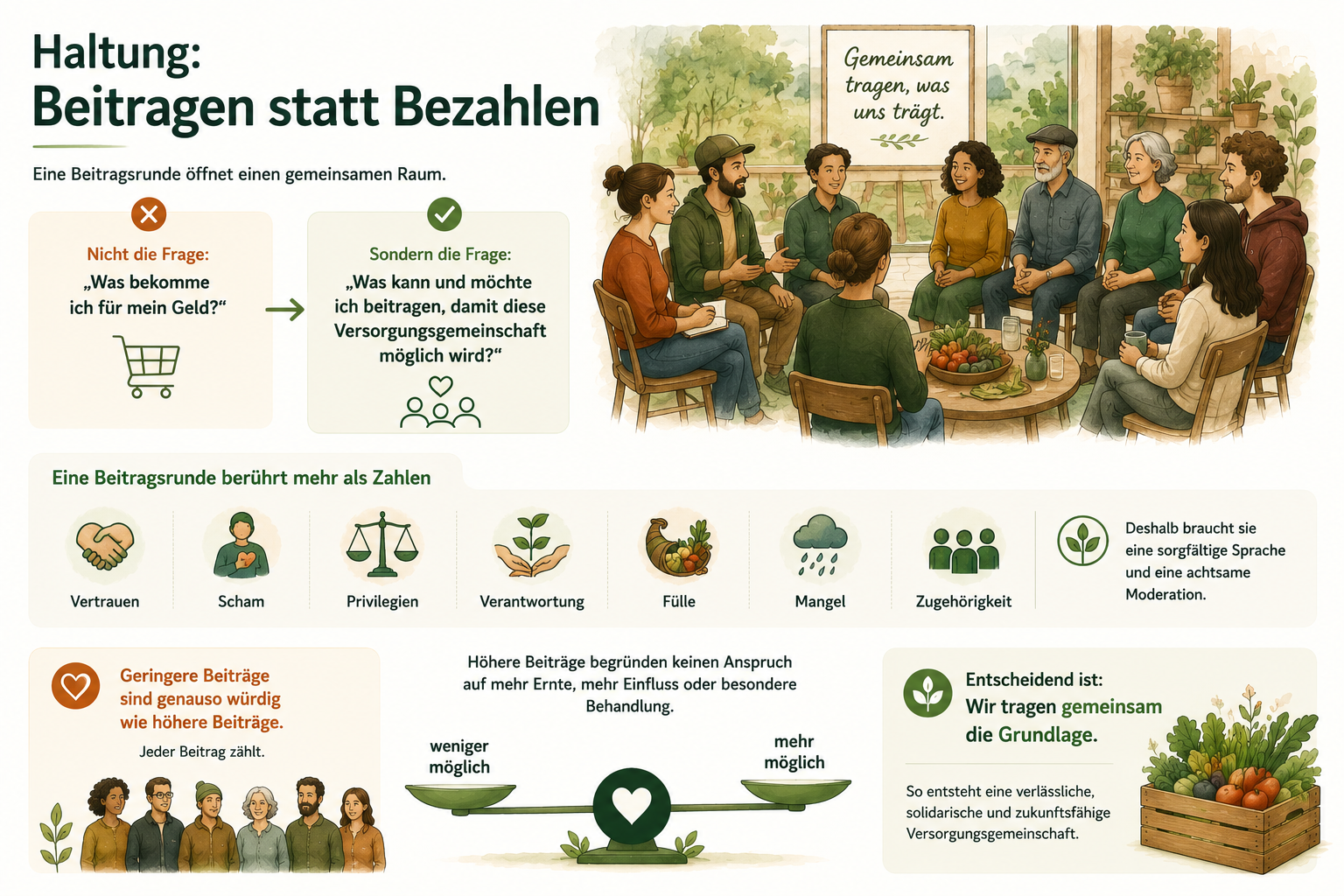
A contribution round opens a shared space.
In this space, the central question is not:
What do I get for my money?
But rather:
What can and do I want to contribute to make this supply community possible?
This means a contribution round touches not only numbers. It also touches trust, shame, privilege, responsibility, abundance, scarcity, and belonging.
That is why it requires careful language and mindful facilitation.
Lower contributions are just as worthy as higher contributions.
Higher contributions do not entitle one to more harvest, more influence, or special treatment.
What matters is that the community collectively supports the foundation.
¶ Core Idea
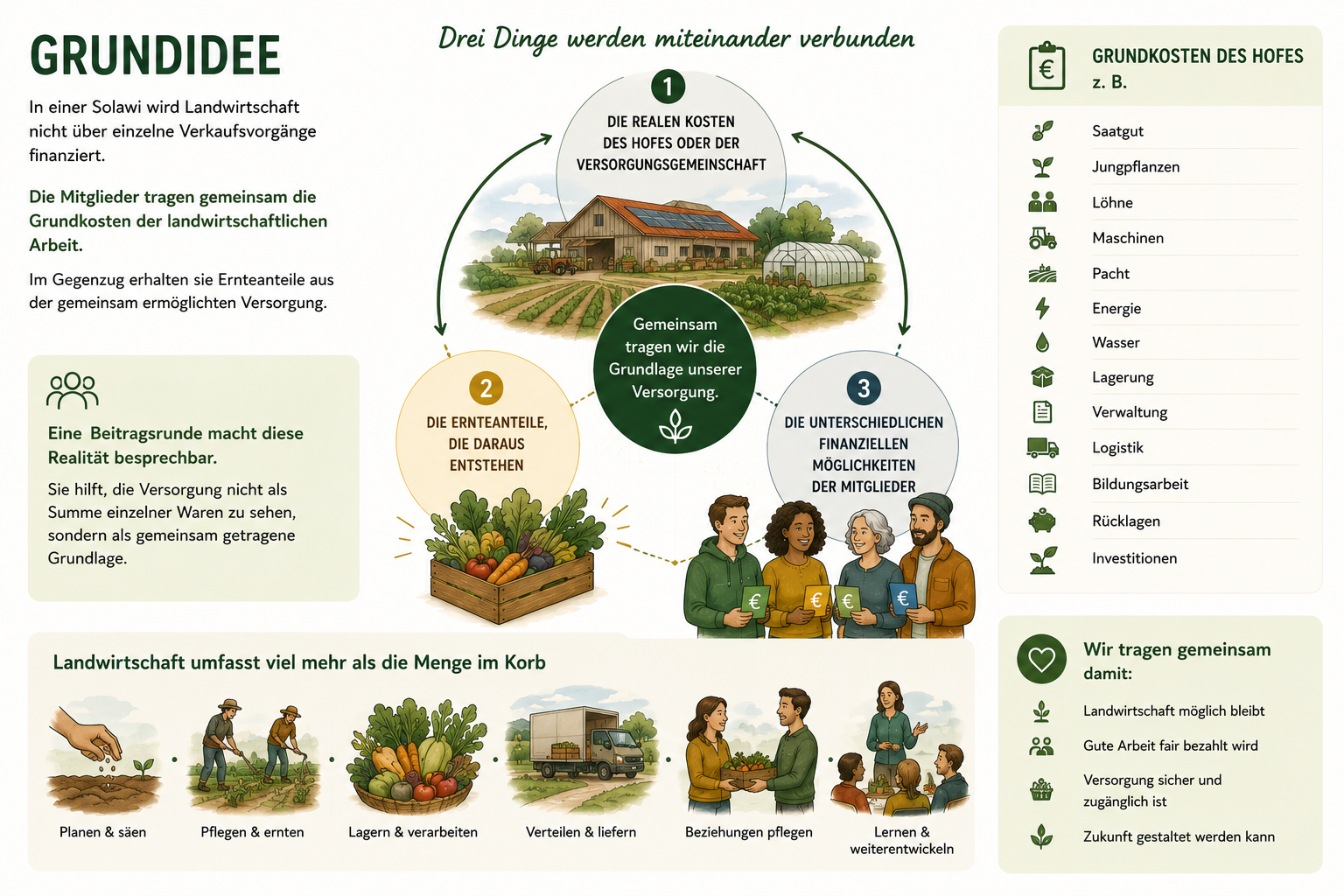
In a CSA, agriculture is not financed through individual sales transactions.
Members collectively bear the basic costs of agricultural work. In return, they receive harvest shares from the jointly enabled supply.
Three things are connected here:
- the real costs of the farm or supply community
- the harvest shares that result from this
- the varying financial capacities of the members
This makes visible that agriculture encompasses more than the quantity in the basket.
Basic costs include, for example:
- seeds
- seedlings
- wages
- machinery
- rent
- energy
- water
- storage
- administration
- logistics
- educational work
- reserves
- investments
A contribution round makes this reality discussable.
It helps to see supply not as a sum of individual goods but as a collectively supported foundation.
¶ Why Contribution Rounds Are Important
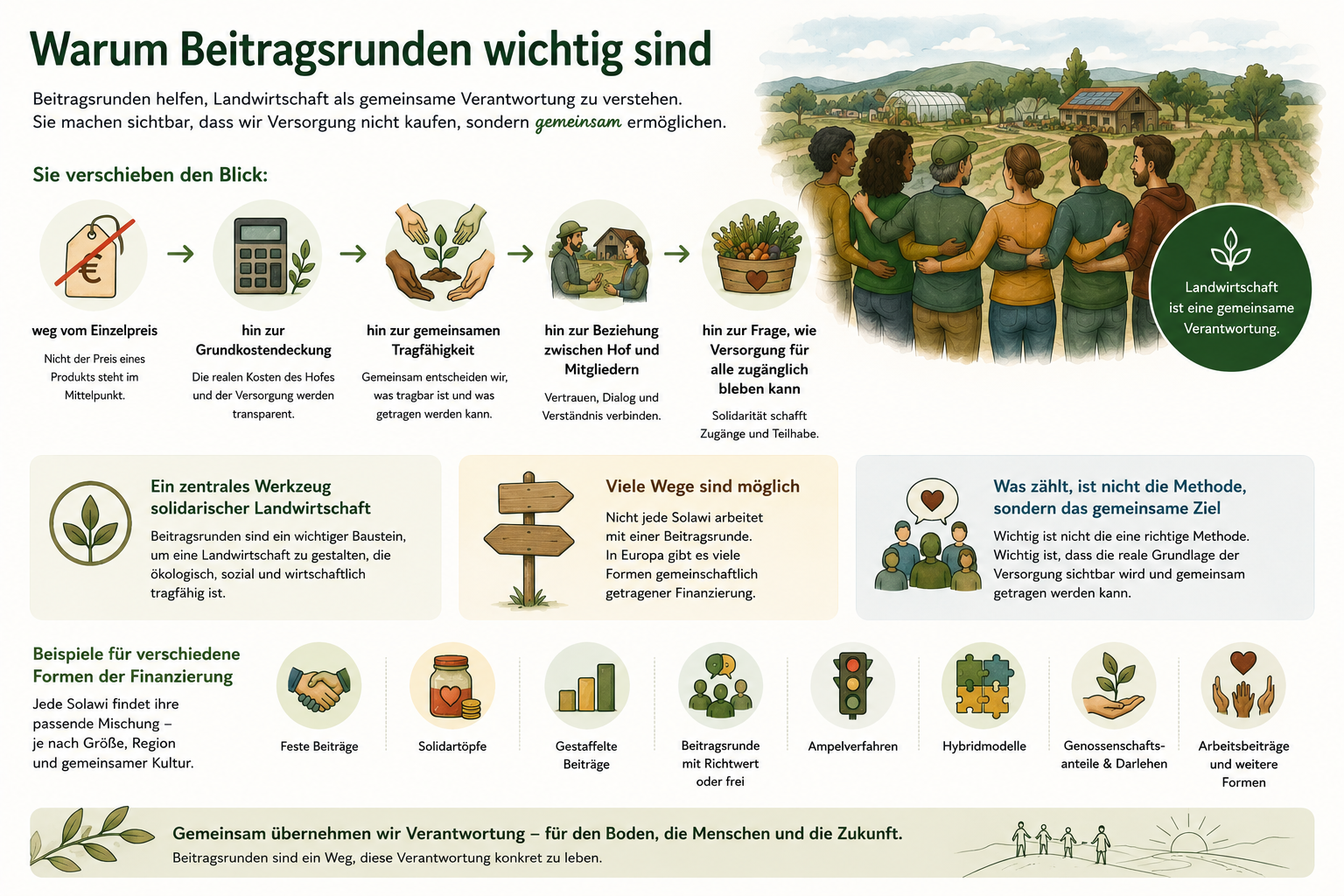
Contribution rounds help to understand agriculture as a shared responsibility.
They shift the focus:
- away from individual prices
- toward covering basic costs
- toward collective sustainability
- toward the relationship between the farm and its members
- toward the question of how supply can remain accessible to different people
Thus, contribution rounds are a central tool of solidarity-based agriculture.
However, they are not the only possible form of solidarity-based contribution.
Not every CSA works with a contribution round. In Europe, there are many forms of community-supported financing.
What matters is not the one right method.
What matters is that the real foundation of supply becomes visible and can be collectively supported.
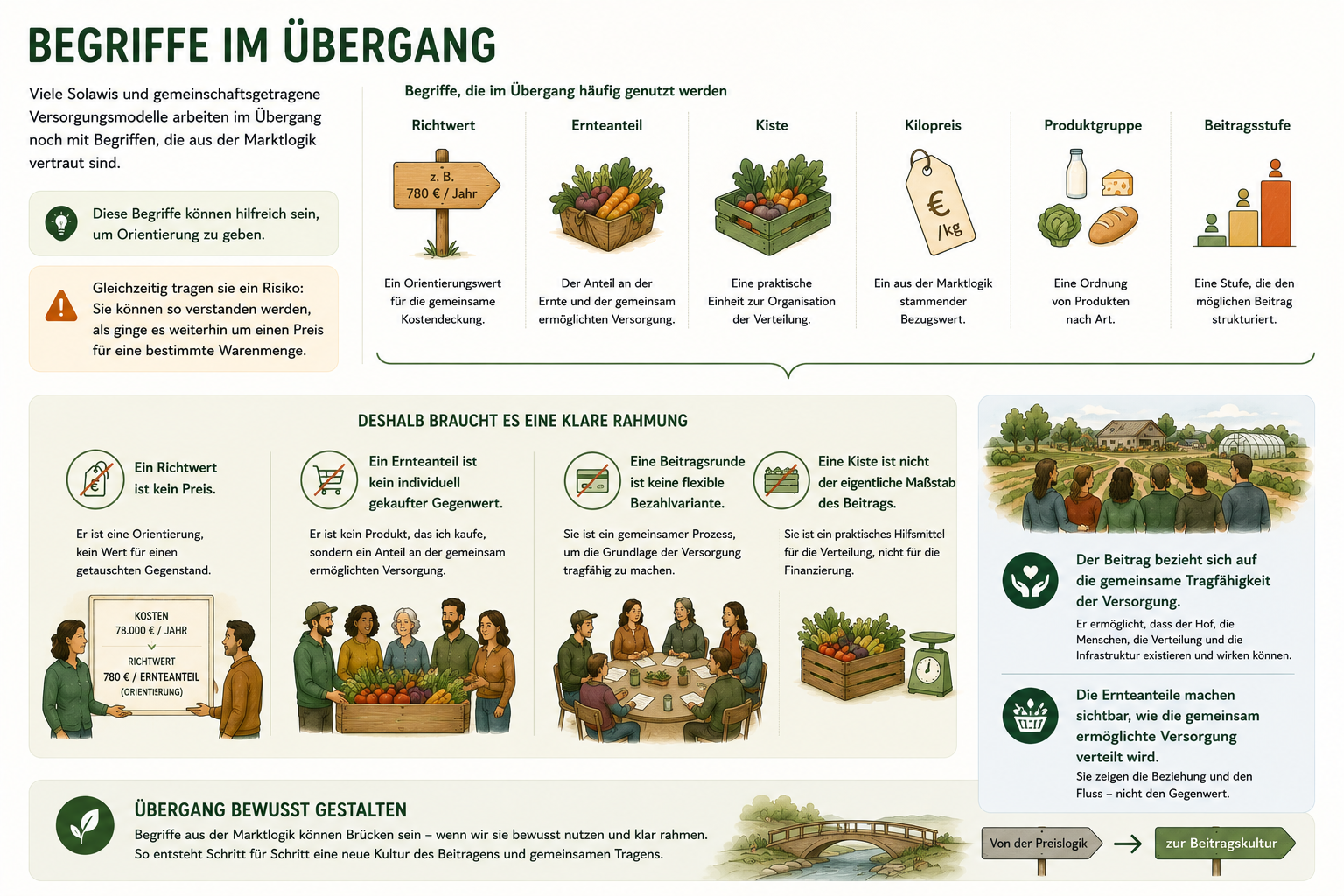
¶ Terms in Transition
Many CSAs and community-supported supply models still work with terms such as:
- reference value
- harvest share
- box
- price per kilogram
- product group
- contribution level
These terms can be helpful in providing orientation.
At the same time, they carry a risk: they can be understood as if it were still about a price for a certain quantity of goods.
That is why a clear framing is needed:
- A reference value is not a price.
- A harvest share is not an individually purchased equivalent.
- A contribution round is not a flexible payment option.
- A box is not the actual measure of the contribution.
The contribution refers to the collective sustainability of the supply.
The harvest shares make visible how the jointly enabled supply is distributed.
¶ Basic Forms of Solidarity-Based Contribution
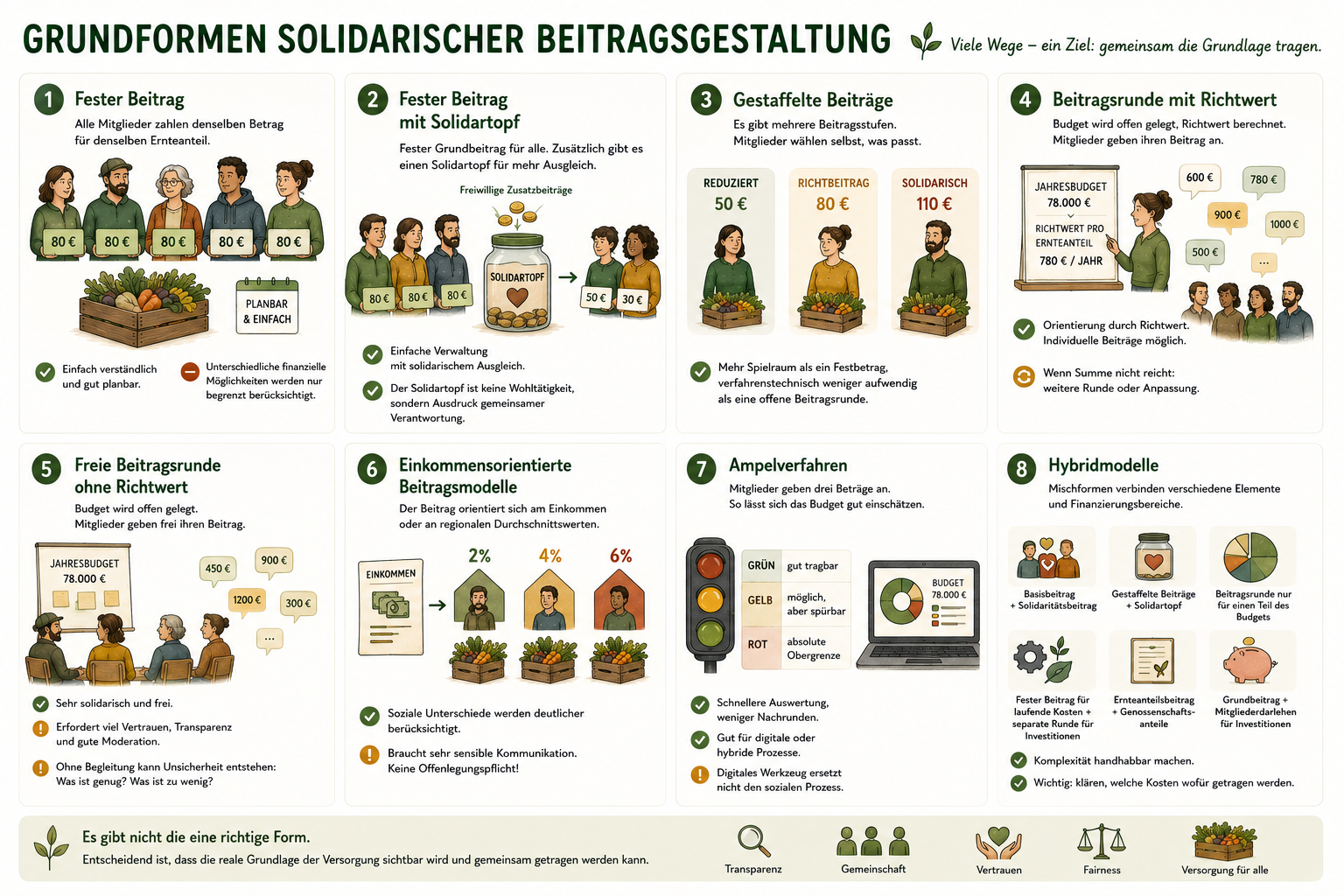
¶ 1. Fixed Contribution
With a fixed contribution, all members pay the same amount for the same harvest share.
This form is easy to understand and administratively manageable.
It is particularly suitable for CSAs that need clear planning or work with many members.
The disadvantage: varying financial capacities are only limitedly taken into account.
¶ 2. Fixed Contribution with Solidarity Fund
Here, there is a fixed basic contribution. Additionally, a solidarity fund is set up.
Members who can give more pay an additional voluntary amount.
From this solidarity fund, reduced contributions for other members can be made possible.
This form combines simple administration with solidarity-based compensation.
Important here too: the solidarity fund is not charity. It is an expression of shared responsibility.
¶ 3. Tiered Contributions
With tiered contributions, there are several contribution levels.
For example:
- reduced contribution
- reference contribution
- solidarity contribution
Members assign themselves to a level.
This form is more accessible than an open contribution round because not every person has to set their own amount.
At the same time, it offers more flexibility than a uniform fixed amount.
¶ 4. Contribution Round with Reference Value
This is the classic form of the contribution round.
The farm or CSA discloses the annual or seasonal budget. From this, a reference value per harvest share is derived.
Members then indicate what contribution they can make.
The reference value serves as a guide. It can be undercut or exceeded.
If the sum of all contributions covers the budget, the round is concluded.
If the sum is insufficient, another round follows or a joint adjustment of the budget.
What is crucial: the reference value is not a price. It is a tool to make collective cost coverage understandable.
¶ 5. Open Contribution Round Without Reference Value
In this form, the total budget is disclosed, but no specific reference value is given.
Members decide freely what contribution they will make.
This form requires a high level of trust, transparency, and shared responsibility.
It can be very solidarity-based but is demanding in terms of facilitation.
Without good support, uncertainty can arise:
- What is enough?
- What is too little?
- What can others contribute?
- How much can I give without overburdening myself?
Therefore, this form needs a lot of space for understanding, conversation, and protection of personal financial information.
¶ 6. Income-Oriented Contribution Models
Some CSAs work with income-based contributions.
Here, the contribution is, for example, thought of as a share of household income or compared with regional averages.
This form can more clearly take social differences into account.
However, it requires very sensitive communication because income is a personal topic.
It is important that no disclosure obligation arises that shames or excludes people.
¶ 7. Traffic Light System
The traffic light system is a further development for contribution rounds.
Members provide several amounts:
- green: easily affordable
- yellow: possible but noticeable
- red: absolute upper limit
The CSA can use this to determine whether the budget is met without having to conduct many follow-up rounds.
This form is particularly suitable for digital or hybrid contribution processes.
Here too, the digital process does not replace the social process. It supports transparency, confidentiality, and evaluation.
¶ 8. Hybrid Models
Many CSAs use mixed forms.
Examples:
- fixed base contribution plus voluntary solidarity contribution
- tiered contributions plus solidarity fund
- contribution round only for part of the budget
- fixed contribution for ongoing costs and separate round for investments
- harvest share contribution plus cooperative shares
- base contribution plus member loans for larger purchases
Hybrid models often emerge where CSAs grow larger or connect multiple farms, products, or financing areas.
They can help make complexity manageable.
What is important is that it remains clear which costs are being covered for what purpose.
¶ Process of a Contribution Round
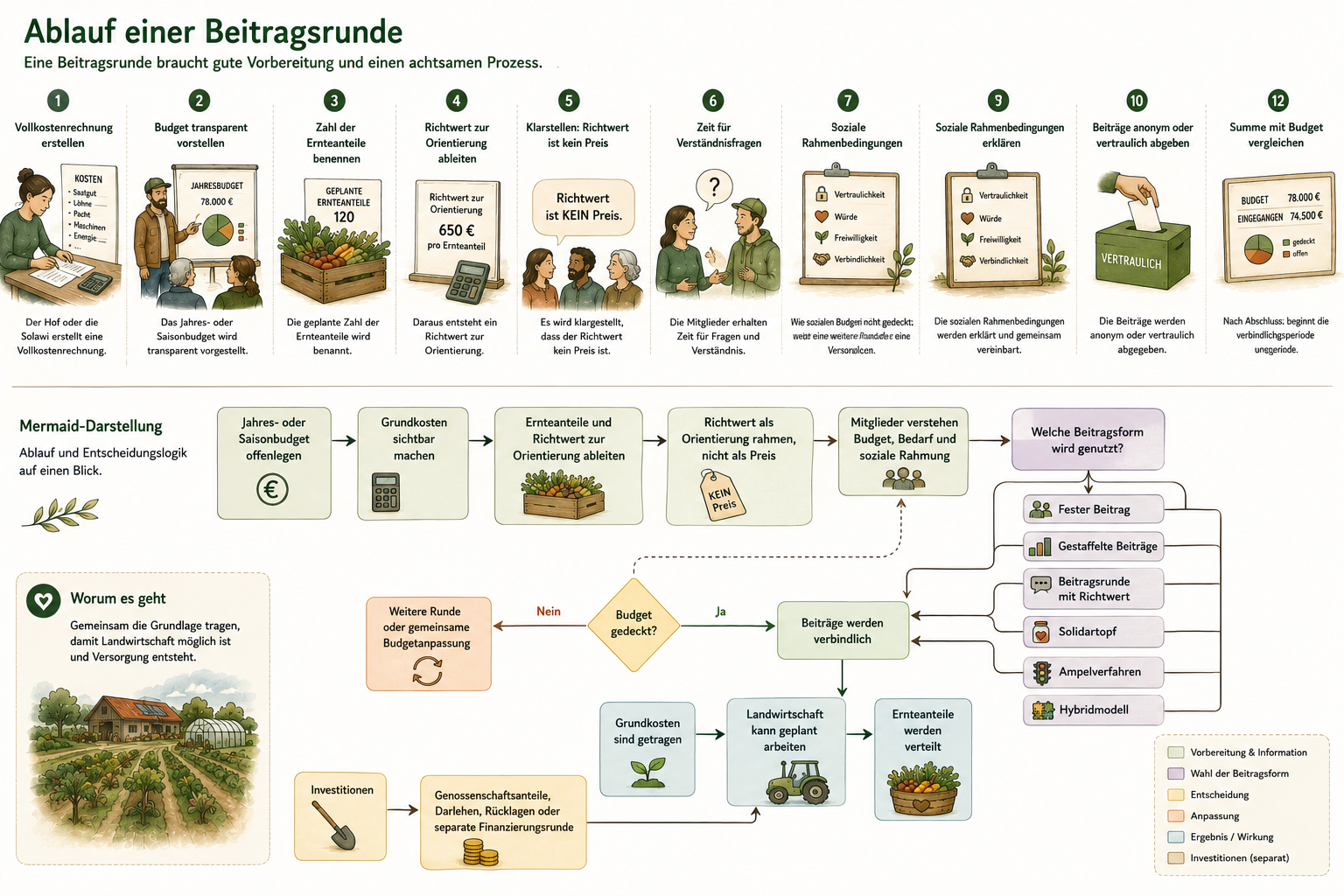
A contribution round requires good preparation.
Typical process:
- The farm or CSA prepares a full cost calculation.
- The annual or seasonal budget is presented transparently.
- The planned number of harvest shares is stated.
- From this, a reference value is derived for orientation.
- It is clarified that the reference value is not a price.
- Members are given time for questions.
- The social framework conditions are explained: confidentiality, dignity, voluntariness, and commitment.
- Contributions are submitted anonymously or confidentially.
- The sum is compared with the required budget.
- If the budget is covered, the contributions become binding.
- If the budget is not covered, another round follows or a joint adjustment of the budget.
- After conclusion, the binding supply period begins.
¶ Process as Diagram
Clicking on a box with ↗ opens the corresponding page in a new window. The steps correspond to the list "Typical Process" above.
| Contribution Form | After Submission |
|---|---|
| Fixed Contribution | becomes binding immediately |
| Tiered Contributions | become binding immediately |
| Solidarity Fund | becomes binding immediately |
| Contribution Round with Reference Value | Check: Is the budget covered? |
| Traffic Light System | Check: Is the budget covered? |
| Hybrid Model | Check: Is the budget covered? |
How to read the diagram: For fixed contributions, tiered contributions, and solidarity funds, contributions become binding immediately. For contribution rounds with a reference value, traffic light systems, and hybrid models, it is first checked whether the budget is covered. If not, another round or a joint budget adjustment follows, and members re-engage with the budget, needs, and social framework (dashed arrow). Once basic costs are covered, agriculture can be planned, and harvest shares are distributed. Investments are handled separately through cooperative shares, loans, reserves, or a separate financing round and also flow into planning.
¶ What Must Be Clearly Resolved in Contribution Rounds
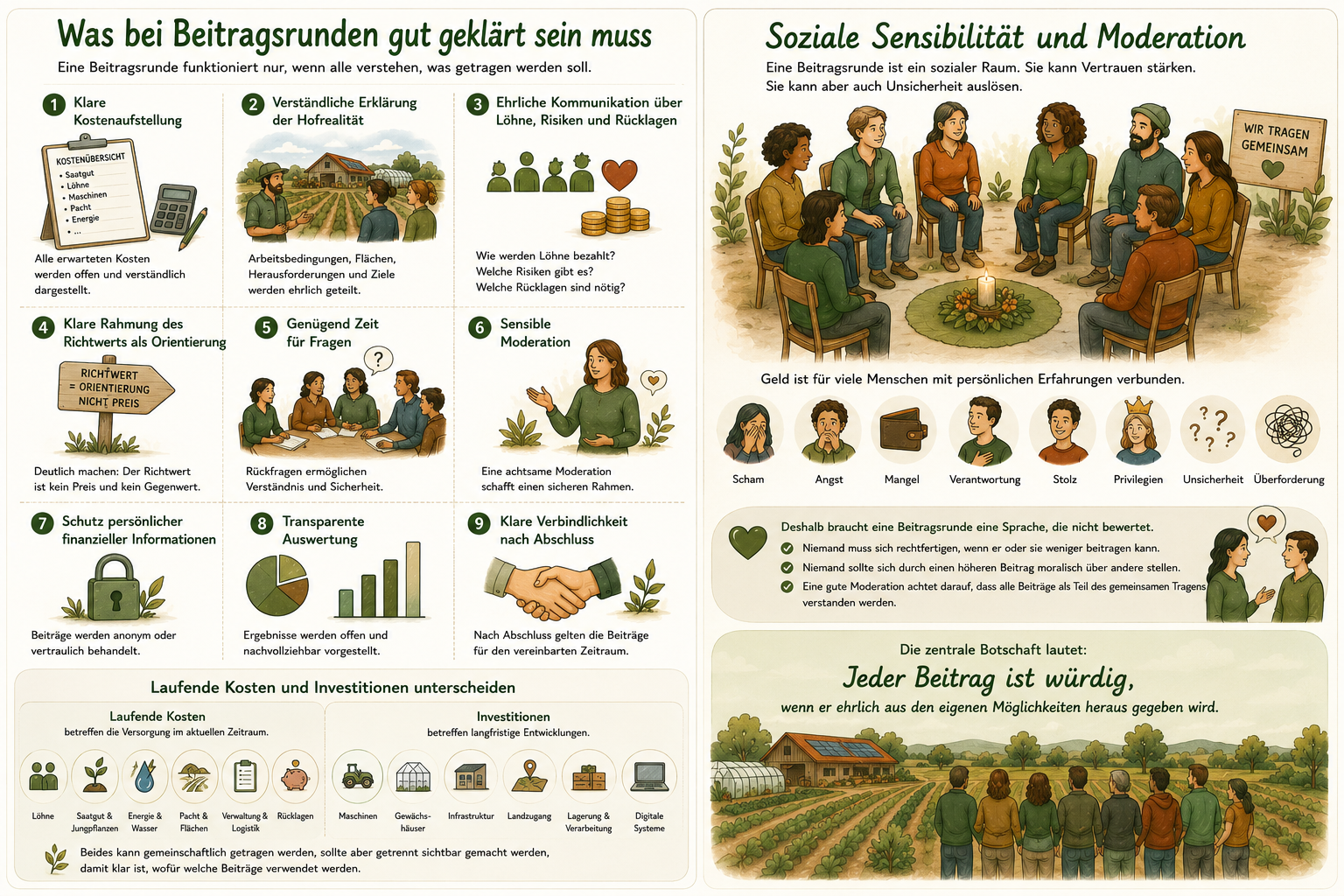
A contribution round only works if participants understand what is to be supported.
Important aspects include:
- clear cost breakdown
- understandable explanation of the farm's reality
- honest communication about wages, risks, and reserves
- clear framing of the reference value as orientation
- sufficient time for questions
- sensitive facilitation
- protection of personal financial information
- transparent evaluation
- clear commitment after conclusion
Particularly important is the distinction between ongoing costs and investments.
Ongoing costs relate to supply in the current period.
Investments relate to long-term developments, such as:
- machinery
- greenhouses
- infrastructure
- land access
- storage
- processing
- digital systems
Both can be collectively supported but should be made visible separately.
¶ Social Sensitivity and Facilitation
A contribution round is also a social space.
It can strengthen trust. But it can also trigger uncertainty.
Money is connected to personal experiences for many people:
- shame
- fear
- scarcity
- responsibility
- pride
- privilege
- insecurity
- overwhelm
That is why a contribution round needs language that does not judge.
No one has to justify contributing less.
No one should feel morally superior because of a higher contribution.
Good facilitation ensures that all contributions are understood as part of collective support.
The central message is:
Every contribution is worthy if it is honestly given within one's own means.
¶ Contribution Rounds in Small CSAs
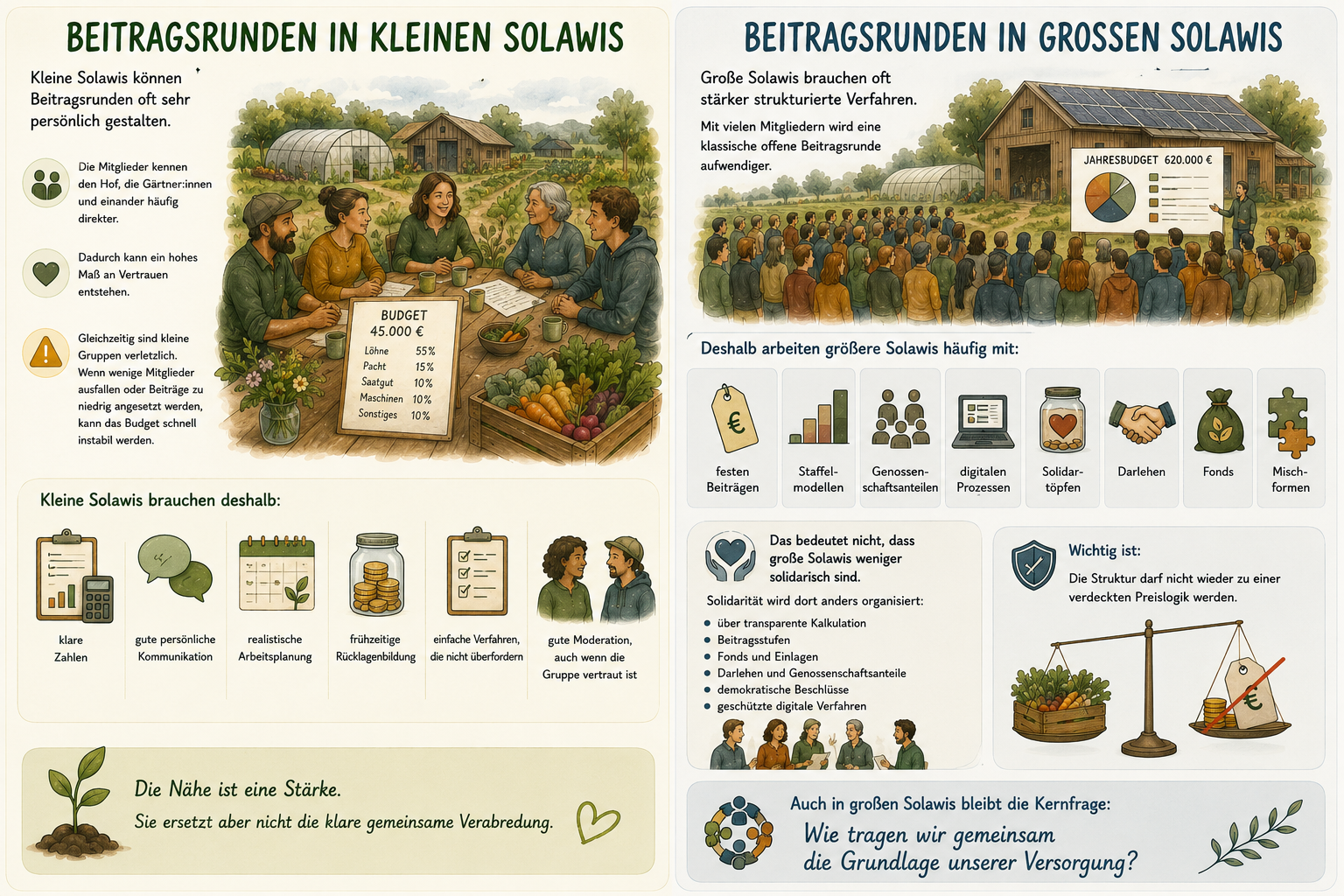
Small CSAs can often design contribution rounds in a very personal way.
Members often know the farm, the gardeners, and each other more directly.
This can create a high level of trust.
At the same time, small groups are vulnerable. If a few members drop out or contributions are set too low, the budget can quickly become unstable.
Small CSAs therefore need:
- clear numbers
- good personal communication
- realistic work planning
- early reserve formation
- simple processes that do not overwhelm
- good facilitation, even if the group is familiar
Proximity is a strength. But it does not replace clear collective agreements.
¶ Contribution Rounds in Large CSAs
Large CSAs often need more structured processes.
With many members, a classic open contribution round becomes more complex.
Therefore, larger CSAs frequently work with:
- fixed contributions
- tiered models
- cooperative shares
- digital processes
- solidarity funds
- loans
- funds
- hybrid forms
This does not mean that large CSAs are less solidarity-based.
Solidarity is organized differently there: through transparent calculations, contribution tiers, funds, deposits, loans, democratic decisions, and protected digital processes.
What is important is that the structure does not revert to a hidden pricing logic.
Even in large CSAs, the core question remains:
How do we collectively support the foundation of our supply?
¶ Digital Processes and Agora Context
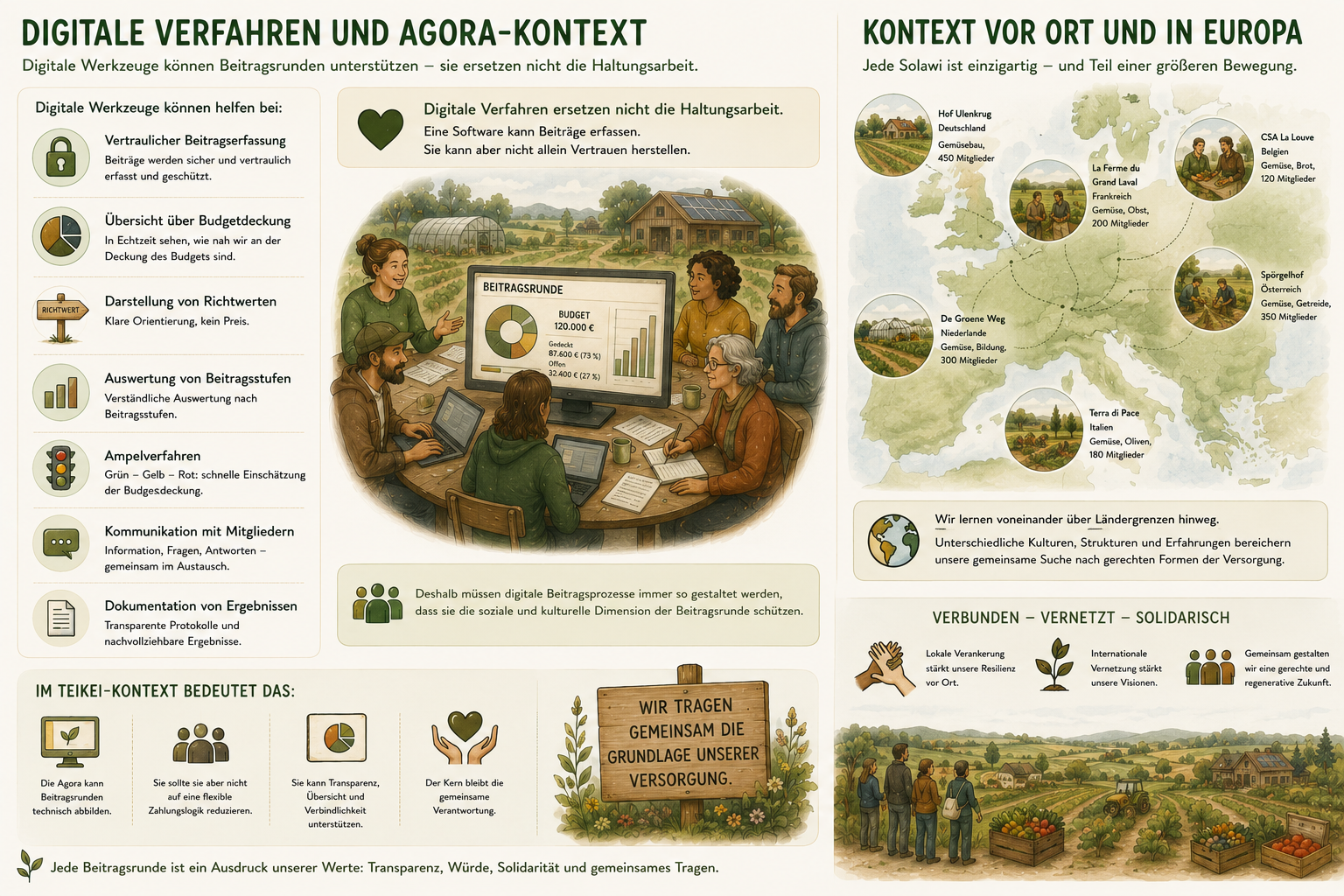
Digital tools can support contribution rounds.
They can help with:
- confidential contribution collection
- overview of budget coverage
- presentation of reference values
- evaluation of contribution tiers
- traffic light systems
- communication with members
- documentation of results
However, digital processes do not replace the work on attitude.
Software can collect contributions. But it cannot create trust on its own.
Therefore, digital contribution processes must always be designed to protect the social and cultural dimension of the contribution round.
In the TEIKEI context, this means:
The Agora can technically map contribution rounds but should not reduce them to a flexible payment logic.
It can support transparency, overview, and commitment.
The core remains shared responsibility.
¶ Practical Examples
¶ Kartoffelkombinat
Kartoffelkombinat demonstrates a large cooperative CSA structure.
Publicly visible is a model consisting of cooperative shares and fixed contributions for harvest shares.
This example represents a form in which ongoing supply, member structure, and investments are organized through a larger cooperative architecture.
¶ KoLa Leipzig
KoLa Leipzig publicly works with harvest shares of different sizes and contribution ranges.
Members can decide within a framework what contribution they can make.
This example shows a tiered model that combines solidarity and predictability.
¶ Luzernenhof
Luzernenhof represents a more needs- and income-oriented model.
There, contributions are not only understood as a fixed share price but are related to withdrawal, household, and financial capacity.
This example shows how contribution design can be connected with self-responsibility and trust.
¶ Biotop Oberland
Biotop Oberland demonstrates a hybrid model consisting of a base contribution, cooperative structure, and solidarity-based additional round.
This example is helpful for understanding that a contribution round can also relate to only part of the total budget.
¶ Smaller CSA Networks
Smaller CSAs often work with personal proximity, direct participation, and manageable contribution processes.
There, classic contribution rounds, solidarity funds, work contributions, and informal compensation forms can play a larger role.
The strength lies in proximity.
The challenge lies in stability.
¶ Scientific Classification
Research describes CSA not as a uniform contribution model but as a diverse form of community-supported agriculture.
What is crucial is the joint financing of the agricultural foundation.
Contribution rounds are one possible expression of this.
In the research by Marius Rommel and in the nascent context, CSA is viewed as a community-supported economic form that connects social relationships, economic sustainability, and transformative impact.
Important here is the tension between:
- economic viability
- social cohesion
- transformative aspiration
Contribution rounds touch all three levels simultaneously.
If contributions are too low, economic viability is jeopardized.
If contributions become too high, social accessibility can be lost.
If the process is too complicated or insufficiently transparent, social cohesion can suffer.
A good contribution round is therefore not just a financial tool.
It is a social negotiation process about the shared foundation of supply.
¶ Limitations
A complete list of all contribution forms practiced in Europe is not reliably possible.
The CSA landscape varies greatly locally.
Many processes are only documented internally or evolve from year to year.
However, the documented basic forms can be described:
- fixed contribution
- fixed contribution with solidarity fund
- tiered contributions
- contribution round with reference value
- open contribution round
- income-oriented models
- traffic light system
- hybrid models
- cooperative shares and loans for investments
- work contributions as a supplementary form of support
¶ Definition
A contribution round is a solidarity-based process for collectively covering the basic costs of a CSA or supply community.
Based on a disclosed budget, members individually commit to what contribution they can make within their means.
What is crucial is the collective coverage of the budget.
Not an equal price for all.
Not an individually purchased equivalent.
But the collective support of the foundation that makes supply possible.
¶ Related Terms
¶ Further Information & Understanding Contexts
- Transformation Guide: From Prices to Contribution Rounds
- Transformation Guide: Models of Basic Cost Contribution
- Contribution Rounds - Development of Agora 3.0
¶ External Sources
- Network Solidarische Landwirtschaft: Handbook Solidarische Landwirtschaft (external)
- Network Solidarische Landwirtschaft: Materials on Contribution Design (external)
- URGENCI: CSA for Europe Handbook (external)
- URGENCI: European CSA Declaration (external)
- Sustainable Economic Communities – Transferring the CSA Logic to Other Supply Fields (external)
- Kartoffelkombinat (external)
- KoLa Leipzig (external)
- Luzernenhof (external)
- Biotop Oberland (external)
- MYZELIUM: Handbook for Community-Based Economics (external)
- 2026-05 - Clarification on Contribution Rounds from the CSX Network (external)
← Letter B · All Terms A–Z
By Felix Schröder, with AI support (ChatGPT)
Created on May 5, 2026 · Last updated on October 13, 2026
Questions or suggestions? support@teikei.us