¶ The Principle of Healthy Size at TEIKEI
Introduction and Overview › Glossary for Networking Language · 7 min read
¶ Brief Summary
Imagine a tree growing in a forest. It doesn’t grow infinitely but stops when it reaches a healthy size. From then on, it helps others: it provides shade, gives animals a home, and produces fresh air. We do something similar at TEIKEI—a community of people who trade fairly with one another. We only grow to a best size. Then, instead of always getting bigger, we focus on getting better: we work well together, protect nature, and share fairly. Just as trees in a forest form a team, we at TEIKEI also work as a team and want to make the world a little better.
¶ Healthy Size – What We Can Learn from Trees
A tree and a forest show us why endless growth isn’t always good. Erwin Thoma, inventor of the Holz100 construction method, often emphasizes the wisdom of nature. For example, he says:
“The forest is the oldest and most proven living community on Earth. There, the principle applies that only those who contribute to the well-being of others survive.”
This means that trees in a natural, mature forest cooperate rather than just compete.
In a young, naturally formed forest—for example, after a storm or a wildfire—many young trees initially compete for light, water, and nutrients. In this early phase, the goal is to establish themselves and take root.
Over time, however, a network forms: fungi, roots, and microorganisms connect the trees into a living community.
In an established, old natural forest, on the other hand, there is a deep, functioning social system:
- Old trees maintain close exchange with younger trees through an underground network of roots and mycorrhizal fungi.
- Nutrients and water are distributed according to need.
- Together, the trees regulate the forest’s microclimate, keep the soil moist, and protect each other from extreme weather.
- These networks make the forest as a whole more resilient, stable, and adaptable.
Natural forests show that cooperation and mutual support, not competition, are the foundation for the survival and long-term stability of living systems.
Erwin Thoma describes how cooperation is more important than endless growth. A beautiful example is the cherry tree: it produces countless blossoms every year not to create more cherry trees, but to provide food for bees, insects, and birds.
It thus shares its energy with the community of forest and meadow dwellers.
For Erwin Thoma, this is an example that in a community, the focus should be less on competition and growth and more on cooperation.
Once a tree reaches its healthy size, it invests in quality over quantity—it bears fruit, provides habitat, and produces oxygen instead of growing ever taller.
TEIKEI applies this principle of healthy size to the economy: just as a tree integrates itself and contributes to the well-being of the forest, businesses and communities should exist in a healthy size and then serve the community and the environment.
Erwin Thoma has also implemented this thinking in his company. He views his business like a tree that grows ring by ring organically:
“We grow according to our guidelines like a tree, ring by ring. We don’t make acquisitions or takeovers and are happy with organic growth that we can finance ourselves.”
Size was never an end in itself for him:
“I never thought in quantities. The company was always a vehicle to realize my vision of building healthy houses.”
This attitude—growing slowly and sustainably and never becoming larger than necessary—is the inspiration for the TEIKEI principle of healthy size.
¶ Practical Example Logistics: Sustainable Transport Units Instead of Endless Truck Convoys
How can the principle of healthy size be applied in practice?
Let’s look at logistics at TEIKEI:
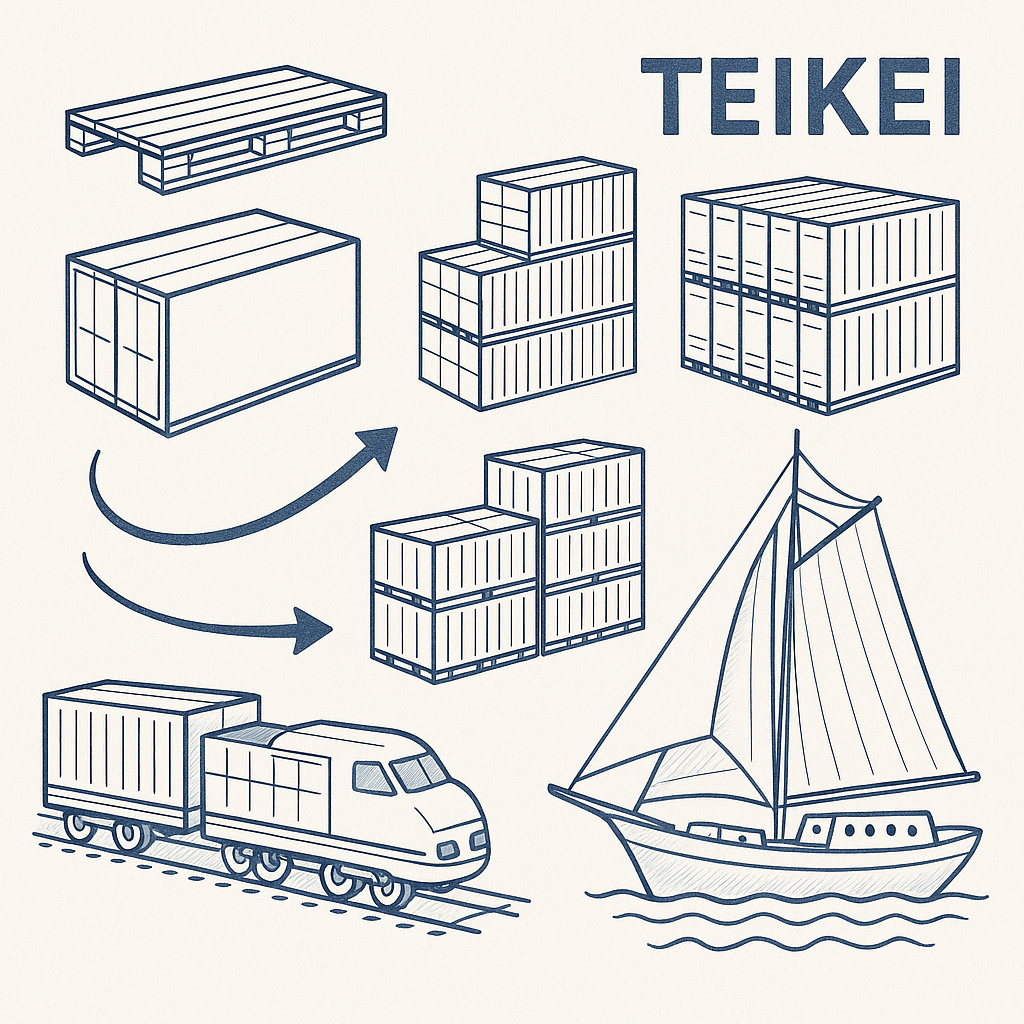
At TEIKEI, we want to transport olive oil as environmentally friendly as possible—moving away from individual truck trips on the road toward bundled transport units that can be shifted to rail and later to sailing ships.
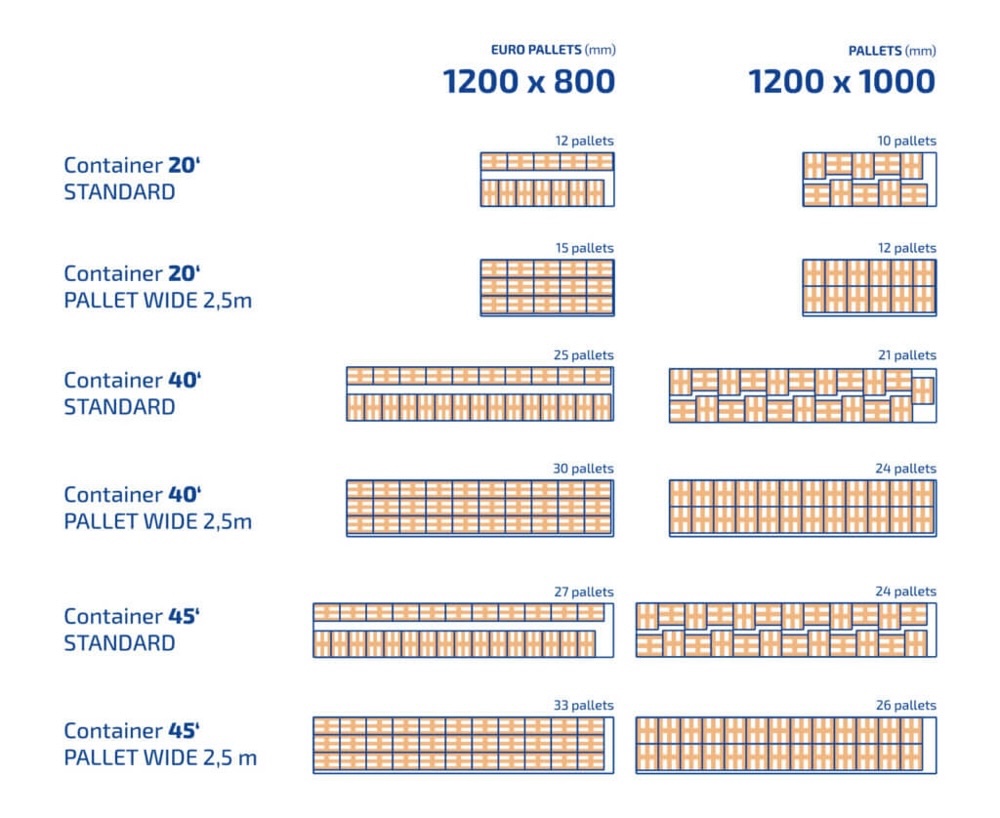
For us, a sustainable transport unit is a 40-foot container.
This container is about 12 meters long and can be placed on rail wagons and loaded onto sailing ships.
Capacity of a 40-foot container:
- Can hold about 30 Euro pallets (Note: Verify the number of pallets per 40-foot container).
- Approximately 700 liters of olive oil can be loaded per pallet.
- Thus, a container holds around 21,000 liters of olive oil.
¶ Concrete Scenario
- One sustainable transport unit: 1× 40-foot container ≈ 21,000 liters of olive oil.
- Three sustainable transport units (i.e., 3× 40-foot containers) can be loaded together onto a sailing ship.
- This would allow about 63,000 liters of olive oil to be transported per sailing voyage.
- To operate the sailing ship and logistics chain in an economically sustainable way, it would make sense to carry out four such transports per year.
Summary:
- Annual capacity: approx. 252,000 liters of olive oil.
- Transport route: First bundled by rail to the port, then by sailing ship powered by wind across the sea.
¶ Advantages of this Logistics Structure:
- Reduction of fossil fuels: Rail and sail transport are more climate-friendly than road freight.
- Bundling: Minimization of emissions through full utilization of containers.
- Plannable quantities: One sailing voyage per quarter possible to better align supply and harvest.
- Flexibility: Ability to adjust depending on harvest yield and community uptake.
¶ Community Organization:
At TEIKEI, we consciously organize logistics as a community:
- Pre-financing through purchase guarantees or harvest shares from members.
- Cooperative planning with producers and logistics partners.
- Gradual shift of transport from road to rail and wind power.
This structure ensures that the healthy size of transport units is maintained, ecological goals are achieved, and TEIKEI’s values are consistently implemented across the entire supply chain.
¶ TEIKEI Principles in Action: Ten Principles and Three Circles of Relationships
TEIKEI’s approach is based on clear principles that originally come from the Japanese TEIKEI movement.
The “Ten Principles of TEIKEI” were formulated in 1978 by the Japan Organic Agriculture Association.
Some of these principles can be recognized in the olive oil scenario:
- Mutual support: Producers and consumers share responsibility.
- Own distribution: Organization of transport and distribution independently.
- Intentional production: Production based on real demand rather than anonymous surplus.
- Democratic administration: Decisions are made collectively.
- Acceptance of products: Buyers accept natural fluctuations.
- Learning in the community: Exchange of knowledge about cultivation, logistics, and sustainable business.
- Fair price negotiation: Prices are determined through dialogue, not competition.
- Maintaining an appropriate group size: Manageable, viable groups instead of unlimited growth.
- Deepening friendly relationships: TEIKEI is built on personal relationships.
- Continuous improvement: Always striving for new improvements.
Additionally, TEIKEI operates based on the “Sacred Three Circles of Relationships”:
- Economy: Fair, regional, ecological.
- Relationships: Personal, warm, transparent.
- Art: Creative, cultural, meaningful.
These three circles intertwine and shape every TEIKEI activity.
¶ Critical Reflection: Why Unlimited Growth Is Not Sustainable
The capitalist economy often follows the principle “Grow or go”.
Many companies are geared toward permanent growth without setting a natural limit to their size.
This leads to:
- Uncontrolled resource consumption
- Social inequality
- Loss of transparency and responsibility
In natural systems, unlimited growth does not exist.
Living systems—like a tree or a forest—follow a natural cycle of emergence, growth, maturation, transformation, and return to the system.
A tree grows until it reaches its healthy size, matures, bears fruit, and eventually becomes part of the nutrient cycle.
Excessive, unchecked growth destabilizes natural systems and is seen as a disturbance in nature.
For businesses, this means:
Without a defined growth limit, they continuously extract resources from the ecological and social environment and disrupt the necessary renewal process.
Serious sustainable development requires the conscious definition of a healthy size.
Only in this way can ecological stability, social justice, and human responsibility be secured in the long term.
¶ TEIKEI After Reaching Healthy Size: Quality Over Quantity
Once a TEIKEI community has reached its healthy size, the focus shifts from growth to quality.
¶ Areas of Focus:
- Improving product quality: Optimization through sustainable methods.
- More service and community: Tastings, exchange trips, cultural projects.
- Environmental services: Projects such as reforestation or educational work.
- Replicating the model: Supporting new groups instead of expanding oneself.
This corresponds to the tree metaphor:
A mature tree provides fruit, oxygen, and habitat instead of growing infinitely.
¶ Goal of TEIKEI
Qualitative added value for society, the environment, and culture—through mutual support and friendship.
Just as the forest has demonstrated for thousands of years.
¶ Related Terms
- Sustainable Transport Unit
- Post-Growth Economy
- Ten TEIKEI Principles
- Decentralization
- Growth
- Community
← Letter G · All Terms A–Z
By the TEIKEI editorial team, with support from AI (ChatGPT)
Created on April 27, 2025 · Last updated on October 14, 2026
Questions or feedback? support@teikei.us