¶ TEIKEI Agora 3.0
Agora and Agora Marketplace › Overview › Development of the Agora · 5 min read · Approved – this is how it will be
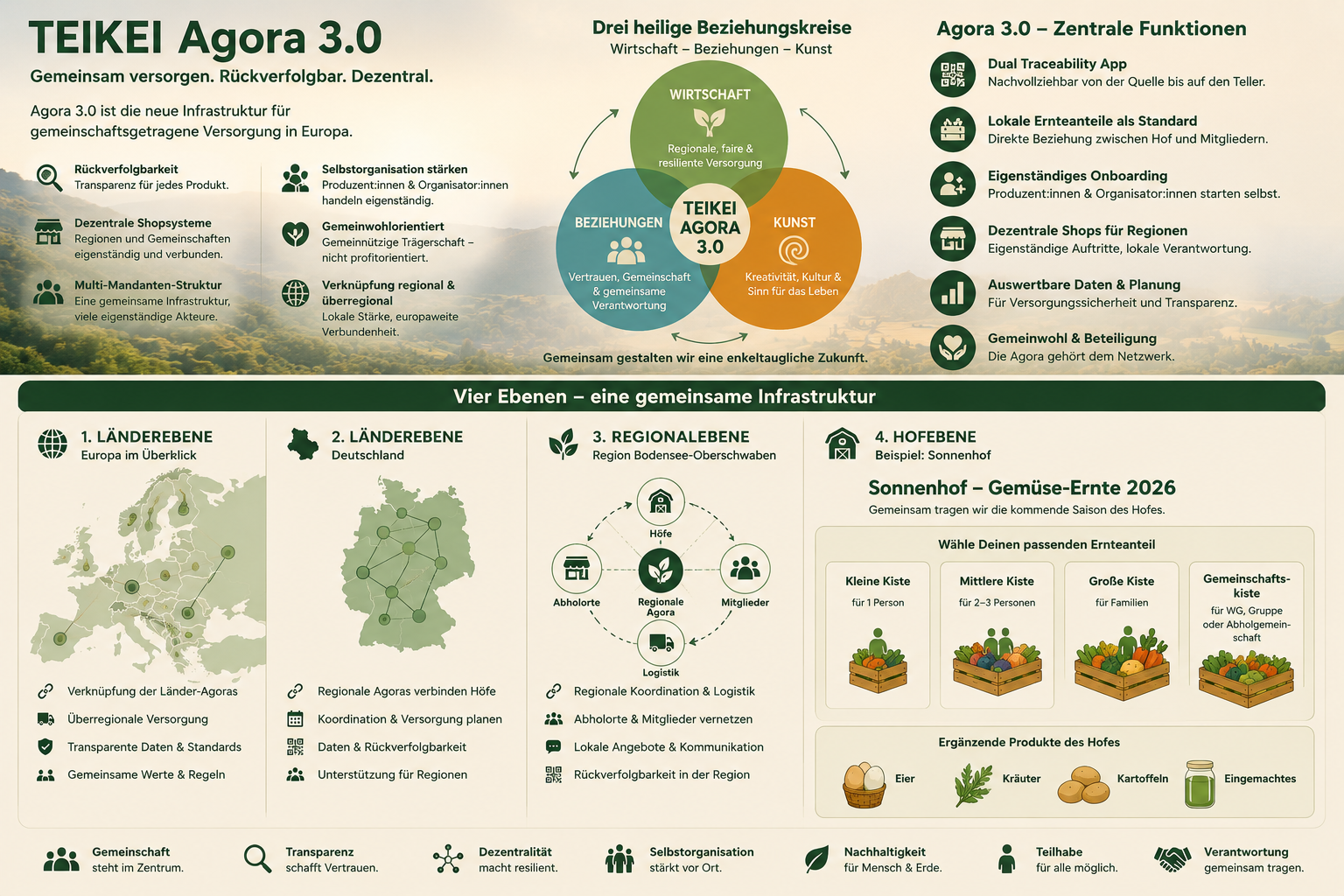
With Agora 3.0, a new quality comes to the forefront: decentralization, traceability, multi-tenancy capability, and an infrastructure in which regional and supra-regional supply chains are not just considered but systemically represented.
While Agora 2.0 integrated basic cost-sharing, graphical enhancements, and initial transparency steps into the platform, Agora 3.0 takes the next step. Here, the focus is on traceability, the Dual Traceability App, decentralized shop systems, multi-tenant structures, and the independent participation of producers and organizers.
Agora 3.0 transforms the Agora from merely a better platform into a new infrastructure for community-supported supply chains.
¶ What Agora 3.0 Is
The new TEIKEI Agora is far more than an online shop. It is the digital core of a shared infrastructure where people, farms, communities, initiatives, and distribution structures in different regions can connect.
It was developed to bring together several previously separate levels:
- Marketing and processing of products and services
- Relationship and network logic between providers and consumers
- Communication, coordination, and joint further development
- Traceability, evaluation, and coordinated supply planning
- Decentralized and independently organizable shop systems
This creates a platform that understands the economy not as an anonymous market but as a visible, shapeable, and networked web of relationships.
¶ The Decisive Difference
Agora 3.0 goes beyond the logic of a central platform. It creates the conditions for different regions, producers, and organizers to work more independently with the system without losing connection to the shared infrastructure.
The functions serve not the platform itself but the self-organization of the network. This is precisely the difference: the Agora becomes a shared technical and organizational foundation on which decentralized supply systems can be built.
¶ Organizational Transition and Non-Profit Status
With Agora 3.0, not only the technical infrastructure is being further developed. The organizational structure behind the Agora is also being realigned.
The Agora is to be gradually transitioned into a non-profit structure. This makes it clearer that it is not conceived as a classic sales platform but as a community-supported infrastructure for supply chains, traceability, regional self-organization, and network development.
This transition strengthens the connection between technical development, legal structure, and public-interest responsibility. It creates a foundation for the Agora to be sustainably maintained, cared for, and further developed as an infrastructure for many independently acting stakeholders.
More on this: Non-Profit Organization
¶ Key Features of TEIKEI Agora 3.0
¶ Dual Traceability and Traceability
A central element of Agora 3.0 is traceability. The Dual Traceability App makes visible where products come from, how they move through harvesting, storage, distribution, and delivery, and which relationships support the supply chain.
This builds transparency not just as information but as a traceable process.
¶ Multi-Tenant Structure
Agora 3.0 is designed as a multi-tenant system. This means that different regions, communities, or even independent distribution projects can build on the same infrastructure without losing their autonomy.
Thus, the Agora becomes a shared foundation on which various contexts can operate.
¶ Decentralized Shop Systems
With Agora 3.0, decentralized shop systems can be established. Regions, initiatives, and supply networks should be able to operate more independently while remaining part of a shared infrastructure.
This allows supply chains to be organized more resiliently and closer to local realities.
¶ Independent Onboarding of Producers
While local harvest shares were initially integrated into Agora 2.0 in model regions, they are to become a standard feature in Agora 3.0. Producers should be able to register independently, create their own offerings, and make their operational realities visible.
This also includes the ability to not just list products but to develop a standalone offering—with quantities, timeframes, conditions, basic costs, and the appropriate integration into the respective supply logic.
¶ More Independent Local Organization
With Agora 3.0, local organizers should also be better enabled to structure regional supply chains more independently. Communities should be able to better coordinate local and supra-regional offerings, make roles more visible, and design their processes more resiliently.
This strengthens local networking rather than replacing it with central control.
¶ What Will Become Standard with Agora 3.0
Agora 3.0 is the phase in which features tested in model regions in 2.0 are gradually made available as standard.
This includes in particular:
- Local harvest shares as a regular component of the Agora
- Independent onboarding of producers
- Independent development of offerings by farms
- Stronger local organizational options for communities
- Multi-tenant-capable structures
- Decentralized shop systems
- Traceability via the Dual Traceability App
- Analyzable data for planning, supply, and transparency
- More resilient local networking
- Better connection between regional and supra-regional supply chains
¶ Why This Development Stage Is Important
With Agora 3.0, it becomes clear that supply chains are not just about products, orders, and basic cost-sharing. They require an infrastructure in which traceability, local self-organization, decentralized responsibility, and shared standards work together.
The platform should therefore not only become more transparent and powerful but also more adaptable to regional needs, more independently usable, and structurally more resilient.
Agora 3.0 is thus the development stage in which the Agora evolves from a strong platform into a shared infrastructure for many independently acting stakeholders.
¶ Role of the Development Team
Building Agora 3.0 is a strategic development project. It requires:
- An interdisciplinary development team
- Continuous further development
- Clear prioritization and financing
- Close feedback with practice, network, and community
- Clean interfaces between central infrastructure and local self-organization
The platform is labor-intensive and involves investments. At the same time, it forms the foundation for a scalable, fair, and community-supported supply chain that does not get stuck in central control but practically enables decentralization.
¶ Approach and Invitation
The new TEIKEI Agora is not a finished product but a growing space. It thrives on collaboration, co-building, and shared responsibility.
Experience, technical knowledge, organizational competence, and strategic perspectives are explicitly welcome. The Agora emerges where technology, relationships, traceability, and responsibility come together.
Agora 3.0 is thus not just a technical update but the next step toward an infrastructure in which community-supported supply chains are more deeply rooted regionally while also becoming connectable across Europe.
¶ Further Information & Understanding Contexts
↑ Up one level: Development of the Agora
Compiled by the TEIKEI editorial team with support from AI (ChatGPT)
Created on March 31, 2026 · Last updated on October 11, 2026
Questions or feedback? support@teikei.us