¶ Dual Transparency and Traceability in TEIKEI Agora 3.0
The further development of TEIKEI Agora 3.0 not only includes new features for ordering, community, and coordination but also deeper visibility into the paths, relationships, and impacts within the network.
A central component of this is the dual traceability structure. It describes a strategic module within the TEIKEI Agora that connects products, farms, locations, logistics points, and communities through structured data, mapping logic, and, in the future, QR codes.
This is not about control.
It is about orientation, relationships, responsibility, and collective learning.
¶ What Dual Traceability Means
Dual traceability means that traceability in the TEIKEI network is considered in two directions.
On the one hand, members and communities can trace where their products come from—from which farms, fields, and people.
On the other hand, producers can see where their products end up—into which regions, communities, and pickup locations they are distributed, the paths they take, and the reach their work has within the network.
These two perspectives are of equal value.
Neither is more important than the other.
This is precisely what makes this module special.
¶ Why This Structure Is Important for TEIKEI
In many supply chains, transparency ends where a product is sold or delivered. The relationship remains one-sided. Members may see the origin, but producers rarely see where their harvest actually goes.
TEIKEI takes a different approach.
The dual traceability structure creates a foundation for making relationships visible along the entire supply and distribution chain. This results in a form of transparency that is not based on surveillance but on mutual visibility.
This strengthens:
- Trust between producers, organizers, and members
- Understanding of logistical connections
- Visibility of reach and impact
- The network’s collective learning capacity
- Fair and traceable further development of distribution structures
¶ The Two Directions of Traceability
¶ From the Farm to the Pickup Location
Producers can trace how their products move through the network.
This includes, in the future, visibility into:
- Place of origin and production context
- Processing and bundling
- Transport and logistics stations
- Distribution warehouses and regional hubs
- Pickup locations and communities
This makes it visible that a product is not simply shipped but is part of a living relational space.
¶ From the Pickup Location Back to the Farm
Conversely, members and communities can trace where their food comes from.
This includes, among other things:
- Participating farms
- People behind the production
- Fields or regions of origin
- Stages along the distribution chain
- Connections between production, logistics, and community
This turns origin from a mere label into an experiential relationship.
¶ What This Structure Can Make Visible
The dual traceability structure does not just connect data points but also relational layers within the network.
For example, it can make visible:
- Which farms supply which regions
- Which communities are connected to which production sites
- The paths products take through the network
- How strongly individual locations, hubs, or pickup points are integrated
- The reach a farm or product has within the network
- Where logistical concentrations, bottlenecks, or new opportunities arise
This turns transparency into a foundation for better decisions, clearer communication, and more conscious further development.
¶ Technical and Conceptual Components
The dual traceability app described in the wiki is not a finished product but a strategic development space within the TEIKEI Agora.
It is based on several conceptual components that can be developed step by step.
These include, in particular:
- Concepts for bidirectional traceability
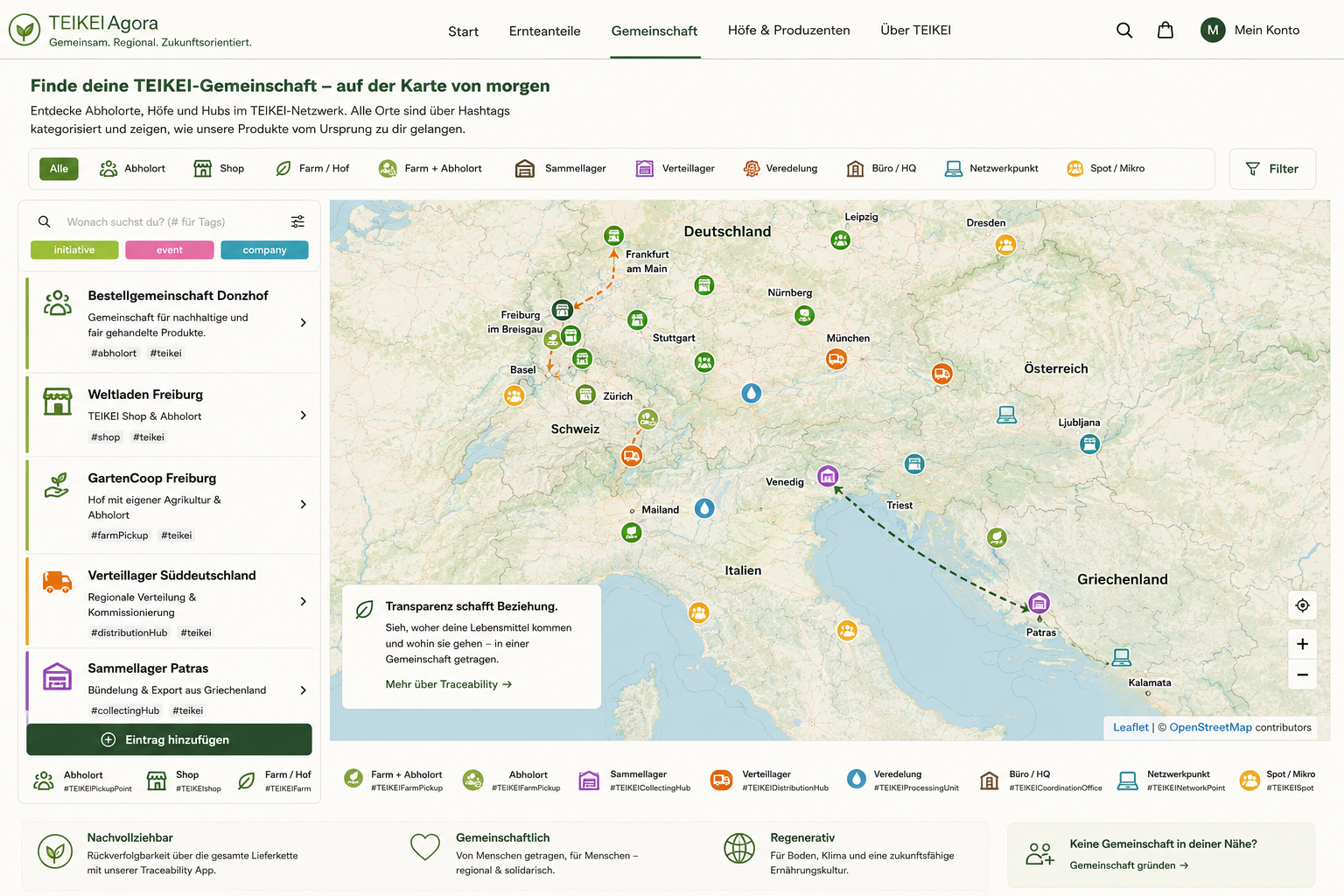
- Map-based representations of farms, fields, logistics points, and pickup locations
- Structured data for linking products, locations, and profiles
- Hashtag and category systems for clear classification of locations
- QR code logic for connecting products with locations, profiles, and paths
- Visualizations for origin, distribution, and network relationships
- Notifications for producers when a product is scanned
- Voluntary contact prompts between farms and members after a scan
The technical implementation is deliberately gradual. Understandability, relationships, and usability take precedence over pure efficiency.
¶ No Control Logic, but Relationship Transparency
A key point is the mindset behind this module.
Traceability in TEIKEI is not intended to exert pressure or increase control. It is not a surveillance tool or a technocratic system for its own sake.
Instead, it is meant to help:
- Make connections understandable
- Share responsibility visibly
- Make paths traceable
- Strengthen trust
- Enable feedback loops between origin and community
This is precisely why this module fits the TEIKEI logic: transparency arises as a connection, not as domination over information.
¶ Direct Feedback After a Scan
A potential feature of the dual traceability structure is direct, voluntary feedback to the farm as soon as a product is scanned via a QR code.
For example, when a member scans a fruit box, olive oil, or another TEIKEI product, this moment can not only open up information about origin. At the same time, it can become visible on the farm profile that a product from this farm has been noticed.
The farm could then receive a simple notification:
Your product has been scanned. Would you like to make contact?
This can create a light, human contact prompt.
The farm could send the member a short message, for example:
Hello, it’s great that our product has reached you. How are you enjoying it? Did it taste good?
The key here is that this connection is designed to be voluntary, data-minimizing, and mindful.
The member decides whether they want to be visible and allow feedback. The farm does not receive control information but an invitation to connect.
This turns the QR code from a mere technical access point into a small bridge between origin and everyday life.
A scan can then mean:
- A product was seen
- A farm was noticed
- A member can provide feedback
- A conversation can emerge
- Relationships become not abstract but alive
This feature makes the idea of dual transparency particularly tangible. Traceability does not end with data. It can become a moment of encounter.
¶ Significance for TEIKEI Agora 3.0
For TEIKEI Agora 3.0, this structure is particularly relevant because it connects digital infrastructure with relational infrastructure.
The Agora is not just a place for ordering and distribution. It is also a space where economic, logistical, and community relationships become visible and can be shaped.
The dual traceability structure can therefore become an important link between:
- Product data and real locations
- Logistics and community
- Producers and members
- Transparency and trust
- Digital interface and lived network reality
It thus supports an Agora that is not only functional but also understandable, capable of learning, and relationship-oriented.
¶ Development Status
The dual traceability structure is currently described as a strategic module, not as a completed application.
It forms the foundation for future functions and tools within the TEIKEI Agora. In the future, this could include various presentation and usage layers, such as map views, QR code connections, origin overviews, network-related visualizations, or direct feedback prompts between members and farms.
Important to note:
The idea is already clear.
Implementation is growing step by step.
¶ Outlook
With dual transparency and traceability, TEIKEI Agora 3.0 creates the opportunity to rethink supply relationships.
Not just as the path of a product from A to B, but as a visible network of people, places, responsibility, and impact.
This can create an infrastructure that makes origin understandable, strengthens connections, and further opens the path toward a fair, learning-oriented, and community-driven network logic.
¶ Dual Transparency & Traceability - Map
¶ Dual Transparency & Traceability - Display for Members After Scanning QR Code


¶ Dual Transparency & Traceability - Display for Producers for Traceability
This layer shows producers how their products are perceived within the network.
When a member scans a product and allows feedback, the farm can see on their profile that a product has arrived and been viewed.
In the future, this could lead to a protected contact prompt:
- Scan of a product by a member
- Display on the farm profile
- Notification: "Your product has been scanned"
- Option for voluntary contact
- Brief follow-up question from the farm to the member
- Optional feedback on taste, quality, arrival, or personal impression
The function is not intended to generate personal data analysis. It is meant to enable encounters.
Producers thus receive not just abstract reach but a sense of where their work arrives and how it is experienced.
This turns traceability into a feedback channel.
Not as an evaluation system.
Not as a control tool.
But as the quiet beginning of a conversation between farm and member.


One level up: TEIKEI Agora 3.0
Author: Felix Schröder, with assistance from AI (ChatGPT)
Creation: written by Felix Schröder › formatted in Markdown by ChatGPT › published by Felix Schröder › layout adjusted by Claude
Created: 2026-04-01 · Last updated: 2026-05-08 · Questions or feedback? support@teikei.us