¶ TEIKEI Fund
¶ What this page is about
This page describes the TEIKEI Fund as a nonprofit development program for community-supported supply.
The fund creates a financial framework for tasks that serve the common good and can be used by many people, farms, communities, regions, and organizations.
At its core is the question:
How can knowledge, education, practical research, community building, regional supply development, and digital infrastructure be promoted in a way that enables a cooperative food culture to grow?
The TEIKEI Fund enables the creation of structures that make community-supported supply understandable, accessible, transferable, and practically implementable.
This includes public knowledge work, educational and learning formats, practical research, documentation, community building, regional supply spaces, cooperation standards, transparency tools, digital infrastructure, Chapter 100, Ethical Intelligence, meeting formats, and funding partnerships.
The fund thus strengthens the nonprofit foundation on which new forms of regional and community-supported supply can emerge.
¶ Guiding Question
What if we measured economic success by whether farms are sustainably supported, communities take responsibility, regional supply emerges, knowledge is shared, and our landscapes become more vibrant?
This question describes the inner compass of the TEIKEI Fund.
The fund focuses on building a supply culture in which food, education, responsibility, landscape, community, and regional collaboration are reconnected.
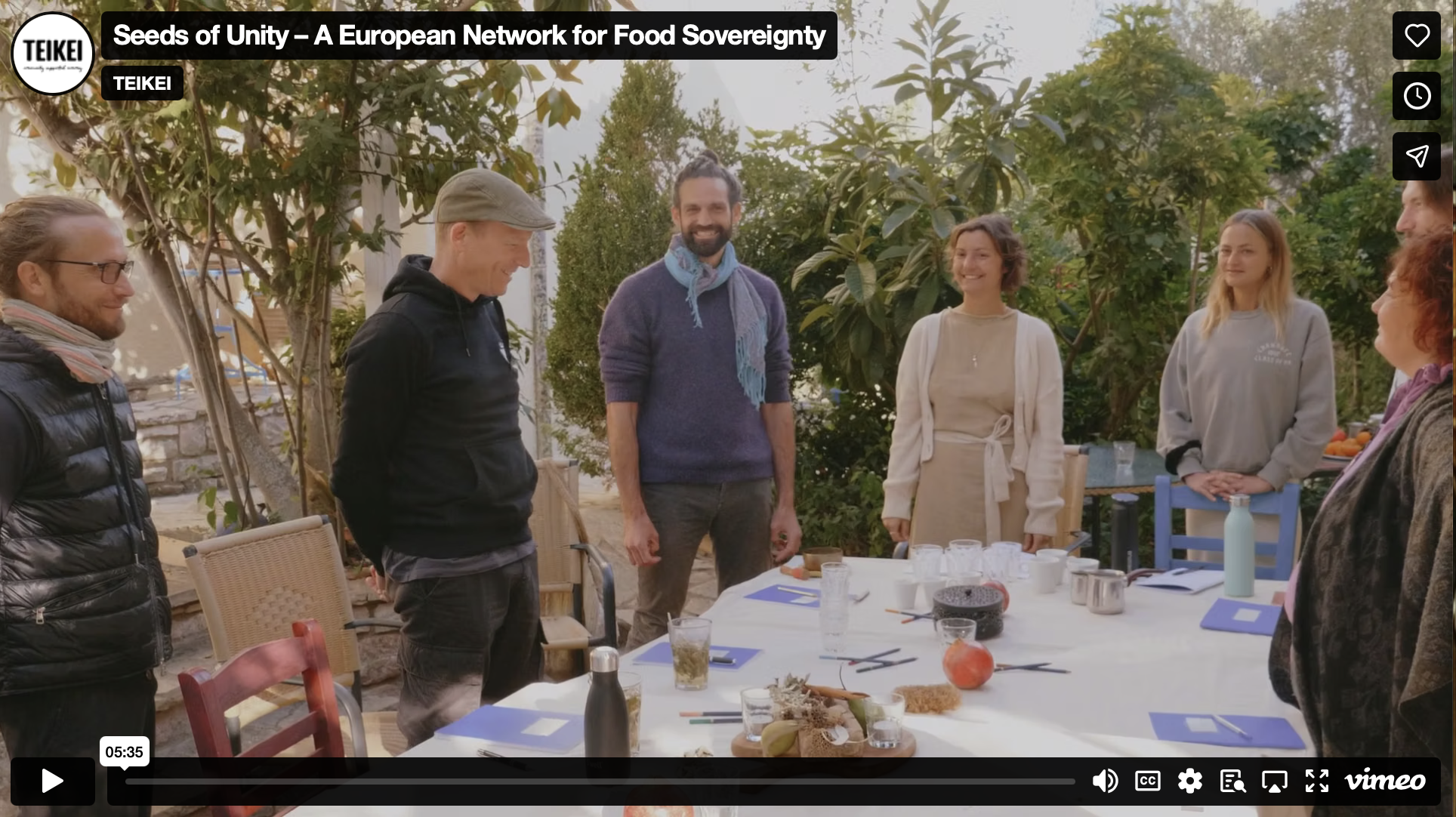
¶ Core Idea
The TEIKEI Fund creates the financial foundation for nonprofit development work.
It enables farms, communities, supply regions, pickup locations, cooperatives, SoLaWis (Community-Supported Agriculture), educational sites, and other independent actors to learn from one another and organize their supply in a more transparent, binding, and community-oriented way.
This involves the interplay of knowledge, education, practice, responsibility, regional supply, community building, transparency, documentation, communication, and digital tools.
The fund supports tasks that benefit many and are not limited to a single economic actor.
It makes knowledge accessible, strengthens communities, supports regional learning processes, and develops tools with which supply can be organized collectively.
¶ Why Now?
Now is the right moment for the TEIKEI Fund.
Years of experience in community-supported supply are available. The first regions are becoming visible. Knowledge work has begun. Digital foundations are emerging. Communities are seeking orientation. The next development phase can begin.
The TEIKEI Fund makes this development phase financeable.
It enables knowledge to be documented, funding applications to be submitted, communities to be supported, learning spaces to be opened, digital tools to be developed, and regional supply spaces to be connected.
Funding can be particularly effective in the early development phase.
This is where foundations are laid that can later benefit many regions, farms, communities, and organizations.
¶ Goal for 2027
By 2027, the TEIKEI Fund aims to enable a first nonprofit development program with a target budget of approximately:
200,000 CHF
This budget will support the creation of publicly usable and common-good-oriented structures.
It will make knowledge publicly accessible, build Chapter 100, develop Ethical Intelligence, support community foundations, strengthen regional supply spaces, document practical knowledge, develop educational and learning formats, and provide digital tools for transparency, knowledge transfer, and coordination.
At the same time, it will help build foundation and funding partnerships and make experiences from existing TEIKEI communities usable for new regions.
The 2027 annual budget is conceived as a first joint development step.
¶ What the TEIKEI Fund Enables
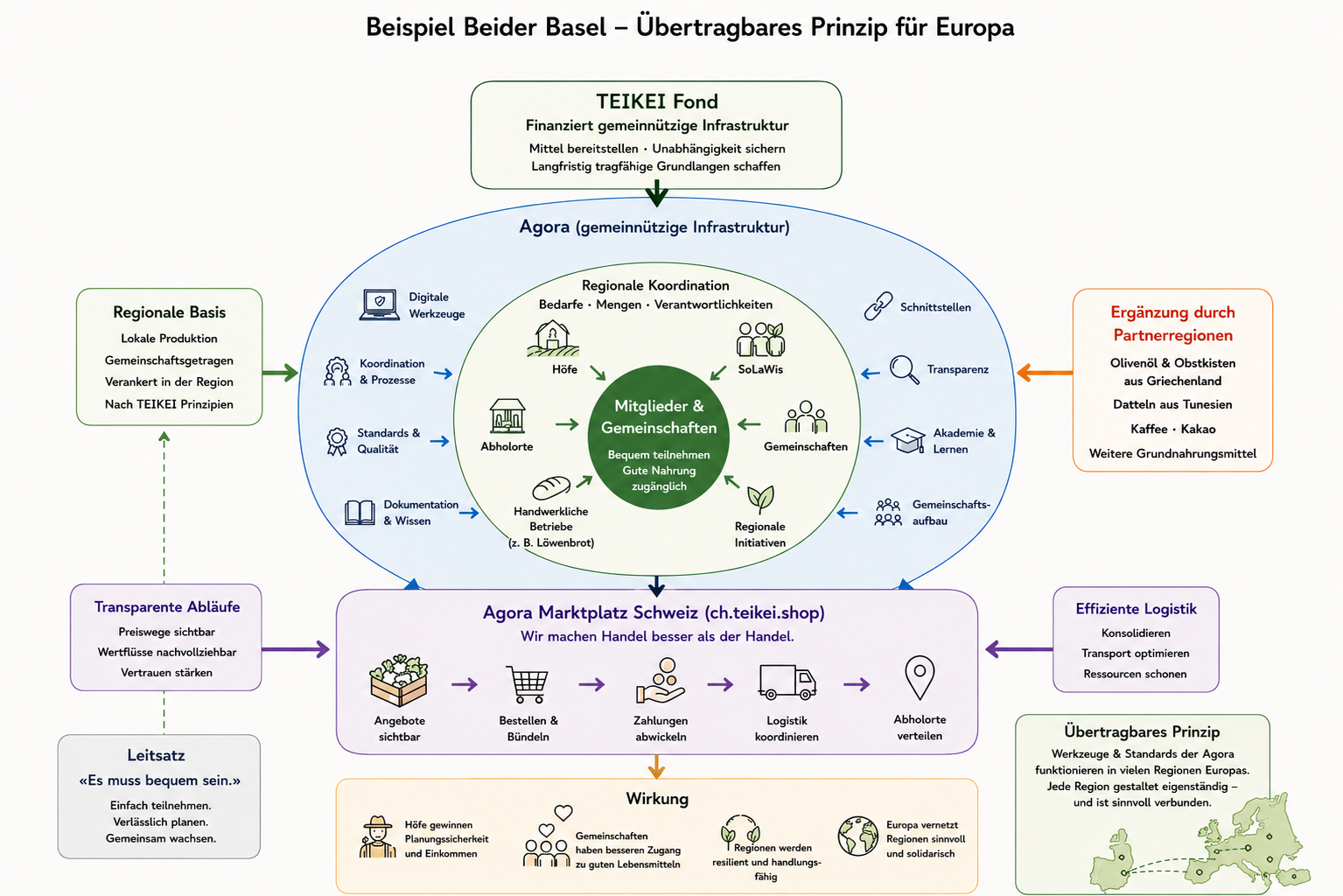
The TEIKEI Fund enables nonprofit development work in several interconnected areas.
At the center are the public TEIKEI knowledge database, Chapter 100, Ethical Intelligence, community foundations, transformation guides, practical documentation, educational and learning formats, tools for knowledge transfer and network communication, regional supply spaces, meeting formats, funding partnerships, and digital infrastructure for transparency, coordination, and common-good-oriented collaboration.
The fund enables people to work concretely: writing, documenting, structuring, supporting, translating, moderating, developing, communicating, submitting funding applications, connecting regions, and strengthening communities.
¶ Chapter 100
Chapter 100 is the knowledge and orientation space for in-depth work on community-supported supply.
Content is created here on steward-ownership, regional supply spaces, cooperative food economies, Community-Supported Agriculture, commons, ethical technology, artificial intelligence in service of communities, governance, decision-making processes, educational work, transformation, and Scaling Deep.
Chapter 100 is intended to become a living learning space.
A place where people can understand how community-supported supply emerges, how regional supply spaces are built, and how practical experiences can be shared.
¶ Ethical Intelligence
Ethical Intelligence describes the work of using knowledge, technology, and artificial intelligence in ways that serve a common purpose.
At its core are orientation, documentation, translation, knowledge transfer, collective learning, decision-making capacity, and responsible data use.
Ethical Intelligence can help sort knowledge, make experiences accessible, document processes, enable translations, create guides, prepare decisions, support communities, make regional developments comparable, and embed values in digital tools.
This turns technology into a tool for community, education, and responsibility.
¶ Scaling Deep
The TEIKEI Fund does not only support growth in breadth.
It supports Scaling Deep.
Scaling Deep means that values take deeper root in communities, regions, tools, and processes.
This includes responsibility, trust, transparency, fairness, regional integration, collective learning, mutual support, relationship-building, good decision-making processes, knowledge sharing, and social and ecological orientation.
The TEIKEI Fund helps embed these values in educational work, documentation, communication, software, community building, and regional practice.
¶ Agora as Nonprofit Infrastructure
The Agora is an infrastructure for cooperative supply.
It connects knowledge, digital tools, and regional practice.
Through the Agora, farms, communities, pickup locations, harvest shares, products, knowledge, communication, regional bundling, and responsibility can become more visible and coordinated.
In the nonprofit context, the focus is particularly on transparency regarding origin, quantities, and needs; visibility of producers; collective planning; process documentation; open standards; regional coordination; knowledge transfer; learning spaces; and digital tools for community-supported supply.
Agora is thus understood as an infrastructure that enables community-supported supply and connects knowledge, values, and practice.
¶ Digital Tools
The TEIKEI Fund can support digital tools if they serve nonprofit purposes.
These include tools for public knowledge work, educational formats, documentation, transparency, practical research, community building, regional coordination, translation, communication, participation, Chapter 100, Ethical Intelligence, open standards, and knowledge transfer.
Digital development is understood here as part of nonprofit infrastructure.
It helps make knowledge accessible, strengthen communities, and better coordinate regional supply spaces.
¶ Supporting Community Foundations
An important part of the fund is supporting community foundations.
Many people want to be part of a different supply system but need orientation, materials, conversations, and examples.
The fund enables spaces where new communities can be introduced, supported, and connected with existing experiences. This includes initial conversations, orientation materials, moderation, role clarification, guides, examples from existing communities, support in setting up pickup locations, connections to farms, communication materials, decision-making models, and learning spaces.
The goal is to make communities capable of action.
They should be able to grow independently while benefiting from the experiences of other regions.
¶ Regional Supply Spaces
The TEIKEI Fund supports the creation of regional supply spaces.
A supply space connects farms, communities, pickup locations, processing, storage, logistics understanding, knowledge, responsibility, education, digital tools, and communication.
Initial development spaces are emerging in Switzerland, southern Germany, northern Europe, and existing TEIKEI communities that want to network more closely.
These regions should be able to learn from one another.
The fund supports the documentation, support, and transferability of these experiences.
¶ Funding Logic
The funding logic of the TEIKEI Fund is clear and accessible.
For each funding phase, it is described which goal is being pursued, which nonprofit purpose the phase serves, which activities are planned, which people and regions are involved, which results are expected, and how the budget, documentation, and public usability are made transparent.
Funding partners can engage with this work from different perspectives.
Some foundations are particularly interested in education and knowledge transfer. Others focus on regional development, agriculture, food, digital commons, social innovation, biodiversity, landscape development, steward-ownership, or transformation.
The TEIKEI Fund connects these approaches within a common framework: the creation of nonprofit foundations for community-supported supply.
¶ Relationship with Foundations and Funding Partners
The TEIKEI Fund views funding as a relationship.
In addition to written funding applications, conversations should emerge.
Especially with larger funding partners, the focus is on jointly examining which purpose connects, what impact can be achieved, which phase is now ready, what form of support would be meaningful, and how an initial funding can lead to a long-term partnership.
The fund thus opens a field in which foundations, funders, regions, and development actors can jointly contribute to a new supply architecture.
¶ Overview of Subpages
The following subpages form the working structure around the TEIKEI Fund and the nonprofit development phase.
They answer key questions relevant to funding structure, foundation review, governance, and future sponsorship.
-
Development Program 2027
Describes the nonprofit development program 2027 for knowledge work, Chapter 100, Ethical Intelligence, community foundations, supply regions, and digital tools. -
Fund Description
Describes the purpose, tasks, use of funds, documentation, and impact of the TEIKEI Fund. -
Nonprofit Impact Logic
Describes how nonprofit work, knowledge, FairShare, Chapter 100, Ethical Intelligence, and regional supply interact. -
Chapter 100 and Ethical Intelligence
Describes Chapter 100 and Ethical Intelligence as knowledge and intelligence infrastructure for TEIKEI. -
Digital Tools and Agora Infrastructure
Describes digital tools, Agora infrastructure, FairShare, traceability, mapping logic, and coordination. -
Community Foundations and Supply Regions
Describes the creation of communities and regional supply spaces. -
Funding Strategy and Foundation Applications
Describes funding logic, foundation outreach, project descriptions, and funding partnerships. -
Governance and Use of Funds
Clarifies roles, decision-making processes, use of funds, and responsibilities within the fund structure. -
Impact Documentation and Reporting
Describes how results, activities, and impacts are documented and made transparent to funding partners. -
Target Structure and Overall Concept
Outlines the interplay between the TEIKEI Fund, nonprofit structure, Lightwave, operational support structures, farms, communities, and supply regions.
¶ Role of Independent Actors
The TEIKEI Fund strengthens nonprofit infrastructure that can be used by various actors.
These include farms, SoLaWis, farm communities, regional supply initiatives, cooperatives, cooperatives, educational sites, processing partners, logistics partners, and other community-oriented organizations.
These actors remain independent.
They can benefit from knowledge, standards, documentation, educational formats, transparency tools, and regional coordination.
¶ Relationship to Future Cooperatives
In the long term, regional, national, or European cooperatives may emerge.
These can support operational supply: goods flows, communities, regional bundling, product areas, logistics, pickup locations, and specific supply projects.
A European cooperative would emerge when several regional networks from different countries want to join forces.
The TEIKEI Fund strengthens the nonprofit foundation for this: knowledge, values, communication, community, regional learning processes, transformative capacity, and public documentation.
¶ Public Impact Commitment
The TEIKEI Fund uses resources in a way that creates publicly usable results.
These include wiki entries, guides, documentation, translations, reports, templates, presentations, project descriptions, learning materials, community tools, digital spaces, regional experience reports, open concepts, and transfer materials for new regions.
This creates knowledge that can be reused by communities, farms, foundations, educational sites, initiatives, and regions.
¶ Vision
In the long term, a structure should emerge in which the TEIKEI Fund supports nonprofit development work, knowledge is publicly accessible, digital tools are used for the common good, communities become capable of action, and regional supply spaces emerge.
Funding should be used transparently and purposefully.
Future cooperatives can support operational supply, while responsibility is distributed institutionally and collectively.
¶ Summary
The TEIKEI Fund is the nonprofit development program for community-supported supply in 2027.
It enables Chapter 100, Ethical Intelligence, public knowledge work, community foundations, value communication, Scaling Deep, regional supply spaces, communication, knowledge transfer, Agora as nonprofit infrastructure, digital tools for education, transparency and coordination, as well as funding applications and foundation relationships.
The fund stands for a simple, powerful idea:
If community-supported supply is to grow, then the knowledge, values, communication, tools, and relationships that make this supply possible must also be financed.
Now is the time to begin.
¶ Further Information and Concrete Examples
- Example: Regional Bundling and Urban Supply Zurich in Cooperation with Koopernikus
- Example: Date Project Tunisia and the TEIKEI Fund
- Example: Food Region Freiburg and the TEIKEI Fund
- Example: Olive Oil via the TEIKEI Agora
¶ Related Terms and Further Reading
This page connects the TEIKEI Fund, nonprofit work, Chapter 100, Lightwave, and regional supply. The following terms are key points for further exploration:
One level up: Nonprofit Organizations
Author: Felix Schröder, with the help of AI (ChatGPT)
Creation: written by Felix Schröder › formatted in Markdown by ChatGPT › published by Felix Schröder › layout adjusted by Claude
Created: 2026-05-06 · Last updated: 2026-10-10 · Questions or feedback? support@teikei.us