¶ Supply Landscape
Introduction and Overview › Glossary for the Networking Language · 3 min read
A supply landscape emerges where food is once again understood as a communal task.
It does not begin with a new project or a central organization. It begins where existing places, people, farms, and initiatives become aware of one another and start connecting their work.
A farm remains a farm.
A CSA remains a CSA.
A food co-op remains a food co-op.
A pickup location remains locally rooted.
And yet, something changes when these places no longer exist merely side by side. From individual initiatives, a shared supply space emerges.
Like in a landscape where water, soil, paths, plants, animals, and people interact, a supply landscape does not arise through top-down control. It emerges through relationships, balance, movement, and equilibrium.
¶ Definition
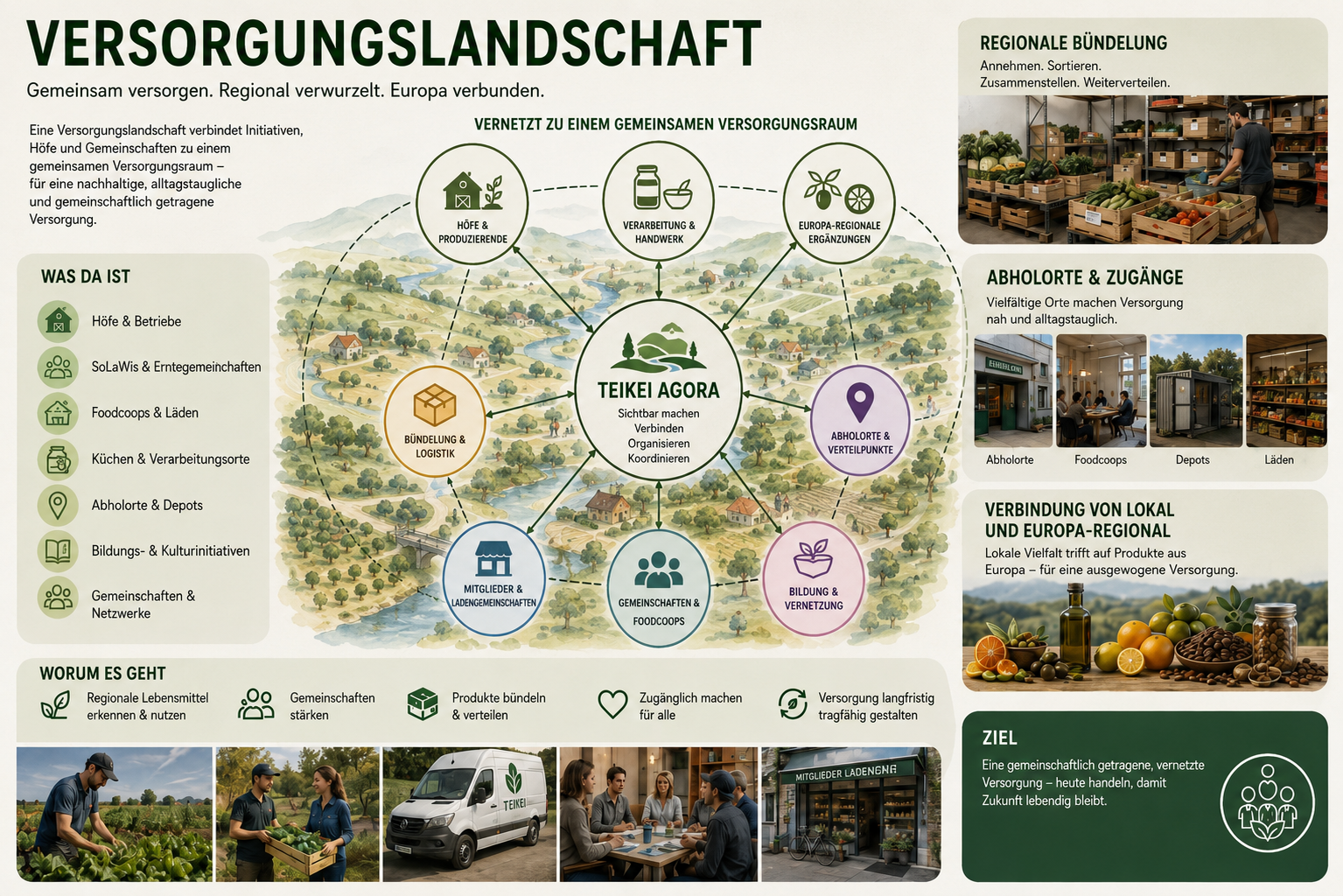
A supply landscape is a communally supported supply space in which farms, initiatives, pickup locations, and communities connect their work so that food becomes regionally anchored, supplemented at a European-regional level, and practically accessible in everyday life.
¶ A Shared Supply Space
In a supply landscape, the focus is not just on producing, ordering, or picking up food. It is about shaping supply as an interconnected process.
This includes the people who cultivate, the places where food is processed, stored, and distributed, the communities that share harvest shares, the pickup locations where food enters daily life, and the relationships that connect all of this.
A supply landscape makes visible that food is never just about products. It consists of soil, labor, paths, trust, responsibility, and shared organization.
¶ Connection Instead of Isolation
Many good structures already exist: farms, CSAs, food co-ops, communally organized shops, educational initiatives, kitchens, depots, and pickup locations.
Often, they work with great care but in isolation from one another.
A supply landscape creates a framework in which these structures can connect. This does not create a new entity above existing initiatives. Instead, a network emerges between them.
This network can help better understand needs, bundle transports, strengthen pickup locations, make harvest shares visible, and distribute responsibility across multiple shoulders.
Like water in a landscape, supply does not follow abstract paths. It follows real places, relationships, opportunities, and boundaries.
¶ Regional and European-Regional Supply
A supply landscape is regionally anchored. It asks what can be grown, processed, and communally supported locally.
At the same time, it remains open to European-regional relationships. Not everything people need or value in daily life grows in every region.
Olive oil, citrus fruits, coffee, or other foods can be part of a supply system if their origin, relationships, and paths are transparently supported.
Thus, a supply landscape connects local roots with a larger network of farms, communities, and infrastructures.
¶ Examples
¶ Related Terms
- Regional Bundling
- Main Community
- Subcommunity
- Microcommunity
- Pickup Location
- Harvest Share
- Producer
- TEIKEI Agora
- Agora Marketplace
- Lightwave
← Letter V · All Terms A–Z
By the TEIKEI editorial team, with AI support (ChatGPT)
Created on May 5, 2026 · Last updated on October 10, 2026
Questions or feedback? support@teikei.us