¶ How Do Closed Loops Work in Agriculture?
¶ What This Page Covers
This page provides a basic introduction to closed loops in agriculture.
It explains which substances and life processes are needed for plants to grow, soils to remain fertile, and agricultural systems to become sustainable in the long term.
At its core is a simple question:
What does agriculture really need to produce food from soil, water, air, sun, plants, animals, microorganisms, and human labor?
¶ Why Loops Matter
Agriculture thrives on the principle that substances are not simply consumed and lost.
Plants absorb nutrients.
Humans and animals feed on plants.
Plant residues, manure, compost, roots, and organic matter return to the soil.
Microorganisms transform these substances.
New fertility emerges from this process.
A closed loop does not mean that a farm is completely independent of all external factors.
It means:
Nutrients, water, carbon, and organic matter should be kept, used, transformed, and made available again within the agricultural system for as long as possible.
¶ The Core Question
Many modern agricultural systems rely heavily on external inputs.
Fertilizers, feed, substrates, energy, and other inputs are brought in from outside.
Harvests, animals, food, and organic matter leave the farm.
When recycling is absent, an open system emerges:
- Nutrients are lost.
- Soils lose humus.
- Water retention deteriorates.
- Plants become more dependent on external fertilization.
- Farms become more dependent on prices, supply chains, and input markets.
Closed loops aim to reduce these losses.
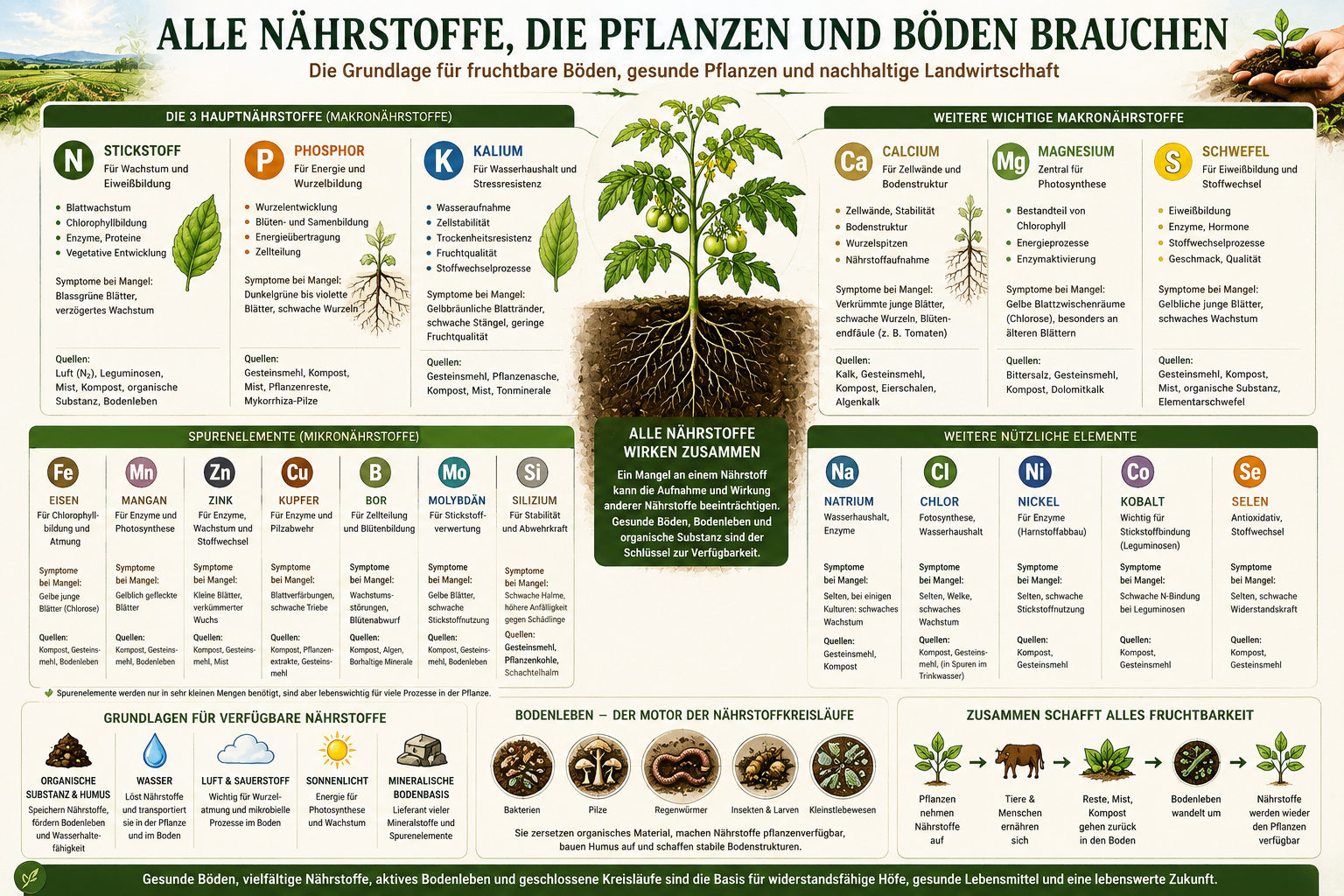
¶ What Plants Fundamentally Need
Plants do not just need "fertilizer."
They require an interplay of energy, water, air, nutrients, soil structure, and living soil organisms.
The basic prerequisites include:
- Light
- Water
- Air
- Carbon
- Nitrogen
- Phosphorus
- Potassium
- Calcium
- Magnesium
- Sulfur
- Trace elements
- Living soil organisms
- A stable soil structure
- Sufficient oxygen in the soil
- Organic matter
These elements work together.
No single nutrient can replace a living system.
¶ The Three Primary Nutrients
In agriculture, three primary nutrients are often emphasized:
- Nitrogen
- Phosphorus
- Potassium
They are frequently referred to by the abbreviations N, P, and K.
These stand for:
- N = Nitrogen
- P = Phosphorus
- K = Potassium
These three substances are important.
But they do not fully explain agriculture.
¶ Nitrogen
Nitrogen is central to plant growth.
Plants need nitrogen for, among other things:
- Leaf growth
- Protein formation
- Enzymes
- Chlorophyll
- Strong vegetative development
Nitrogen is present in the atmosphere in very large quantities.
However, plants cannot absorb atmospheric nitrogen directly.
It must first be converted into plant-available forms through microorganisms, legumes, soil processes, or technical methods.
In living loops, nitrogen therefore plays a special role.
It indicates whether a soil is biologically active or whether a system remains heavily dependent on external fertilization.
¶ Phosphorus
Phosphorus is important for energy processes in plants.
It plays a role in:
- Root formation
- Flower formation
- Seed formation
- Cell division
- Energy transfer within the plant
Phosphorus is often present in the soil but not always plant-available.
Whether plants can absorb it depends heavily on soil life, pH value, fungi, root exudates, and soil structure.
Therefore, phosphorus is not just a question of quantity.
It is also a question of biological availability.
¶ Potassium
Potassium regulates important processes in the plant's water balance.
It is involved in:
- Water uptake
- Stability of plant cells
- Resistance to drought stress
- Fruit quality
- Metabolic processes
Potassium helps plants cope with stress.
A good potassium balance is therefore particularly important during periods of heat, drought, and changing weather conditions.
¶ Other Important Nutrients
In addition to nitrogen, phosphorus, and potassium, plants need other important nutrients.
These include, among others:
- Calcium
- Magnesium
- Sulfur
Calcium is important for cell walls, soil structure, and interactions within the soil.
Magnesium is a central component of chlorophyll and thus important for photosynthesis.
Sulfur is needed for protein formation and metabolic processes.
These substances cannot be considered in isolation either.
They interact with soil life, water, pH value, organic matter, and mineral foundations.
¶ Trace Elements
Plants also need very small amounts of other elements.
These include, for example:
- Iron
- Manganese
- Zinc
- Copper
- Boron
- Molybdenum
- Silicon
They are only needed in small quantities.
Nevertheless, they can be crucial.
If trace elements are missing or unavailable, plants can be weakened even if the primary nutrients are present.
¶ Carbon as a Foundation
Carbon is often overlooked, although it plays a central role.
Plants absorb CO₂ from the air.
With the help of sunlight and water, they form carbon compounds from it.
Some of this is built into plant biomass.
Another part enters the soil via roots, plant residues, mulch, compost, and manure.
There, carbon becomes the foundation for:
- Humus
- Soil structure
- Water retention capacity
- Food for microorganisms
- Long-term fertility
Without carbon, there is no lasting humus formation.
¶ Soil Life
A closed loop does not function solely through chemical substances.
It requires living mediators.
These include:
- Bacteria
- Fungi
- Earthworms
- Insects
- Microorganisms
- Plant roots
- Animals
- Humans
These organisms break down, digest, transform, connect, and stabilize organic material.
They make nutrients available.
They build soil structure.
They help store water.
They connect plants with minerals, air, water, and organic matter.
¶ The Simple Loop
An agricultural loop can be described in simplified terms as follows:
Sun, water, and air enable plant growth.
Plants build biomass.
Humans and animals use part of this biomass as food.
Plant residues, roots, manure, compost, and organic matter return to the soil.
Microorganisms and soil organisms transform these substances.
From this, nutrient availability, humus, and soil structure emerge.
The soil becomes more fertile.
New plants can grow.
¶ Material Flow in the Farm System
In a farm system, substances are constantly in motion.
What matters is whether they are retained within the system or permanently removed.
Material flows include, for example:
- Harvest
- Plant residues
- Roots
- Mulch
- Manure
- Compost
- Feed
- Bedding
- Water
- Soil material
- Nutrients
- Seeds
- Food
A closed loop asks:
What leaves the farm?
What stays on the farm?
What can be returned?
What needs to be supplemented?
What can be retained within the system through better design?
¶ Animals in the Loop
Animals can play an important role in agricultural loops.
They eat plants, cover crops, grass, harvest residues, or by-products.
They return manure and urine.
They can maintain areas, spread seeds, stimulate soil processes, and keep landscapes open.
However, this only works if animal husbandry is integrated into the farm system.
Isolated animal husbandry can create nutrient surpluses, feed dependencies, and environmental burdens.
Integrated animal husbandry can help close nutrient loops.
¶ Compost and Manure
Compost and manure are important elements of many farm loops.
They return organic material to the soil.
They bring not only nutrients.
They also bring carbon, microorganisms, structure, and biological activity.
Good compost is therefore not just "fertilizer."
It is a means of building soil.
Manure is also not just a waste product.
It can be part of a living loop if animals, bedding, composting, application, soil life, and plant needs are thoughtfully integrated.
¶ Open and Closed Systems
No agricultural system is completely closed.
Harvests leave the farm.
People eat food.
Nutrients are often lost from the agricultural loop through human waste, processing, waste, or wastewater.
Seeds, tools, energy, minerals, or materials also frequently come from outside.
Therefore, "closed" is not an absolute state.
It is a direction of development.
A farm can tighten loops, reduce losses, and decrease dependencies.
¶ Why Loops Are Not Just a Technical Issue
Closed loops are not just a technical question.
They also involve organization, responsibility, and relationships.
If nutrients are to be retained within a region, the following are needed:
- Farms
- Composting sites
- Animals
- Storage
- Processing
- Return of organic matter
- Regional cooperation
- Members
- Collection points
- Knowledge
- Time
- Joint financing
Loops do not emerge automatically.
They must be designed, maintained, and supported.
¶ TEIKEI Perspective
From a TEIKEI perspective, closed loops are the foundation of community-supported food systems.
It is not just about distributing food.
It is about sustaining the conditions under which food can be produced in the long term.
This includes:
- Fertile soils
- Living farm systems
- Regional nutrient loops
- Water retention capacity
- Biodiversity
- Long-term relationships
- Transparent responsibility
- Community-supported infrastructure
When members share in the harvest, they are not just supporting the harvest.
They are also supporting the development of the foundations from which the harvest can emerge.
¶ Further Subpages
This section can be expanded step by step.
Possible subpages include:
- Primary nutrients in agriculture
- Nitrogen cycle
- Carbon cycle
- Phosphorus and potassium
- Compost and manure management
- Plants, roots, and soil life
- Animals in the farm loop
- Humus formation
- Water in the agricultural loop
- Regional return of organic matter
- Limits of closed loops
¶ Key Takeaway
Agriculture does not arise from individual nutrients.
It arises from loops.
Plants grow because sun, water, air, minerals, soil life, organic matter, and human care work together.
Closed loops help ensure that these connections are not lost.
They make it visible that fertility is not just consumed but can be built, maintained, and passed on.
One level up: Closed Loops
Author: Felix Schröder, with the help of AI (ChatGPT)
Creation: written by Felix Schröder › formatted in Markdown by ChatGPT › published by Felix Schröder › layout adjusted by Claude
Created: 2026-05-16 · Last updated: 2026-05-16 · Questions or feedback? support@teikei.us