¶ Closed Loop Systems
¶ What This Section Is About
This section explains how closed loop systems can be understood in agriculture.
At its core is the question of how fertility arises, is maintained, and can be passed on.
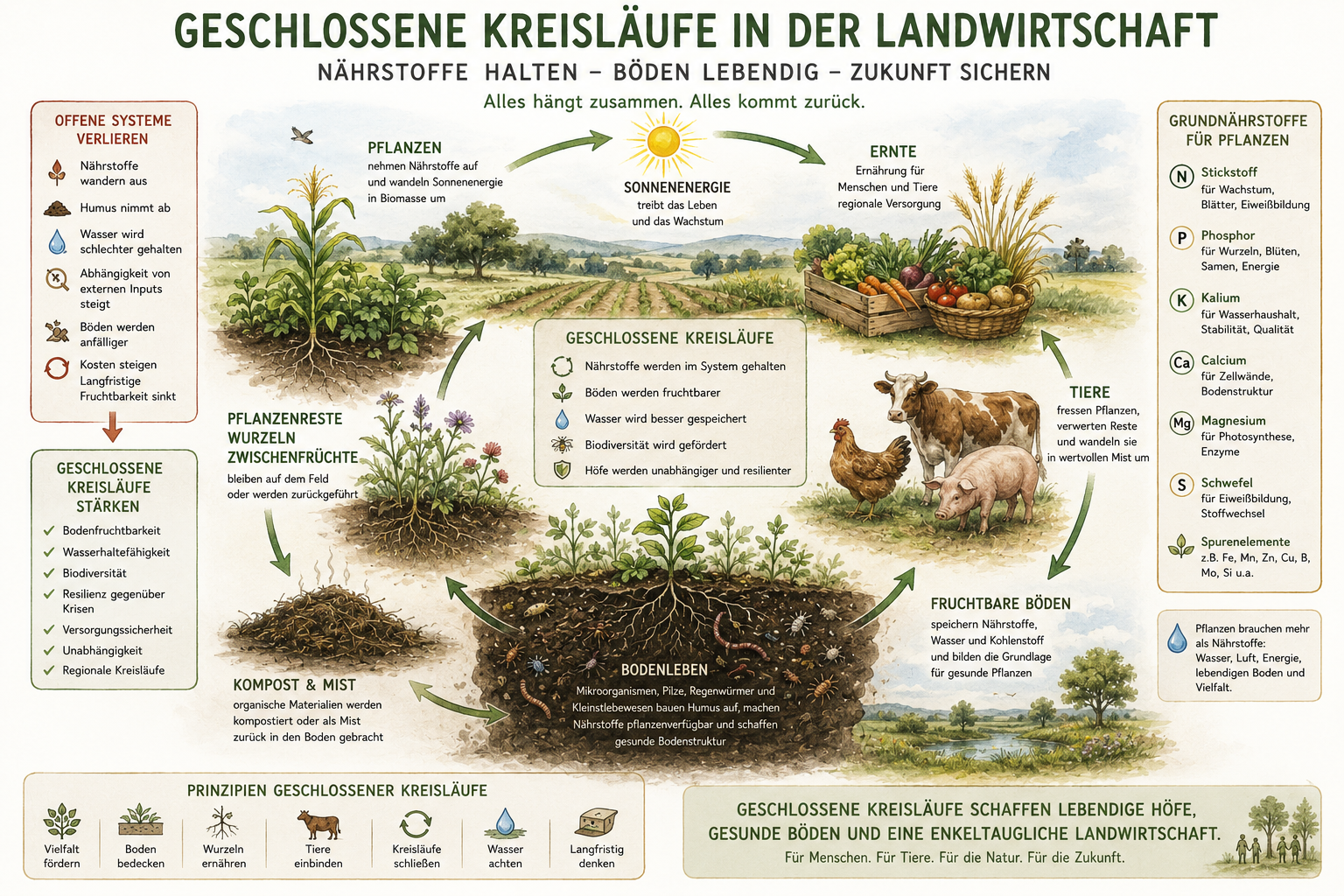
Agriculture thrives on the fact that materials are not simply consumed and lost.
Plants grow.
Animals and humans feed themselves.
Plant residues, roots, manure, compost, and organic matter return to the soil.
Microorganisms transform these materials.
From this, soil fertility, humus, nutrient availability, and new plant vitality emerge.
¶ Basic Understanding
A closed loop does not mean that a farm is completely independent of everything external.
Every farm is embedded in landscape, climate, water, soil, people, animals, tools, energy, seeds, processing, and social relationships.
Closed loops therefore do not describe absolute isolation.
They describe a direction:
Nutrients, carbon, water, and organic matter should be kept in the system for as long as possible, used meaningfully, transformed, and made fertile again.
¶ Why This Matters
Many of today's agricultural systems rely heavily on external inputs.
These include, among others:
- synthetic fertilizers
- purchased feed
- external substrates
- energy
- packaging and transport
- technical inputs
When harvests, animals, food, and organic matter leave the farm without nutrients being returned, open systems emerge.
This results in the gradual loss of fertility, humus, water retention capacity, and nutrients.
Closed loop systems help reduce these losses.
¶ Key Topics
This section brings together fundamentals on:
- Basic nutrients
- Nitrogen
- Carbon
- Phosphorus and potassium
- Compost
- Manure management
- Plant roots
- Soil life
- Animals in the farm system
- Water
- Humus formation
- Regional return of organic matter
¶ Current Directory
- How do closed loop systems work in agriculture?
- Basic nutrients in agriculture
- Nitrogen cycle
- Carbon cycle
- Phosphorus and potassium
- Compost and manure management
- Plants, roots, and soil life
- Animals in the farm cycle
- Water in the agricultural cycle
¶ TEIKEI Perspective
From a TEIKEI perspective, closed loop systems are part of community-supported agriculture.
It is not just about producing food.
It is about considering and supporting the foundations of production.
These include:
- living soils
- stable water balances
- humus formation
- biodiversity
- integrated farm systems
- regional nutrient cycles
- transparent responsibility
- long-term relationships between farms and members
When these foundations become visible, agriculture can be understood differently.
Not as the isolated production of individual goods.
But as a living connection of soil, plants, animals, people, water, air, sun, and shared responsibility.
¶ Further Development
This section can be expanded step by step.
Some pages explain the basics.
Other pages may later document concrete farm examples, practical reports, sketches, diagrams, or development paths.
This creates an understandable introduction to the question of how agriculture can become more fertile, resilient, and less dependent on external inputs.
One level up: Regenerative Agriculture and Development Paths
Author: Felix Schröder, with the help of AI (ChatGPT)
Creation: written by Felix Schröder › formatted in Markdown by ChatGPT › published by Felix Schröder › layout adjusted by Claude
Created: 2026-05-16 · Last updated: 2026-05-16 · Questions or suggestions? support@teikei.us