¶ Regional Bundling as a Connecting Structure in the TEIKEI Network
TEIKEI Network › Actors · 8 min read
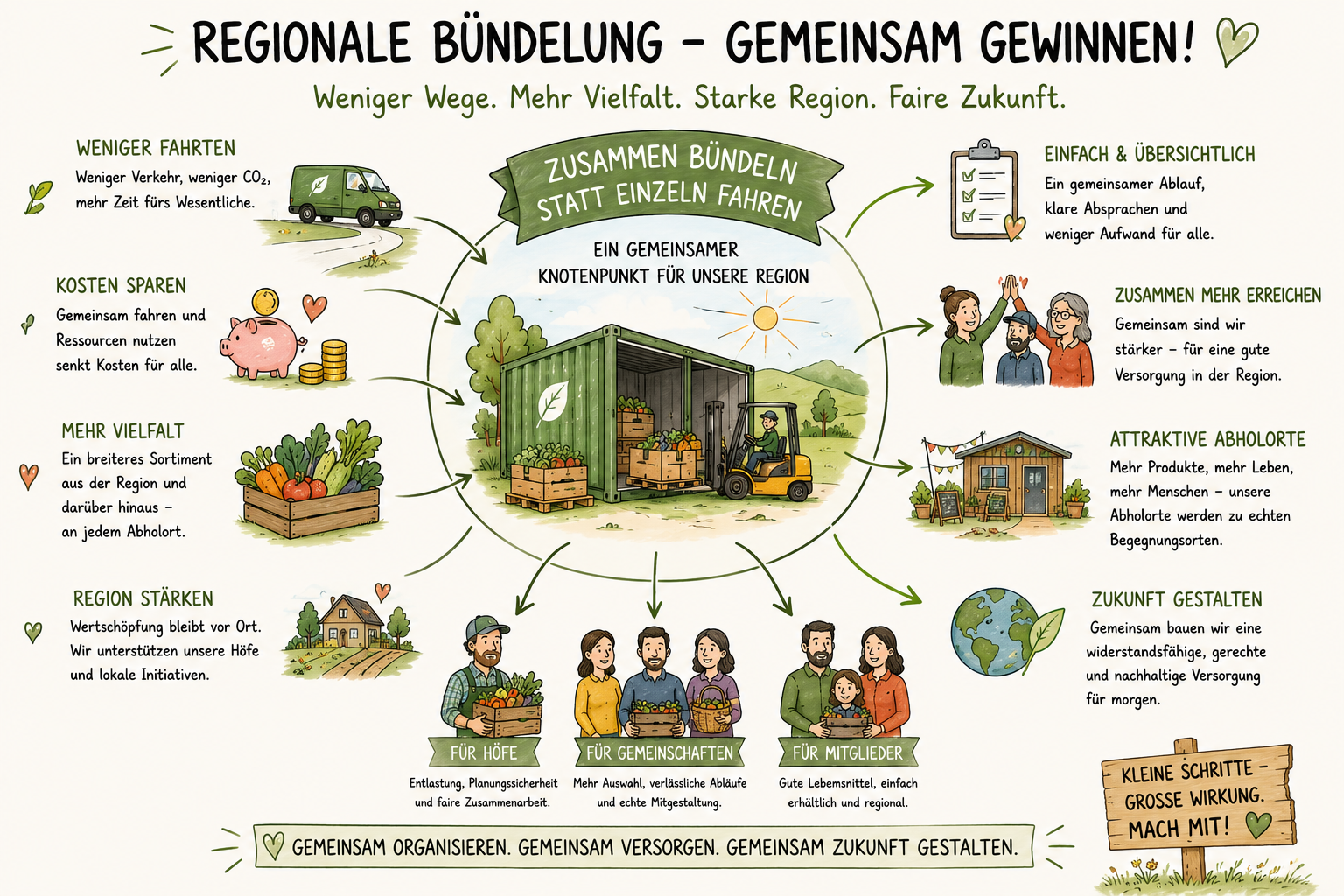
Regional bundling refers to the level at which goods flows, distribution points, communities, and regional initiatives are brought together in a specific area.
It is not a classic warehouse and not merely a logistical location. Rather, it describes a community-driven context in which different participants coordinate their processes so that distribution becomes practicable in the first place.
¶ What This Is About
Whenever multiple farms, different types of offerings, and several pickup locations come together in a region, a form of bundling is needed.
This includes, for example:
- the joint delivery of goods from different farms
- the consolidation of regional and Europe-regional deliveries
- sorting by distribution points
- preparing joint deliveries
- coordinating between organizers, communities, and logistics
Regional bundling provides the practical framework for this.
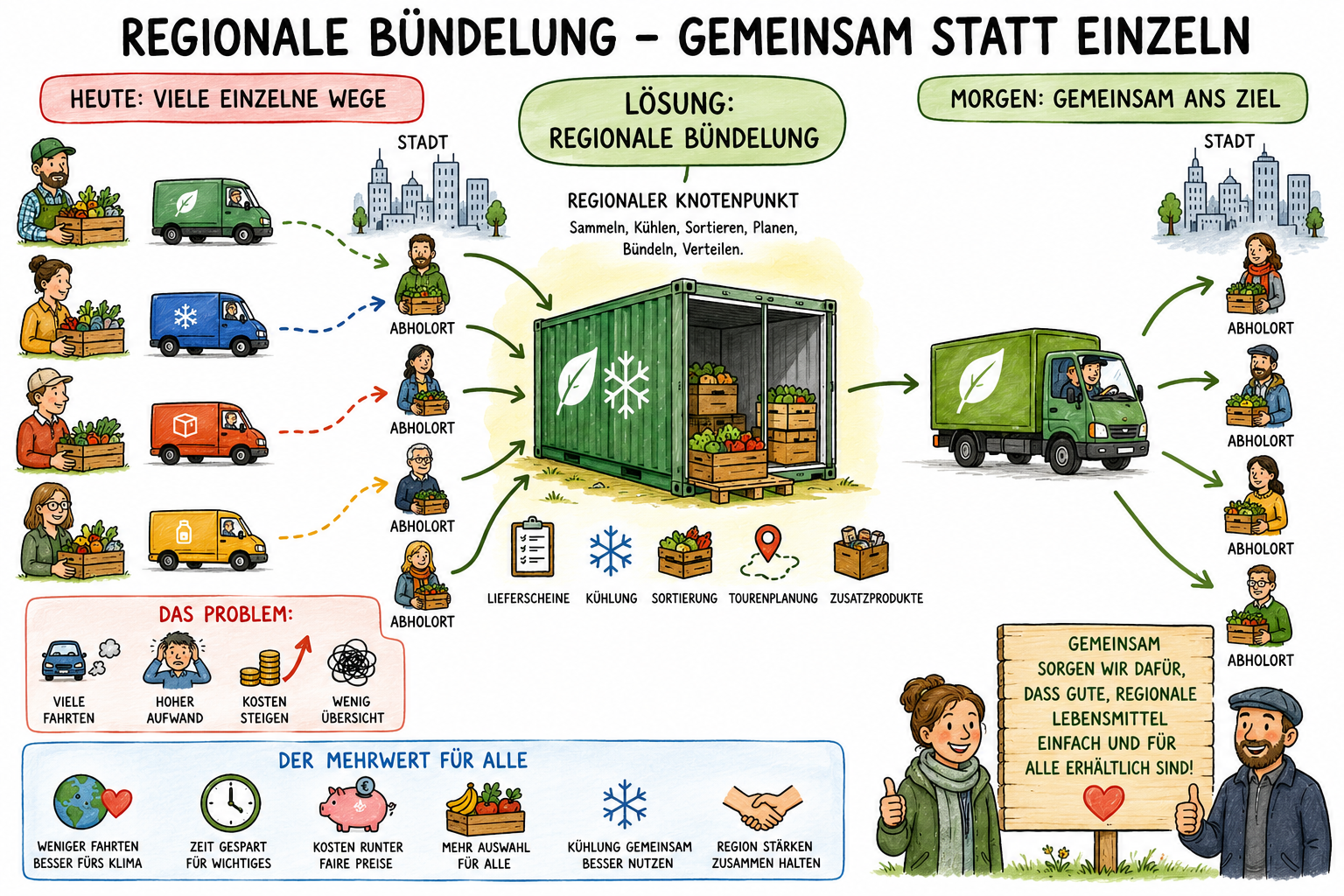
¶ Flowchart: Regional Bundling in the TEIKEI Network!
The flowchart shows how regional bundling brings together different goods flows, initiatives, and distribution points in a specific area. It illustrates that regional bundling is not just a logistical step but a connecting level between farms, deliveries, communities, and pickup locations.
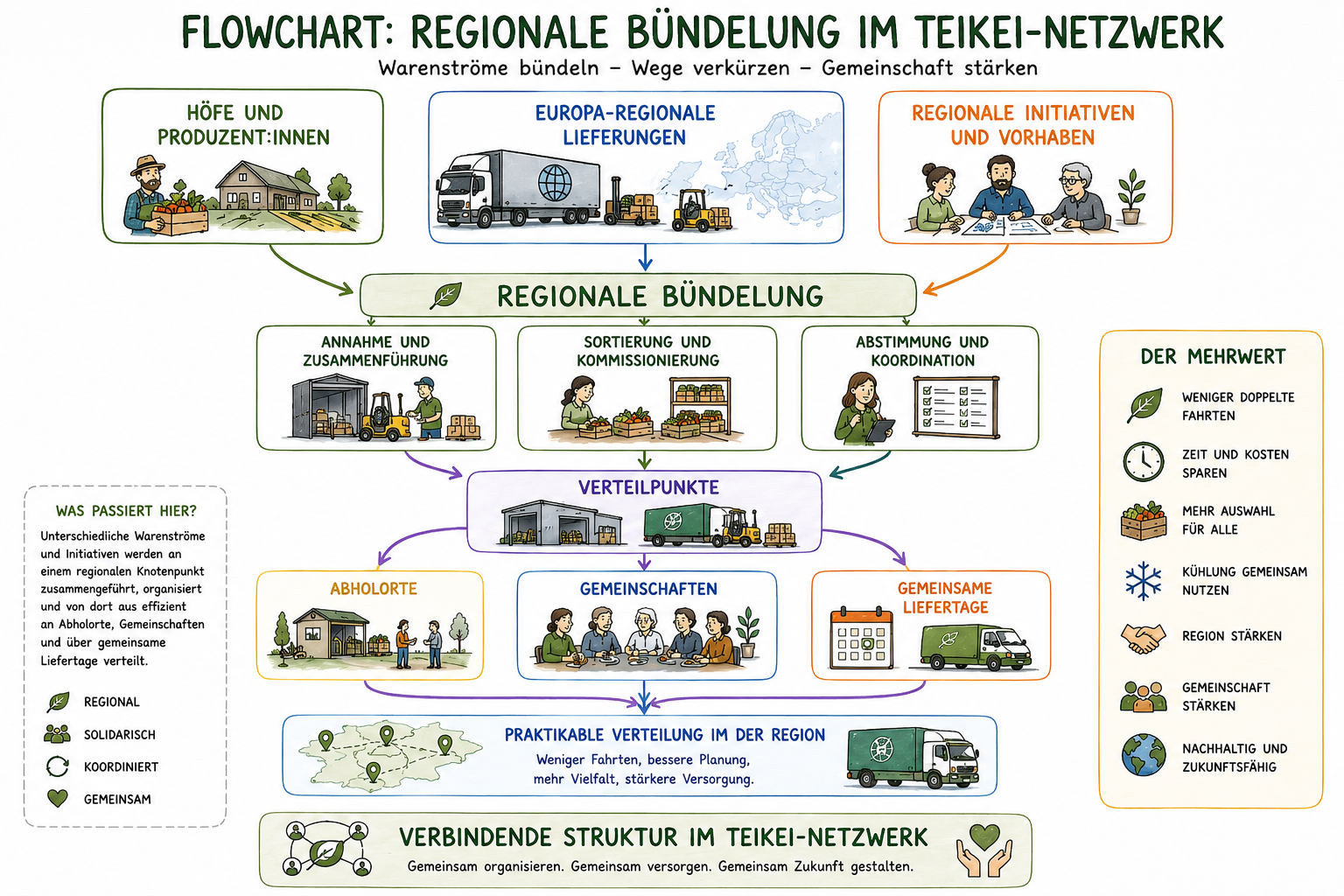
¶ Flowchart: Goods Flows Today and with Regional Bundling
The following flowchart shows the difference between uncoordinated distribution with many individual routes and regional bundling.
In the current situation, multiple farms or projects travel individually to different pickup locations. Orders, delivery notes, rhythms, and responsibilities often arise separately from one another. This quickly makes distribution confusing.
With regional bundling, a shared goods flow emerges: A pickup round connects multiple farms, brings their products to a regional bundling point, and also consolidates Europe-regional deliveries as well as products from other food regions there. Orders, delivery notes, rhythms, and distribution points are prepared jointly at this point. This allows a bundled assortment to be created at individual pickup locations.
¶ Classification: Current Situation Without Regional Bundling
In this scenario, many individual goods routes emerge. Individual producers supply certain pickup locations directly. Some pickup locations also receive Europe-regional products, others do not. While this creates diversity in the network, there is no shared assortment at all pickup locations.
This can work for small, established individual relationships. However, as soon as multiple producers, multiple pickup locations, and different types of offerings come together, this structure quickly becomes confusing.
Advantages
- direct relationship between producers and individual pickup locations
- simple individual agreements possible
- no additional bundling structure needed
- well-suited for small, already established individual relationships
- individual producers can deliver flexibly and at short notice
Disadvantages
- many individual trips
- different delivery and order rhythms
- separate delivery notes and agreements
- high coordination effort for producers, organizers, and pickup locations
- no shared assortment at all pickup locations
- products are only available at individual pickup locations
- members must consider different pickup locations, ordering processes, or times depending on the product
- Europe-regional products are not automatically connected with regional products
- regional products from different farms do not appear as a shared offering
- pickup locations remain differently attractive depending on which products are coincidentally available
- smaller pickup locations can grow more difficultly because no sufficiently broad assortment emerges
- the supply appears fragmented from the outside
- new members find it harder to understand where to get what
- entry for a larger population group remains confusing
- farms quickly bear responsibility for pickup locations, communication, and additional logistics
- distribution remains highly dependent on individual agreements
- waiting lists for CSA structures are harder to expand permanently if the offering is not easily accessible in everyday life
Without regional bundling, supply remains highly dependent on individual routes, individual relationships, and individual pickup locations.
This may be suitable for small contexts but becomes a limitation when a good, broader offering for more people is to be created.
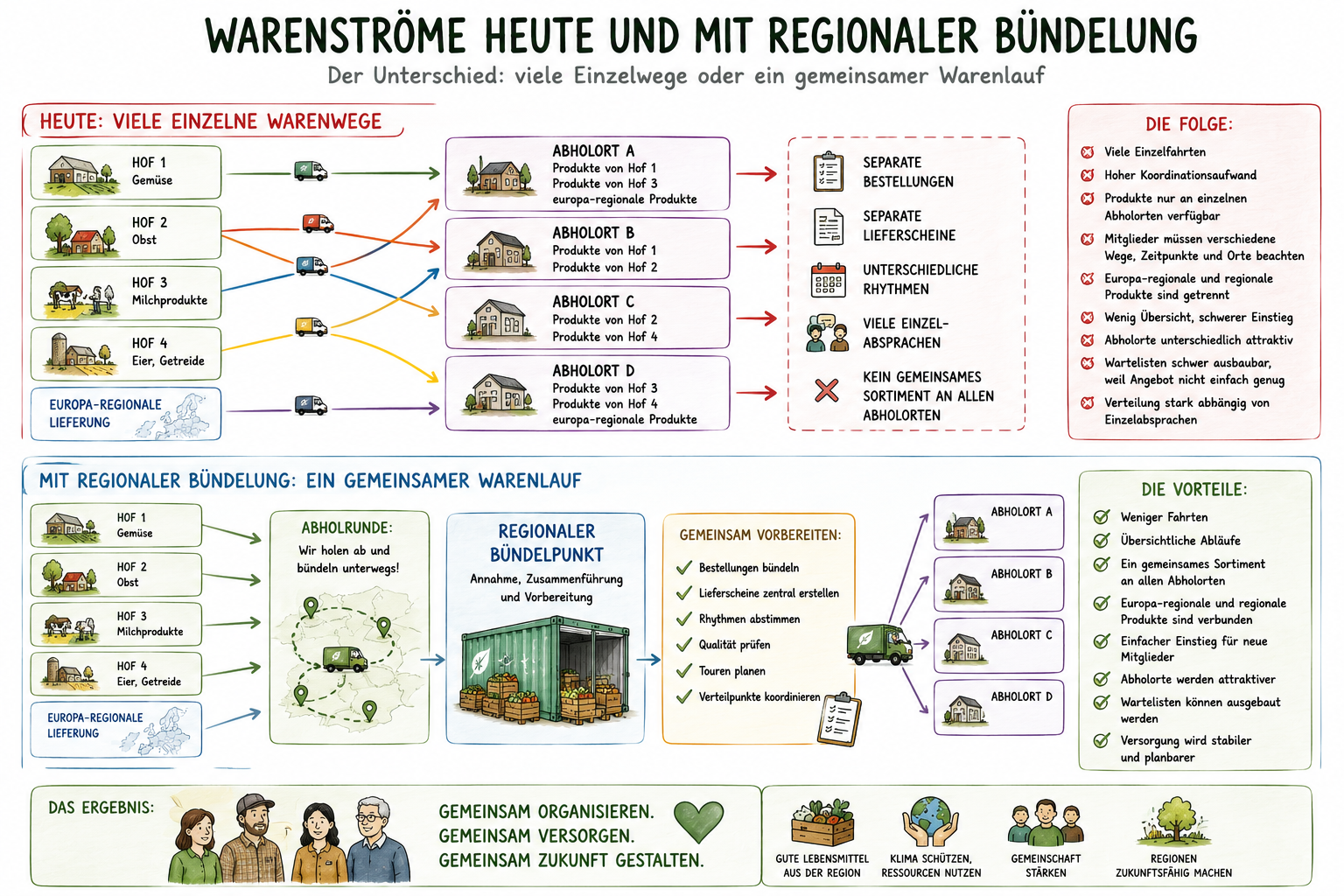
Current Situation: Many Individual Goods Routes
How to Read This Diagram: Each producer (1) supplies two pickup locations directly. The Europe-regional delivery (2) only goes to pickup location A and pickup location D. This means each pickup location (3) receives a different partial assortment:
| Pickup location | receives |
|---|---|
| Pickup location A | Product from Producer 1, Product from Producer 3, Europe-regional products |
| Pickup location B | Product from Producer 1, Product from Producer 2 |
| Pickup location C | Product from Producer 2, Product from Producer 4 |
| Pickup location D | Product from Producer 3, Product from Producer 4, Europe-regional products |
The individual effort (4) is evident as follows: Producer 1 has separate orders, Producer 2 has separate delivery notes, Producer 3 has different rhythms, Producer 4 has many individual agreements. Because each pickup location receives different products, there is no shared assortment at all pickup locations (5).
¶ Classification: Situation with Regional Bundling
In this scenario, goods flows are first consolidated. A pickup round connects multiple producers. The products come together at a regional bundling point. There, they are combined with Europe-regional deliveries and products from other food regions, sorted by distribution points, and passed on with shared delivery notes.
Advantages
- fewer individual trips
- shared rhythms become possible
- orders can be better consolidated
- delivery notes can be created in bundles
- regional, Europe-regional, and supplementary products from other food regions come together
- distribution points receive a bundled assortment
- members find more products at their pickup location
- pickup locations become more attractive and understandable
- coordination becomes visible at a shared location
- regional supply can gradually become more sustainable
Disadvantages
- clear coordination is required
- a regional bundling point must be organized
- pickup times, delivery notes, and responsibilities must be aligned
- errors at the bundling point can affect multiple distribution points
- the start requires shared rules
- without simple processes, additional complexity can arise
Outlook
Through a shared membership and contribution logic, the costs of regional bundling can be borne differently than in individual farm-pickup location relationships.
Pickup locations, distribution points, and regional bundling structures would no longer be the sole responsibility of individual producers. They would become part of the shared network and could be co-financed through contributions managed via the TEIKEI Agora or the shared platform structure.
This includes, for example:
- basic costs of pickup locations
- costs for regional bundling points
- coordination of pickup and delivery rhythms
- shared delivery notes and accounting processes
- intermediate logistics between producers, regional bundling, and distribution points
- storage, cooling, or space usage costs
- organizational work in the background
This way, logistics would no longer appear merely as an additional task for individual farms.
It could be understood as a community-supported infrastructure and co-financed through contributions to basic cost participation, usage fees, or other contributions within the network.
This is not yet a finished model, but an important outlook: Regional bundling can only become sustainable in the long term if its costs are made visible collectively and borne collectively.
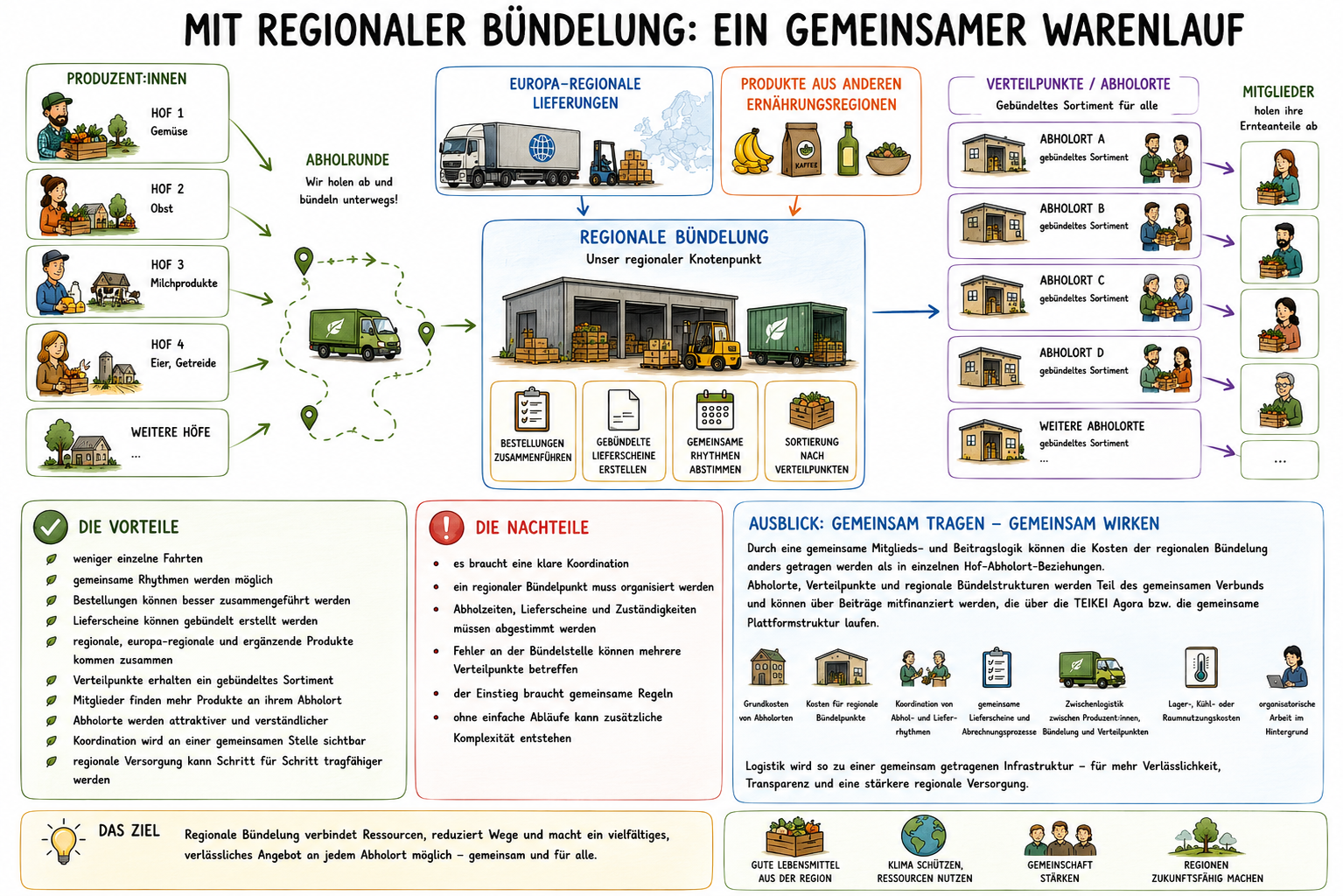
With Regional Bundling: A Shared Goods Flow
This is how it could work: With regional bundling, a shared goods flow emerges. The numbers in the diagram correspond to this list:
- Pickup round: A pickup round visits Farm 1 → Farm 2 → Farm 3 → Farm 4 and also collects goods from additional farms (Farm 1, Farm 2, Farm 3, Farm 4, and others).
- Regional bundling: Here, the goods from the pickup round are combined with Europe-regional deliveries and products from other food regions.
- Joint preparation: The regional bundling handles three tasks: consolidating orders, creating bundled delivery notes, and coordinating shared rhythms.
- Sorting by distribution points: All three tasks feed into the sorting. The bundling also passes the goods directly to sorting.
- Distribution points / Pickup locations: Each distribution point receives a bundled assortment: Distribution point / Pickup location A, bundled assortment; Distribution point / Pickup location B, bundled assortment; Distribution point / Pickup location C, bundled assortment; Distribution point / Pickup location D, bundled assortment; other distribution points, bundled assortment.
- Members pick up: Members collect their goods at each distribution point.
¶ Role in the Network
In the TEIKEI Network, there are different levels of logistical responsibility.
While collection warehouses and distribution warehouses are described more as infrastructural nodes, regional bundling is closer to the concrete practice of a specific area.
It operates where:
- multiple initiatives cooperate with each other
- shared distribution points are used
- types of offerings are delivered in bundles
- initial logistical test runs take place in a region
Regional bundling is thus a connecting structure between local initiative and larger network context.
¶ Why This Level Is Important
Not every region needs a fully developed warehouse or complete distribution infrastructure from the start.
Collaboration often begins with people in a region first learning how to organize delivery, bundling, and onward distribution together.
Especially in such development phases, regional bundling helps to:
- better utilize existing resources
- consolidate individual deliveries
- connect distribution points sensibly
- make new regions operational
- link international and regional goods flows
It is thus a learning and growing form of regional logistics.
¶ Example Tasks
Depending on the region, regional bundling can take on different tasks:
- receiving goods from multiple farms
- temporary intermediate station before distribution
- sorting and order picking for individual pickup locations
- coordination between organizers and projects
- connecting regional and international deliveries
- preparing shared delivery days
What matters is not technical perfection but the ability to make supply sustainable through community effort.
¶ Embedding in the Region
Regional bundling is always tied to a specific area.
A region like Freiburg, for example, can show how:
- different projects cooperate with each other
- shared distribution points are used
- pickup locations and communities are better connected
- types of offerings from multiple farms come together in one delivery
This makes regional bundling a place of lived network economy.
¶ Goal of This Level
This page creates a concept and a place for that form of collaboration that operates between farm, distribution point, and community.
It makes visible that supply does not only depend on production and pickup but also on the ability to bundle wisely in a region, coordinate collectively, and gradually build sustainable logistics.
¶ Further Links
↑ One level up: Actors
By Felix Schröder, with support from AI (ChatGPT)
Created on March 29, 2026 · Last updated on October 10, 2026
Questions or feedback? support@teikei.us