¶ The 4M Practice at TEIKEI
When we rethink food supply, simply shopping differently is not enough.
The real difference emerges where our role changes.
No longer just consuming.
No longer just choosing.
No longer just comparing.
But becoming part of a system that we collectively sustain.
¶ The 4M Practice
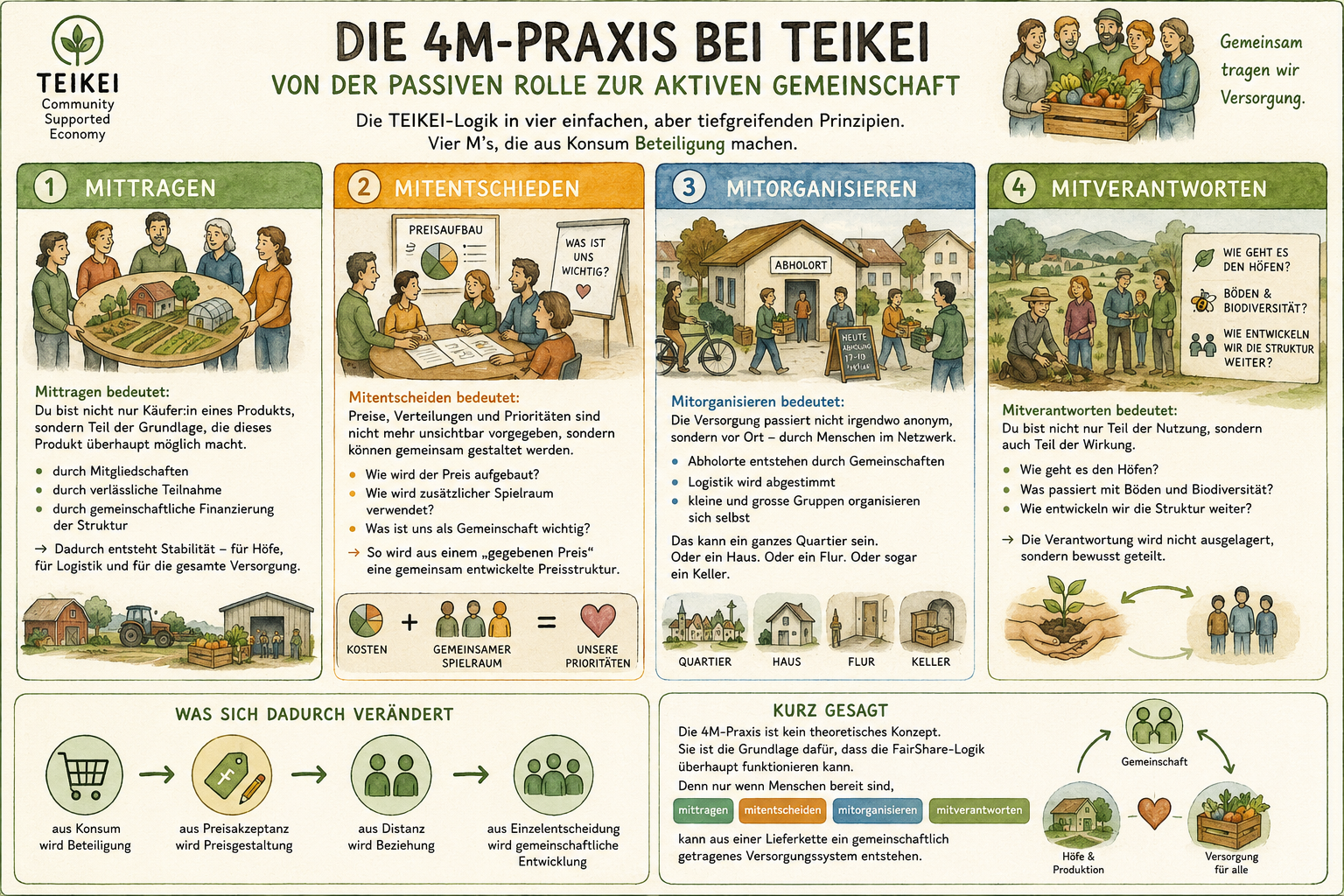
The TEIKEI logic can be summarized in four simple yet profound principles:
- co-sustaining
- co-deciding
- co-organizing
- co-responsibility
These four "M"s describe what it means to transition from a passive role into an active community.
¶ 1. Co-sustaining
Co-sustaining means:
You are not just a buyer of a product, but part of the foundation that makes this product possible in the first place.
- through memberships
- through reliable participation
- through collective financing of the structure
This creates stability—for farms, for logistics, and for the entire supply system.
¶ 2. Co-deciding
Co-deciding means:
Prices, distributions, and priorities are no longer invisibly predetermined but can be shaped together.
- How is the price structured?
- How is additional leeway used?
- What matters to us as a community?
This turns a "given price" into a collectively developed pricing structure.
¶ 3. Co-organizing
Co-organizing means:
Supply does not happen somewhere anonymously but locally—through people in the network.
- Pickup locations emerge through communities
- Logistics are coordinated
- Small and large groups organize themselves
This could be an entire neighborhood.
Or a house.
Or a hallway.
Or even a basement.
This makes supply tangible and concrete again.
¶ 4. Co-responsibility
Co-responsibility means:
You are not just part of the usage but also part of the impact.
- How are the farms doing?
- What happens to soils and biodiversity?
- How do we further develop the structure?
Responsibility is not outsourced but consciously shared.
¶ What Changes as a Result
The 4M practice describes a shift in roles:
- from consumption to participation
- from price acceptance to price shaping
- from distance to relationship
- from individual decision to collective development
¶ In Short
The 4M practice is not a theoretical concept.
It is the foundation that makes the FairShare logic possible in the first place.
Because only when people are willing to:
- co-sustain
- co-decide
- co-organize
- co-responsibility
can a supply chain become a collectively sustained supply system.
One level up: FairShare
Author: Felix Schröder, with assistance from AI (ChatGPT)
Creation: written by Felix Schröder › formatted in Markdown by ChatGPT › published by Felix Schröder › layout adjusted by Claude
Created: 2026-04-14 · Last updated: 2026-05-08 · Questions or feedback? support@teikei.us