¶ FairShare at TEIKEI
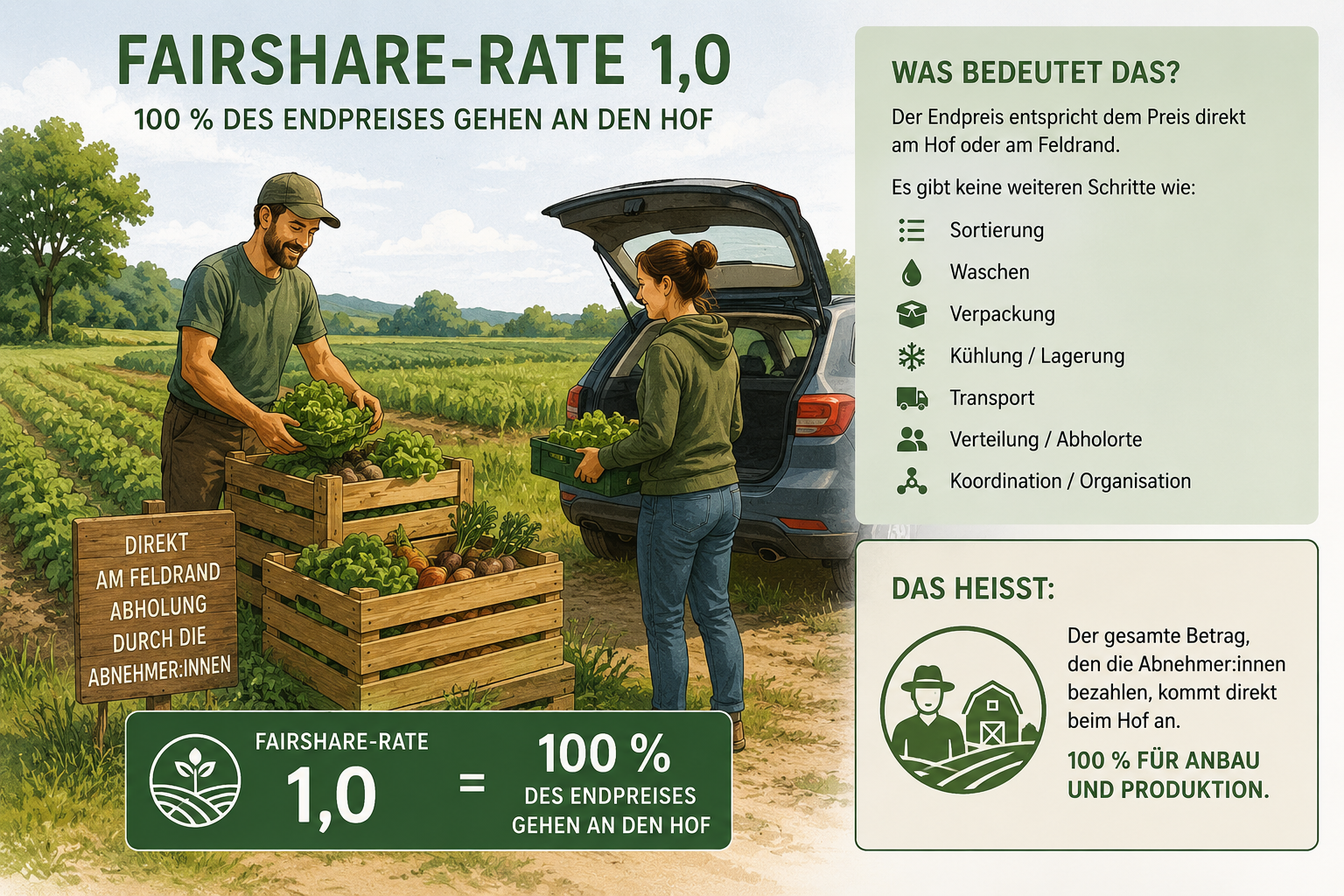
Imagine a product right at the edge of the field.
It has been harvested, but not yet washed.
It is not sorted, not packaged, not cooled, and not transported.
It is ready in simple harvest crates.
When the recipients pick it up right there, the entire price goes directly to the farm.
This is FairShare Rate 1.
From there, the real question begins:
Which steps are necessary for this product to reach a community?
What do these steps cost?
Who bears them?
And how much of the final price ultimately remains with the farm?
At TEIKEI, the FairShare Rate is a simple metric for this big question:
How much of the final price actually reaches the farm – and how much is used along the way for harvesting, sorting, washing, packaging, storage, transport, coordination, and distribution?
It makes visible whether a supply chain truly brings people closer to production
or whether it just sounds better but structurally functions similarly to conventional trade.
The FairShare Rate is therefore not a marketing value.
It is a test value.
It helps to recognize:
- how directly a product travels from the farm to the community
- which additional work steps increase the final price
- what share remains with the producing farm
- whether the responsibility chain is efficiently and meaningfully designed
- whether a model truly has a transformative effect or just sounds good
The term farm share refers to the portion that flows directly into cultivation and production or reaches the producing farm.
¶ What does a FairShare Rate of 1 mean?
A FairShare Rate of 1.0 means:
The final price corresponds to the price directly at the farm or at the edge of the field.
In this case, 100% of the final price flows into agricultural production or to the producing farm.
This can mean, for example:
- a product is harvested
- it is located directly at the edge of the field
- it is not sorted
- it is not washed
- it is not packaged
- it is in simple harvest crates
- the recipients pick it up themselves
- there is no further storage, logistics, or distribution
This is the most direct form.
As soon as additional steps are added, the FairShare Rate changes.
If a product is offered through a farm store, additional tasks arise.
If it is washed, sorted, cooled, packaged, or transported, additional costs arise.
If larger structures, pickup locations, storage, or digital tools are used, costs also arise.
These costs are not wrong.
They show that work is being done.
What is important is that it remains visible which work is added, who bears it, and how much the final price changes as a result.
A higher FairShare Rate does not automatically mean something is bad.
It initially only shows:
Additional necessary steps lie between the farm and the member.
The crucial question is:
Are these steps meaningful, transparent, and collectively borne – or does unnecessary extraction occur along the way?
¶ How is the FairShare Rate interpreted?
The FairShare Rate compares two prices:
- the price directly at the farm
- the final price at the community
Simply put:
How many times is the farm price contained in the final price?
Examples:
-
FairShare Rate 1.0
→ the final price corresponds to the farm price
→ approximately 100% remains with the farm -
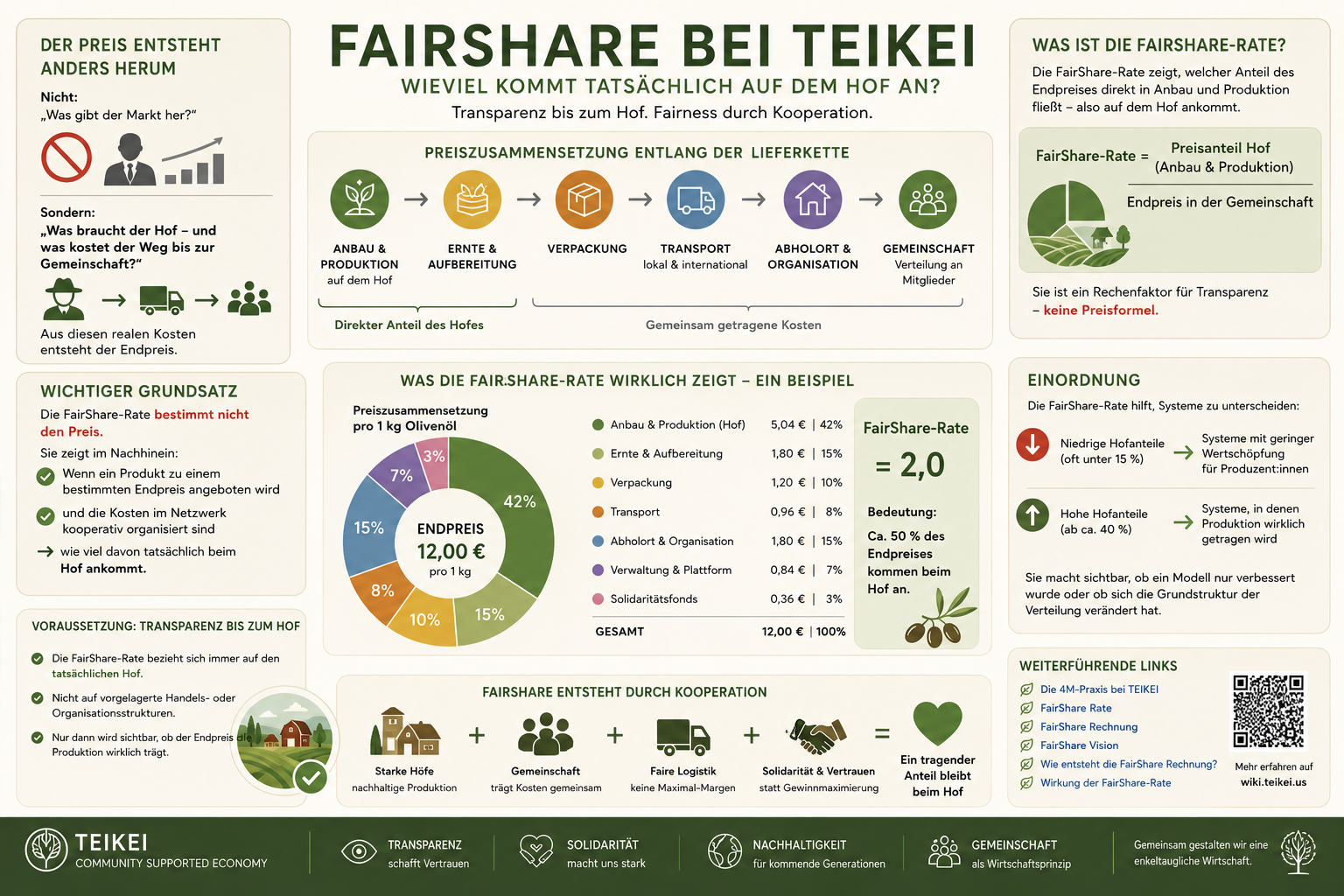
FairShare Rate 2.0
→ the final price is twice as high as the farm price
→ approximately 50% remains with the farm -
FairShare Rate 4.0
→ the final price is four times as high as the farm price
→ approximately 25% remains with the farm -
FairShare Rate 8.0
→ the final price is eight times as high as the farm price
→ approximately 12.5% remains with the farm
The lower the FairShare Rate, the greater the share that remains with the farm.
The higher the FairShare Rate, the more costs, steps, or extractions lie between the farm and the member.
¶ At TEIKEI, the price is created the other way around
In conventional trade, the question is often:
"What can the market bear?"
At TEIKEI, the question is:
"What does the farm need – and what does the path to the community cost?"
The final price is based on these real costs.
The price does not start with the market.
It starts with the farm reality:
- cultivation
- care
- harvest
- processing
- soil
- water
- people
- machinery
- storage
- risks
- development opportunities
- basic cost coverage
In addition, there is the path from the farm to the community:
- sorting
- washing
- packaging
- storage
- transport
- import and customs clearance, if necessary
- coordination
- pickup locations
- digital infrastructure
- communication
- community management
If we compare the price at the community with the price at the farm, the FairShare Rate results.
It shows what share of the final price actually reaches the producing farm.
¶ Important Principle
The FairShare Rate is not a tool for price setting.
It does not say:
This price is right.
This price is wrong.
It shows retrospectively how a final price is composed.
It makes visible:
- what share goes directly to the farm
- what costs arise on the way to the community
- how much additional steps change the final price
- whether the responsibility chain is sustainably and meaningfully organized
The FairShare Rate is therefore a transparency and orientation metric.
It helps to understand prices.
It does not set prices.
¶ Prerequisite: Transparency down to the farm
For the FairShare Rate to be meaningful at all, a clear foundation is needed:
Transparency must extend all the way to the producing farm –
not just to a warehouse, exporter, or organizational intermediary.
This means:
- The FairShare Rate always refers to the actual farm
- not to upstream trade or organizational structures
- and not to aggregated or obscured price information
Only then does it become visible whether the final price truly supports production.
If only an intermediate price is known, no clear picture emerges.
Then we might know what a warehouse, an exporter, or an organization received.
But we still do not know whether the farm is truly supported.
FairShare therefore requires transparency down to the origin.
Not for control.
But so that it becomes visible whether responsibility reaches the place where agricultural reality begins.
¶ Additional costs are not automatically a problem
Not every additional cost is a problem.
A farm store requires work.
Sorting takes time.
Cooling requires infrastructure.
Transport requires vehicles, people, energy, and planning.
A pickup location requires organization.
Digital infrastructure requires maintenance and development.
All of this can be meaningful.
The FairShare Rate does not morally evaluate these steps.
It makes them visible.
This allows for joint examination:
Which steps are necessary?
Which steps can be better bundled?
Which steps strengthen the supply?
Which steps increase the price without strengthening responsibility?
This is how the FairShare Rate distinguishes between real, necessary additional costs and unnecessary extraction.
¶ The FairShare Rate as a test value for the responsibility chain
The FairShare Rate helps to understand the efficiency of a responsibility chain.
It does not just show whether a price "sounds fair."
It shows how much of the final price actually remains with the farm and how much is needed along the way for additional tasks.
This allows TEIKEI to ask concrete questions:
- Is this path from the farm to the community meaningful?
- Are the additional steps necessary?
- Are transport, storage, and distribution well bundled?
- Is work made visible and appropriately borne?
- Does unnecessary price increases occur along the way?
- Does the farm truly reach a sustainable situation despite the final price?
- Is the model structurally different – or just differently presented?
This makes the FairShare Rate a tool against pure marketing.
It shows whether a supply is truly organized differently.
¶ Why a bonus is not enough
Many models talk about fair prices, premiums, or bonus payments.
This can be helpful.
But a bonus does not automatically change the basic structure.
What matters is not just whether the farm receives something extra.
What matters is what share of the total final price actually reaches the farm.
If a product costs very little at the farm and is later sold for many times that amount, a small bonus may sound good without fundamentally changing the distribution.
The FairShare Rate therefore looks at the whole.
It does not ask:
Was there a markup?
It asks:
What share of the final price truly supports production?
¶ Transformative or just better told?
The FairShare Rate also helps with an uncomfortable question:
Does a model truly change the structure of the supply?
Or does it just stabilize the existing system with a better story?
A food product can be described as regional, organic, or fair.
Nevertheless, the largest part of the final price may disappear along the way into structures that have little to do with the farm.
Then the food system is not changed.
Then only the existing system is perpetuated.
The FairShare Rate helps to make this difference visible.
It does not ask about the narrative.
It asks about the flow of money.
And thus about real responsibility.
¶ What the FairShare Rate truly shows
The FairShare Rate makes visible what is possible through cooperation.
When transport, organization, and distribution are collectively borne
and not every step is designed for maximum margin,
→ a final price can emerge in which a supporting share remains with the farm.
This is not a fixed price.
It is the result of a functioning structure.
A FairShare Rate of 2.0, for example, means:
→ approximately 50% of the final price goes into cultivation and production.
This is hardly achievable in many conventional structures because numerous stages lie between the farm and the final price, each incorporating their own costs, risks, margins, and power positions.
At TEIKEI, it becomes visible which steps are truly necessary.
And which steps can be organized differently.
¶ Classification
The FairShare Rate helps to distinguish between systems:
- Systems with low farm shares
- Systems with long, hard-to-trace paths
- Systems with high intermediate costs
- Systems with strong narratives but weak money flow to the farm
- and systems in which production is truly supported
It makes visible whether a model has only been improved
or whether the basic structure of distribution has changed.
FairShare makes visible whether supply is organized differently – or just told differently.
¶ Further Reading
The following articles show how the FairShare logic works in practice and what impact it has on price structures:
- The 4M Practice at TEIKEI
- FairShare Rate
- FairShare Calculation
- FairShare Vision
- How is the FairShare Calculation created?
- Impact of the FairShare Rate
One level up: 09 - Economy & Vision
Author: Felix Schröder, with the help of AI (ChatGPT)
Creation: written by Felix Schröder › formatted in Markdown by ChatGPT › published by Felix Schröder › display adjusted by Claude
Created: 2026-03-27 · Last updated: 2026-05-19 · Questions or feedback? support@teikei.us