¶ How the FairShare Logic Becomes Possible in TEIKEI
Economy & Vision › FairShare · 8 min read
At first glance, the FairShare calculation appears to be a simple redistribution of the final price.
In reality, it is based on a fundamentally different way of organizing agriculture, logistics, distribution, and economic responsibility.
¶ The Decisive Difference
In conventional systems, the price is determined by the market:
- Supply and demand dictate what is "feasible"
- Producers receive a market price or a slightly improved version of it
- Fair surcharges or bonuses are often added afterward
- At the same time, products frequently bear costs that are only indirectly related to their own supply chain
In the TEIKEI system, the calculation starts at a different point:
- The central question is not "What can the market bear?"
- Instead, the question is: "What is concretely needed to make cultivation, logistics, distribution, and collaboration sustainably organizable?"
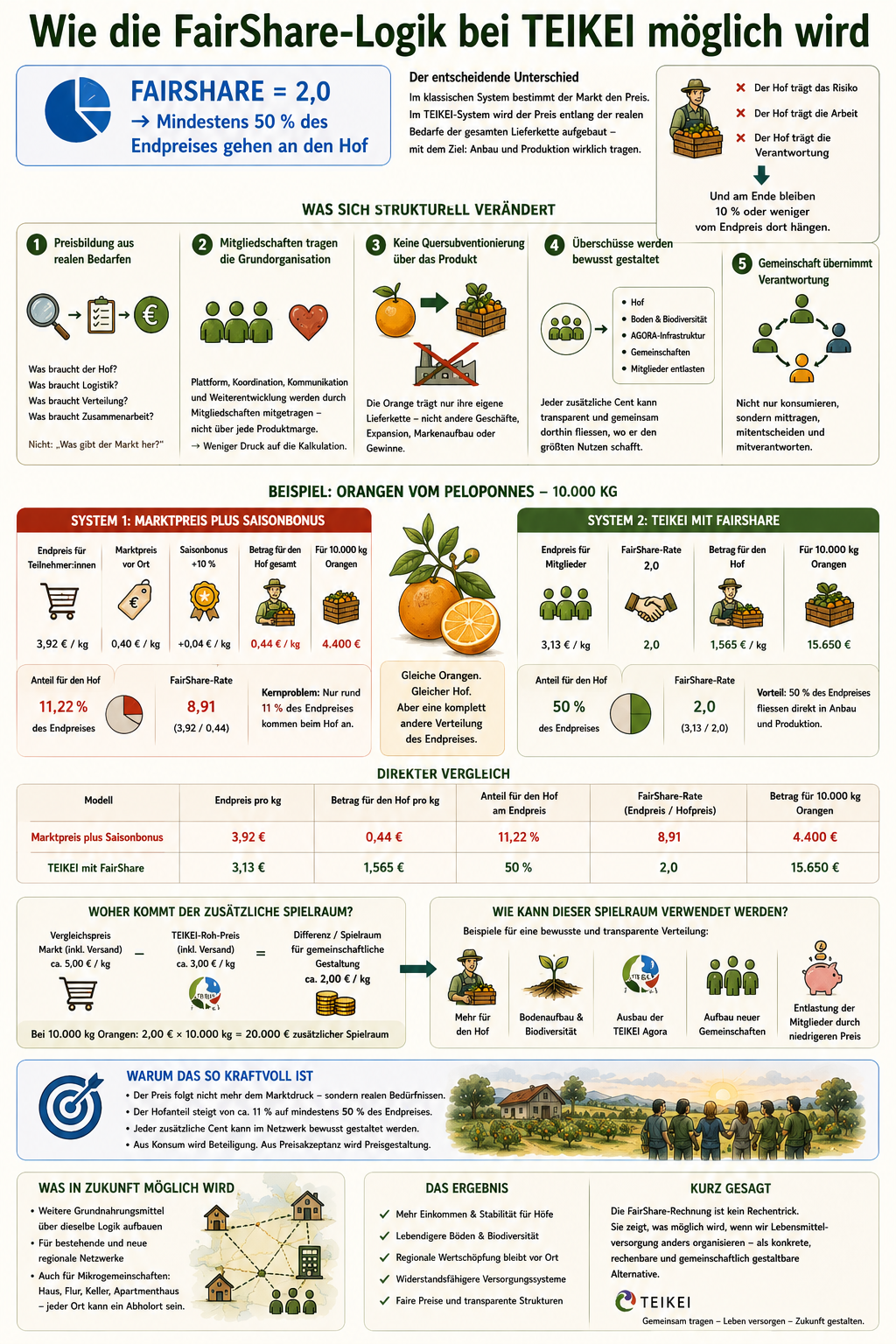
The price is thus not set from above by market logic but is built along the real needs of the supply chain.
¶ What Changes Structurally
The FairShare logic only becomes possible because several fundamental decisions come together.
¶ 1. The Price Arises from Real Needs, Not Market Pressure
In discussions with farms, the first question is not what price would be enforceable in competition.
The starting question is:
- What does the farm need to make agriculture viable?
- What does logistics need?
- What does the final distribution need?
- What does collaboration need to function sustainably?
This creates a price based on the actual requirements of the participants—not based on what a market is currently pushing or allowing in the short term.
¶ 2. The Basic Organization of TEIKEI Is Supported Through Basic Cost Contributions
A key difference is that the basic costs of the TEIKEI Agora do not have to be fully covered by each individual product.
Basic cost contributions / harvest shares already cover parts of the shared structure, such as:
- Platform
- Coordination
- Communication
- Organizational work
- Further development of the network
As a result, the core organization is under significantly less economic pressure than conventional companies, which must finance their entire structure through product margins.
This fundamentally changes the calculation.
At the same time, it is important to note: We have not yet fully arrived at this point.
We are on the way to securing the basic organization as far and as stably as possible through memberships and community-supported structures, so that the FairShare calculation can be gradually expanded. The less pressure there is on the core organization to secure its existence through product margins, the more resources can flow along the supply chain to where they are actually needed: into agriculture, into farms, into soil fertility, biodiversity, and the long-term transformation of agricultural systems.
This is precisely why we are also working on establishing a cooperative.
The cooperative will enable and secure the framework conditions of this FairShare logic in depth. It creates a structure in which not a few control the supply chain while others only buy or supply, but in which all participants have the opportunity to become participants and co-owners of the supply chain.
This applies to, for example:
- Producers
- Organizers
- Communities
- Logistics actors
- Members in the network
This gradually creates a supply structure in which responsibility, design, and ownership come closer together.
The FairShare calculation is therefore not just a different pricing logic but part of a larger organizational change: toward a community-supported supply chain in which value creation, responsibility, and decision-making power are distributed more fairly.
¶ 3. There Is No Cross-Subsidization Through the Product
In conventional trade, a product often not only carries its own supply chain but also additional structures:
- Central corporate apparatuses
- Expansion
- Other business areas
- Factories or investments in other locations
- Reserves for growth
- Marketing and brand logics
- Profit extraction
At TEIKEI, the claim is different:
The orange should not covertly generate income for something that has little to do with its specific supply chain.
It should enable:
- The farm to cultivate
- Packaging and transport to be covered
- Final distribution to function
- Communities to gain access to food
This is where a major difference lies.
¶ 4. Surpluses Are Consciously Designed Instead of Invisibly Extracted
When members are willing to pay more than the pure actual costs of the supply chain, leeway is created.
This leeway does not automatically disappear into corporate margins but can be consciously designed.
For example:
- As a direct additional amount for the farm
- As a fund for soil regeneration and biodiversity
- As an investment in new functions of the TEIKEI Agora
- As support for building further communities
- As a mixed model between farm, infrastructure, and transformation
This means:
Every additional cent per kilogram can be consciously allocated within the network.
Not a company decides covertly on its margin, but the community can visibly decide which development it wants to enable.
¶ How the Calculation for Oranges Can Be Understood in Concrete Terms
The figure of approximately €16,000 to €22,000 for 10,000 kg of oranges is not just a random range.
It shows the potential that arises when products are not calculated according to market logic but according to real costs and community priority.
¶ Starting Point: The Actual Costs of the Supply Chain
In the TEIKEI model, the actual costs of the specific supply chain are first reflected in the product price.
These include, for example:
- Cultivation
- Harvest
- Packaging
- Transport
- Distribution
The basic costs of the TEIKEI Agora itself are not fully passed on to the product because they are supported by basic cost contributions.
In this example, this results in a "raw price" of approximately:
- Converted to €3.00 per kg of oranges (including a current TEIKEI trading margin of 10% in the transition phase until the cooperative structure is implemented)
This price covers the real supply chain under TEIKEI conditions, including shipping costs to the community.
¶ Comparison with an Existing Market Price
If, in the market for comparable organic oranges, a price of
- €4.00 to €5.00 per kg
is charged, plus shipping to the doorstep, it becomes clear how large the difference between real supply chain costs and typical market selling prices can be.
If we calculate conservatively with a comparison value of €5.00 per kg and a TEIKEI price of €3.00 per kg:
The difference is then:
- €5.00 - €3.00 = €2.00 per kg
For a quantity of 10,000 kg, this results in:
- €20,000 of additional leeway
And this is where the core of the FairShare logic lies.
¶ Where the Range of €16,000 to €22,000 Comes From
The range results from how this additional leeway is used within the network.
¶ Option 1: The Entire Additional Leeway Goes to the Farm
If the entire difference of around €2.00 per kg were added to the farm, this would result in 10,000 kg:
- €20,000 additionally
Then a large part of the difference would flow directly back into agricultural practice.
¶ Option 2: Part Goes to the Farm, Part to Joint Development
It is also possible to consciously and transparently divide this additional leeway.
For example:
- One-third for the farm
- One-third for the expansion of the Agora
- One-third for regenerative development or community funds
Or:
- A high share for the farm
- A smaller share for soil building, biodiversity, and transformation
Or also:
- Part for the farm
- Part for the further development of the community-supported infrastructure
- Part as direct relief for members through a lower final price
This means: The resulting leeway does not have to be automatically fully extracted or always distributed in the same direction. It can also be used to consciously lower the final price. In such a model, for example, one-third of the advantage could directly benefit the members by reducing the price per kilogram, while the remaining parts continue to benefit the farm and joint development.
Decisive here is not that there is only one correct distribution model. What is decisive is that discussions about the price structure become possible at all and that this price structure is transparent and traceable—right back to the farm itself and not just to the packing house.
This is where a fundamental difference from the usual market logic lies:
- It becomes visible what the farm needs
- It becomes visible what logistics and distribution need
- It becomes visible what community development needs
- And it becomes visible where members can be consciously relieved
Depending on the model, an amount of approximately
- €16,000 to €22,000
of additional value can be created, which is not extracted by the market but remains jointly designable within the network.
This range is therefore not a vague estimate.
It results from the question:
How do we want to use the leeway that arises when we organize food supply differently?
¶ Why This Is So Powerful
The real difference is not just that the farm can receive more.
The real difference is that the community begins to take responsibility for the entire price formation.
This means:
- Not just consuming
- Not just "buying fairly"
- Not just hoping that something will be better distributed somewhere in the end
But:
- Co-supporting
- Co-deciding
- Co-organizing
- Co-responsibility
This is precisely how the role of all participants changes.
From consumption to participation.
From price acceptance to price design.
From an anonymous supply chain to a cooperative supply system.
¶ What This Makes Possible in the Future
When we organize food supply in this way, much more is created than just a better orange price.
The foundation is laid to gradually build up further areas of basic food supply using the same logic.
The TEIKEI Agora is not just a platform but a tool for this new organization of supply:
- For existing communities
- For new regional networks
- And in the future also for micro-communities
This means:
- A house can be a community
- A floor can be a community
- A basement can be a community
- Even an apartment building can become a small pickup location
This can make routes shorter, access easier, and participation more everyday.
Not only large groups can organize themselves, but also small, local, and practical communities.
¶ In Short
The FairShare calculation is not a mathematical trick.
It shows what becomes possible when:
- Prices are based on real needs
- Basic costs are borne jointly
- Products do not have to cross-subsidize foreign structures
- Surpluses are consciously designed instead of invisibly extracted
Then, even with an orange, it becomes visible what potential lies in reorganizing food supply—as a concrete, calculable, and community-designable alternative.
↑ One level up: FairShare
By Felix Schröder, with support from AI (ChatGPT)
Created on April 14, 2026 · Last updated on May 8, 2026
Questions or feedback? support@teikei.us