¶ What a Higher FairShare Rate Enables
Economy & Vision › FairShare · 7 min read
¶ When More of the Final Price Flows into Cultivation and Production, It Changes Not Just Income – It Changes the Scope for Action Locally
A higher FairShare rate doesn’t simply mean that a farm “earns more money.”
It means that a larger portion of the final price reaches the place where the actual foundation of supply is created: in the field, in the soil, in the care of crops, in local collaboration, and in the people who carry out this work.
This is precisely where its true power lies.
Because as soon as more of the final price remains in cultivation and production, services can be provided that are often impossible or only partially possible under today’s price pressure.
¶ 1. A Higher FairShare Rate First Creates Stability
Many farms today operate under constant pressure:
- Yields must remain high
- Costs are continually rising
- Investments are postponed
- Necessary tasks are delayed or scaled back
- Dependencies on intermediaries, inputs, and loans increase
When a larger share of the final price stays directly on-site, something very fundamental emerges first:
greater calm in the economic foundation
This means:
- Ongoing costs can be covered more reliably
- Seasonal fluctuations are better absorbed
- Decisions no longer have to be made solely based on short-term financial shortages
- The farm gains time for more meaningful planning
A higher FairShare rate is therefore not just a financial improvement.
It is a prerequisite for being able to farm again from a position of internal stability.
¶ 2. Services Can Be Funded That Often Remain Invisible Today
A large part of the truly important work on a farm is often not adequately reflected in the final price of conventional systems.
This includes, for example:
- Care and observation of crops
- Soil building
- Compost management
- Humus development
- Mixed cropping and more diverse planting systems
- Care of marginal zones, hedges, and watercourses
- More careful harvesting
- Sorting into smaller units
- Community organization and coordination
These tasks do not always immediately increase short-term yields.
But they enhance the quality, resilience, and future viability of the entire system.
A higher FairShare rate makes precisely such services financially feasible.
¶ 3. Local Ecological Services Can Be Provided That Would Otherwise Be Lost
When price pressure decreases, a farm can do things that are often considered “too costly” under constant cost pressure.
These include, among others:
- Building and maintaining living soils
- Promoting biodiversity
- Establishing regeneration areas
- Integrating trees, hedges, and windbreaks
- Water-retaining structures in the soil
- Avoiding particularly aggressive inputs
- More manual labor where it is ecologically beneficial
- Transitioning to more diverse and robust cultivation systems
These services do not only affect the individual farm.
They impact the landscape, water balance, microclimate, and long-term fertility.
A higher FairShare rate therefore also means:
More money doesn’t just stay in the account – more money can flow back into the vitality of a place.
¶ 4. Room for Better Social Conditions Emerges
Not only soils suffer under price pressure, but people do too.
When a farm operates at its limits for too long, it has direct consequences:
- Self-exploitation
- Overwork
- Lack of recovery time
- No resources for further training
- Insufficient personnel support
- Insecurity for families and employees
A higher FairShare rate can therefore also enable social benefits, such as:
- Fairer wages
- Greater security for the farming family
- Additional workers during peak times
- Further training and knowledge transfer
- More time for planning, coordination, and quality work
- More dignified working conditions
This makes it clear:
FairShare is not just about products and prices. FairShare affects the daily lives of people on the ground.
¶ 5. Regional Value Creation Can Be Strengthened Locally
When more resources remain at the source, additional services can emerge or be strengthened in the region.
These include, for example:
- Local processing steps
- Storage and basic infrastructure
- Shared equipment
- Cooperation between multiple farms
- Regional logistics
- Educational and visitor formats
- Jobs in rural areas
- Stable relationships with communities and pick-up points
This not only strengthens the individual farm.
It fosters a more resilient environment around it.
A higher FairShare rate can thus help ensure that not only production is maintained, but also regional structures, skills, and collaboration.
¶ 6. Quality Is No Longer Played Off Against Survival
Under intense price pressure, farms often have to make decisions they would prefer not to make.
For example:
- Faster instead of more careful work
- Simpler instead of better solutions
- Short-term yield instead of long-term soil building
- Standardization instead of diversity
- Dependence on cheap inputs instead of self-development
A higher FairShare rate shifts this framework.
Then, decisions can be made more often for:
- Quality instead of speed
- Care instead of depletion
- Diversity instead of narrowing
- Regeneration instead of mere endurance
- Relationships instead of anonymous mass logic
This changes the quality of the entire supply system.
¶ 7. The Supply System Becomes More Crisis-Resistant
A system in which only a small portion of the final price remains in production is inherently fragile.
Even small changes can have major impacts:
- Extreme weather
- Crop failures
- Rising energy prices
- More expensive inputs
- Labor shortages
- Logistics disruptions
However, when more substance can be built locally, resilience increases.
For example, through:
- Healthier soils
- More robust plant populations
- Greater diversification
- Less dependence on external inputs
- More stable collaboration within the network
- Better planning on the farm
A higher FairShare rate therefore strengthens not only income but also the resilience of the entire supply system.
¶ 8. What Can Become Possible Locally
A higher FairShare rate can enable the following services to be provided or expanded on a farm or in its surroundings:
- Regular compost use and humus building
- Care of soil life and water retention capacity
- Planting of hedges, trees, and protective structures
- Transition to mixed cropping
- Consciously lower yield pressure per area
- Better harvest planning
- Investments in storage and simple processing
- Additional seasonal workers
- Time for documentation, transparency, and exchange
- Farm tours, encounters, and educational work
- Closer collaboration with local communities
- Stronger regional logistics and distribution
- Building of contingency and stability reserves
In conventional pricing logic, these services often appear as “side issues” or “additional costs.”
In reality, they are part of a healthy, future-proof agriculture.
¶ 9. The Deeper Connection
A higher FairShare rate does not stand alone.
It is connected to:
- Better planning
- Less depletion of people and soil
- More ecological care
- Stronger regional responsibility
- Less dependence on anonymous market mechanisms
- More transparency in pricing
- More sustainable relationships between farms, communities, and distribution
That is why FairShare is not just a metric.
FairShare is an expression of how seriously a system takes the foundation of its own supply.
¶ Closing Thought
The higher the share that truly remains in cultivation and production, the more can emerge locally that is necessary for a long-term healthy supply:
- Living soils
- Stable farms
- Dignified working conditions
- Diverse crops
- Regional collaboration
- Resilient supply structures
A higher FairShare rate is therefore not just an advantage for the farm.
It is a prerequisite for agriculture to fulfill its true purpose again:
to sustain life, secure supply, and build a future.
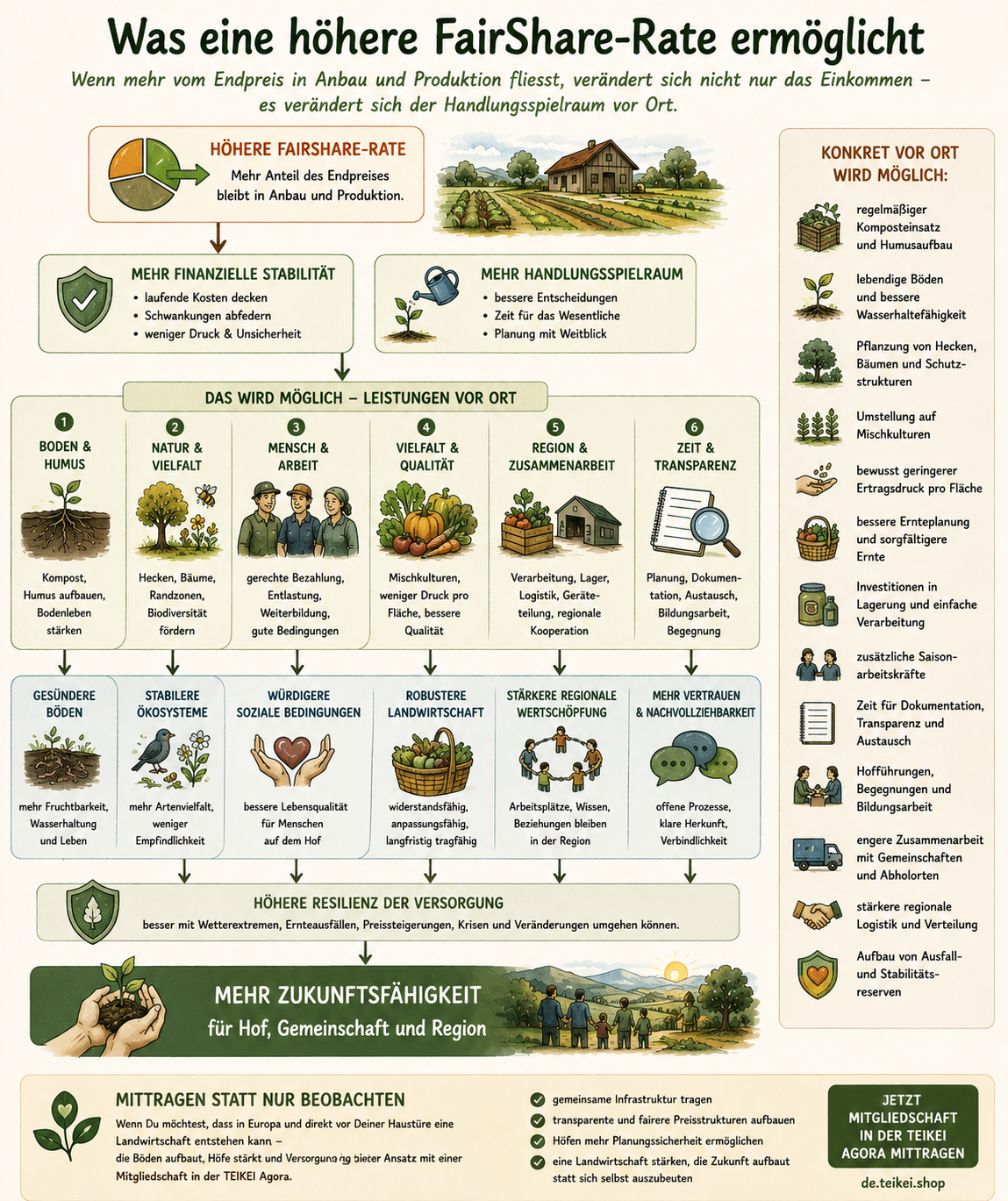
How It Could Be: What a Higher FairShare Rate Triggers
The diagram shows a chain of effects. Each step makes the next possible. In step 4, the scope for action on the farm opens up six areas of action. Each area has its own effect:
| No. | Area of Action on the Farm | Effect |
|---|---|---|
| 4.1 | Soil building and humus care | Healthier soils |
| 4.2 | Biodiversity and regeneration areas | More stable ecosystems |
| 4.3 | Better working conditions | More dignified social conditions |
| 4.4 | More diverse cultivation systems | More robust agriculture |
| 4.5 | Regional infrastructure and collaboration | Stronger regional value creation |
| 4.6 | More time for quality, planning, and transparency | Greater trust and traceability |
How to read the diagram: All six effects together lead to step 5, less dependence on external inputs. This is followed by steps 6 and 7.
¶ Support Instead of Just Observing
If you want agriculture in Europe and right on your doorstep to develop in a way that builds soils, strengthens farms, and organizes supply more fairly, then support this approach with a basic cost contribution in the TEIKEI Agora.
With your membership, you help:
- Support the shared infrastructure
- Build transparent and fairer pricing structures
- Give farms more planning security
- Strengthen an agriculture that builds a future instead of exploiting itself
Agriculture in Europe and on your doorstep deserves it.
↑ One level up: FairShare
By Felix Schröder, with support from AI (ChatGPT)
Created on April 2, 2026 · Last updated on May 8, 2026
Questions or feedback? support@teikei.us