¶ Contribution and Bidding Rounds in the TEIKEI Agora
¶ Classification
Contribution and bidding rounds are central tools in many community-supported agriculture (CSA) models to collectively bear financing.
They enable not a fixed price to determine access, but rather the community to jointly take responsibility for the costs incurred.
This principle can be mapped in the TEIKEI Agora in a structured, transparent, and Europe-regionally scalable manner.
¶ Basic Principle from CSA
In classic CSA models, a bidding round often proceeds as follows:
- The total requirement of a farm is disclosed (e.g., annual budget)
- This requirement is divided into shares
- Members indicate what contribution they can make
- Higher contributions offset lower contributions
- Goal: The total requirement is fully covered
Important:
The focus is not on a market price, but on covering real costs through the community.
¶ Transfer to TEIKEI
The TEIKEI Agora expands this principle with three central elements:
¶ 1. Precise Needs Assessment
Through the Agora, the need can be determined very accurately:
- Number of participants
- Desired delivery quantities
- Product selection and seasonal planning
- Regional differences
This creates a realistic picture of the actual supply requirement.
¶ 2. Clear Cost Structure (Dual Transparency)
Through the combination of:
- Dual Transparency (making the cost structure visible)
- Traceability App (traceability along the entire chain)
the following costs can be transparently presented:
- Production (cultivation, care, harvest)
- Logistics (transport, storage, distribution)
- Infrastructure (platform, organization, community work)
- Risk equalization (crop failures, fluctuations)
The community thus sees not just an end price, but understands the composition.
¶ 3. Community-Organized Contribution Rounds
On this basis, contribution rounds can be organized in the Agora:
- A total requirement is defined (e.g., for a season or a year)
- The community sees the costs transparently
- Participants choose their individual contribution
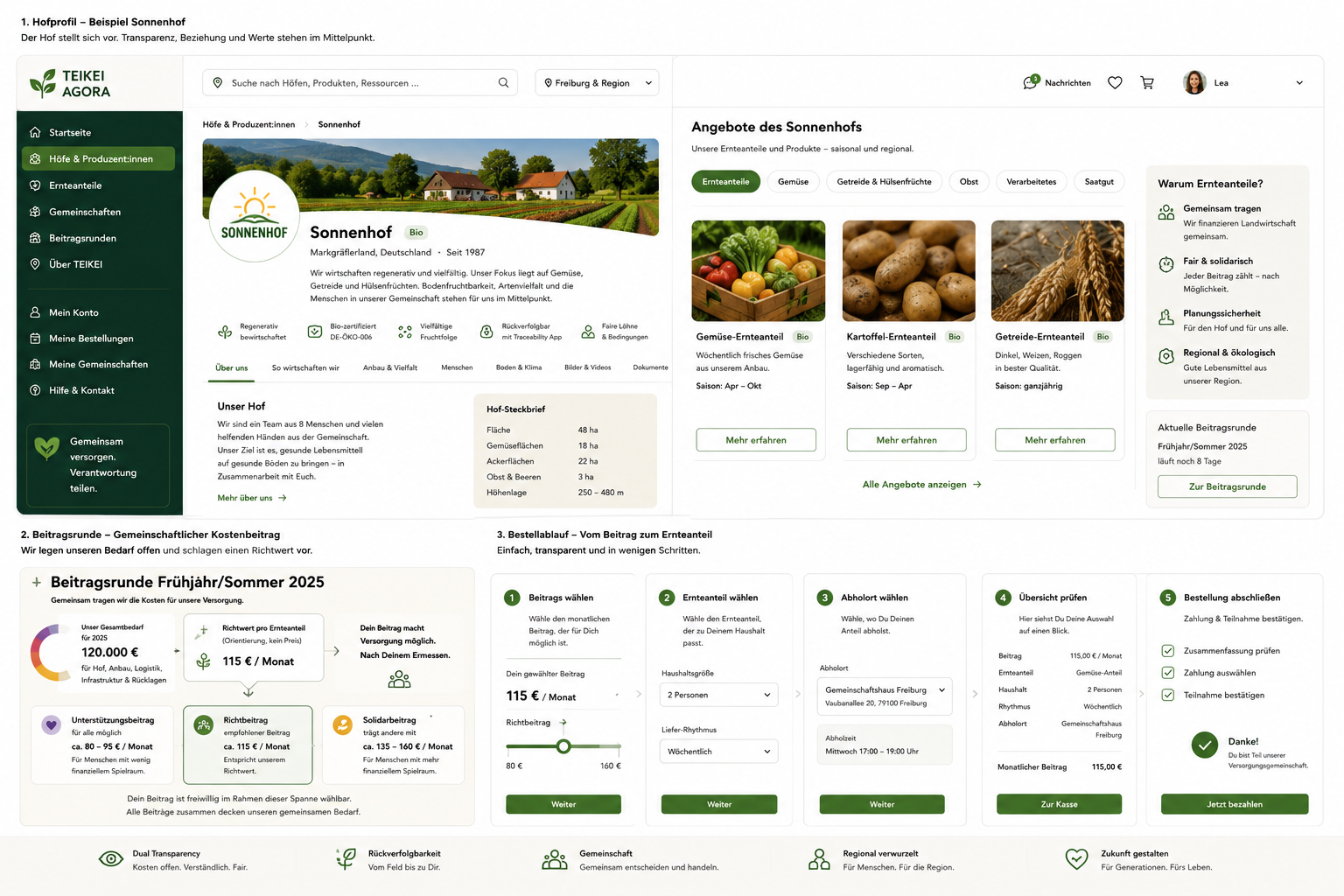
- Contributions can be structured via minimum, guideline, and support contributions
The organization can be carried out by:
- AgoraAdmins
- Network Stewards
- Local community groups
¶ Possible Process in the TEIKEI Agora
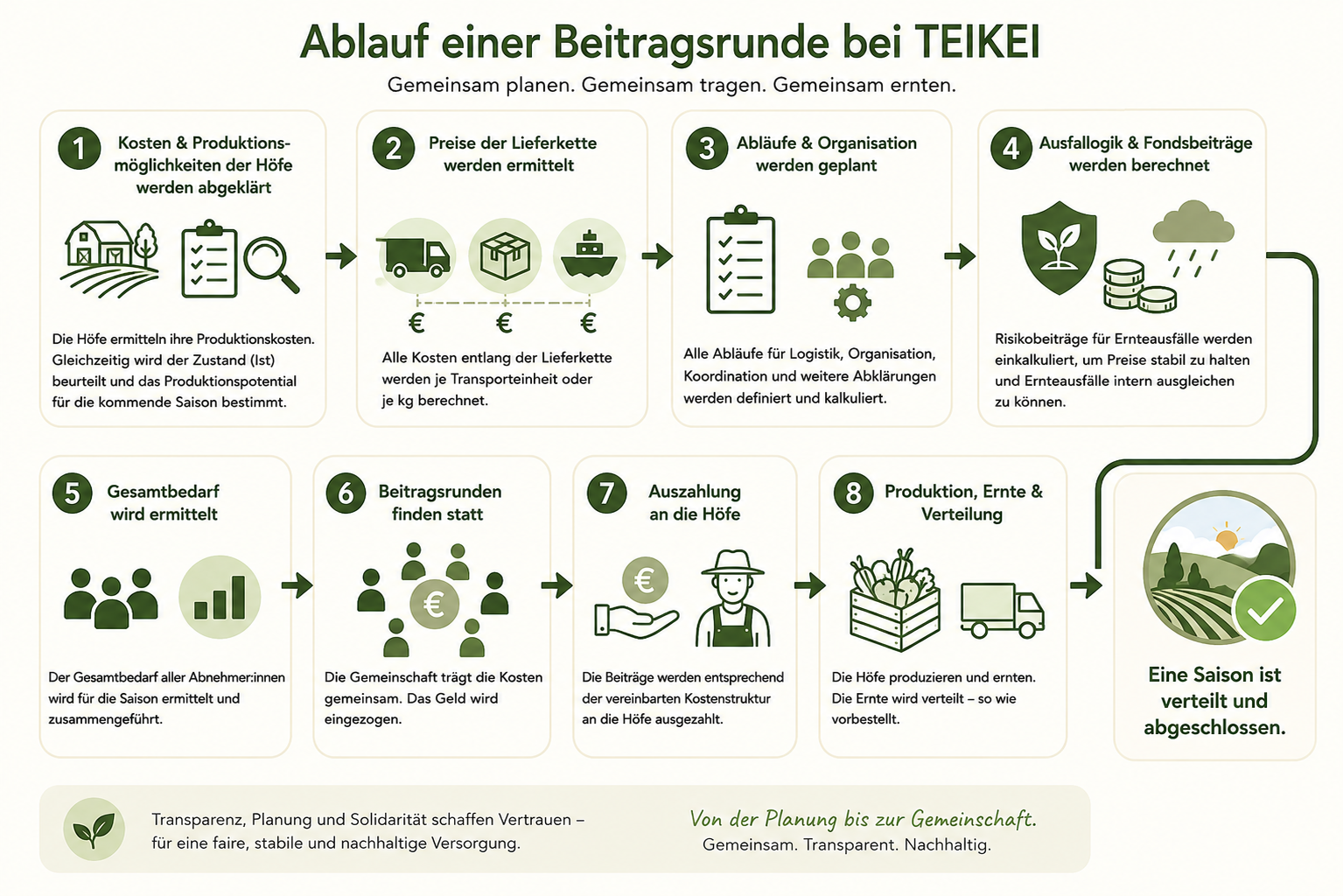
¶ Phase 1: Making Needs Visible
- Forecasts from orders and harvest shares
- Aggregation of data at the community level
- Visualization in the dashboard
¶ Phase 2: Disclosing Costs
- Breakdown of real costs
- Presentation per harvest share or supply unit
- Supplemented by FairShare logic
¶ Phase 3: Starting the Contribution Round
- Define time period (e.g., 2 weeks)
- Make contribution ranges visible
- Enable free input or selection models
¶ Phase 4: Evaluation & Adjustment
- Check whether the total requirement is covered
- If necessary:
- Second round
- Adjustment of the structure
- Targeted communication in the community
¶ Phase 5: Establishing Commitment
- Contributions are converted into harvest shares
- Integration into the payment and delivery logic of the Agora
- Planning security for producers
¶ Social Dimension
A central goal of this structure is:
To enable access to healthy food regardless of income
This means concretely:
- Households with limited financial means can make lower contributions
- Households with more leeway contribute more
- Infrastructure costs are borne jointly
This is particularly relevant for:
- Single parents with high care work burdens
- People with little time and low income
- Communities in the development phase
¶ Role of the Community
Contribution rounds are not a purely technical process, but a social space:
- Exchange about needs
- Transparency creates trust
- Responsibility is shared
Moderation is ideally carried out by:
- Local organizers
- AgoraAdmins
- Network Stewards
¶ Significance for TEIKEI
The integration of contribution rounds into the Agora can:
- Increase planning security for producers
- Replace price logics with needs logics
- Make social justice concretely implementable
- Strengthen the recursive network economy
¶ Open Questions & Further Development
- How binding vs. flexible should contributions be?
- What UI/UX is needed in the Agora for contribution rounds?
- How are transitions between classic orders and contribution models designed?
- How can European differences be integrated?
These questions are being further developed and tested in the network.
¶ Related Topics
- Dual Transparency & Traceability App
- FairShare Rate
- Harvest Shares
- Communities
- Contribution Rounds in CSAs – Various Models
One level up: Accounting Systems
Author: Felix Schröder, with help from AI (ChatGPT)
Creation: written by Felix Schröder › formatted in Markdown by ChatGPT › published by Felix Schröder › display adjusted by Claude
Created: 2026-03-27 · Last updated: 2026-05-13 · Questions or feedback? support@teikei.us