¶ Capitalism as a "Bubble"
Economy is a natural part of human life. It happens wherever people exchange, share, care for one another, or organize provision collectively. In this sense, economy is nothing artificial and not something that only takes place in companies, markets, or states. It is older than modern financial systems and more deeply rooted in life than what is often understood today by the term "economy."
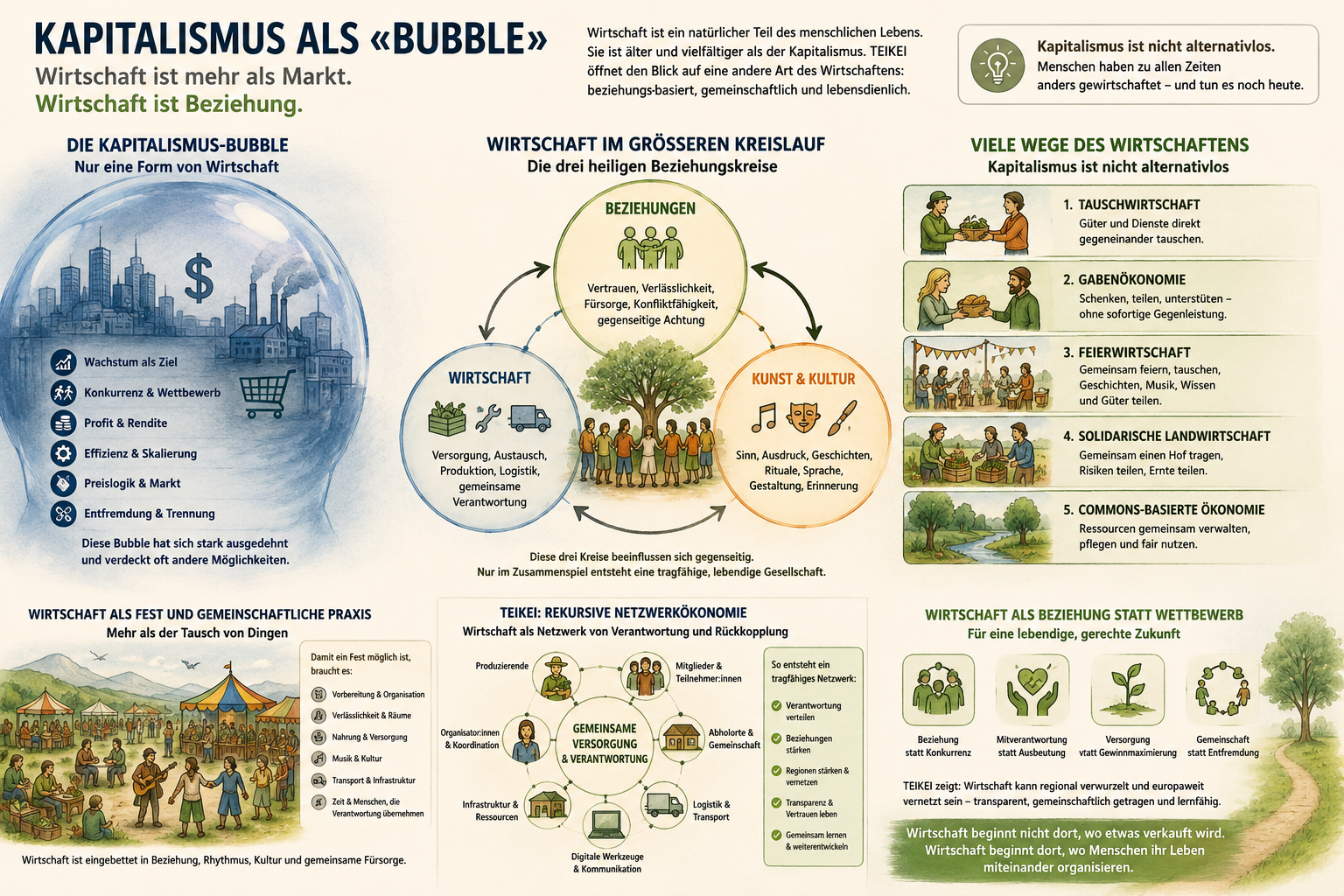
For what we today mostly refer to as economy is in reality only one specific form of it: capitalism. It is not the economy itself, but merely one variant among many. It is a bubble that has expanded greatly in recent centuries and today often seems as if there were no conceivable alternatives outside of it.
TEIKEI, with recursive network economy, reminds us that economy never stands alone. It is always part of a larger context. It is interwoven with relationships, with culture, and with the question of how people want to live together.
¶ Economy is part of a larger cycle
In TEIKEI's understanding, economy cannot be viewed in isolation. It is embedded in a living interplay of three areas:
-
Economy
What people need to live and organize together. This includes food, tools, provision, exchange, logistics, and shared responsibility. -
Relationships
How people interact with each other. Trust, reliability, care, conflict resolution, and mutual respect shape every form of economic activity. -
Art & Culture
What creates meaning and provides expression. Stories, songs, rituals, language, design, and collective memory are not side issues but part of a living society.
These three sacred circles of relationship influence each other. An economy that focuses only on efficiency, growth, and price logic often loses the relational level and becomes culturally impoverished. Conversely, an economy becomes more sustainable when it is embedded in trust, expression, and communal practice.
TEIKEI therefore understands economy not merely as the distribution of goods but as part of a broader context of life.
¶ Capitalism is not without alternatives
If capitalism today often seems self-evident, it is also because many other forms of economy have faded from view. Yet people have always engaged in different economic practices. There have been and still are numerous models in which competition, profit, and accumulation are not at the center, but rather community, reciprocity, and provision.
Here are some examples that show: capitalism is not without alternatives.
¶ 1. Barter economy
In the barter economy, goods and services are directly exchanged for one another. Money is not necessarily required. What matters is the relationship between what is given and what is received.
Barter is a very immediate form of economy. It makes visible that value is not determined solely by prices but also by concrete needs, skills, and agreements between people.
¶ 2. Gift economy
In a gift economy, things are not primarily sold but given away. People give, share, or support without immediately expecting direct compensation.
This does not mean that everything is noncommittal. On the contrary: gift economies often rely on strong social bonds, trust, and the knowledge that community can only endure if people stand by one another.
Here, value does not lie in possession but in circulation and in the relationship created through giving.
¶ 3. Celebration economy
A particularly fascinating form is the celebration economy. Here, different regions, communities, or tribes meet at specific times, bringing what has grown, been produced, or cultivated in their region, and engage in a shared exchange.
Exchanged are not only products like food, medicinal plants, tools, textiles, or handcrafted goods. Also shared are stories, music, knowledge, experiences, and cultural expressions.
In this context, economy cannot be separated from encounter. It does not occur as a cold transaction but as part of a celebration. The celebration itself thus becomes a place of provision, relationship-building, and cultural renewal.
¶ 4. Community-supported agriculture
Community-supported agriculture demonstrates very concretely that provision can also be organized outside of classical market logic. Members or participants collectively support a farm, finance the year's work, and share the harvest.
This fundamentally changes the relationship between producers and participants. It is no longer just about buying and selling but about shared responsibility, risk-sharing, and collective provision.
This is closely aligned with TEIKEI: agriculture is not understood as an isolated production effort but as a relational process.
¶ 5. Commons-based economy
In the commons-based economy, resources are managed, maintained, and used collectively. These can include land, water, seeds, knowledge, software, or infrastructure.
At the center is not exclusive ownership but the question of how something can be preserved and used fairly for the common good. Commons emerge where people share responsibility and develop rules that serve the whole.
Here, too, it becomes clear: economy can be organized cooperatively without becoming unclear or chaotic.
¶ Example: Economy as celebration and communal practice
A particularly powerful image is the idea of economy as an annual celebration. Different communities come together and bring what is abundant in their region. These can be food, medicinal plants, music, medicine, knowledge, tools, or handcrafted products.
But the true core lies deeper: in this case, economy does not merely consist of things changing place. Economy consists of the celebration itself becoming possible.
For such a celebration to take place year after year, preparation, reliability, spaces, food, music, organization, transport, time, and people who take responsibility are needed. Economy is then not a separate sector but embedded in relationship, rhythm, culture, and shared care.
This image helps to understand why TEIKEI does not think of economy in terms of competition but from the perspective of relationship and responsibility.
¶ What TEIKEI learns from this
TEIKEI takes this perspective seriously and develops from it the recursive network economy. Behind this lies the insight that economy does not consist solely of individual transactions but of circles of responsibility, relationship, and feedback.
Producers, members, organizers, pickup locations, logistics, infrastructure, and digital tools are not merely loosely connected. They form a network that is only sustainable if it is not oriented solely toward price and efficiency but also toward trust, transparency, and communal participation.
The recursive network economy therefore attempts to organize economy in such a way that:
- Responsibility is not concentrated in a few places
- Relationships are not displaced by pure market logic
- Regional characteristics are preserved
- Provision is collectively supported
- Learning and development remain part of the system
TEIKEI does not claim that organization, structure, or economic efficiency are unimportant. On the contrary. But they are placed in a larger context.
¶ Economy as relationship instead of competition
The core idea behind TEIKEI is: Economy is relationship.
This does not mean that there are no prices, quantities, planning, or commitments. It means rather that these things are not considered in isolation from the people who sustain them.
If economy is understood only as competition, deeper questions quickly fade from view:
- Who bears the risk?
- Who ensures continuity?
- Who becomes visible and who disappears?
- How do trust and reliability emerge?
- How does a structure remain vibrant in the long term?
TEIKEI responds to this with a different approach. The primary focus is not on the greatest possible advantage for individuals but on how provision, relationship, and cultural vitality can be thought of together.
¶ Why this change in perspective is important
As long as capitalism appears to be the only conceivable economic form, many things seem unchangeable: price pressure, alienation, concentration of power, dependence on anonymous markets, or the separation between producers and participants.
Yet these structures are not laws of nature. They are the results of historical developments and political decisions. They can therefore also be shaped differently.
TEIKEI opens up a different horizon here. Economy can be regionally anchored and at the same time connected across Europe. It can be organized transparently, collectively supported, and adaptable. It can bring people into relationship with one another instead of reducing them to roles like provider and buyer.
¶ What TEIKEI puts into practice
TEIKEI has consciously chosen the recursive network economy. Instead of simply making old power structures more efficient, new ways of economic activity are being tested: communal, circular, self-organized, and relationship-based.
This does not mean that everything is already complete. It means that TEIKEI chooses a different starting point.
Not:
"How do we adapt people to an existing economic system?"
But:
"What could economy look like if it served life, strengthened relationships, and truly supported provision collectively?"
This is where the strength of this approach lies.
¶ Key takeaway
Capitalism is not the economy itself. It is only one historical and currently dominant form of it. To understand economy more deeply, one must therefore look beyond this bubble.
TEIKEI does exactly that.
With the recursive network economy, TEIKEI reminds us that economy does not consist only of numbers, prices, and markets but of relationships, culture, and collectively borne responsibility.
Or, put another way:
Economy does not begin where something is sold.
Economy begins where people organize their lives together.
¶ Further information & understanding contexts
One level up: Understanding economy
Author: Felix Schröder, with the help of AI (ChatGPT)
Creation: written by Felix Schröder › formatted in Markdown by ChatGPT › published by Felix Schröder › layout adjusted by Claude
Created: 2026-04-15 · Last updated: 2026-10-11 · Questions or suggestions? support@teikei.us