¶ Understanding Economics – A Broad Perspective from TEIKEI Practice
¶ What This Section Is About
The section Understanding Economics invites you to consider economic questions from a broad perspective.
The primary goal here is not to redefine the term "economy."
Nor is it simply about describing capitalism in a better way.
The starting point is different:
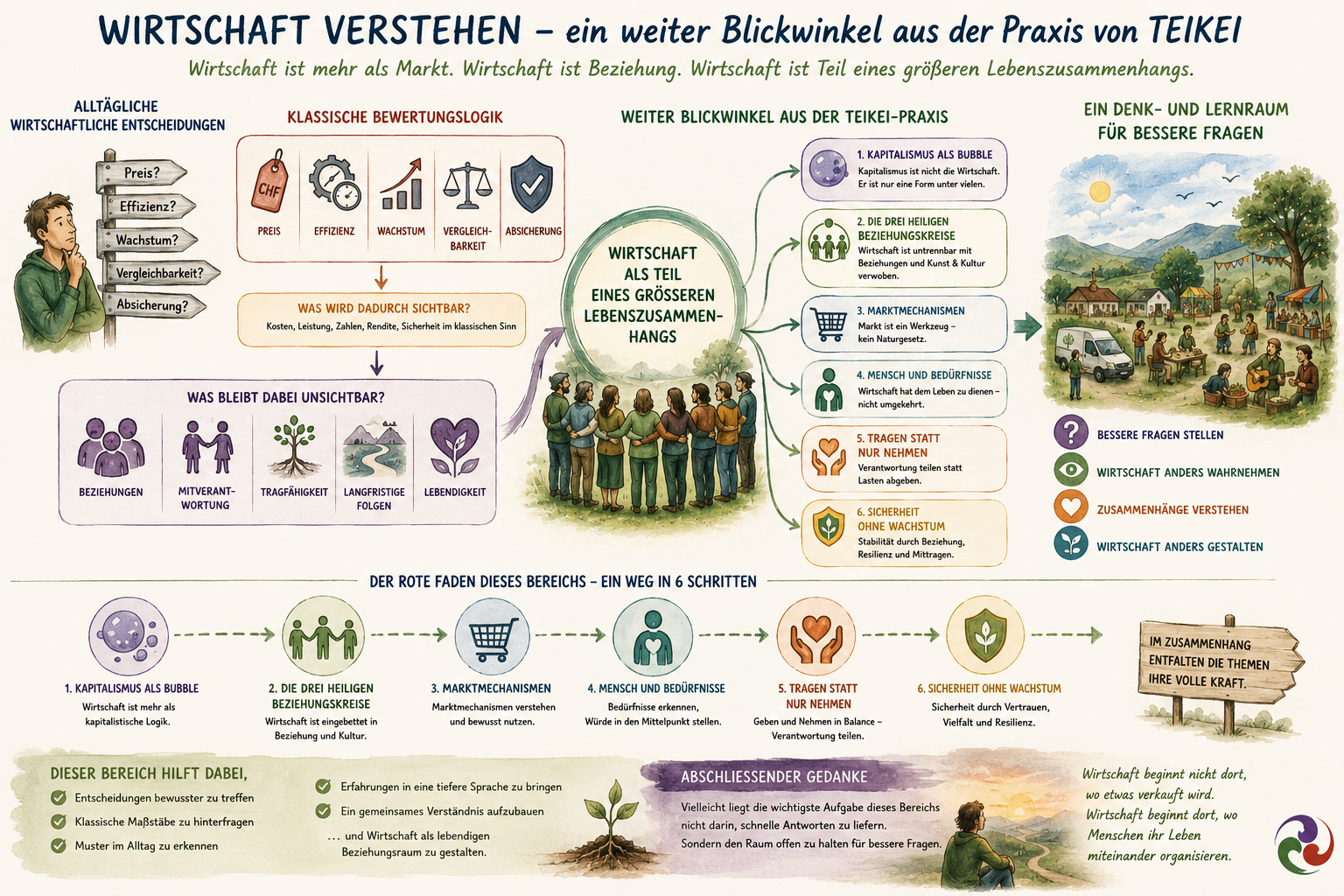
In TEIKEI’s daily life, situations repeatedly arise where decisions must be made that, by classical standards, seem to have quick answers. For example, regarding price, efficiency, growth, comparability, or security.
At the same time, practice shows that these very standards often fall short. They explain some things, but they do not capture the whole picture.
This is why this section was created.
It collects thoughts, observations, and insights that grow from lived experience within the TEIKEI network. It asks not only how economics is typically evaluated but also what becomes visible when we consciously refuse to fall back too quickly into the usual patterns of thought.
The Thought Process
Where This Section Leads
You can find the contributions of both series below under "The Red Thread of This Section."
¶ The Starting Point at TEIKEI
TEIKEI has often resisted making economic decisions based solely on classical evaluation criteria.
This does not mean that numbers, planning, or reliability are unimportant.
It means something else:
As soon as we only look through the lens of familiar standards, we quickly fall back into the same three tracks:
- What is most efficient?
- What is safest in the classical sense?
- What is most scalable or easiest to compare?
These questions are not wrong.
But they are often too narrow.
Because in a community-supported network, it is not just about efficiency, but also about resilience.
Not just about security, but also about relationships.
Not just about growth, but also about how a system remains vibrant without responsibility resting on just a few.
This is precisely where the perspective this section aims to make visible begins.
¶ Why a Broader Perspective Is Necessary
Many economic decisions appear objective and neutral at first glance.
In reality, however, they often already carry certain assumptions.
For example:
- that growth creates stability
- that comparability creates fairness
- that professionalization is automatically an improvement
- that centralization is more efficient and therefore more reasonable
- that security arises primarily through capital, control, and safeguards
However, TEIKEI’s experiences show that such assumptions do not always hold.
Some things may become easier in the short term, but poorer in the long run.
Some things may become more predictable, but also more rigid.
Some things may become more professional, but also more distant.
Some things may become more efficient, but lose precisely what was meant to be protected.
That is why a space is needed where such tensions are not overlooked but consciously examined.
¶ What This Section Is Really About
This section asks:
- What becomes invisible when we decide only based on classical economic criteria?
- Which burdens, relationships, or long-term consequences fall out of view?
- What forms of responsibility, shared effort, and vitality are lost when we reduce everything to price, growth, or efficiency?
- How does our action change when we view economics from the practice of a community-supported network?
- What qualities does an economy need so that it is based not on domination but on care?
This is not about a new ideology.
It is about looking more closely from TEIKEI’s experiences.
¶ The Red Thread of This Section
The contributions in this section together form a path.
They show step by step that economics cannot be understood merely as market activity but as part of a larger context of life.
¶ Foundational Series
The following sequence is recommended as a first red thread:
- 🟢 Capitalism as a "Bubble"
- 🟢 The Three Sacred Circles of Relationship
- 🟢 Market Mechanisms
- 🟢 Humans and Needs
- 🟢 Bearing Instead of Just Taking
- 🟢 The Clear Boundary
- 🟢 Security Without Growth
- 🟢 The pinu'u Vision
¶ Qualities of a Cooperative Economy
In addition, a second series is emerging.
These contributions can be read independently of the sequence. However, together they deepen the question of which inner qualities sustain a cooperative economy.
-
Qualities of a Cooperative Economy
Overview of the entire deepening series. -
From Domination to Care
Patriarchy, matriarchy, and cooperative economy
The individual pages can also be read on their own.
However, their full power unfolds in context.
¶ What the Contributions Collectively Reveal
The existing contributions in this section already highlight important foundations:
The contribution on capitalism as a bubble reminds us that economics is more than today’s dominant market form and that provision, exchange, and communal practice are older and more diverse than capitalist logic.
The contribution on the three circles of relationship makes clear that economics at TEIKEI is never considered in isolation but always in interplay with relationships and art/culture.
The subsequent contributions build on this:
They take a closer look at market mechanisms, needs, the relationship between taking and bearing, and the question of how security can be understood differently.
The new deepening series Qualities of a Cooperative Economy complements this perspective.
It asks not only how economics functions but from which qualities economics emerges:
- from relationship instead of mere transaction
- from responsibility instead of control
- from strength instead of mere power
- from trust instead of fear
- from care instead of domination
- from cooperation instead of pure competition
Together, this does not create a rigid doctrinal system but a space for thought and learning.
¶ How This Section Differs from Classical Economic Explanation
This section does not simply retell existing economic theories.
It looks from practice.
This means:
We observe what actually happens in the network.
We examine where classical decision-making logics are insufficient.
We take tensions seriously when they arise.
And we try to find words for them without quickly falling back into familiar categories.
This does not create a smooth model.
But it creates something more honest:
an understanding that is tested against reality.
¶ A Section That Grows with Practice
The pages in this section are not to be understood as final statements.
They are a working foundation that has grown from experience and will continue to grow with new insights from our daily life.
This means:
- Observations from practice can deepen existing contributions
- New experiences can correct previous assumptions
- Tensions that are only now becoming visible may later be named more clearly
- Concepts may sharpen over time
- New contributions may emerge when practice raises new questions
This section therefore remains intentionally open to further development.
¶ What This Section Is Intended to Help With
Understanding Economics is meant to help:
- not reduce economic decisions too quickly to familiar standards
- more consciously question classical evaluation criteria
- recognize recurring patterns in TEIKEI’s daily life
- translate experiences from the network into a deeper language
- build a shared understanding of what might set TEIKEI apart
- more consciously perceive and practice the qualities of a cooperative economy
This section thus serves not only reflection but also orientation.
¶ Concluding Thought
Perhaps the most important task of this section is not to provide quick answers.
Perhaps it is to keep the space open for better questions.
Questions that arise from real life.
Questions that cannot be immediately forced into old tracks.
And questions that can help us not only explain economics differently but perceive and shape it differently.
Economics does not begin with money. Economics begins with relationship.
One level up: 09 - Economy & Vision
Author: Felix Schröder, with the help of AI (ChatGPT)
Creation: written by Felix Schröder › formatted in Markdown by ChatGPT › published by Felix Schröder › layout adjusted by Claude
Created: 2025-05-28 · Last updated: 2026-10-13 · Questions or suggestions? support@teikei.us