¶ The Three Sacred Circles of Relationship: Economy, Relationships, and Art
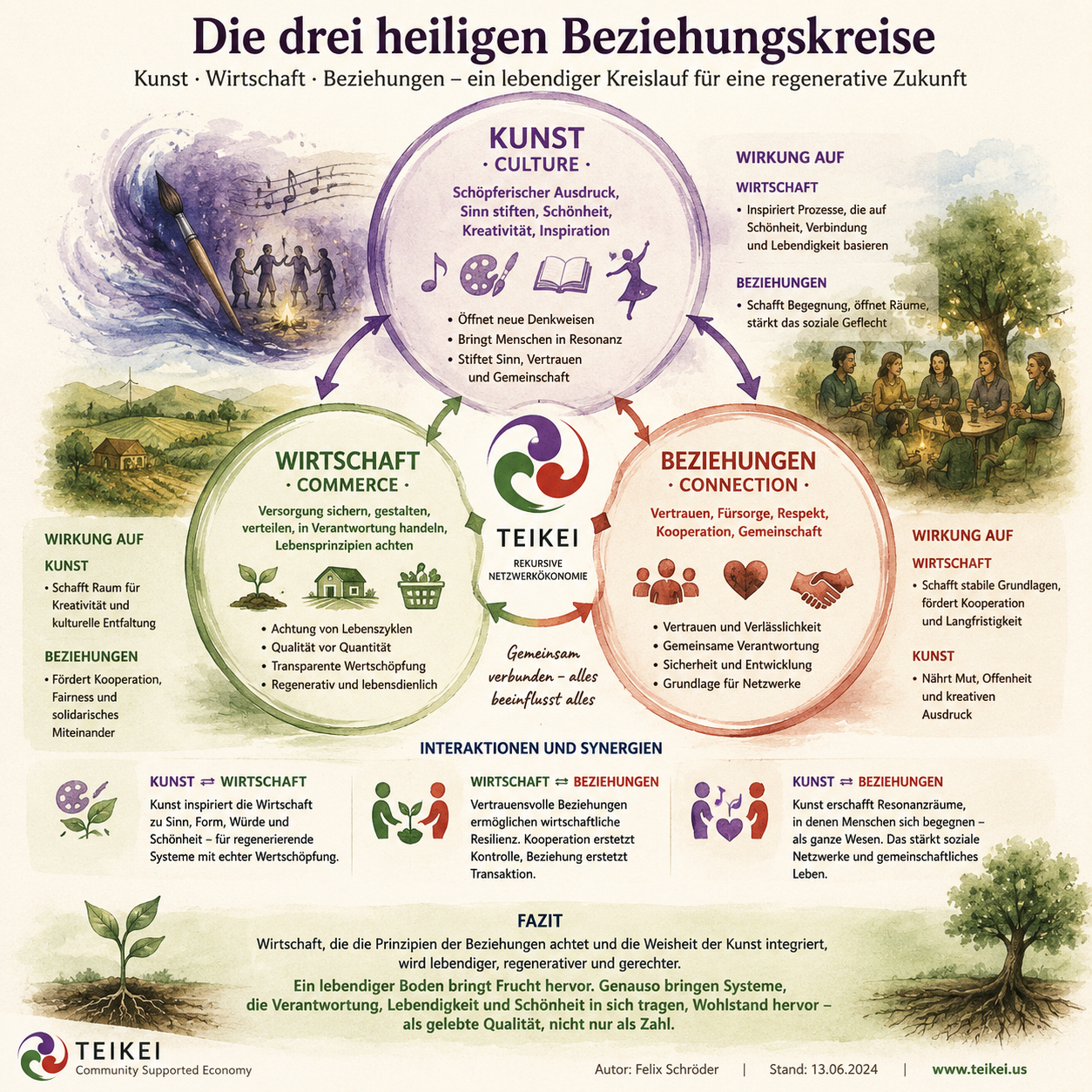
The concept of the three sacred circles of relationship between art, economy, and relationships is a metaphorical representation that highlights the deep interconnectedness of these three areas of life. They demonstrate how responsibility, vitality, and interdependence can serve as central principles in a sustainable society.
CultureCommerceConnection describes this interplay as a living cycle: when cultural depth (Culture), economic care (Commerce), and human connection (Connection) come together, a powerful framework for a regenerative future emerges.
¶ Art · Culture
¶ Role and Significance
Art connects us with our inner vitality and with the world around us. It encompasses a variety of forms of expression such as painting, music, theater, literature, and dance. It serves as a medium for creativity, self-expression, and cultural reflection. Yet art is not merely expression—it is also responsibility.
¶ Impact on the Economy
Art acts as a creative force on the economy. It opens spaces for new ways of thinking, invites mindfulness, and inspires processes based on beauty, connection, and vitality. Where artistic principles are integrated, systems emerge that are not based on exploitation but on care and relationship—like healthy soil that develops fertility through respectful attention. An economy touched by art thus becomes not only functional but meaningful and regenerative.
¶ Impact on Relationships
Art brings people into resonance—across language, origin, or age. It creates encounters, opens spaces for shared experience, and strengthens the social fabric. In this role, art not only fosters connection but also trust, meaning, and community.
¶ Economy · Commerce
¶ Role and Significance
The economy encompasses the production, distribution, and consumption of goods and services. Yet beyond efficiency and growth, a thriving economy also involves respect for the principles of life. Healthy soil—rich in nutrients and alive—is an expression of a system that respects life forces. Where this respect exists, economic success flourishes in true abundance.
¶ Impact on Art
An economy based on care, quality, and resonance provides art with room to breathe. It creates conditions in which creativity is not stifled by performance pressure but can serve as a cultural nourishment. In this way, art is not merely decorative but systemically relevant—as a mirror, catalyst, and driver of change.
¶ Impact on Relationships
Economic practices based on cooperation, fairness, and transparent value creation strengthen relationships between people. Such an economy is connective, not divisive—it enables shared responsibility, mutual support, and a sense of solidarity in everyday life.
¶ Relationships · Connection
¶ Role and Significance
Relationships form the supporting fabric of our society. They enable trust, security, and development—both in personal and communal contexts. In the recursive network economy, they serve as the foundation for collectively made decisions and solidary structures.
¶ Impact on the Economy
Relationships built on trust, reliability, and mutual responsibility create stable foundations for economic action. They foster cooperation over competition, long-term thinking over short-termism, and shared responsibility for risks and opportunities. In such networks, the economy is not seen as an isolated system but as an expression of living community—anchored in relationship, strengthened by mutual care, and carried by a shared sense of purpose.
¶ Impact on Art
Where relationships are based on trust, openness, and resonance, a fertile ground for artistic creation emerges. Healthy social structures nurture the courage for truth, vulnerability, and creative expression. Art becomes not only a mirror of society but part of a living dialogue—carried by community, inspired by encounter, and deepened through collective experience.
¶ Interactions and Synergies
¶ Economy and Art
Art inspires the economy to go beyond efficiency—toward meaning, form, dignity, and beauty. Where these qualities take root, regenerative systems with true value creation emerge.
¶ Economy and Relationships
Trusting relationships enable economic resilience. Cooperation replaces control, relationship replaces transaction.
¶ Art and Relationships
Art creates resonance spaces in which people meet—as whole beings, not merely as roles or consumers. This depth also strengthens social networks and opens new forms of communal living.
¶ Conclusion
The three circles—art, economy, and relationships—cannot be separated from one another. Their interconnection reveals how deeply everything is connected. An economy that respects the principles of relationships and integrates the wisdom of art becomes not only more efficient but also more vibrant, regenerative, and just.
Soil full of life bears fruit. Similarly, systems that embody responsibility, vitality, and beauty yield prosperity—not merely as a number, but as a lived quality.

¶ Meaning of the TEIKEI Symbol
The TEIKEI logo features three organically flowing shapes in the colors violet, red, and green. They symbolically represent the three sacred circles of relationship:
- Violet symbolizes Art · Culture—the deeply transformative space for insight, emotion, and creative processes.
- Green embodies Economy · Commerce—as a living, life-serving, and earth-connected creative force.
- Red stands for Relationships · Connection—the warmth of human encounter, the social, the interpersonal.
In their form, the three elements create a cycle that points to mutual interaction. Only when art and relationship deeply touch can an economy emerge that is truly green—regenerative, connected, and in service of life.
Author: Felix Schröder
Last updated: 13.06.2024
🌐 www.teikei.us
One level up: Understanding Economy
Author: Felix Schröder, with assistance from AI (ChatGPT)
Creation: written by Felix Schröder › formatted in Markdown by ChatGPT › published by Felix Schröder › layout adjusted by Claude
Created: 2025-03-25 · Last updated: 2026-06-27 · Questions or feedback? support@teikei.us