¶ Capitalist Market Mechanisms – Why Organizations Face Growth Pressure
¶ What This Entry Covers
This entry describes fundamental mechanisms of the capitalist market model. It does not refer to individual business forms but rather structural framework conditions that affect many organizations as soon as they operate in the open market.
It is important to understand:
The legal form alone does not determine whether an organization faces growth pressure. Even a non-profit structure, a cooperative, or a small enterprise can encounter the same constraints if it operates within the same market mechanics.
The following mechanisms therefore operate fundamentally—regardless of whether an organization is profit-oriented, socially oriented, or formally non-profit.
¶ The Central Insight
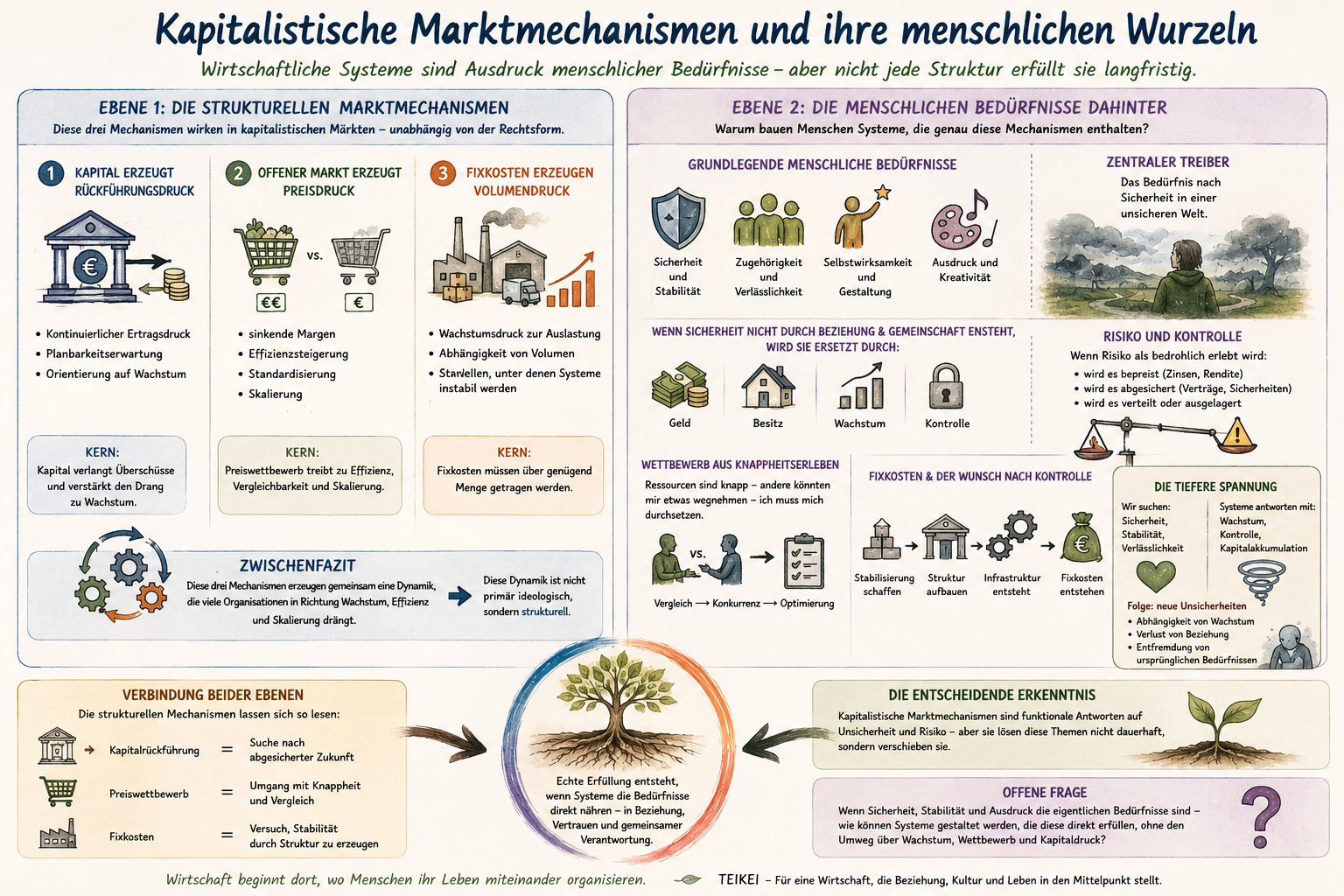
In capitalist markets, growth is often not simply a free choice. It frequently arises from structural constraints.
These constraints become particularly relevant when three conditions interact:
- Capital must be repaid or earn interest
- Prices are subject to open competition
- Fixed costs must be covered by sufficient volume
When these mechanisms are active, pressure builds toward:
- greater efficiency
- greater volume
- greater standardization
- greater scalability
¶ 1. Capital Repayment Obligation
¶ Basic Principle
As soon as an organization takes on capital that must be repaid, earn interest, or is tied to a return expectation, structural pressure arises.
This applies, for example, to:
- Loans
- Investor funds
- Equity models with return expectations
- Financing with fixed repayment obligations
¶ Why This Matters
Capital that must be repaid requires ongoing surpluses.
These surpluses must be generated regardless of whether the actual supply situation, network relationships, or social goals make this seem sensible at the time.
This shifts the internal logic of an organization:
- It is no longer enough to operate sustainably
- Additional resources must be generated for repayment, interest, or returns
¶ Consequence
Once this pressure persists, the incentive grows to:
- increase revenue
- open up more markets
- standardize processes more strongly
- design structures for scalability
In this sense, capital not only creates room for action but often also growth pressure.
¶ Key Statement
Capital with repayment pressure forces organizations to generate continuous surpluses, thereby reinforcing the drive toward growth and scaling.
¶ 2. Price Competition in the Open Market
¶ Basic Principle
As soon as offerings are comparable in the open market, price becomes a central decision factor.
People, organizations, and buyers then compare, for example:
- the final price
- delivery conditions
- availability
- the perceived value
¶ Why This Matters
When multiple providers offer similar services or products, pressure arises to be cheaper or more efficient than others.
This leads to a typical dynamic:
- Prices are compared
- Margins come under pressure
- Organizations attempt to reduce costs
- Cost reduction leads to efficiency gains
- Efficiency gains often lead to scaling
¶ Consequence
Price competition frequently does not reward the most relationship-focused, caring, or long-term sensible structure but rather the one that can best reduce costs and standardize performance.
As a result, even organizations with social or public-benefit goals face adaptation pressure if they are fully exposed to open price competition.
¶ Key Statement
Open price competition drives organizations toward efficiency, comparability, and scaling because high costs and slow processes are penalized in the market.
¶ 3. Fixed Costs and Volume Pressure
¶ Basic Principle
Fixed costs are costs that arise regardless of quantity.
Examples include:
- Software and platforms
- Warehousing and infrastructure
- Administration and coordination
- Machinery and vehicles
- Rent, basic systems, and core staff
These costs often arise regardless of whether an organization operates on a small or large scale.
¶ Why This Matters
When high fixed costs are present, the following logic automatically applies:
- With low volume, costs per unit are high
- With high volume, costs per unit decrease
This means:
The more volume flows through the system, the better fixed costs can be distributed.
¶ Consequence
This creates pressure to generate more volume to sustain the organization’s structure economically.
Even without aggressive growth intentions, a situation can arise in which an organization says:
- We need more participants
- We need more revenue
- We need more capacity utilization
Not because this is desired in terms of content but because the cost structure demands it.
¶ Key Statement
Fixed costs create volume pressure because an organization often only becomes economically stable beyond a certain size.
¶ How These Three Mechanisms Interact
Each of these three points can already generate growth pressure on its own. They become particularly effective when they occur together.
This then creates a typical market logic:
- Capital demands surpluses
- The market demands competitive prices
- The cost structure demands sufficient volume
From this combination, a direction often emerges that many organizations can hardly choose freely:
- Become larger
- Become more efficient
- Become more standardized
- Become more scalable
Therefore, growth in capitalist markets is often not a character flaw or mere ideology but a structural consequence of certain framework conditions.
¶ Why the Legal Form Does Not Automatically Solve the Problem
It is a common misconception that a different legal form automatically eliminates these dynamics.
An organization can, for example, be socially, non-profit, or cooperatively structured and still face the same constraints if it:
- Operates in a capital-dependent manner
- Competes in open price competition
- Must bear high central fixed costs
The legal form can set rules and distribute power differently. However, it does not automatically change the fundamental mechanics of the market.
¶ The Actual Analytical Distinction
To better understand the economy, one should clearly distinguish between:
¶ 1. Legal Form
The legal structure of an organization, such as a corporation (AG), limited liability company (GmbH), non-profit GmbH (gGmbH), entrepreneurial company (UG), or cooperative.
¶ 2. Objective
The question of what purpose an organization pursues, such as profit, supply, public benefit, or regional stability.
¶ 3. Structural Mechanics
The question of what economic constraints the organization is actually exposed to.
Only at this third level does it become apparent whether an organization truly operates differently or merely follows the same mechanisms under a different label.
¶ The Most Important Insight
To understand growth pressure, one must not only look at intentions, values, or legal forms.
What is decisive is whether the structure of an organization is built in such a way that it:
- Must continuously service capital
- Must compete in open price comparisons
- Can only cover high fixed costs through more volume
If this is the case, growth pressure arises almost inevitably.
¶ Condensed Key Message
Growth pressure does not primarily arise from greed but from structural market mechanisms.
¶ Even More Concisely Summarized
The three most important mechanisms of the capitalist market model are:
- Capital creates repayment pressure
- Market comparison creates price pressure
- Fixed costs create volume pressure
From this combination arises the tendency toward efficiency, scaling, and growth—regardless of the legal form.
One level up: Understanding the Economy
Author: Felix Schröder, with assistance from AI (ChatGPT)
Creation: written by Felix Schröder › formatted in Markdown by ChatGPT › published by Felix Schröder › layout adjusted by Claude
Created: 2026-04-15 · Last updated: 2026-06-27 · Questions or feedback? support@teikei.us