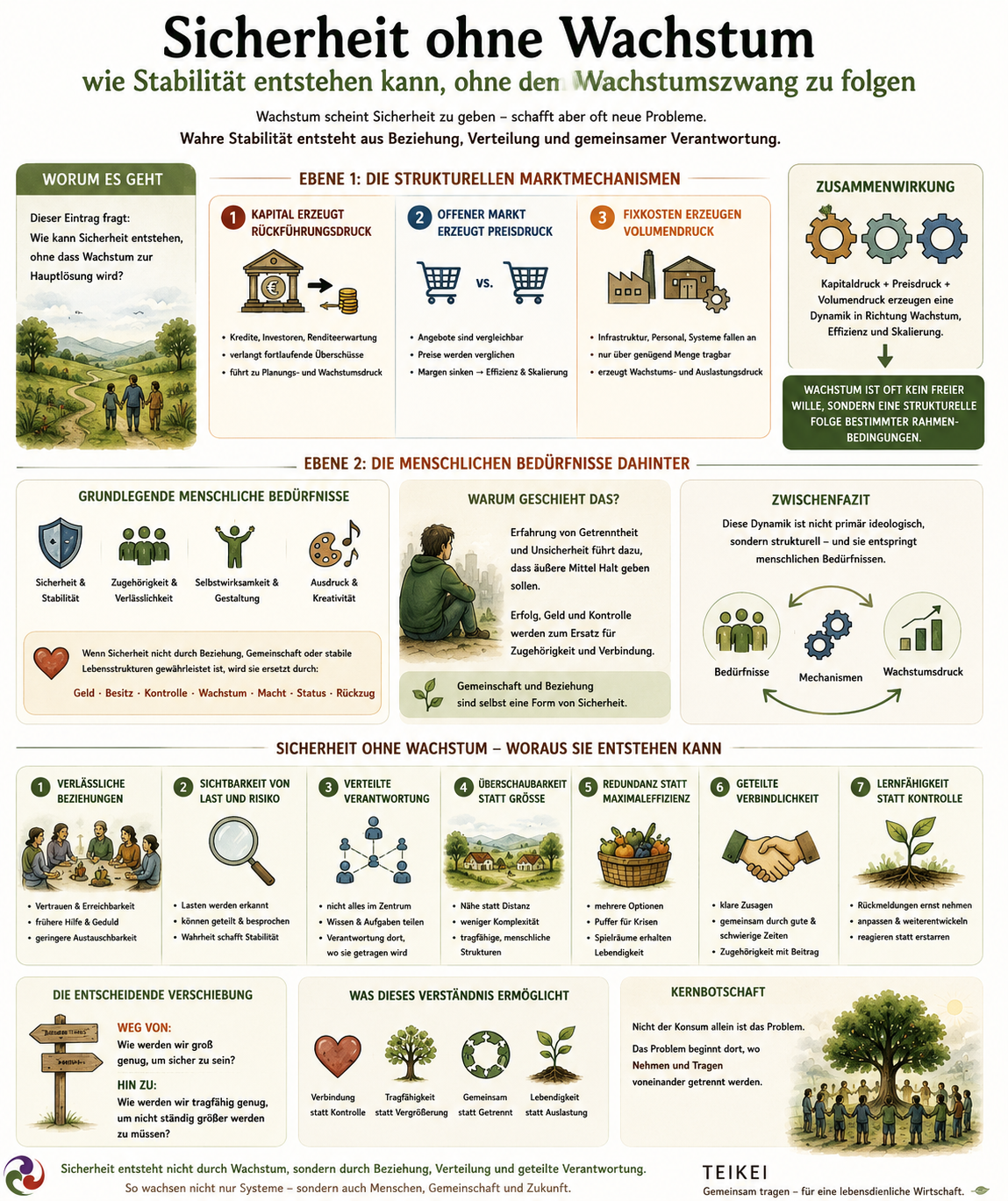
¶ Security Without Growth – How Stability Can Emerge Without Following the Compulsion to Grow
¶ What This Entry Is About
Many systems do not grow because growth itself is their most beautiful goal, but because they promise security through it.
More volume is supposed to bear costs.
More capital is supposed to cushion uncertainty.
More size is supposed to reduce dependencies.
More professionalization is supposed to prevent failures.
At first glance, this seems understandable. And often, it works for a while.
Yet the same movement frequently creates new problems:
- more complexity
- more centralization
- more distance
- more fixed costs
- more pressure to utilize capacity
- more dependence on money, control, and comparability
Thus, growth becomes the apparent answer to insecurity, while simultaneously generating new insecurity.
This entry therefore asks:
How can security emerge without growth becoming the primary solution?
¶ The Starting Point
Security is a genuine human need.
Every person requires a minimum level of:
- reliability
- continuity
- protection from overwhelm
- belonging
- sustainable relationships
- future viability
The question, therefore, is not whether security is important.
The question is:
How is security created?
In classical economic thinking, the answer often is:
- through capital
- through size
- through efficiency
- through standardization
- through control
In the TEIKEI context, a broader perspective reveals that security can also emerge differently.
Not merely as top-down safeguarding, but as resilience that grows from relationships, distribution, visibility of burdens, and communal reliability.
¶ The Individual’s Need for Security
The question of security does not only apply to organizations but to every individual.
Where people feel internally or externally insecure, they seek something to provide stability.
This can take many forms:
- money
- possessions
- control
- status
- power
- growth
- independence
- withdrawal
These things are not simply wrong. They can indeed provide protection. But they often become overwhelming where something else is lacking.
A person who perceives themselves as successful yet feels deeply alone, isolated, or permanently disconnected often develops an especially strong need for security. Then, something else must compensate for the missing connection.
What is sought is not just prosperity but a sense of stability.
And because this stability does not come from belonging, relationships, or community, it is often sought as a substitute in:
- more money
- more growth
- more power
- more influence
- more control
- more independence
Thus, external means become proxies for something internal that actually needs to be nurtured differently.
¶ The Illusion of Separation
Beneath the strong need for security often lies something deeper: the experience of separation.
Where people feel separate, the sense easily grows that they must fend for their own survival alone. Then, security becomes something that must be possessed, accumulated, controlled, or defended.
In this internal logic, things like money, growth, power, or independence take on outsized importance. They are meant to provide stability where connection is lacking.
Therefore, the question of security is not just about structures but also about a view of humanity.
If life is primarily experienced as separation, it seems reasonable to secure as much as possible:
- through possessions
- through control
- through reach
- through influence
- through constant growth
If, however, people experience themselves as part of a living whole, something fundamental shifts.
Then, security does not arise only through accumulation but also through:
- belonging
- trust
- mutual reliability
- visible shared responsibility
- community
This does not mean that money, structure, or foresight become unimportant. It only means they no longer have to replace everything.
Perhaps here lies one of the deeper roots of the compulsion to grow: not just in markets and institutions but also in a culture of separation.
Where belonging is weak, security must become greater.
Where connection grows, the compulsion for constant expansion can diminish.
¶ When Success Replaces Connection
Therefore, it is worth evaluating success not only by visible outcomes.
A person can be socially regarded as very successful yet deeply insecure. Precisely where connection is lacking, success often becomes an attempt to create security.
Then, "more" does not simply mean more.
More money is meant to reassure.
More power is meant to protect.
More growth is meant to provide independence.
More control is meant to keep uncertainty at bay.
Yet none of this can truly replace the need for genuine belonging.
It can cover it up, amplify it, or numb it for a while.
But it does not satisfy it.
Thus, beneath many economic excesses lies not just greed but often separation, a lack of connection, and a deep need for security that has not found a human form.
¶ Why Community Is So Central
This is precisely why belonging and community are not merely social add-ons.
They are themselves a form of security.
Where people are embedded in sustainable relationships, the entire internal pressure changes.
Then, security does not have to be replaced to the same extent by:
- capital
- growth
- power
- control
- status
Because part of what would otherwise be sought through money or expansion is already present in another way:
- through connection
- through reliability
- through mutual aid
- through visibility
- through shared responsibility
- through belonging
In this sense, community can be understood as a form of genuine capital.
Not because it replaces money.
But because it supports something that would otherwise be desperately secured through money.
¶ Understanding Security Differently
Security without growth does not mean:
- no development
- no professionalism
- no planning
- no reserves
- no structure
It means something else:
Security is not primarily derived from expansion but from a form of order in which burdens, risks, knowledge, and responsibility are sustainably distributed.
Then, stability does not arise merely because something becomes larger but because something is better embedded.
¶ How Security Without Growth Can Emerge
Security without growth does not arise from a single means. It emerges from the interplay of several supporting elements.
¶ 1. Reliable Relationships
Where people know each other, are accessible, and remain in relationship over time, a form of security emerges that does not need to be purchased.
Reliable relationships create:
- earlier perception of problems
- faster mutual aid
- more patience in difficult phases
- greater willingness to share responsibility
- lower interchangeability
An anonymous system often requires much more control.
A relationship-based system can absorb many things earlier, more gently, and more humanely.
This does not mean that relationships solve everything.
But without relationships, a system often has to replace what is lacking in trust with money, rules, or growth.
¶ 2. Visibility of Burdens and Risks
A system often remains seemingly stable only because its burdens are made invisible.
Then, many see only:
- the product
- the delivery
- the platform
- the service
What remains invisible, however, are:
- organizational effort
- risk of failure
- emotional strain
- relationship maintenance
- coordination work
- carrying through crises
Where burdens remain invisible, they are shifted onto a few people.
Where they remain visible, they can be shared, discussed, and redistributed.
Here, security does not arise through repression but through truthfulness.
¶ 3. Distributed Responsibility
A system does not become stable when a few bear more and more.
In the short term, this may appear efficient. In the long term, it makes the whole fragile.
Because then, too many functions depend on too few people, positions, or tools.
Distributed responsibility means:
- not centralizing everything
- taking local spaces seriously
- not tying knowledge to individuals
- designing tasks so they remain transferable and comprehensible
- situating responsibility where it can be borne
A system with distributed responsibility is often less smooth but more robust.
¶ 4. Manageability Instead of Mere Size
Not every system becomes more secure as it grows.
Beyond a certain threshold, more size itself becomes a risk:
- more coordination effort
- more lack of transparency
- more distance
- more gaps
- more need for control
Therefore, an important question is not only:
How can we grow?
But also:
How can we be structured so that we remain manageable?
Manageability is not a sign of weakness.
It is often a prerequisite for closeness, learning capacity, and genuine shared responsibility.
¶ 5. Redundancy Instead of Maximum Efficiency
Maximum efficiency sounds reasonable but often makes systems vulnerable.
When everything is stretched to the limit, there is hardly any room for:
- illness
- crop failures
- errors
- delays
- conflicts
- transitions
Security without growth therefore requires, in some places, consciously more than the minimum:
- multiple key people instead of just one
- alternatives instead of only one way
- time buffers instead of complete compression
- relationship maintenance instead of just function
What may seem inefficient in the short term is often what keeps a system alive in the long term.
¶ 6. Shared Commitment
Where people are only loosely connected, a system must absorb many uncertainties itself.
Where commitment is shared, a different form of stability emerges.
This can be seen through:
- firm commitments
- shared responsibility through good and difficult phases
- clear contributions
- responsibility that is not arbitrarily revoked
- honest communication about limits and changes
Security then arises not only from reserves but from the knowledge:
We do not immediately fall apart when things get tough.
¶ 7. Learning Capacity Instead of Rigid Control
A system can try to create security through more and more rules.
This is sometimes necessary. But if security is organized only through control, the whole becomes rigid.
Long-term stability also requires the ability to:
- recognize mistakes
- take feedback seriously
- identify patterns
- readjust decisions
- learn from crises
A learning system is not stable because nothing ever goes wrong.
It is stable because it can respond to reality without losing its internal coherence.
¶ The Connection to TEIKEI
In the TEIKEI context, this does not mean that every question is already resolved.
But from practice, we can learn:
Security does not arise only through money, size, or control.
It can also grow where people commit, contributions become visible, responsibility is shared, and provision is understood as a communal process.
Perhaps herein lies one of the most important shifts of all:
What is sought in many systems through money, power, or growth is often, in truth, a need for stability.
TEIKEI can help make this stability not just an abstract promise but concretely experienceable in relationships, community, and shared responsibility.
Then, community is not merely background music to the economy but part of its actual supporting structure.
¶ The Decisive Shift
The real change may lie in this movement:
Away from the question:
How do we become big enough to be secure?
Toward the question:
How do we become resilient enough not to constantly have to grow?
This is not the same question.
And precisely in this difference, another path opens up.
¶ Concluding Thought
Security without growth is not a shortcut.
It often requires more attention, more honesty, and more shared responsibility.
But perhaps its strength lies precisely here:
It does not build primarily on expansion but on connection.
Not primarily on control but on resilience.
Not primarily on extension but on a form of stability that grows from living structures.
One level up: Understanding the Economy
Author: Felix Schröder, with the help of AI (ChatGPT)
Creation: written by Felix Schröder › formatted in Markdown by ChatGPT › published by Felix Schröder › layout adjusted by Claude
Created: 2026-04-15 · Last updated: 2026-06-27 · Questions or suggestions? support@teikei.us