¶ Carrying instead of just taking – when a system truly becomes different
¶ Guiding principle
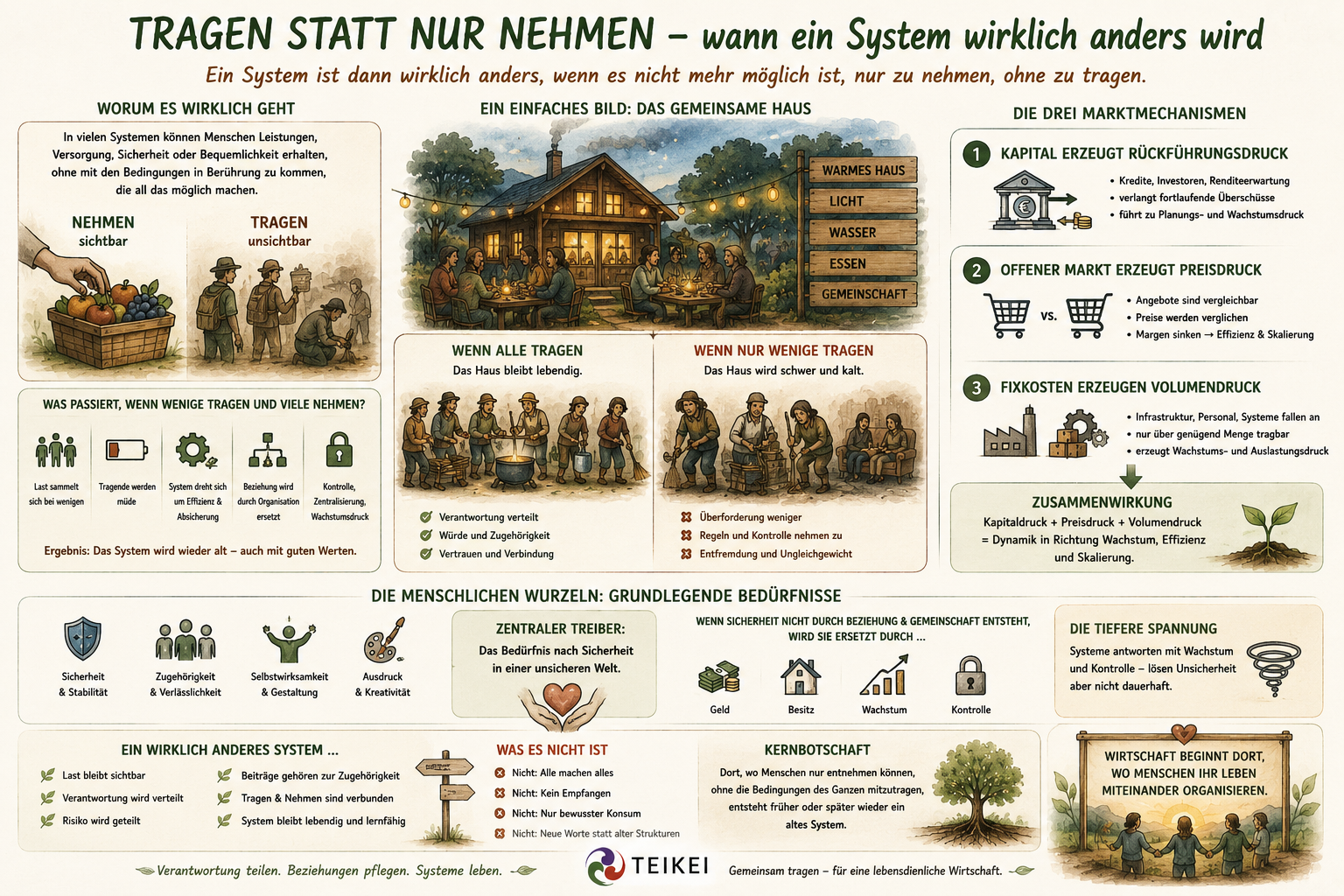
A system is truly different only when it is no longer possible to just take without carrying.
This sentence sounds simple at first. But it contains a profound truth about economics, community, and responsibility.
For many systems do not fail because their values are wrong. They fail because their burdens are distributed unequally.
¶ What it’s really about
On the surface, one might say:
The problem is consumption.
But that is not deep enough.
The real point is:
In many systems, people can receive services, provisions, security, or convenience without coming into contact with the conditions that make all this possible.
They see the result, but not the burden.
They use the fruit, but they do not feel the soil.
They receive the service, but they do not bear the risk.
That is where the old logic begins.
¶ Why this is so important
As soon as a system allows many to just take while few carry, almost inevitably the following happens:
- The burden accumulates with a few people.
- These people must become more reliable, faster, and more resilient.
- The system begins to revolve around efficiency and security.
- Responsibility becomes professionalized.
- Relationship is replaced by organization.
- Over time, a structure emerges in which some perform and many receive.
Then the language may still be beautiful. Perhaps the values are still good. But at its core, the system has become old again.
¶ A simple image
Imagine a shared house.
In this house, it is warm. There is light. It is clean. There is water. Food is on the table.
Now many people live in this house.
If everyone lives there, but only two or three people constantly:
- fetch wood
- make fire
- carry water
- cook
- clean
- repair
- organize supplies
then at first, perhaps nothing happens. For a while, this even works well.
But over time, the whole house changes.
Those carrying the load become tired.
They begin to set rules.
They want to plan better.
They want to avoid failures.
They want more supplies.
They want more security.
They want everything to become more predictable.
This is understandable. It is not a moral failing. It is a consequence of the unequal burden.
And then the house changes:
It becomes more organized, stricter, more technical, and more controlled.
Not because someone is evil.
But because too few carry.
¶ What this image shows
The problem does not begin with bad people or wrong intentions.
The problem begins where the structure allows extraction to be easy and carrying to remain invisible.
Because then carrying becomes the task of a minority.
And any minority that must permanently carry the burden of the whole will sooner or later begin to control or simplify that whole more strongly.
From this arise:
- Centralization
- Bureaucracy
- Efficiency pressure
- Growth pressure
- Inner alienation
¶ Why this also applies to economics
In economics, it is often similar.
People buy a product, use a service, or receive provisions.
But much of what makes this system possible remains outside their experience:
- Crop failures
- Organizational burden
- Storage problems
- Coordination effort
- Financial uncertainties
- Maintenance of relationships
- Responsibility for the whole
If all this is carried by only a few, sooner or later the same basic form emerges again:
- here the users
- there the carriers
And that is the old logic, even if it is designed to be friendly.
¶ The decisive difference
A system does not become different just because it offers better products.
It also does not become different just because it uses fairer words or appeals to more conscious people.
It only truly becomes different when the fundamental relationship changes:
Not some carry and many take,
but many carry in different ways.
Here, carrying does not mean that everyone must do everything equally.
It means:
- The burden of the whole remains visible.
- Responsibility is not completely outsourced.
- Risk does not disappear invisibly with a few.
- Contributions are part of belonging.
- The system does not live on passivity.
¶ A second, very simple example
Imagine a fruit tree from which many people eat.
If people only come, pick, and leave, it may seem harmless at first.
But at some point, the question arises:
- Who planted the tree?
- Who cared for it?
- Who protects it in winter?
- Who waters it in dry times?
- Who endures the bad years?
If these questions have no place in the system, the whole lives on invisible work.
Then taking is visible, but carrying is invisible.
And wherever carrying becomes invisible, exploitation, overburdening, or alienation arises.
¶ Why this truth is so fundamental
This insight is so important because it goes deeper than many political or economic terms.
It does not first ask:
- Is something left or right?
- Is something non-profit or profit-oriented?
- Is something modern or traditional?
It asks something more fundamental:
How is the relationship between giving, burden, and responsibility organized?
Because that is where it is decided whether a system turns people into co-carriers or mere takers.
¶ What is often misunderstood
Some people hear such a thought and think:
Then everyone must always do everything together.
That is not what is meant.
A carrying system does not mean:
Everyone does everything.
It means:
Each person stands in a real relationship to the whole.
This relationship can look different:
- through time
- through money
- through commitment
- through helping
- through taking responsibility
- through sharing risk
- through local organization
- through careful participation
What matters is not equality of contributions.
What matters is that belonging is not separated from the burden.
¶ Why consumption alone cannot solve this
Even conscious consumption does not fully solve this problem.
Someone can shop very mindfully, have good values, and prefer fair products.
And still remain in a role where the actual responsibility lies with others.
Then the old merely becomes a little friendlier.
Therefore, it is not enough to choose differently.
It must also be carried differently.
¶ The inner core of the sentence
A system is truly different only when it is no longer possible to just take without carrying.
This does not mean:
No one may receive.
It means:
Receiving and carrying must not be completely separated from each other.
Because where this separation is permanently possible, the same imbalance always arises again:
A few become the carriers of the whole, many the users of the whole.
And from this ultimately grows again what one actually wanted to overcome.
¶ Why this is also humanly true
People need not only provisions.
They also need meaning, connection, and effectiveness.
Those who only receive may be comfortably provided for externally, but internally often remain disconnected.
Those who contribute in a sustainable way experience themselves differently:
not just as consumers, but as part of the life process.
Therefore, carrying is not just a burden.
It is also a form of dignity, relationship, and belonging.
¶ How to recognize a truly different system
A truly different system can be recognized by the fact that it does not ignore these questions:
- What do you carry?
- Which burden remains visible?
- How is responsibility distributed?
- How is risk shared?
- How does belonging remain connected to contribution?
- How do we prevent a few from having to carry the whole for many?
Where these questions are alive, something new can emerge.
Where they are missing, the old returns, even if the language sounds new.
¶ Condensed core statement
Where people can only take without carrying the conditions of the whole, an old system emerges again sooner or later.
¶ Even shorter
It is not consumption alone that is the problem.
The problem begins where taking and carrying are separated from each other.
¶ Further information & understanding connections
One level up: Understanding economics
Author: Felix Schröder, with the help of AI (ChatGPT)
Created: written by Felix Schröder › formatted in Markdown by ChatGPT › published by Felix Schröder › layout adjusted by Claude
Created: 2026-04-15 · Last updated: 2026-10-11 · Questions or suggestions? support@teikei.us