¶ Wholesaler
Introduction and Overview › Glossary for the Networking Language · 8 min read
A wholesaler is a company or organization that purchases goods in large quantities, consolidates them, stores them, and resells them to other commercial buyers.
These include, for example:
- Retail
- Organic shops
- Gastronomy
- Canteens
- Institutions
- Processing businesses
- Other bulk buyers
- Regional distribution centers
Wholesale typically does not target individual households directly but rather people and organizations that resell, further process, or require larger quantities for an institution.
¶ Core Function
The most important function of wholesale is consolidation.
Many producers cannot deliver their goods individually to all points of sale, kitchens, institutions, or communities. At the same time, many smaller buyers cannot place orders with every farm, mill, oil mill, or processing business individually.
Wholesale therefore takes on an intermediary role.
It collects goods, maintains inventory, organizes transport, creates assortments, handles billing, and ensures that larger quantities are predictably available.
¶ Typical Tasks
A wholesaler often performs several tasks simultaneously:
- Purchasing larger quantities of goods
- Storage and inventory management
- Assortment creation
- Quality assurance
- Packaging and order picking
- Transport and delivery
- Invoicing
- Payment terms and pre-financing
- Communication with suppliers and buyers
- Managing fluctuations, shortages, and short-term demand
This allows the wholesaler to bear part of the logistical, financial, and organizational burden between production and procurement.
¶ Historical Context
Trade in larger quantities has existed for a very long time.
Even where goods were moved over greater distances, intermediary structures emerged: traders, storage facilities, transshipment points, market halls, ports, and later trading offices.
As the division of labor increased, this function became more important.
Agricultural businesses, craft businesses, and later industrial businesses produced goods but could not always reach all buyers themselves. At the same time, cities, markets, shops, and institutions needed a reliable supply of various products.
From this tension, modern wholesale emerged.
It became a distinct stage between production, processing, retail, and commercial buyers.
¶ Why Wholesale Became Important
Wholesale did not emerge by chance.
It fulfilled concrete functions that became necessary for larger supply systems:
- Consolidating larger quantities
- Making goods available over distances
- Balancing seasonal fluctuations
- Organizing storage
- Making prices and quantities calculable
- Enabling producers to access buyers
- Enabling buyers to access many producers
- Distributing risks among multiple parties
This role is particularly significant for food because freshness, shelf life, quantity planning, and transport are closely linked.
¶ Risk Assumption in Wholesale
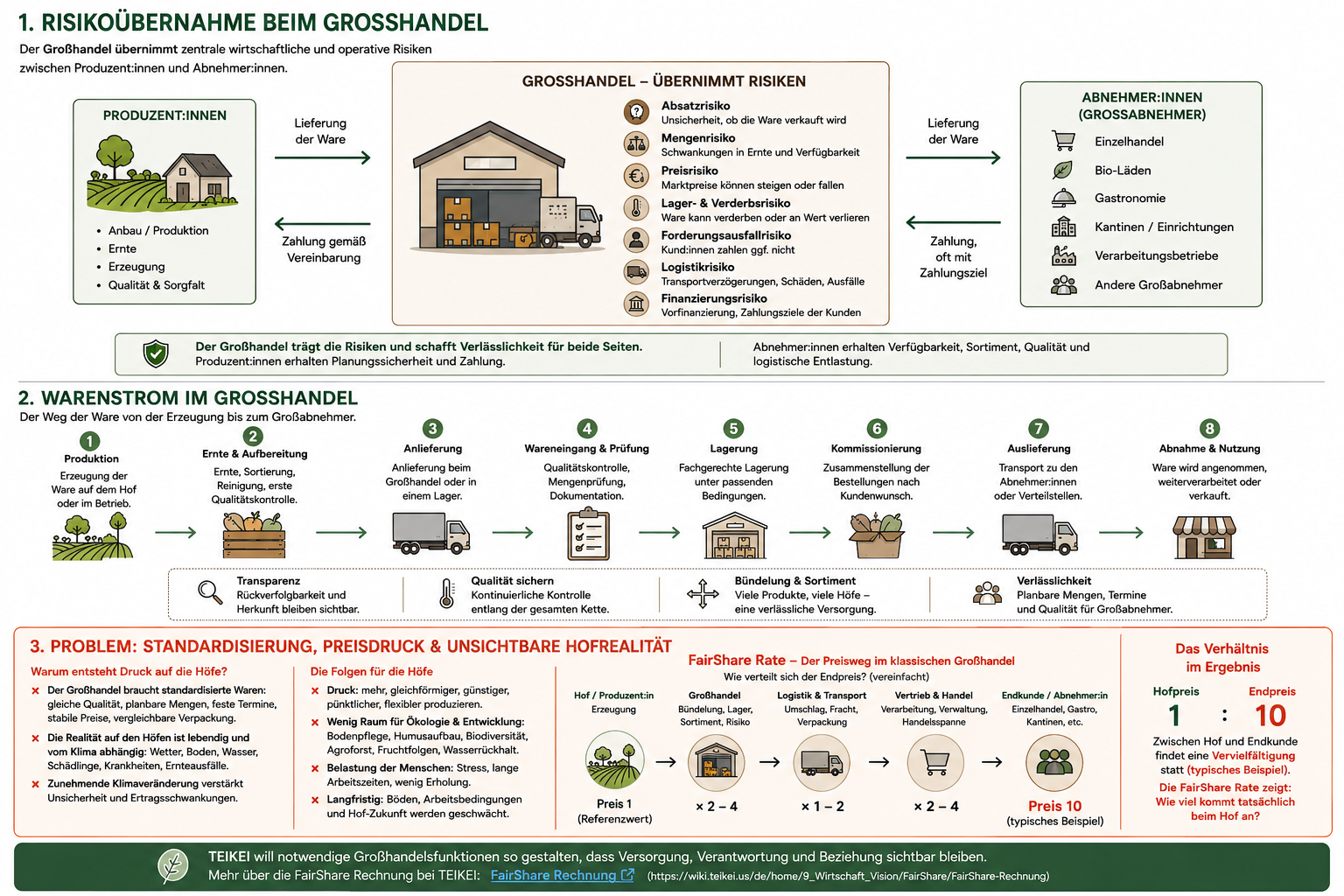
An important part of the wholesale function is risk assumption.
The wholesaler purchases goods before it is certain whether they can be fully, timely, and at the expected price resold.
It bears various risks:
- Sales risk
- Quantity risk
- Price risk
- Storage and spoilage risk
- Default risk
- Logistics risk
- Financing risk
This means: Wholesale creates reliability between producers and buyers.
Producers often gain greater planning security because they do not have to organize every single delivery themselves and do not have to reach every single buyer directly.
Buyers receive availability, assortment, quality, and logistical relief.
This function is real—we should not underestimate it.
¶ Goods Flow in Wholesale
The flow of goods in wholesale usually follows a clear sequence:
- Production on the farm or in the business
- Harvest and initial processing
- Delivery to the wholesaler or a warehouse
- Goods receipt, inspection, and documentation
- Storage
- Order picking
- Delivery to buyers
- Receipt, use, further processing, or resale
Many practical tasks arise in this process.
Goods must be inspected, sorted, cooled, stored, documented, assembled, and delivered.
Wholesale makes this work visible and manageable. At the same time, costs, margins, and dependencies arise.
¶ Bulk Buyers
A bulk buyer is not automatically a wholesaler.
A bulk buyer purchases larger quantities but does not necessarily resell them.
Examples of bulk buyers include:
- Canteens
- Kitchens
- Gastronomy
- Schools
- Care facilities
- Companies
- Larger communities
- Processing businesses
A wholesaler can deliver to bulk buyers.
However, a bulk buyer can also source directly from producers, processing businesses, or through a collectively organized structure.
¶ Wholesale in the Organic Sector
In the organic sector, wholesale has long played a special role.
Many organic producers, natural food stores, and regional initiatives relied on structures that could consolidate small and medium-sized businesses. Organic wholesalers not only handled the movement of goods but often also provided consulting, relationship management, assortment building, and the connection between production and specialty trade.
Over time, the situation has changed.
Organic products are no longer found only in specialty organic stores. Supermarkets, discounters, and drugstores have significantly expanded their organic assortments. This increases the reach of organic products while also changing the pressure on prices, quantities, standardization, and delivery capability.
For many organic wholesalers, this creates a difficult tension:
- They must deliver reliable quantities.
- They must keep up with large retail structures in terms of price.
- They must meet high quality and documentation requirements.
- They must work flexibly, quickly, and efficiently.
- At the same time, they must preserve the values of the organic movement.
The more organic products are organized according to global trade principles, the more organic wholesalers are pushed into structures focused on price pressure, availability, scaling, interchangeable goods, and high turnover speed.
¶ Problem: Standardization, Price Pressure, and Invisible Farm Reality
Wholesale performs important functions: consolidation, storage, distribution, quality assurance, and risk assumption.
At the same time, this system creates a structural tension.
For wholesale to function reliably, it needs goods that are as standardized as possible:
- Uniform sizes
- Uniform quality
- Predictable quantities
- Fixed delivery dates
- Stable availability
- Comparable packaging
- Calculable prices
These requirements often only partially align with the reality of agricultural production.
Farms work with living processes. Weather, soil, water, plants, animals, labor, diseases, drought, heavy rain, heat, and crop failures cannot be fully standardized.
Due to increasing climate change, this tension is growing.
What is expected as reliable goods in trade is produced on farms under increasingly uncertain conditions.
¶ Efficiency Pressure on Farms
When farms supply a highly standardized trade system, pressure often arises:
- To produce as much as possible
- To produce as uniformly as possible
- To deliver as cheaply as possible
- To deliver as punctually as possible
- To have as little waste as possible
- To respond as flexibly as possible to demand
This often leaves farms with little financial and temporal room to build the ecological foundation of their work.
This includes, for example:
- Humus formation
- Soil care
- Water retention
- Biodiversity
- Agroforestry
- Diverse crop rotations
- Fair working conditions
- Relief from work pressure
- Adaptation to climate change
Instead, many businesses must deliver very efficiently and keep production running at full capacity.
In the long term, this can come at the expense of soils, working conditions, and the resilience of the people working on the farms.
¶ FairShare Rate
The FairShare Rate in TEIKEI describes the ratio between the price received by the farm and the price ultimately paid by members or end buyers.
Further reading:
In traditional wholesale, a significant multiplication can occur between the farm price and the final price.
Simplified:
- The farm receives price 1
- In the end, end buyers pay price 10
In between are wholesale, storage, transport, packaging, sorting, losses, trade margins, payment risks, administration, and other costs.
These intermediate steps are not automatically wrong. Many fulfill real functions.
The problem arises where the multiplication of the price is no longer traceable and, at the same time, too little remains for the farm to sustain the entire farm reality.
¶ What Needs to Become Visible
The crucial question is therefore not only: How does the goods get efficiently from A to B? But also:
- How much of the final price reaches the farm?
- Who bears which risks?
- Who has financial leeway?
- Who bears the consequences of climate, crop failures, and price pressure?
- Is there room for ecological development?
- Are soils, people, and farm development supported?
- Or is only the most standardized goods paid for?
¶ Significance for TEIKEI
At TEIKEI, we do not categorically reject wholesale. We take its function seriously.
Consolidation, storage, transport, order picking, and billing are real tasks. They do not disappear just because a supply is collectively supported.
The decisive question is therefore: How can we organize necessary wholesale functions so that relationships, responsibility, and transparency are preserved?
For TEIKEI, this means:
- Quantities are planned collectively.
- Origin remains visible.
- Producers do not become anonymous suppliers.
- Money flows should be traceable.
- Logistics are understood as part of shared responsibility.
- Bulk buyers can be integrated without the supply tipping into pure trade logic.
- The FairShare Rate makes visible how much of the final price actually reaches the farm.
¶ Difference from TEIKEI Structures
Traditional wholesale usually operates as a trade stage between production and procurement.
At TEIKEI, we try to embed necessary functions such as consolidation, distribution, communication, and billing into a collectively supported structure. Our goal is not to avoid every wholesale function. We want to shape these functions so that they serve the supply and do not obscure the relationship between producers, communities, and members.
¶ In Short
A wholesaler consolidates goods, organizes storage, distribution, and billing, and makes larger supply systems manageable.
Historically, wholesale emerged from the necessity of organizing quantities of goods across distances, markets, and many buyers.
In the organic sector, wholesale is today under increasing pressure to function according to the principles of globalized food trade.
Wholesale requires standardized goods, predictable quantities, and efficient processes. This logic often stands in tension with the living reality of farms, especially under conditions of strong climate change.
The FairShare Rate helps make visible how much of the final price actually reaches the farm and how much the price multiplies between the farm and the end buyer.
¶ Related Terms
← Letter G · All Terms A–Z
By the TEIKEI editorial team, with support from AI (ChatGPT)
Created on May 19, 2026 · Last updated on October 10, 2026
Questions or suggestions? support@teikei.us