¶ Example Calculation: FairShare Logic and Basic Cost Participation with the TEIKEI Approach
¶ Why This Example Calculation Is Even Possible
The FairShare calculation is not an accounting trick or an after-the-fact bonus on an otherwise unchanged system. It only becomes possible with TEIKEI because the structure itself is built differently: basic cost participation covers the shared foundation, harvest and demand are coordinated well in advance, and logistics are not treated as an external cost block but are organized collectively.
This creates a different price architecture. The final price does not primarily have to follow market constraints but can be designed so that a significantly larger share flows directly into cultivation and production.
This is exactly what the following example calculation illustrates:
Same oranges. Same final price. Same farm.
And yet, in one model €4,400 reaches cultivation and production, while in the other, it’s €19,600.
→ How the FairShare Calculation Works
¶ Same Oranges, Same Final Price, Same Farm – But €4,400 or €19,600 for Production
The starting point is 10,000 kg of oranges from the Peloponnese.
In both models, people pay at the end:
€3.92 per kg
The comparison is between:
- a model with market price plus seasonal bonus
- the TEIKEI model with FairShare
The key difference:
In the first model, €0.44 per kg remains for the farm.
In the TEIKEI model, €1.96 per kg flows into cultivation and production.
The difference does not arise because members pay more.
The difference arises from how the same final price is distributed.
¶ Starting Point
For the calculation, we assume a common local price for organic quality of €0.40 per kg.
In the first model, the farm receives this market price during the season. At the end of the season, a 10% bonus is added.
This results in:
- Base price per kg: €0.40
- 10% bonus: €0.04
- Total payout per kg: €0.44
For 10,000 kg of oranges, this amounts to:
10,000 × €0.44 = €4,400
¶ System 1: Market Price Plus Seasonal Bonus
The final price is €3.92 per kg.
After the bonus, €0.44 per kg reaches the farm.
This means:
- Final price: €3.92 per kg
- Amount for the farm: €0.44 per kg
- Total for 10,000 kg: €4,400
- Share for the farm: 11.22%
- FairShare rate: 8.91
The calculation is:
3.92 / 0.44 = 8.91
For every euro that participants pay, around 11 cents reach cultivation and production.
¶ System 2: TEIKEI with FairShare
Now we calculate with the exact same final price of €3.92 per kg.
For Europe-wide regional supply, we set a FairShare rate of 2.0.
This means:
50% of the final price flows into cultivation and production.
The calculation is:
3.92 / 2.0 = €1.96
The farm thus receives:
€1.96 per kg
For 10,000 kg of oranges, this amounts to:
10,000 × €1.96 = €19,600
This results in:
- Final price: €3.92 per kg
- Amount for the farm: €1.96 per kg
- Total for 10,000 kg: €19,600
- Share for the farm: 50%
- FairShare rate: 2.0
¶ Direct Comparison
| Model | Final price per kg | Amount for the farm per kg | Share for the farm | FairShare rate | Amount for 10,000 kg |
|---|---|---|---|---|---|
| Market price plus seasonal bonus | €3.92 | €0.44 | 11.22% | 8.91 | €4,400 |
| TEIKEI with FairShare | €3.92 | €1.96 | 50% | 2.0 | €19,600 |
The final price is identical.
But the amount that reaches cultivation and production increases from:
€4,400 to €19,600.
That is:
€15,200 more for the farm.
Or, in other words:
At exactly the same final price, the farm receives about 4.45 times as much money in the TEIKEI model.
¶ What This Comparison Shows
Here, the structural question becomes particularly clear.
In both cases, participants pay:
€3.92 per kg
In the first model:
- €0.44 goes to the farm
- €3.48 goes into the rest of the price structure
- the farm receives 11.22%
In the TEIKEI model:
- €1.96 goes into cultivation and production
- €1.96 remains for logistics, processing, infrastructure, organization, and other necessary tasks
- production receives 50%
This makes the decisive question visible:
Not just: How much do people pay for food?
But:
Where does the money they are already paying end up?
¶ The Real Difference
This is not about an additional bonus.
Nor is it about simply making food more expensive.
It is about organizing the same existing money flow differently.
The model with market price plus bonus starts with the market price of the product and then supplements it.
TEIKEI starts with a different question:
How must the entire final price be distributed so that agriculture, logistics, and community infrastructure can become jointly sustainable?
¶ Context Based on an Example Farm
For illustration, we calculate with a hypothetical orange farm producing:
- about 155,000 kg of oranges per year
This number serves only as an example calculation and is not a statement about an average Greek orange farm.
¶ Market Price Plus Bonus
155,000 × €0.44 = €68,200
¶ TEIKEI with FairShare
155,000 × €1.96 = €303,800
¶ Difference
€303,800 – €68,200 = €235,600
The same sales volume and the same final price thus lead to a completely different economic outcome for production.
¶ Impact on Agriculture and the Ecosystem
A higher share for cultivation and production does not automatically mean that this money becomes additional private income.
Rather, it can enable a farm to regain room for maneuver.
For example, for:
- more people who can be well paid to work on the farm
- soil building and humus development
- water retention and irrigation infrastructure
- agroforestry and more diverse crops
- less dependence on maximum yields
- regenerative areas
- long-lasting machinery and infrastructure
- better working conditions
- reserves for poor harvest years
- long-term planning
This changes the economic question.
No longer exclusively:
How much yield must this hectare produce for the farm to survive?
But increasingly:
How can this place sustainably produce soil, food, landscape, and human livelihoods in the long term?
¶ Briefly Explained
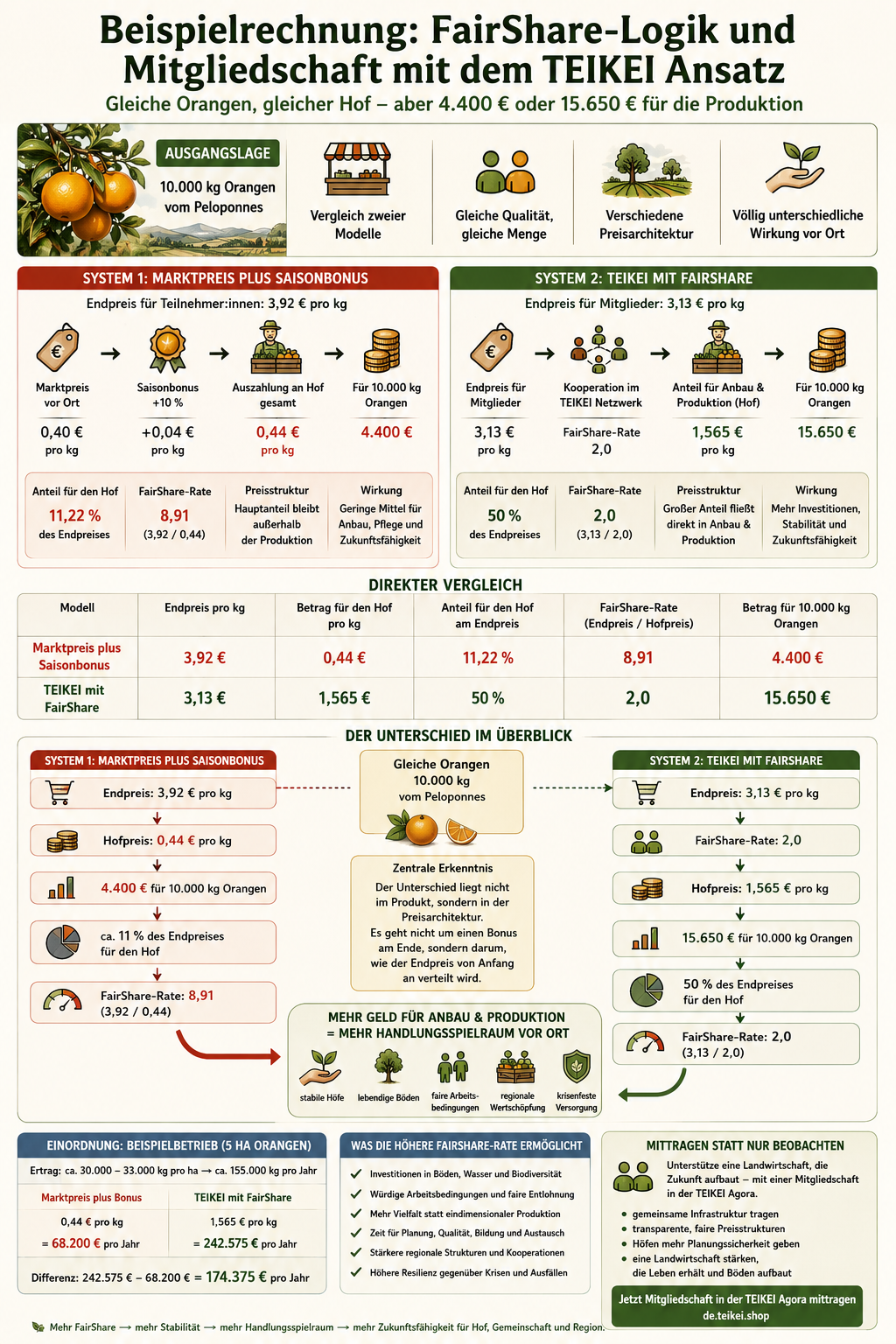
The flow diagram shows the same starting point with two different pricing logics.
In both cases:
→ 10,000 kg of oranges
→ €3.92 final price per kg
→ €39,200 total revenue
Market price plus bonus
→ €0.44 per kg for the farm
→ €4,400 total
→ FairShare 8.91
→ about 11% for the farm
TEIKEI with FairShare
→ €1.96 per kg for cultivation and production
→ €19,600 total
→ FairShare 2.0
→ 50% for cultivation and production
Same final price – but a completely different distribution.
¶ Participate Instead of Just Observing
If you want agriculture in Europe and right on your doorstep to develop in a way that builds soils, strengthens farms, and organizes supply more fairly, then support this approach with basic cost participation in the TEIKEI Agora.
With your membership, you help:
- support the shared infrastructure
- build transparent and fairer price structures
- give farms more planning security
- strengthen an agriculture that builds a future instead of exploiting itself
Agriculture in Europe and on your doorstep deserves it.
↑ One level up: FairShare
By Felix Schröder, with support from AI (ChatGPT)
Created on March 27, 2026 · Last updated on October 13, 2026
Questions or feedback? support@teikei.us