¶ Direct Sales
Getting Started and Overview › Glossary for Networking Language · 7 min read
Direct sales means that producers pass their goods on to customers as directly as possible.
Unnecessary intermediary stages are avoided.
Instead of going through multiple trade levels, the goods come more directly from the farm, business, or project to the people who use, process, or eat them.
Direct sales can take place in various forms:
- Farm shops
- Market stalls
- Subscription boxes
- Crowdfarming projects
- Online orders directly from the farm
- REKO rings
- Solidarity pickup groups
- Project-based platforms
- Direct deliveries to gastronomy or institutions
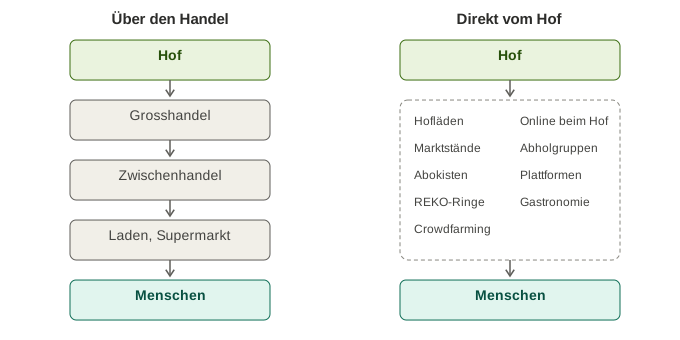
Via trade or directly from the farm: In direct sales, intermediary stages are eliminated.
¶ Core Function
The most important function of direct sales: It shortens the path between production and purchase.
This can reduce certain costs.
Fewer trade levels, fewer anonymous intermediary processes, and often less complex sales structures are needed.
For producers, direct sales can mean:
- Direct contact with customers
- Better visibility of their own work
- Greater appreciation
- More direct feedback
- More influence on price, presentation, and communication
- Less dependence on individual wholesale structures
For customers, direct sales can mean:
- Better knowledge of the origin
- A more personal connection to the farm
- Fresher or more traceable products
- More transparency about production methods and the people behind them
¶ Direct Sales Are Not Automatically Cooperative
Direct sales are sometimes confused with community-based supply.
It is important to distinguish between the two.
Direct sales initially only mean:
The goods are sold more directly.
It does not yet say anything about whether the structure is cooperative, community-supported, or jointly managed in the long term.
A farm can sell directly and still operate independently.
A platform can broker products directly from producers and still function according to classic sales logic.
A market stall can create personal contact and still remain primarily a point of sale.
Direct sales are therefore not automatically a cooperative structure.
They can strengthen relationships.
But they can also remain purely project-based, product-based, or sales-based.
¶ Cost Efficiency
Direct sales can be very cost-efficient if the structures remain simple.
This is especially true when:
- The distances are short
- The quantities remain manageable
- Customers are easily reachable
- Communication is simple
- No extensive product range is needed
- Storage and transport remain minimal
- Pickup is well organized
Then direct sales can help keep more of the paid amount at the farm.
At the same time, real costs also arise in direct sales.
These include:
- Communication
- Packaging
- Pickup or delivery
- Order organization
- Payment processing
- Market stall fees
- Sales labor time
- Storage
- Customer service
- Returns or losses
This work is sometimes underestimated because it is not visible as a classic trade level.
¶ Project-Based Limitations
Direct sales often work well for specific products, specific farms, or specific groups.
They are often project-based.
For example, a farm sells its own vegetables, fruit, eggs, meat, cheese, grain, oil, or processed products directly.
This can work very well.
At the same time, a single farm rarely covers the entire breadth of daily needs.
People need more than just one product or product group.
They need a diverse range:
- Vegetables
- Fruit
- Grains
- Oil
- Legumes
- Dairy products
- Eggs
- Bread
- Durable staple foods
- Special seasonal products
- Processed foods
If direct sales only represent a single project or farm, the rest of the supply often remains with conventional retail or wholesale.
¶ Farm Shops
Farm shops are a well-known form of direct sales.
They enable personal contact and make the farm as a place visible.
However, many farm shops do not sell exclusively their own products.
To make the range appealing and complete for visitors, many farm shops purchase additional products.
This can make sense.
But it also shows:
A farm shop is not automatically a fully direct farm supply.
Often, a mix of own production, regional purchases, and wholesale goods emerges.
¶ Market Stalls
Market stalls are also a classic form of direct sales.
They create proximity, conversation, and visibility.
At the same time, the same applies here:
Many market stalls purchase additional goods to offer a broad and attractive range.
This is especially the case when the farm’s own production is seasonally limited or does not offer enough variety.
The market stall can thus be both a direct sales channel and a trading location.
¶ Crowdfarming
Crowdfarming describes project-based models in which people source specific products directly from a farm or business.
Often, a specific product is the focus:
- Oranges
- Olive oil
- Coffee
- Cheese
- Wine
- Nuts
- Avocados
- Honey
Crowdfarming can help producers achieve better visibility and more direct sales.
At the same time, it often remains product-based.
The connection is usually to a specific product or project, not to a jointly managed regional supply.
¶ REKO Rings
REKO rings are direct marketing structures in which producers and customers usually come together via digital groups.
Social media platforms like Facebook are often used for this.
Producers post their offers.
Customers order in advance.
The handover takes place at an agreed location and time.
REKO rings can strengthen direct sales by enabling simple agreements, short distances, and personal handover.
At the same time, they mostly remain a coordinated sales and pickup structure.
A permanent joint financing, risk, and supply responsibility does not automatically arise from this.
¶ Positive Effects for Farms
Direct sales can have many positive effects for farms.
They can help:
- Retain more added value on the farm
- Build more independent sales channels
- Maintain direct relationships with customers
- Make their own work more visible
- Receive direct feedback
- Better explain special qualities
- Make pricing more transparent
- Build trust
Especially for small and medium-sized farms, direct sales can be an important component.
They can open up scope for action that is difficult to achieve in anonymous trade.
¶ Limits of Direct Sales
Direct sales also have clear limits.
They are not automatically less labor-intensive.
Many tasks that would otherwise be handled by trade or wholesale remain with the farm.
These include:
- Advertising
- Communication
- Packaging
- Sorting
- Delivery
- Payment processing
- Pickup
- Complaints
- Product range maintenance
- Digital channel management
- Individual customer support
For individual farms, this can quickly lead to additional burdens.
The farm then not only produces food but also takes on sales, communication, logistics, and customer service.
This can make sense, but it requires time, people, and good structures.
¶ Why Direct Sales Alone Are Often Not Enough
Direct sales can strengthen individual relationships.
But they do not automatically solve the question of how a more comprehensive supply can be organized.
Most people do not buy just one product.
They need a supply that works in everyday life.
If direct sales only represent individual products or farms, the supermarket remains the place where everything comes together.
This is a central limitation.
The supermarket is strong not just because of price.
It is strong because it bundles variety, availability, habit, and easy accessibility.
Those who want to build a real alternative must therefore offer more than just selling individual products directly.
¶ Cooperation as the Next Step
In the long term, it can make sense for farms not to practice direct sales individually.
A structure becomes stronger when several farms join forces.
Then, individual direct sales channels can evolve into a cooperative supply structure.
This means:
- Several farms bundle their offerings
- Different products complement each other
- Customers receive a more practical selection
- Work can be distributed
- Logistics can be organized jointly
- Communication is bundled
- Risks become more visible
- Regional supply becomes more sustainable
This creates not just a single sales channel but a joint supply structure.
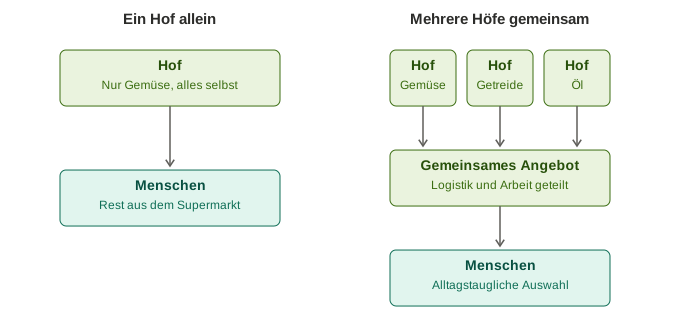
A single farm or several farms together: Only the bundled offering becomes practical for everyday use.
¶ Taking Consumer Behavior Seriously
A cooperative structure must take people’s actual consumer behavior seriously.
People do not just need what a single farm happens to offer.
They need a supply that fits into their daily lives.
This includes:
- Variety
- Regularity
- Easy pickup
- Clear communication
- Appropriate quantities
- Reliable quality
- Affordable structures
- Traceable origin
When several farms work together, an alternative can emerge that is not just idealistically correct but also practically usable.
¶ Difference from Wholesale
Direct sales avoid unnecessary intermediary stages.
Wholesale, on the other hand, bundles goods, storage, product range, risk, and distribution in a professional trade structure.
Both have functions.
Direct sales strengthen proximity and can reduce costs.
Wholesale creates availability, product range, and logistical reliability.
The central question is therefore not just:
Direct sales or wholesale?
But rather:
What tasks must be fulfilled to make supply reliable, fair, transparent, and ecologically sustainable?
¶ Significance for Community-Based Supply
Direct sales can be a starting point.
They can make relationships visible and strengthen producers.
However, for a more comprehensive community-based supply, more is needed:
- Cooperation between farms
- Joint logistics
- Clear pickup structures
- Transparent pricing
- Shared responsibility
- Visible goods flows
- Traceable money flows
- Long-term planning
- Joint development
Only then does a sustainable alternative to supermarkets and anonymous trade emerge from individual direct sales.
¶ In Short
Direct sales mean that producers pass their goods on to customers as directly as possible.
They can reduce costs, strengthen relationships, and give farms more visibility.
However, direct sales are not automatically cooperative.
They often remain product-based, project-based, or limited to individual farms.
Farm shops, market stalls, crowdfarming, and REKO rings can be important forms of direct sales. At the same time, many farm shops and market stalls purchase additional goods because their own offerings alone are not sufficient to meet the needs of many people.
In the long term, a stronger alternative emerges where farms join forces, complement their offerings, and jointly build a supply that takes people’s actual consumer behavior seriously.
¶ Related Terms
← Letter D · All Terms A–Z
By the TEIKEI editorial team, with AI support (ChatGPT)
Created on May 19, 2026 · Last updated on October 10, 2026
Questions or suggestions? support@teikei.us