¶ Golf Courses as Land Use
¶ What This Page Covers
This page describes golf courses from the perspective of land area, water, biodiversity, maintenance intensity, and ecological potential.
The central question is:
What happens to soil, water, and ecosystems when large areas are permanently used as golf courses—and what potential arises when such areas are maintained in a more nature-friendly way?
Golf courses are not agriculture.
However, they do use large landscape areas.
They influence soils, water balance, vegetation, maintenance practices, and biodiversity.
This makes them relevant for assessing agriculturally used or potentially restorable land.
¶ Basic Understanding
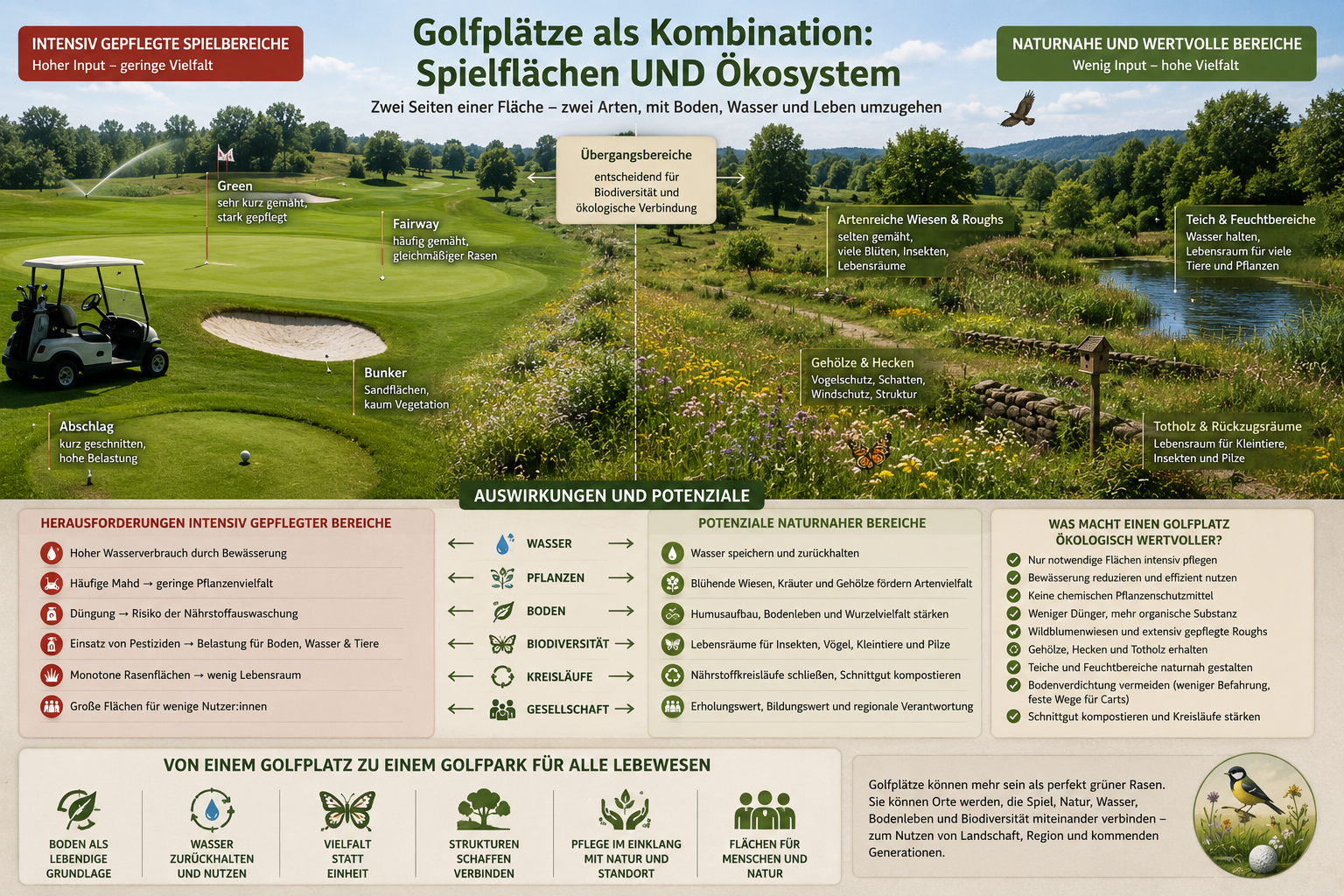
A golf course is not just short-cut grass.
It consists of different zones:
- Greens
- Tees
- Fairways
- Roughs
- Sand bunkers
- Paths
- Cart tracks
- Water features
- Woodlands
- Edge areas
- Maintenance areas
- Infrastructure
These zones have very different effects on the ecosystem.
An intensively maintained green is ecologically different from a species-rich meadow, a pond, a woodland edge, or an extensively maintained edge area.
Therefore, a precise distinction must be made:
Not every part of a golf course is equally problematic.
But the intensively maintained playing areas can significantly restrict ecological functions.
¶ The Central Question
The central question is not just:
Is a golf course green?
But rather:
- How alive is the soil?
- How deeply do the plants root?
- How much water is used?
- How often is it mowed?
- How much fertilizer is applied?
- Are chemical pesticides used?
- Are there flowers, herbs, shrubs, and habitats?
- Is water retained, infiltrated, or drained?
- Are there refuges for insects, birds, and small animals?
- How large is the proportion of near-natural areas?
- Can a golf course be partially ecologically enhanced?
Golf courses demonstrate that "green" does not automatically mean alive.
¶ Intensively Maintained Turf Is Not Automatically a Living Ecosystem
Many areas of golf courses consist of short, heavily maintained turf.
This turf is meant to be uniform, resilient, and playable.
To achieve this, it is regularly mowed, maintained, irrigated, and often fertilized.
Maintenance is particularly intensive on greens and tees.
The soil there is often treated less as a diverse habitat and more as a technical playing surface.
This can mean:
- very short vegetation
- low plant diversity
- few flowers
- shallow root zones
- regular disturbance
- controlled nutrient input
- high maintenance effort
- limited habitats for insects and soil organisms
Such turf can look green and still be ecologically poor.
¶ The Real Problem
The central problem of golf courses is not primarily soil compaction.
More important are usually:
- high land consumption
- intensive turf maintenance
- irrigation requirements
- frequent mowing
- possible fertilization
- possible use of chemical pesticides
- low plant diversity on playing areas
- ecological homogenization of large areas
- technical shaping of the landscape
- use of large areas by comparatively few people
The more a golf course is focused on perfect, uniform playing surfaces, the less room remains for natural dynamics.
This affects soil life, floral diversity, insects, water balance, and landscape structure.
¶ Water Requirements
Golf courses can require a lot of water.
The demand depends heavily on:
- climate
- soil type
- turf type
- maintenance standards
- irrigation technology
- size of the maintained area
- regional water availability
- season
- evaporation
- shade and wind
- player expectations
In dry regions, an intensively irrigated golf course can become a major intervention in the regional water balance.
This is particularly problematic where water is already scarce or where agriculture, drinking water, ecosystems, and recreational use compete for the same resource.
¶ Retaining Water Instead of Forcing Turf
A regenerative perspective does not first ask:
How can a golf course always stay green?
But rather:
How can a landscape absorb, retain, and circulate water sensibly?
This includes:
- humus-rich soils
- deeper roots
- shrubs
- hedges
- ponds
- wet areas
- mulch and leaf litter
- adapted plant species
- regional water retention
- fewer overheated areas
- less technical dependence on irrigation
If a golf course only stays green in dry periods through high irrigation, this is not a sign of resilience.
It shows a dependence on technical water supply.
¶ Fertilization and Nutrients
Intensively maintained turf requires nutrients.
Depending on maintenance practices, nitrogen, phosphorus, potassium, and other nutrients are applied.
This can be done through mineral or organic fertilizers.
The question is not just whether fertilization occurs.
The question is:
- How much is fertilized?
- When is it fertilized?
- How deeply does the turf root?
- Can the soil retain nutrients?
- Is there leaching?
- Are water bodies affected?
- Is humus being built up?
- Is the turf dependent on continuous input?
If nutrients are not integrated into living soil processes, they can be more easily lost.
This creates a maintenance and input logic instead of a cycle.
¶ Chemical Agents and Plant Protection
Golf courses can be susceptible to diseases, fungi, unwanted plants, or insects when the turf is very uniform, short, and heavily used.
Plant protection may then be applied.
The intensity depends on the country, legal requirements, maintenance philosophy, and standards for playing surfaces.
It becomes problematic when chemical agents enter soils, water bodies, or adjacent habitats.
An ecological golf course maintenance would therefore ask:
- How can plant health be strengthened through soil life?
- How can turf stress be reduced?
- Which areas really need intensive maintenance?
- Where can wild meadows, herbs, shrubs, and extensive areas develop?
- How can chemical control be replaced by ecological stability?
¶ Biodiversity
Many traditional golf course areas are species-poor.
Short-maintained turf offers little food and habitat for insects, wild bees, butterflies, soil organisms, and birds.
Particularly species-poor are:
- intensively mowed greens
- frequently cut fairways
- monotonous turf systems
- pesticide-affected areas
- nutrient-rich, flower-poor turf areas
- highly homogenized maintenance areas
At the same time, golf courses can also contain valuable areas if maintained appropriately.
These include:
- roughs with wildflowers
- hedges
- old trees
- ponds
- wet areas
- deadwood
- extensive meadows
- woodland edges
- sand and dry areas
- unfertilized edge areas
- unmowed refuges
A golf course is therefore not automatically ecologically poor.
Its ecological value depends heavily on how much area is managed in a near-natural way.
¶ The Potential of Golf Courses
Golf courses also have special potential.
They are often large, contiguous green areas.
They sometimes already include:
- open meadows
- water features
- woodlands
- old trees
- paths
- edge structures
- little sealed areas
- varied terrain
If these areas are maintained less intensively, they can become valuable habitats.
Possible developments include:
- wildflower meadows
- species-rich roughs
- hedge structures
- wet biotopes
- ponds with natural banks
- deadwood areas
- extensive meadows
- tree rows
- agroforestry elements
- public learning sites for soil, water, and biodiversity
This way, golf courses can become transitional areas that better combine recreational use, landscape maintenance, and ecological enhancement.
¶ Land Consumption
Golf courses require a lot of space.
This space is then not or only limitedly available for other uses.
Depending on location, this can mean:
- less agricultural land
- fewer publicly accessible green spaces
- loss of natural habitats
- alteration of watercourses
- fragmentation of the landscape
- high maintenance infrastructure
- use of large areas by comparatively few people
This question is particularly important in regions with land pressure.
There, the question must be asked:
Which use is sustainable for soil, water, nutrition, biodiversity, and people in the long term?
¶ Golf Courses and Agriculture
Golf courses can be established on former agricultural land.
This changes the function of the soil.
A soil that previously produced food becomes a recreational area.
This is not automatically wrong.
But it changes the societal significance of the area.
From a TEIKEI perspective, it is important:
Soil is not just any surface.
Soil is the basis of life.
When fertile soils are permanently transformed for recreational use, this affects food security, regional supply, and long-term responsibility.
¶ Technically Maintained Landscape
Golf courses are often highly designed landscapes.
They can look natural.
Nevertheless, they are frequently technically shaped by:
- terrain modeling
- drainage
- irrigation
- turf base layers
- sand construction
- bunkers
- paths
- water hazards
- intensive maintenance
- regular mowing
- fertilization
- plant protection
- machinery operation
This distinguishes them from a meadow, a forest, or pasture.
The landscape is managed to remain playable.
The ecological question is:
How much natural life can this landscape retain?
¶ Can Golf Courses Become Regenerative?
A golf course does not automatically become regenerative just because it is green.
But golf courses can be significantly improved ecologically.
This includes:
- less intensively maintained turf areas
- reduction of irrigation
- adapted, drought-tolerant grasses
- avoidance of chemical pesticides
- less fertilization
- building humus
- promoting soil life
- more wildflower meadows
- hedges and tree structures
- extensive roughs
- ponds and wet biotopes
- deadwood areas
- unmowed zones
- composting of clippings
- limiting golf cart traffic to fixed paths
- public ecological education areas
The more areas are taken out of intensive maintenance, the greater the ecological value can become.
¶ The Decisive Difference
The difference does not lie solely between golf and non-golf.
The difference lies between:
- short-maintained, highly controlled intensive turf
- and a diverse, deeply rooted, living landscape
A golf course can be ecologically problematic if almost everything is focused on perfect playing surfaces, green turf, and technical control.
A golf course can become more ecologically valuable if large parts are managed as habitats, meadows, woodlands, water features, and soil-building areas.
¶ What Would Be More Ecologically Valuable?
A golf course would be more ecologically valuable if:
- only the absolutely necessary playing areas are intensively maintained
- fairways are not excessively irrigated and fertilized
- roughs remain species-rich and extensive
- no chemical pesticides are used
- clippings are sensibly composted
- soil life is promoted
- flowering areas and herbs are allowed
- trees and hedges are part of the facility
- water is retained in the landscape
- local plant species are used
- maintenance goals are adapted to climate and location
- undisturbed refuges are created
The goal would not be perfect green uniformity.
The goal would be an area that better combines play, soil life, water, and biodiversity.
¶ What Would Be Problematic?
Golf courses are particularly problematic when:
- they require high irrigation in water-scarce regions
- fertile agricultural land is permanently lost
- sensitive habitats are built over or drained
- pesticides and fertilizers endanger water bodies
- large areas are mowed in a species-poor manner
- maintenance goals work against site conditions
- water is artificially retained without strengthening landscape cycles
- access and benefits remain limited to few people
- ecological potentials remain unused
Then a large area is heavily controlled for a narrow use.
¶ Golf Courses as Potential Transitional Areas
Some golf courses could play a different role in the future.
They could be partially or completely further developed into:
- public landscape parks
- biodiversity areas
- agroforestry systems
- community gardens
- extensive pastures
- learning sites for soil and water
- wetlands
- regional climate adaptation areas
- areas for humus building
- areas for community-supported agriculture
This requires careful analysis:
- What soils are present?
- How does water flow?
- What legacy issues or maintenance inputs exist?
- Which areas are already valuable?
- Where can agriculture be meaningful?
- Where is nature conservation more important?
- What use does the region need?
¶ TEIKEI Perspective
From a TEIKEI perspective, golf courses raise important questions about land responsibility.
It is not about blanket condemnation of individual recreational forms.
It is about taking soil as the basis of life seriously.
One area can look green and still contribute little to fertility.
Another area can look less maintained and be ecologically much more alive.
TEIKEI therefore asks:
- Does an area serve soil, water, biodiversity, and people in the long term?
- Is fertility being built or just the surface maintained?
- Is water being retained or consumed?
- Are cycles being strengthened or opened?
- Is the area part of community responsibility?
- Could it contribute to regional supply, recreation, biodiversity, or education?
¶ Connection to Land Assessment
Golf courses belong to the category:
Assessment of agriculturally used land
There, existing land uses are examined.
The question is:
What has happened to an area so far, and what development would be needed for it to serve the ecosystem more than harm it?
For golf courses, this means:
- understanding maintenance intensity
- examining water requirements
- reviewing the use of fertilization and plant protection
- assessing biodiversity
- strengthening near-natural areas
- identifying ecological potentials
- examining possible repurposing or partial enhancement
¶ Classification
This page does not replace professional ecological mapping or soil investigation.
Golf courses vary greatly.
Decisive factors are:
- location
- climate
- water availability
- soil type
- previous maintenance
- fertilization
- plant protection
- landscape structure
- proportion of near-natural areas
- accessibility
- regional land requirements
For a concrete assessment, soil analysis, vegetation mapping, water analysis, and an honest review of previous use are needed.
¶ Key Point
Golf courses show that green areas can have very different effects.
A short-maintained, irrigated, and intensively maintained turf is not automatically living soil.
Living landscapes need roots, diversity, water retention capacity, humus, soil life, flowers, animals, shrubs, and time.
If golf courses ignore these connections, they can weaken soil, water, and biodiversity.
If they develop large parts of their area in a near-natural way, they can become transitional spaces.
The decisive question is:
Is an area only maintained to look green?
Or is it designed so that soil, water, and life become stronger in the long term?
¶ Further Information & Understanding Contexts
- Regenerative Agriculture and Development Paths
- Water in the Agricultural Cycle
- Plants, Roots, and Soil Life
One level up: Assessment of agriculturally used land
Author: Felix Schröder, with the help of AI (ChatGPT)
Created: written by Felix Schröder › formatted in Markdown by ChatGPT › published by Felix Schröder › layout adjusted by Claude
Created: 2026-05-16 · Last updated: 2026-10-10 · Questions or suggestions? support@teikei.us