¶ Plants, Roots, and Soil Life
¶ What This Page Is About
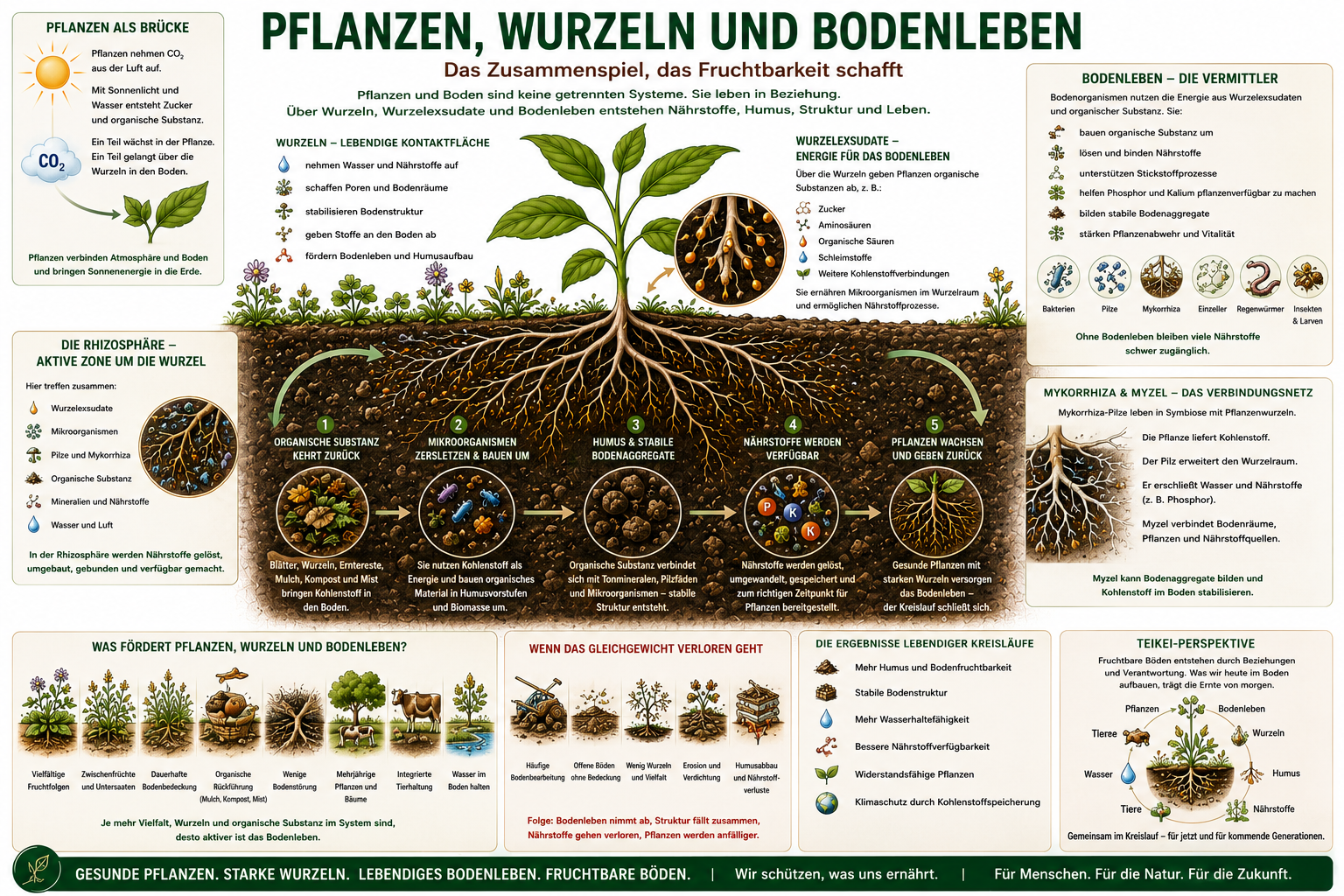
This page explains the interplay between plants, roots, and soil life.
At its core is the question:
How does soil fertility arise through the relationship between plants, roots, microorganisms, fungi, organic matter, and humus?
Plants do not simply grow on the soil.
They live with the soil.
Through their roots, they connect with microorganisms, fungi, water, air, minerals, and organic matter.
This interplay creates nutrient availability, soil structure, humus formation, and long-term fertility.
¶ Basic Understanding
Fertile soil is not passive material.
It is a living space.
The following work together within it:
- Plant roots
- Bacteria
- Fungi
- Mycorrhiza
- Earthworms
- Insects
- Microorganisms
- Organic matter
- Water
- Air
- Minerals
- Humus
Plants are not merely users of the soil.
They are active shapers of soil life.
¶ Plants as a Connection Between Air and Soil
Plants absorb CO₂ from the air.
With the help of sunlight and water, they form sugars and other carbon compounds.
Some of this is incorporated into leaves, stems, fruits, seeds, and roots.
Another part enters the soil via the roots.
In this way, plants connect the atmosphere with soil life.
They bring solar energy into the soil.
Without plants, there is no lasting flow of living carbon into the soil.
¶ Roots as a Living Interface
Roots are more than anchoring organs.
They are the interface between plant and soil.
Through roots, the plant absorbs water and nutrients.
At the same time, it releases substances into the soil.
Roots can:
- Open up soil spaces
- Form pores
- Stabilize soil structure
- Feed microorganisms
- Create water pathways
- Mobilize nutrients
- Bring organic matter into the soil
- Support humus formation
The more living roots there are in the soil, the more active soil life can become.
¶ The Rhizosphere
The rhizosphere is the active zone around the plant root.
Here, soil life is particularly dense and dynamic.
In the rhizosphere, the following come together:
- Root exudates
- Bacteria
- Fungi
- Mycorrhiza
- Minerals
- Organic matter
- Water
- Oxygen
- Nutrients
This zone is crucial for plant nutrition.
Here, nutrients are dissolved, transformed, bound, and made available again.
The rhizosphere is therefore a central location for closed cycles.
¶ Root Exudates
Plants release so-called root exudates through their roots.
These are organic substances such as:
- Sugars
- Amino acids
- Organic acids
- Mucilage
- Enzymes
- Other carbon compounds
These substances feed microorganisms in the root zone.
They are an important reason why soil life is particularly active near living roots.
Root exudates are not waste.
They are part of an active relationship between plant and soil.
¶ Root Exudates as Energy for Microorganisms
Microorganisms need energy.
They obtain this energy, among other things, from root exudates.
The plant releases some of its carbon, formed through photosynthesis, into the soil.
Microorganisms use this carbon.
In return, they can:
- Make nutrients available
- Transform organic matter
- Support nitrogen processes
- Help dissolve phosphorus
- Mobilize potassium from mineral bonds
- Form soil aggregates
- Strengthen plant defense
- Promote humus formation
This creates an exchange.
The plant provides energy.
Soil life supports fertility.
¶ Soil Life as a Mediator
Soil life mediates between minerals, organic matter, and plants.
Without soil life, many nutrients remain difficult to access.
With active soil life, nutrients can be dissolved, transformed, stored, and made available at the right time.
Soil life includes, among others:
- Bacteria
- Fungi
- Mycorrhiza
- Actinobacteria
- Algae
- Protozoa
- Nematodes
- Mites
- Springtails
- Earthworms
- Insect larvae
These organisms do not form a rigid system.
They are a living network.
¶ Bacteria
Bacteria perform many tasks in the soil.
They can break down organic matter, transform nutrients, and enable metabolic processes.
Some bacteria are important for nitrogen processes.
Others help dissolve or transform nutrients.
Bacteria are particularly active where energy is available.
Root exudates, organic matter, compost, manure, and dead roots are important energy sources.
¶ Fungi
Fungi are crucial for building living soil structures.
They can break down organic material.
They can permeate hard-to-reach soil spaces.
They can connect plants with nutrients and water.
Fungal hyphae can link soil particles together.
This supports stable soil aggregates.
Fungi are particularly important in systems with perennial plants, trees, shrubs, hedges, forest gardens, and minimally disturbed soils.
¶ Mycorrhiza
Mycorrhiza describes the relationship between plant roots and certain fungi.
The plant releases carbon compounds to the fungus.
The fungus expands the root space.
It can access water and nutrients that the plant alone would have difficulty reaching.
Mycorrhiza is particularly important for:
- Phosphorus access
- Water uptake
- Nutrient transport
- Soil structure
- Plant resilience
- Connection between plants and soil spaces
Mycorrhiza clearly shows:
Plants do not feed solely through their own roots.
They live in relationship with fungal networks.
¶ Mycelium
Mycelium is the fine network of fungal threads in the soil.
It can permeate large soil spaces.
Mycelium connects organic matter, minerals, water, plant roots, and microorganisms.
It can:
- Link soil particles
- Transport nutrients
- Access water
- Transform organic matter
- Support humus formation
- Stabilize soil structure
Mycelium is an important component of living soils.
It makes visible that soil fertility does not consist solely of individual substances but of relationships.
¶ Roots and Soil Structure
Roots build soil structure.
They grow through the soil and create pores.
When roots die, fine cavities remain.
These pores help water and air penetrate the soil.
They create habitats for soil organisms.
Roots can also stabilize soil particles.
Together with fungi, bacteria, organic matter, and humus, stable soil aggregates form.
Good soil structure is important for:
- Water absorption
- Air in the soil
- Root growth
- Nutrient transport
- Erosion protection
- Soil life
- Plant stability
¶ Roots and Humus Formation
Roots are an important pathway for humus formation.
Aboveground plant residues lie on the soil surface.
Roots bring organic matter directly into the soil.
They feed microorganisms.
They partially die and become organic matter.
They leave carbon in the soil space.
Thus, roots can directly contribute to humus formation.
Particularly valuable are:
- Deep roots
- Fine roots
- Permanent roots
- Diverse root systems
- Living root spaces over as long periods as possible
¶ Trees, Shrubs, and Perennial Plants
Trees, shrubs, and perennial plants are particularly important for soil life.
They maintain living root spaces over long periods.
They continuously release root exudates.
They return leaves, fine roots, and organic matter.
They stabilize the soil.
They promote mycorrhiza and mycelium.
They create microclimates.
They can access deeper soil layers.
In agroforestry systems, forest gardens, hedges, orchards, olive groves, or vineyards, such structures can be consciously used.
¶ Annual Plants and Living Soils
Annual crops can also make important contributions to soil life.
The key is that the soil is not only covered for short periods.
Annual systems therefore require special attention to:
- Crop rotations
- Cover crops
- Undersowing
- Mulch
- Root diversity
- Reduced soil disturbance
- Organic return
- Compost and manure
- Soil cover
When annual crops are connected with living intermediate phases, they too can become part of stable cycles.
¶ Plant Diversity
Different plants feed different soil life.
They have different root depths, root forms, exudates, and nutrient requirements.
A diverse plant world can therefore access more soil spaces than a monoculture.
Plant diversity promotes:
- Different microorganisms
- Various root depths
- Better soil structure
- More stable nutrient cycles
- Greater biodiversity
- Higher resilience
- More organic matter
Diversity is therefore not decoration.
It is a foundation of living soil processes.
¶ Soil Cover
Soil cover protects the soil.
It can consist of:
- Living plants
- Mulch
- Leaves
- Harvest residues
- Cover crops
- Undersowing
- Permanent greening
Covered soils are better protected from:
- Drying out
- Erosion
- Overheating
- Crusting
- Nutrient loss
- Humus degradation
Soil cover keeps the soil space more stable.
This allows roots and soil life to work better.
¶ Soil Disturbance
Soil disturbance can impair soil life.
This includes:
- Intensive soil cultivation
- Compaction
- Bare soil
- Loss of organic matter
- Frequent destruction of root spaces
- Disruption of fungal networks
Soil cultivation may be necessary in certain situations.
But it has effects on soil life.
A regenerative perspective therefore asks:
How can soil cultivation be designed so that soil structure, root spaces, mycelium, and organic matter are damaged as little as possible?
¶ Oxygen and Water
Soil life needs air and water.
Too little water slows biological activity.
Too much water can cause oxygen deficiency.
Compacted soils hinder root growth and air exchange.
Good soil has pores for water and air.
Roots, earthworms, fungi, organic matter, and stable soil structure help form these pores.
This creates a soil that can breathe and retain water.
¶ Plants, Roots, and Nitrogen
Plants and roots are closely connected to the nitrogen cycle.
Legumes can live together with nodule bacteria.
These bacteria can bind atmospheric nitrogen into biological cycles.
Other microorganisms in the soil also contribute to nitrogen processes.
Plants provide energy through root exudates.
Microorganisms use this energy.
In return, they can support nitrogen processes.
Thus, nitrogen supply becomes part of a living soil process.
¶ Plants, Roots, Phosphorus, and Potassium
Phosphorus and potassium come mainly from soil, rock, minerals, organic matter, and recycling.
Plant roots, mycorrhiza, mycelium, microorganisms, and root exudates can help access these nutrients.
Especially phosphorus is often present in the soil but is immobile or bound.
Mycorrhizal fungi can expand the root space and make phosphorus more available.
Potassium can also be gradually accessed through root activity, organic acids, soil life, and weathering.
¶ Plants, Roots, and Carbon
Plants bring carbon into the soil.
They do this through:
- Root exudates
- Living roots
- Dead roots
- Plant residues
- Mulch
- Leaves
- Compost
- Manure
- Cover crops
Carbon feeds soil life.
Soil life transforms organic matter.
From this, humus, soil structure, and long-term fertility can arise.
Therefore, plants and roots are central actors in the carbon cycle.
¶ Plants, Roots, and Water
Roots influence the water balance.
They create pores.
They stabilize the soil.
They help absorb rainwater.
They reduce erosion.
Plants cover the soil and reduce evaporation.
Humus and organic matter store water.
Soil life improves structure.
This creates a connection:
Plants feed soil life.
Soil life improves soil structure.
Soil structure holds water.
Water enables plant growth.
¶ Forest as a Model
A forest clearly demonstrates the interplay between plants, roots, and soil life.
Trees stand for long periods.
Their roots remain active.
Leaves, branches, deadwood, fruits, and fine roots return to the soil.
Fungi connect soil spaces.
Microorganisms transform organic matter.
Humus forms.
Water is retained.
Nutrients circulate.
The forest does not fertilize itself with external inputs.
It lives from lasting relationships between plants, roots, soil life, water, air, rock, and time.
Agriculture cannot simply copy this logic.
But it can learn from it.
¶ Agricultural Application
In agriculture, the interplay between plants, roots, and soil life can be strengthened through:
- Diverse crop rotations
- Cover crops
- Undersowing
- Permanent greening
- Agroforestry
- Hedges and tree structures
- Mulch
- Compost
- Well-managed manure systems
- Reduced soil disturbance
- Avoidance of compaction
- Year-round soil cover
- Integration of animals
- Promotion of mycorrhiza
- Return of organic matter
These measures are not isolated tricks.
They strengthen relationships.
¶ Open and Living Systems
An open system loses soil life.
Typical signs are:
- Bare soils
- Few roots
- Low plant diversity
- Little organic return
- Compaction
- Erosion
- Little humus
- Weak soil structure
- Strong dependence on external inputs
A more living system works differently:
- Soil remains covered.
- Roots remain active for as long as possible.
- Plant diversity is promoted.
- Organic matter returns.
- Soil life is fed.
- Mycorrhiza can develop.
- Humus is built.
- Water is better retained.
- Nutrients are kept in the system and made available.
¶ Difference from Pure Input Logic
Plants, roots, and soil life cannot be replaced by individual inputs.
Fertilizer can provide nutrients.
But it does not automatically replace:
- Living root spaces
- Root exudates
- Mycorrhiza
- Humus formation
- Soil structure
- Water retention capacity
- Diverse soil life
- Closed cycles
A regenerative perspective therefore asks not only:
What is missing?
But also:
Which relationships in the soil need to become alive again?
¶ TEIKEI Perspective
From a TEIKEI perspective, plants, roots, and soil life are part of the real foundation of community-supported agriculture.
They are not side issues.
They are part of the farm reality.
When a farm builds living root spaces, strengthens soil life, returns organic matter, promotes mycorrhiza, and develops humus, long-term productivity arises.
This work is part of the foundation from which harvest shares emerge.
Members therefore do not only support the harvest.
They also support the conditions under which harvest remains possible in the long term.
¶ Connection to Closed Cycles
Plants, roots, and soil life connect all central cycles:
- Nitrogen cycle
- Phosphorus and potassium cycle
- Carbon cycle
- Water cycle
- Humus formation
- Composting
- Manure management
- Animal integration
- Soil fertility
Without living roots and active soil life, these cycles remain weak.
Therefore, this area is a central foundation of closed agricultural cycles.
¶ Classification
This page does not replace soil analysis or professional advice.
Every soil is different.
Every crop has its own requirements.
Every region has its own climate, water, and soil conditions.
For specific decisions, observation, experience, soil analyses, and site-specific knowledge are needed.
This page provides a basic understanding.
It shows why plants, roots, and soil life should not be considered separately.
¶ Key Point
Plants, roots, and soil life form the living core of agriculture.
Plants bring solar energy and carbon into the soil.
Roots create contact, structure, and exchange.
Microorganisms, fungi, and soil animals transform organic matter and make nutrients available.
Humus, water, and soil structure arise from this interplay.
Fertility arises where these relationships are nurtured.
¶ Further Information & Understanding Contexts
- How do closed cycles work in agriculture?
- Basic nutrients in agriculture
- Nitrogen cycle
- Carbon cycle
- Phosphorus and potassium
- Compost and manure management
- Water in the agricultural cycle
One level up: Closed Cycles
Author: Felix Schröder, with the help of AI (ChatGPT)
Created: written by Felix Schröder › formatted in Markdown by ChatGPT › published by Felix Schröder › layout adjusted by Claude
Date: 2026-05-16 · Last updated: 2026-05-16 · Questions or suggestions? support@teikei.us