¶ Water in the Agricultural Cycle
¶ What This Page Is About
This page explains the role of water in agricultural cycles.
At its core is the question:
How does water move through the atmosphere, landscape, soil, plants, and agricultural systems – and how can agriculture help retain, distribute, and make water more effectively alive?
Water is not a secondary aspect of agriculture.
Water is the foundation of:
- Germination
- Plant growth
- Photosynthesis
- Nutrient transport
- Soil life
- Humus formation
- Cooling
- Landscape fertility
- Yield security
- Climate resilience
- Nutrition
Without water, there is no living agriculture.
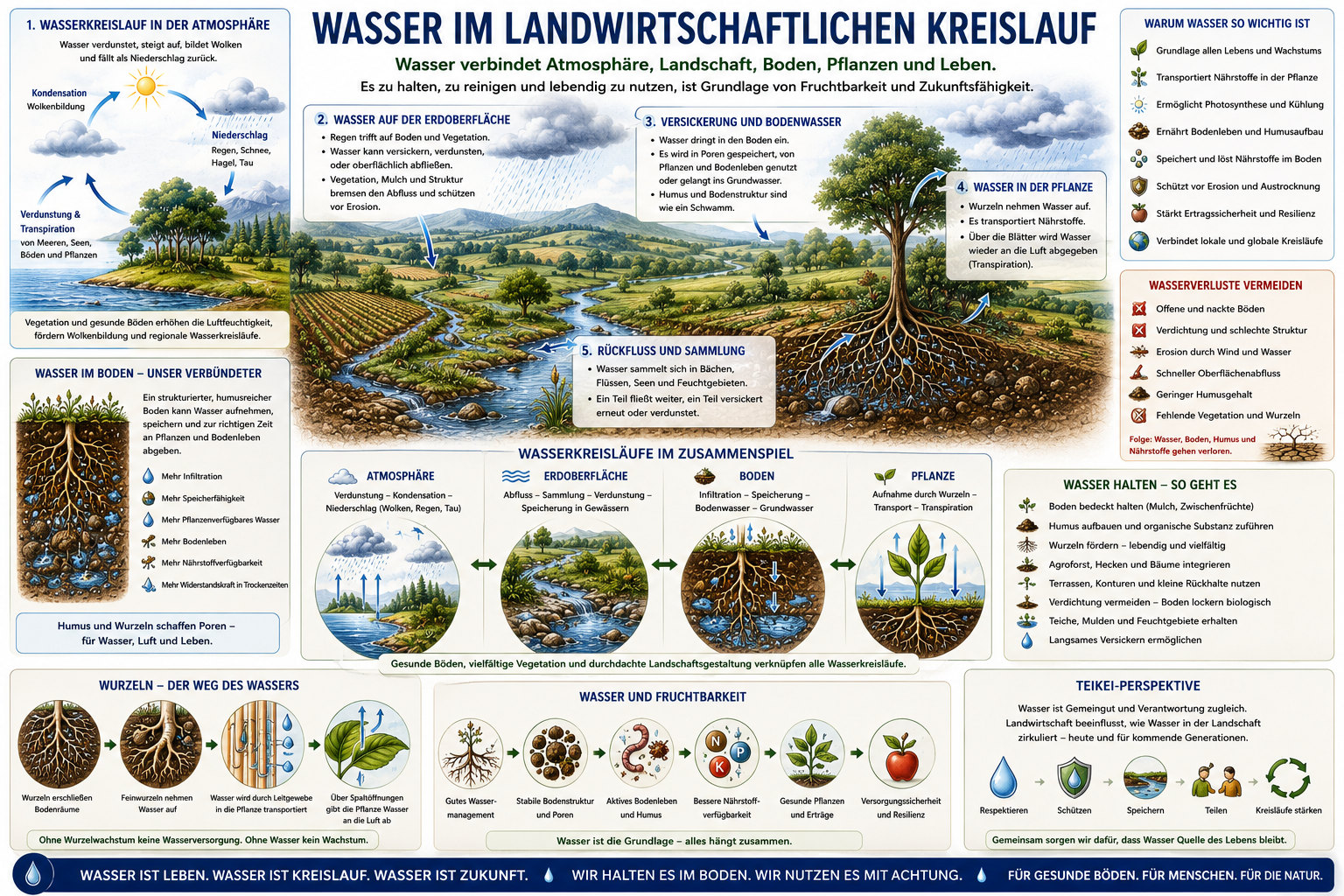
¶ Basic Understanding
Water is constantly in motion.
It evaporates.
It rises into the atmosphere.
It forms clouds.
It falls back as rain, snow, dew, or fog.
It flows over surfaces.
It seeps into soils.
It is absorbed by plants.
It is released back into the air through leaves.
It collects in springs, streams, rivers, lakes, wetlands, groundwater, and seas.
The water cycle is therefore not a single process.
It is a network of many interconnected cycles.
¶ The Central Question
For agriculture, it is not only important how much water falls.
What matters is:
- Does water come slowly or suddenly?
- Can the soil absorb water?
- Is water stored or does it run off?
- Is the soil covered or exposed?
- Is there humus and soil structure?
- Can plants access water?
- Does water remain in the landscape?
- Is water lost through evaporation or circulated meaningfully by plants?
- Is there erosion, compaction, or desiccation?
- Can the farm system cope with drought and heavy rainfall?
Water clearly demonstrates:
Fertility is not created solely by precipitation.
Fertility arises from a landscape's ability to absorb, retain, clean, distribute, and reintegrate water into living cycles.
¶ Water in the Atmosphere
Some water is found in the atmosphere.
It occurs as:
- Water vapor
- Clouds
- Fog
- Dew
- Rain
- Snow
- Hail
- Humidity
Water enters the atmosphere through evaporation.
Evaporation occurs over:
- Seas
- Lakes
- Rivers
- Moist soils
- Plants
- Forests
- Wetlands
- Agricultural areas
Plants release water through their leaves.
This process is called transpiration.
Together, evaporation from surfaces and transpiration from plants are referred to as evapotranspiration.
¶ Clouds, Rain, and Landscape
Clouds form when water vapor rises, cools, and condenses.
Whether water returns as rain depends on many factors:
- Temperature
- Humidity
- Wind
- Vegetation
- Soil moisture
- Landscape shape
- Elevation
- Bodies of water
- Forests
- Regional climate
Landscapes influence the water cycle.
Forests, hedges, wetlands, humus-rich soils, and diverse vegetation can help retain water longer in a region.
Open, overheated, compacted, or cleared areas lose water more quickly.
¶ Water on the Earth's Surface
When rain falls to the earth, various things can happen.
Water can:
- Land on plants
- Fall on mulch or foliage
- Slowly seep into the soil
- Run off over the surface
- Form puddles
- Carry away soil
- Enter ditches, streams, and rivers
- Evaporate
- Be stored in depressions, ponds, or wetlands
The surface determines whether water becomes life or loss.
A covered soil absorbs water differently than a bare, crusted, or compacted soil.
¶ Runoff
When water cannot penetrate the soil, it flows off the surface.
This can happen with:
- Compacted soils
- Sealed surfaces
- Steep slopes
- Lack of vegetation
- Crusted soil surface
- Very heavy rain
- Dried-out soils with poor structure
Surface runoff can carry away soil.
This results in the loss of humus, nutrients, and fertile soil particles.
Water loss then becomes soil loss.
¶ Erosion
Erosion occurs when water or wind carry away soil.
With water erosion, this happens primarily through heavy rain and rapid runoff.
Areas particularly at risk include:
- Exposed soils
- Slopes
- Fine, unprotected surfaces
- Compacted soils
- Areas without roots
- Areas without mulch or plant cover
Erosion is more than visible damage.
It removes the most fertile topsoil.
This simultaneously reduces a farm's water retention capacity, nutrients, humus, and soil life.
¶ Infiltration
Infiltration means:
Water enters the soil.
There, it can be stored, absorbed by plants, transported through soil pores, or released into groundwater.
Good infiltration requires:
- Stable soil structure
- Pores
- Roots
- Earthworm channels
- Organic matter
- Soil life
- Humus
- Covered soils
- Minimal compaction
A living soil is like a sponge.
It can absorb, retain, and slowly release water.
¶ Water in the Soil
Soil water is water held within the soil space.
It is found in pores, on soil particles, in humus, between aggregates, and near roots.
Not all water in the soil is equally accessible to plants.
There is:
- Water that drains quickly
- Water stored in pores
- Water adhering to soil particles
- Water available to plants
- Water so tightly bound that plants can hardly use it
For plants, not only the total amount matters.
What matters is how much water is plant-available.
¶ Soil Structure and Water
Soil structure determines how water behaves.
A well-structured soil has different pore sizes:
- Large pores for air and rapid infiltration
- Medium pores for plant-available water
- Small pores for long-term water storage
Roots, fungi, bacteria, earthworms, organic matter, and humus help build this structure.
Compaction destroys pores.
Then water infiltrates more poorly.
Roots grow less well.
Oxygen is lacking.
Soil life is weakened.
¶ Humus and Water-Holding Capacity
Humus is particularly important for the water cycle.
Humus-rich soils can absorb and retain water better.
This means:
- Less rapid surface runoff
- Better supply during dry periods
- More stable soil structure
- Reduced erosion
- More habitat for soil organisms
- Better nutrient availability
Humus does not act like a water tank with fixed boundaries.
It improves the entire soil environment.
It helps the soil retain water more effectively.
¶ Water and Soil Life
Soil life needs water.
Bacteria, fungi, earthworms, and microorganisms cannot work actively without moisture.
At the same time, many soil organisms also need oxygen.
Too much water can displace oxygen.
Too little water halts biological activity.
A good soil therefore maintains a balance:
- Enough water for life
- Enough air for roots and soil organisms
- Stable pores
- Good structure
- Organic matter
- Living roots
Water and soil life together form the foundation of many nutrient cycles.
¶ Water in the Plant
Plants consist largely of water.
Water is necessary for:
- Germination
- Cell growth
- Nutrient transport
- Photosynthesis
- Cooling
- Metabolism
- Stability of plant cells
- Fruit formation
Plants absorb water through their roots.
The water transports dissolved nutrients into the plant.
Water is released back into the air through the leaves.
This flow is not just a loss.
It is part of the plant's vitality.
¶ Transpiration
Transpiration is the release of water through the leaves.
Plants open small pores on their leaves, called stomata.
Through these stomata, they absorb CO₂.
At the same time, they lose water.
This process is closely linked to photosynthesis.
Plants are therefore constantly in a balance:
They need open stomata to absorb CO₂.
But open stomata also mean water loss.
When water becomes scarce, plants close their stomata.
Then photosynthesis decreases.
Growth is slowed.
¶ Water and Photosynthesis
Water is directly involved in photosynthesis.
Plants need:
- Light
- CO₂
- Water
From these, they build sugars and other carbon compounds.
If water is lacking, the plant cannot perform sufficient photosynthesis.
Then less carbon enters the plant and the soil.
This means:
Water affects not only yield.
Water also influences the carbon cycle, root exudates, soil life, and humus formation.
¶ Water and Nutrients
Nutrients often reach plants dissolved in water.
Water transports:
- Nitrogen compounds
- Potassium
- Calcium
- Magnesium
- Sulfur
- Trace elements
- Dissolved organic substances
If too little water is present, nutrients cannot be well absorbed.
If too much water flows quickly through the soil, nutrients can be leached.
A healthy water cycle therefore also stabilizes nutrient cycles.
¶ Water and Roots
Roots seek water.
They grow into soil spaces where moisture, oxygen, and nutrients are present.
Deep roots can access water from deeper soil layers.
Fine roots explore small soil spaces.
Roots create pores.
When roots die, they leave cavities through which water can later penetrate more easily.
Root diversity helps access water in different soil layers.
¶ Water and Mycorrhiza
Mycorrhizal fungi can help plants access water.
Fungal hyphae are finer than plant roots.
They can explore small soil spaces.
They can reach water and nutrients from areas that roots alone would struggle to access.
The plant provides carbon compounds to the fungi.
The fungi expand the root space.
Thus, the water cycle is also a relationship between plant and soil life.
¶ Water in the Landscape
Agriculture does not only take place in individual fields.
Water moves through entire landscapes.
It flows from slopes into valleys.
It collects in depressions.
It follows soil structure, vegetation, ditches, paths, terraces, hedges, tree lines, and water bodies.
A landscape can lose water quickly.
Or it can slow, distribute, store, and infiltrate water.
Regenerative agriculture therefore asks:
How can water be retained in the landscape without causing damage?
¶ Small Water Cycles
In addition to the large global water cycle, there are smaller regional cycles.
When water evaporates in a landscape and later returns as rain in the same or a nearby region, this is often referred to as small or regional water cycles.
Vegetation plays an important role here.
Plants cool the surface.
They release water into the air.
They influence humidity and microclimate.
Forests, hedges, agroforestry, wetlands, and humus-rich soils can stabilize regional moisture.
¶ Large Water Cycles
The large water cycle connects seas, atmosphere, continents, rivers, groundwater, and ice.
Water evaporates from seas.
It is transported with air masses.
It falls as precipitation over land.
It flows back to the seas via rivers and groundwater.
Agriculture cannot control this large cycle alone.
But it can influence what happens to precipitation when it falls on an area.
¶ Soil Water Cycle
The soil water cycle describes how water is absorbed, stored, moved, and released in the soil.
This includes:
- Precipitation
- Infiltration
- Percolation
- Storage in soil pores
- Uptake by roots
- Evaporation from the soil
- Transpiration by plants
- Groundwater recharge
- Capillary rise
- Runoff at saturation
A healthy soil water cycle is slow, permeable, and alive.
A disturbed soil water cycle is fast, superficial, and loss-prone.
¶ Plant Water Cycle
The plant water cycle describes the path of water through the plant.
It begins with absorption through the roots.
Water rises through vascular tissues into stems, leaves, flowers, and fruits.
There, it is used for metabolism, cooling, growth, and nutrient transport.
Some is transpired through the leaves.
This creates a water flow from the root to the atmosphere.
This flow connects soil, plant, and air.
¶ Farm Water Cycle
A farm has its own water cycle.
This includes:
- Roofs
- Paths
- Fields
- Pastures
- Ditches
- Ponds
- Storage
- Irrigation
- Mulched areas
- Compost sites
- Animals
- Water troughs
- Wastewater
- Wash water
- Soil moisture
- Groundwater
- Landscape structures
A farm can lose or retain water.
It can quickly drain rainwater or slowly bring it into the soil.
It can increase or prevent erosion.
It can consciously integrate plant water, soil water, and landscape water.
¶ Retaining Water Instead of Just Irrigating
Irrigation may be necessary.
But it does not replace a healthy water cycle.
A pure irrigation logic asks:
How do we bring more water to the area?
A cycle logic also asks:
- How do we retain the existing water in the soil?
- How do we reduce evaporation?
- How do we promote infiltration?
- How do we protect soil structure?
- How do we build humus?
- How do we prevent rapid runoff?
- How do we create shade and microclimate?
- How do we retain water in the landscape?
Retaining water is often as important as supplying water.
¶ Methods to Strengthen the Water Cycle
Water cycles can be strengthened through:
- Permanent soil cover
- Mulch
- Cover crops
- Undersowing
- Humus building
- Compost
- Reduced soil compaction
- Living roots
- Agroforestry
- Hedges
- Tree structures
- Terraces
- Keyline design
- Contour planting
- Ponds and retention areas
- Adapted grazing management
- Erosion protection
- Regional water retention
- Landscape diversity
Not every measure fits everywhere.
The location is decisive.
¶ Soil Cover
Soil cover protects water.
It reduces direct sunlight on the soil.
It decreases evaporation.
It protects against raindrops that can destroy soil aggregates.
It promotes soil life.
It supports humus formation.
Soil cover can consist of living plants, mulch, crop residues, foliage, or cover crops.
¶ Agroforestry and Water
Agroforestry systems can stabilize water balances.
Trees and shrubs:
- Shade the soil
- Slow wind
- Reduce evaporation
- Bring deep roots into the soil
- Create organic matter
- Promote mycorrhiza
- Improve soil structure
- Can access water from deeper layers
- Create microclimate
Agroforestry is not a simple irrigation system.
It is a landscape structure that connects water, soil, plants, and climate.
¶ Hedges, Trees, and Wind
Wind dries out soils and plants.
Hedges and trees can slow wind.
This reduces evaporation.
Plants are less stressed.
The soil remains moister.
At the same time, hedges create habitats, leaf fall, roots, shade, and biodiversity.
They thus affect not only water but the entire farm system.
¶ Terraces and Contours
On slopes, water can run off quickly.
Terraces, contour planting, and adapted cultivation along contour lines can slow water.
This helps:
- Reduce erosion
- Promote infiltration
- Build soil
- Retain nutrients
- Better supply plants
In many old cultural landscapes, such structures were developed over generations.
They show that water management is always landscape design.
¶ Ponds, Depressions, and Retention Areas
Ponds, depressions, ditches, wetlands, and retention areas can retain water in the landscape.
They can buffer heavy rainfall.
They can promote biodiversity.
They can influence microclimate.
They can allow water to slowly infiltrate.
It is important to plan such elements in a site-appropriate manner.
Poorly designed water structures can also cause damage.
¶ Water Quality
Water is not just about quantity.
Water has quality.
Agriculture influences water quality through:
- Nutrient losses
- Erosion
- Soil cover
- Pesticides
- Organic matter
- Livestock farming
- Compost management
- Runoff paths
- Riparian buffer strips
- Soil structure
A healthy water cycle should not only retain water.
It should also protect water.
¶ Water and Climate Resilience
Climate resilience means that a farm can better cope with changes.
This includes:
- Drought
- Heat
- Heavy rainfall
- Irregular precipitation
- Long dry periods
- Floods
- Wind
- Soil erosion
A living water cycle helps cushion such stresses.
It does not make a farm invulnerable.
But it can strengthen resilience.
¶ Water and Closed Cycles
Water connects all other cycles.
It connects:
- Carbon cycle
- Nitrogen cycle
- Phosphorus and potassium cycle
- Soil life
- Plant growth
- Humus formation
- Composting
- Manure management
- Livestock farming
- Landscape design
Without water, nutrients cannot circulate well.
Without water, soil life works only to a limited extent.
Without water, carbon does not flow into living plant processes.
Water is therefore the connecting foundation of closed cycles.
¶ Open and Living Water Systems
An open water system loses water quickly.
Typical signs are:
- Hard surface runoff
- Erosion
- Exposed soils
- Little humus
- Poor soil structure
- Compaction
- Little shade
- Weak vegetation
- Rapid desiccation
- Strong dependence on irrigation
A living water system works differently:
- Water infiltrates.
- Soil remains covered.
- Humus stores water.
- Roots create pores.
- Plants cool.
- Hedges and trees slow wind.
- Water is slowed in the landscape.
- Soil life stabilizes structure.
- Nutrients remain better in the system.
- Plants become more resilient.
¶ Difference from Pure Technical Logic
Technology can be important.
Irrigation, storage, drainage, pumps, sensors, or pipelines may be necessary in certain situations.
But technology does not replace a living water landscape.
A regenerative perspective therefore asks not only:
How do we technically bring water to the area?
But also:
How can the area regain the ability to absorb, retain, and use water effectively?
¶ TEIKEI Perspective
From a TEIKEI perspective, water is part of the real foundation of community-supported agriculture.
Water is not just a site factor.
Water is part of the farm's reality.
When a farm builds humus, keeps soil covered, prevents erosion, plants trees, retains water in the landscape, and strengthens soil life, long-term supply capacity is created.
This work is part of the foundation from which harvest shares arise.
Members therefore do not only support the harvest.
They also support the conditions under which harvest remains possible in the long term.
¶ Connection to Regional Responsibility
Water does not end at the field edge.
What happens on a farm also influences:
- Neighboring areas
- Streams
- Groundwater
- Landscape moisture
- Erosion
- Regional cooling
- Biodiversity
- Drinking water
- Long-term supply
Water therefore requires responsibility beyond individual crops.
It connects farm, landscape, and region.
¶ Classification
This page does not replace hydrological planning, soil analysis, or professional advice.
Water processes are site-dependent.
They depend on:
- Climate
- Precipitation
- Soil type
- Slope
- Vegetation
- Humus
- Compaction
- Groundwater
- Water bodies
- Management
- Infrastructure
- Regional landscape
For specific decisions, site-based observation, experience, and professional support are needed.
This page provides a basic understanding.
It shows why water should not only be understood as an irrigation issue but as a cycle issue in living agriculture.
¶ Key Takeaway
Water is the mobile breath of agriculture.
It falls from the atmosphere.
It touches plants, soil, and landscape.
It seeps, flows, evaporates, cools, nourishes, and connects.
In living soils, water is not just channeled through.
It is retained, cleaned, distributed, and becomes part of fertility.
Agriculture becomes more future-proof when it does not just consume water but returns it to living cycles.
¶ Further Information & Understanding Connections
- How do closed cycles work in agriculture?
- Basic nutrients in agriculture
- Nitrogen cycle
- Carbon cycle
- Phosphorus and potassium
- Plants, roots, and soil life
- Compost and manure management
- Animals in the farm cycle
One level up: Closed Cycles
Author: Felix Schröder, with the help of AI (ChatGPT)
Created: written by Felix Schröder › formatted in Markdown by ChatGPT › published by Felix Schröder › layout adjusted by Claude
Date: 2026-05-16 · Last updated: 2026-05-16 · Questions or suggestions? support@teikei.us