¶ Projects in the TEIKEI Network
The projects in the TEIKEI Network are concrete expressions of a collectively supported economy.
They demonstrate how shared principles can be translated into different fields of practice: agriculture, logistics, digital coordination, education, procurement, and other forms of collaboration.
¶ Role of Projects in the Network
Projects are not isolated units.
They are interconnected and contribute to the whole in different ways.
They can:
- establish new supply pathways
- further develop existing structures
- bundle and make knowledge accessible
- create infrastructures for cooperation
- open pilot spaces for new forms of collaboration
This makes it visible that the TEIKEI Network is not just composed of roles and relationships, but also of concrete initiatives that put these relationships into practice.
¶ How Projects Are Understood at TEIKEI
A project in the TEIKEI Network is more than a single measure.
Projects are development spaces where people, communities, and structures work together on a concrete task.
They emerge from a real need, draw on experiences from the network, and contribute to advancing the shared practice.
A project can:
- be designed for the long term
- be in a development phase
- start as a pilot and be continued later
- complement other projects or be interlinked with them
¶ Difference Between Agora and Agora Marketplace
Within the network, it is important to distinguish between the Agora and the Agora Marketplace.
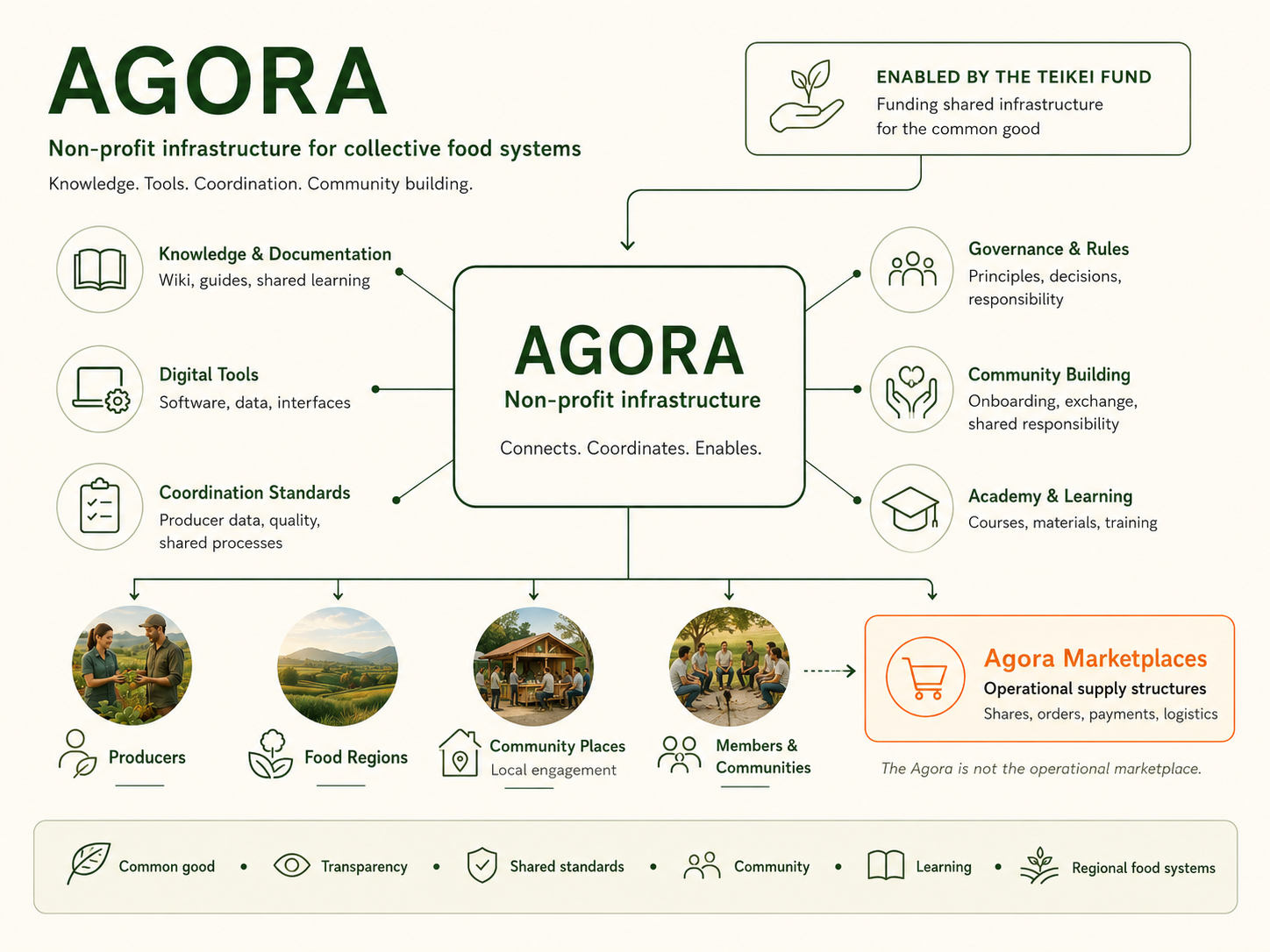
The Agora is the nonprofit infrastructure and coordination space of the network.
It supports knowledge, digital tools, documentation, standards, governance, support, and joint development.
It provides the foundation on which different projects, food regions, communities, and operational structures can work together.
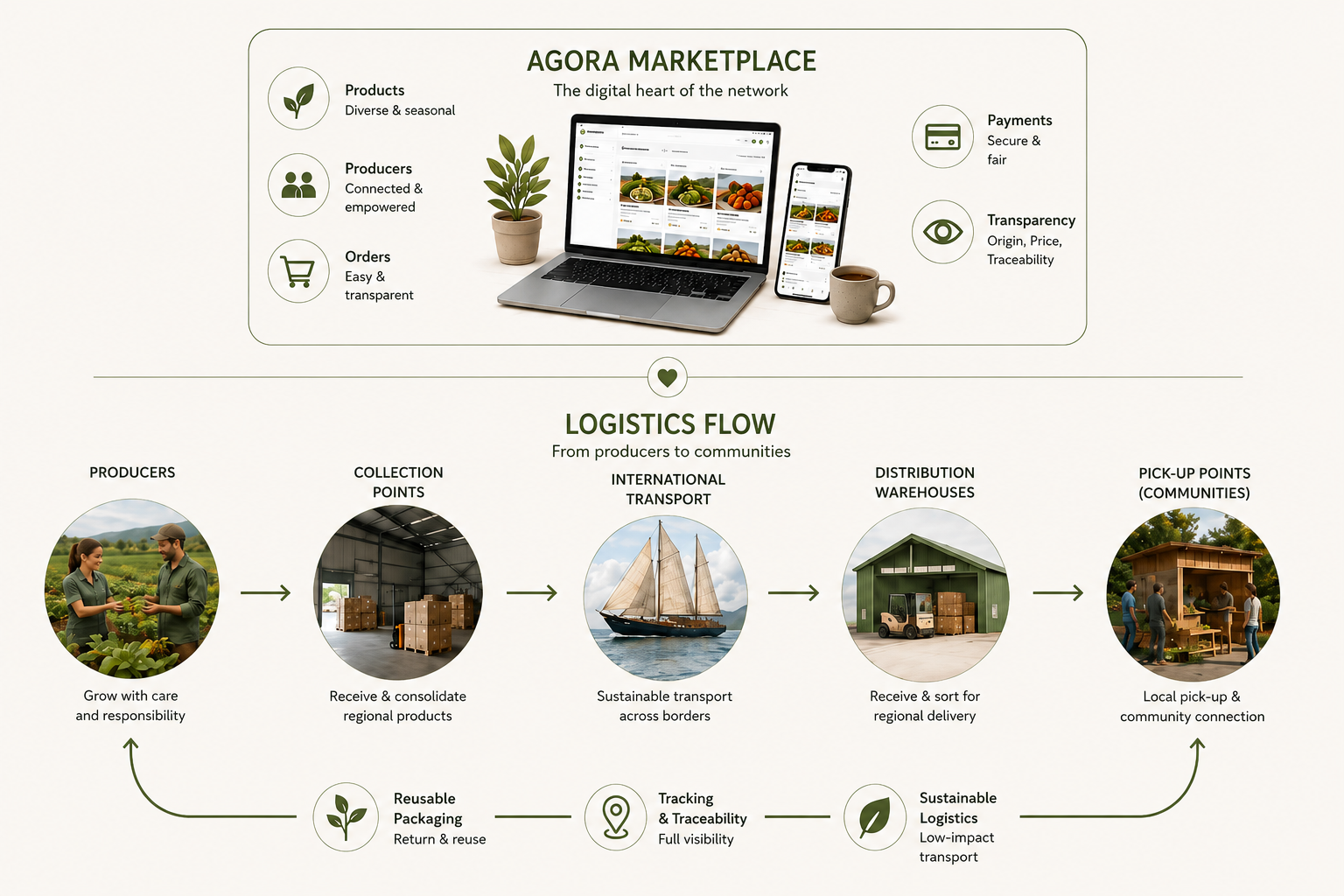
The Agora Marketplace is the operational economic level.
Here, harvest shares, orders, payments, goods flows, regional bundling, logistics processes, and pickup locations are organized in concrete terms.
Simply put:
- The Agora provides infrastructure, knowledge, and coordination.
- The Agora Marketplace organizes the concrete supply.
- The Agora does not map the flow of goods itself.
- The Agora Marketplace connects producers, harvest shares, logistics, and members in practical execution.
This distinction helps to clearly separate responsibilities, money flows, goods flows, and information flows.
¶ Project Areas at a Glance
The following project areas are established in the TEIKEI Network:
Additional historical or parallel project lines are outlined at the end of this page.
¶ Agora
The Agora is the nonprofit infrastructure and coordination space in the TEIKEI Network.
It connects knowledge, digital tools, documentation, standards, governance, support, and joint development.
It enables Agora Marketplaces, food regions, producers, pickup locations, and communities to collaborate on a common foundation.
It is not the operational marketplace itself.
¶ Marketplace
The Agora Marketplace is the operational economic level within the Agora architecture.
Here, harvest shares, orders, payments, goods flows, regional bundling, logistics, and pickup locations are organized in concrete terms.
The Agora Marketplace makes visible how community-supported supply is practically implemented.
¶ Logistics
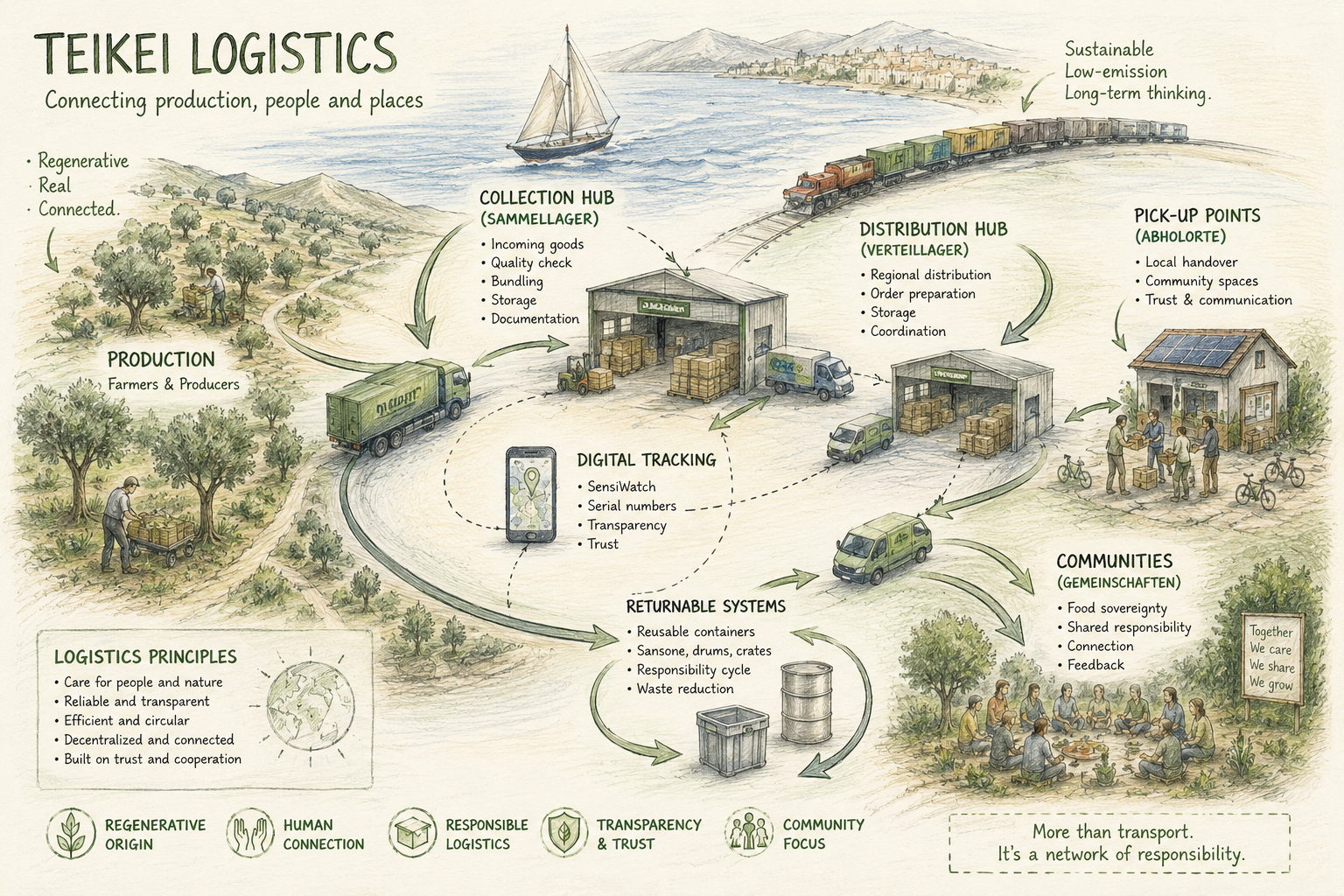
TEIKEI Logistics designs the network’s logistical infrastructure.
It connects production, collection warehouses, distribution warehouses, intermediate storage, pickup locations, and communities.
The focus is not only on transport but also on bundling, traceability, storage capacity, responsibility, and reliable handover points.
¶ Academy
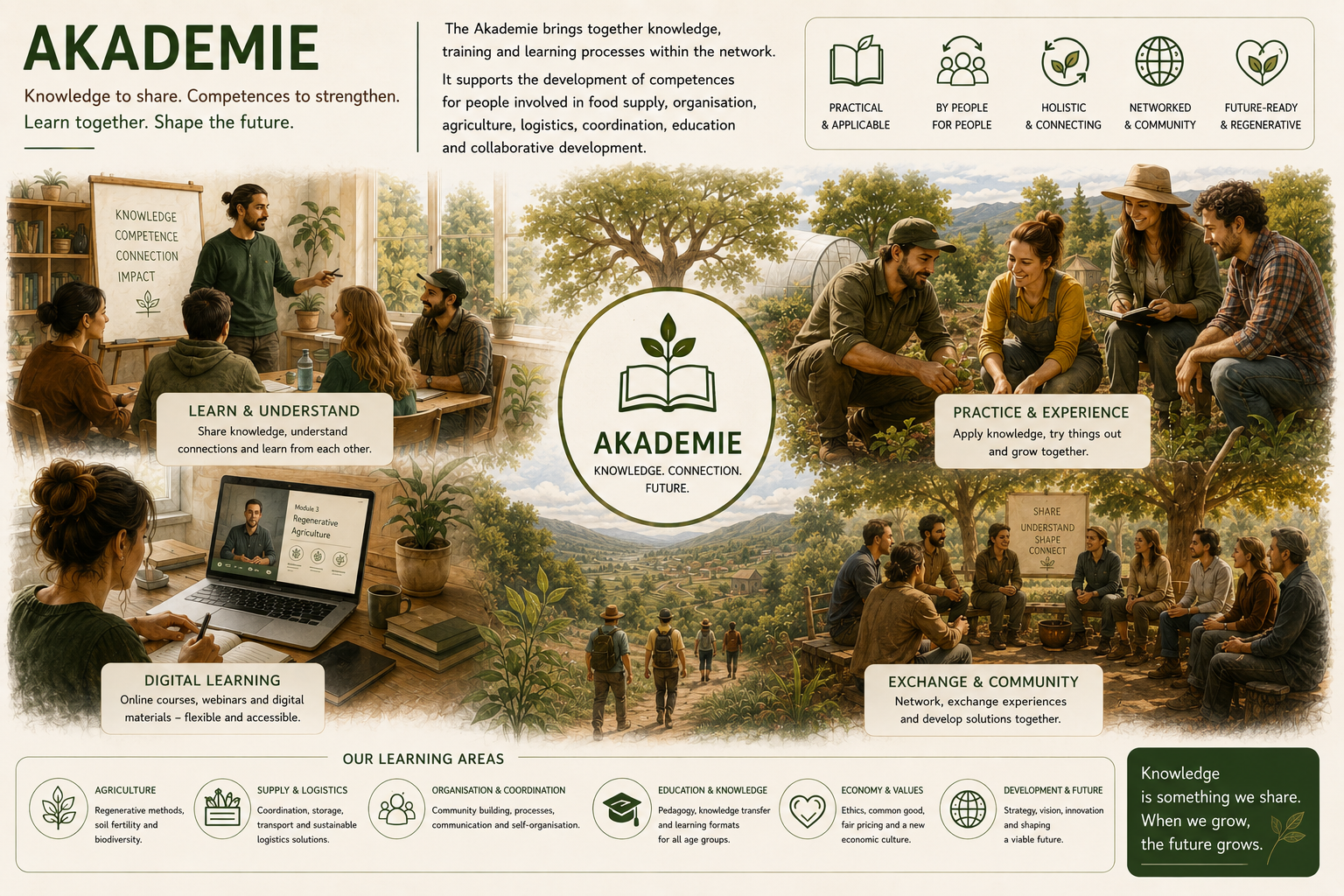
The Academy bundles knowledge, training, and learning processes in the network.
It supports the development of competencies for people involved in supply, organization, agriculture, logistics, coordination, education, and joint development.
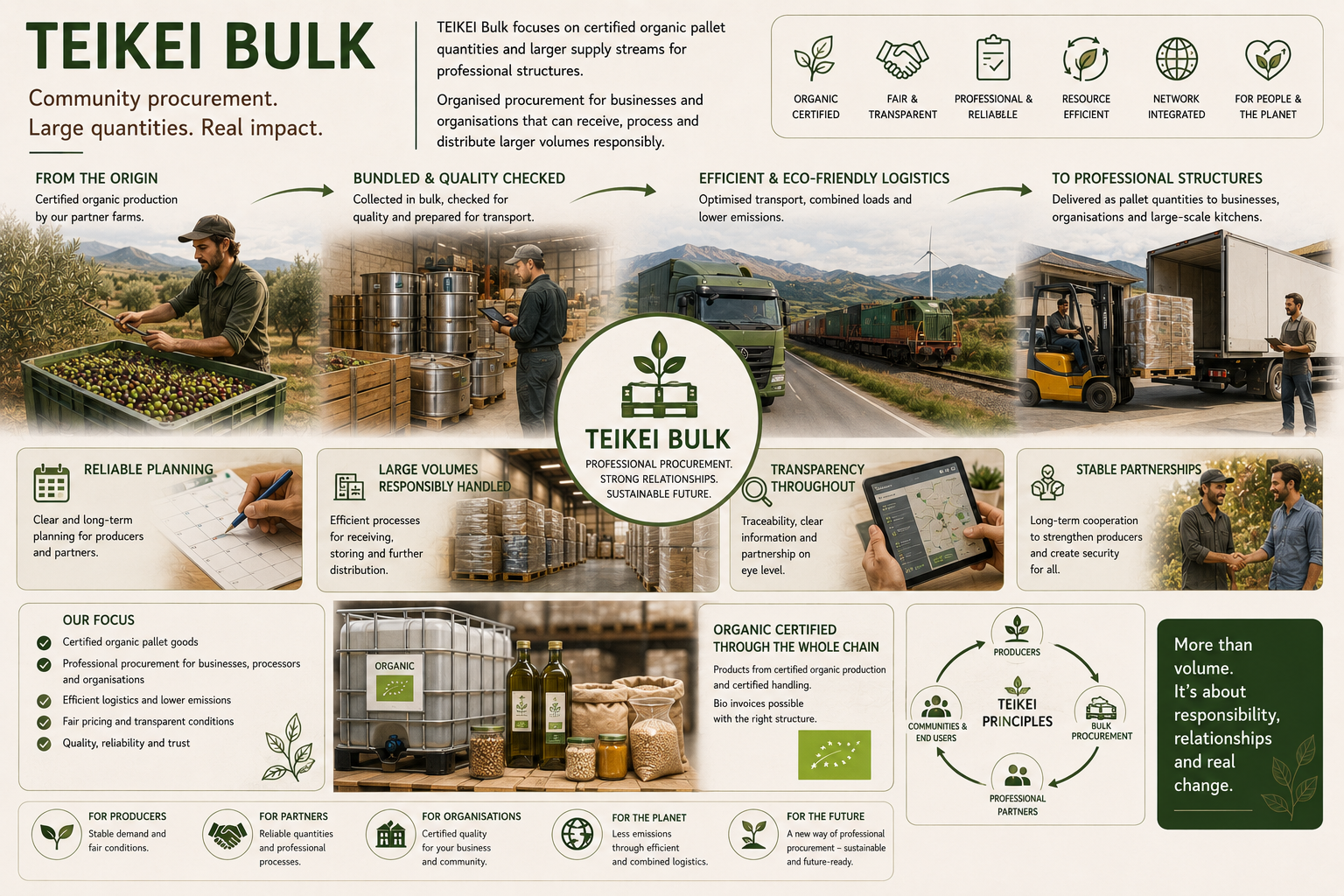
¶ Bulk Purchasing
TEIKEI Bulk develops structures for community-based procurement, bundling, and distribution of larger quantities of food and materials.
It focuses on quantities that individual communities often cannot manage alone but which can become part of a community-supported supply through bundling.
¶ Fruit Boxes
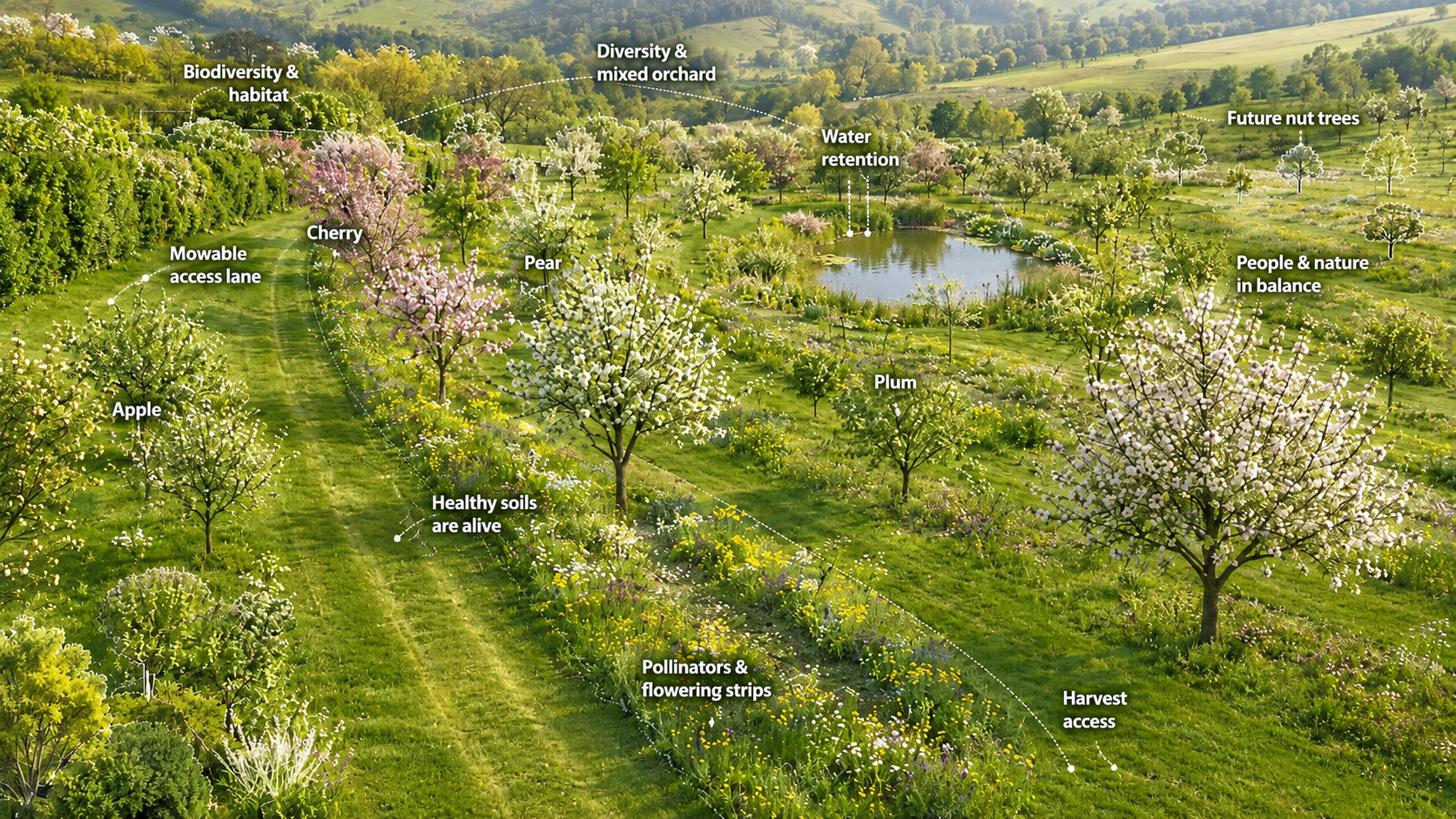
TEIKEI Fruit bundles the production, distribution, and further development of fruit within the network.
The focus is on community-supported supply of fresh fruit.
This includes questions of harvesting, sorting, cooling, packaging, transport, storage, distribution, and communication with communities.
¶ Olive Oil
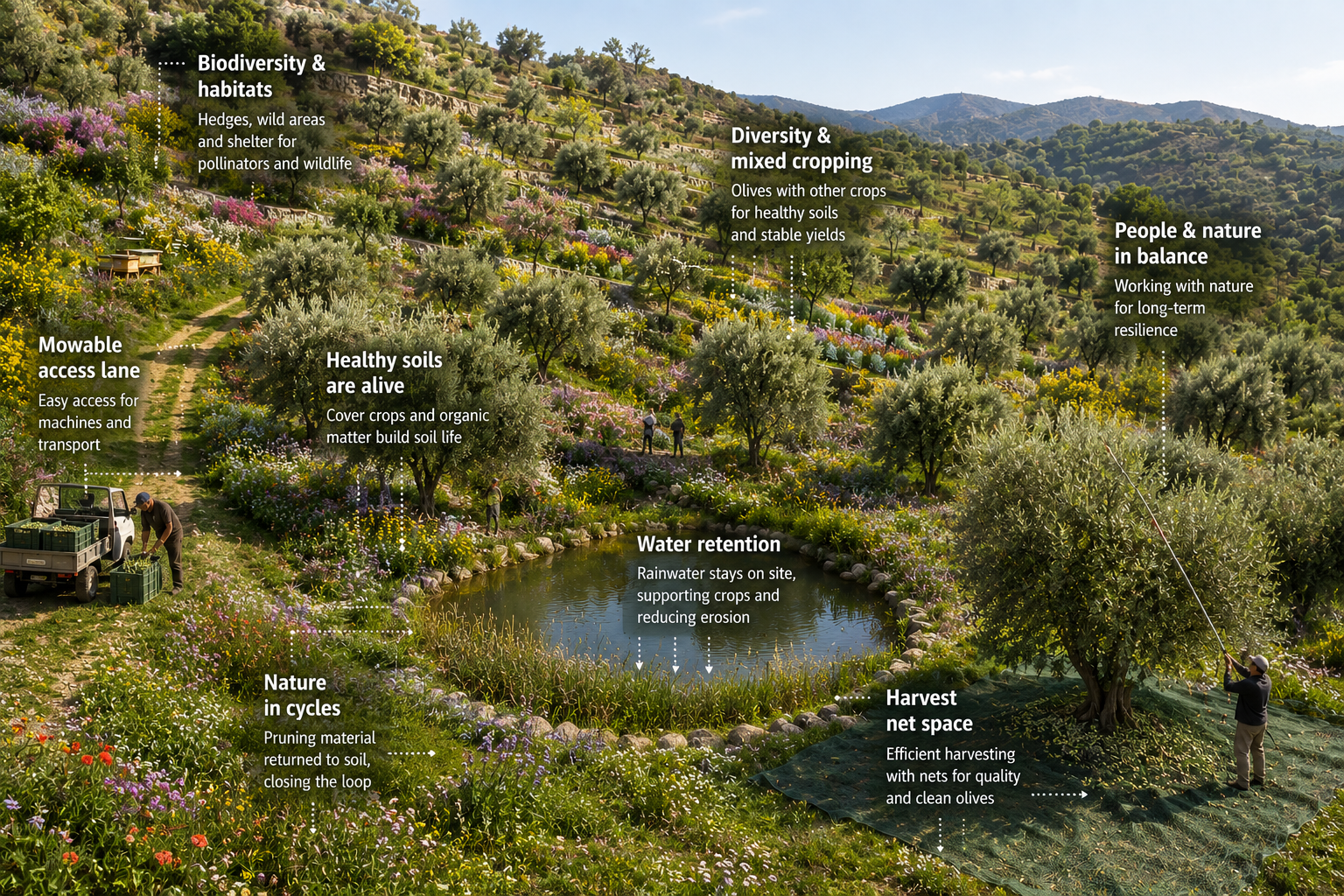
TEIKEI Olive has existed since 2014 and is a central origin of the network.
The project connects producers, communities, and logistics around olive oil and related products.
It has made many foundational aspects visible that are now important for other project areas: community-supported quantities, transparent relationships, Europe-regional logistics, traceability, and long-term collaboration.
¶ Significance for the Network
The projects demonstrate that TEIKEI is not just an idea but a growing practice.
They create concrete places, systems, and processes where collaboration is tested, stabilized, and further developed.
At the same time, they help ensure that the network remains adaptable for new regions, new participants, and new forms of collaborative economy.
¶ Interplay of Projects
The individual projects have different focuses but are interconnected.
For example, they combine:
- production and supply
- infrastructure and coordination
- marketplace and operational execution
- logistics and distribution
- knowledge and transfer
- pilot projects and long-term structural development
This interplay is what gives the network its special quality.
The Agora provides the common framework for tools, knowledge, and coordination.
The Agora Marketplaces handle the concrete economic supply level, where harvest shares, goods flows, payments, and pickup locations come together in practice.
¶ Additional Projects and Historical Lines
Beyond the Agora, there are other projects and historical development lines in the TEIKEI environment.
These projects are not automatically in direct organizational connection with the Agora. Some have emerged independently, others belong to the history of TEIKEI or exist in parallel within the broader network environment.
Between 2018 and 2020, there was an initial attempt to bring several existing TEIKEI projects together more closely. This attempt did not prove sustainable.
With today’s development of the Agora, a second approach is being taken.
The goal is not to centrally control independent projects. Instead, it is about creating common foundations, documentation, visibility, and possible interfaces while learning from past mistakes.
A mention in this section does not automatically mean that a project is part of the Agora or is organized via the Agora Marketplace. Onboarding is possible in the future without any issues.
¶ Subpages in This Section
- TEIKEI Global
- Coffee
- TEIKEI Hemp
- TEIKEI Textile
- TEIKEI Cacao
- TEIKEI Chilli
For TEIKEI Textile, TEIKEI Cacao, and TEIKEI Chilli, no dedicated public pages are currently available.
¶ Outlook
As the TEIKEI Network continues to develop, the projects will also be advanced, differentiated, and supplemented by new areas.
The project pages provide an overview of these initiatives and show how a shared approach leads to concrete structures for a sustainable food supply.
↑ One level up: TEIKEI Network
Compiled by the TEIKEI editorial team with support from AI (ChatGPT)
Created on March 23, 2026 · Last updated on May 18, 2026
Questions or feedback? support@teikei.us