¶ TEIKEI Bulk – Community-Based Procurement and Bulk Quantities
TEIKEI Network › Projects · 7 min read
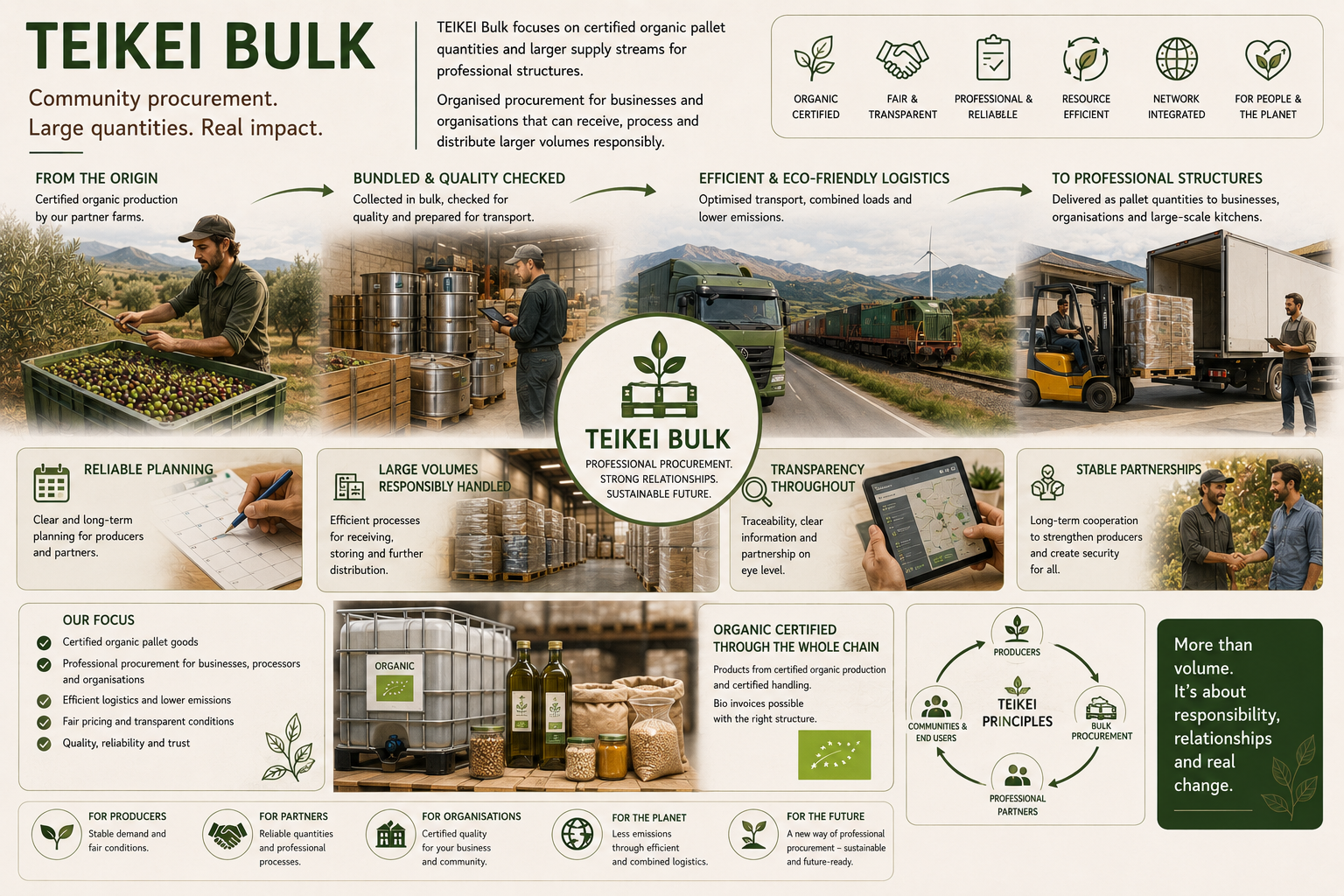
TEIKEI Bulk is the project within the TEIKEI Network that focuses on palletized goods and larger volume flows for professional structures.
This does not refer to classic individual orders, but rather organized procurement models for actors who process larger quantities further, distribute them professionally, or use them to supply their own communities and customer bases. TEIKEI Bulk is therefore particularly aimed at primary suppliers, larger companies, and organizations capable of receiving pallet quantities and responsibly integrating them into their own structures.
¶ Role in the Network
TEIKEI Bulk plays a special role within the network. While many other TEIKEI procurement channels consist of smaller communities, pickup locations, or directly managed supply relationships, TEIKEI Bulk operates at the level of professional bulk quantities.
The project thus creates a bridge between TEIKEI’s core principles and the requirements of larger goods flows. It is not about reverting to old wholesale logistics, but rather about how larger quantities can be organized in a way that remains predictable, transparent, and ecologically responsible.
TEIKEI Bulk therefore represents a form of professional procurement that does not detach itself from the network’s values but instead seeks to carry them into larger and more complex structures.
¶ Who TEIKEI Bulk Is For
TEIKEI Bulk is designed for professional actors who work with larger quantities. These include, among others:
- Primary suppliers
- Processors
- Large kitchens
- Regional distribution structures
- Organizations with their own professional distribution systems
- Companies or associations that supply communities on a larger scale
The focus is therefore not on spontaneous individual purchases, but on reliable structures that can receive, pass on, or process quantities and require stable, traceable, and long-term viable supply chains.
¶ What It Means in Practice
At the heart of TEIKEI Bulk is the bundling of demand. Instead of generating many small, separate goods movements, larger quantities are consolidated to make procurement, logistics, and redistribution more predictable.
This offers several advantages:
- Producers receive clearer and longer-term planning
- Larger quantities can be organized more efficiently
- Logistics can be managed more professionally and resource-efficiently
- Partners can work with more stable quantities and better calculable processes
TEIKEI Bulk is therefore not simply a model for "more volume," but a tool to shape larger goods flows in a way that embeds them in a community-oriented and ecologically aligned supply system.
¶ Procurement Not as Anonymous Wholesale
A key difference from conventional wholesale structures is that TEIKEI Bulk does not simply sell larger quantities. The project is embedded in the TEIKEI logic and is thus part of a framework of transparency, long-term partnerships, and ecological responsibility.
TEIKEI Bulk does not attempt to merely copy traditional wholesale but instead enables a different form of professional procurement. The underlying question is: How can larger quantities be moved without losing the relationship with producers or the responsibility for quality, origin, and logistics?
This creates a structure that is professional and scalable but does not revert to the anonymity of typical supply chains.
¶ Role of Organic Certification
For cost reasons, TEIKEI is no longer organically certified itself. Our role is not to certify but to make information accessible: Farms provide their own organic certification, and TEIKEI passes this information on.
How it will work: In the producer profiles, farms will be able to display their own organic certificates, visible to all (see Dual Transparency and Traceability). An AI tool we are developing will verify these certificates to ensure transparency and security. Additionally, we are creating a labeling system that allows organically grown products to be identified as such on the label, as legally permitted.
For TEIKEI Bulk, this means: For every pallet, TEIKEI provides the farms’ organic certificates and proof of origin. An organic invoice via TEIKEI is no longer possible because TEIKEI itself is no longer certified.
The focus of TEIKEI Bulk is on what holds up even without a seal: traceable quality, clean processing, and stable relationships with farms.
¶ Logistics, Efficiency, and Fossil Fuel Reduction
TEIKEI Bulk is closely linked to the question of how professional logistics can be organized more sustainably. Larger volume flows create special requirements: They must be well-timed, economically viable, and ecologically responsible.
Bulk is therefore not just a question of quantity but also of transport logistics. Larger, consolidated units can help:
- Avoid unnecessary partial transports
- Better coordinate logistical processes
- Utilize transport capacities more effectively
- Develop more professional and climate-friendly solutions
TEIKEI Bulk thus also represents an attempt to not automatically equate bulk quantities with high environmental impact but to organize them in a way that makes them part of a lower-fossil and long-term sustainable supply chain.
¶ Significance for Producers and Primary Suppliers
For producers and larger customer structures, TEIKEI Bulk creates greater stability. Reliability is crucial, especially for larger quantities—not just for logistics but also for cultivation planning, processing, and pricing.
This is particularly important for structures that do not purchase on a short-term basis but need to plan reliably. These include, for example, kitchens with fixed annual demand, processors with predictable capacity utilization, or regional distribution structures serving multiple customer groups.
TEIKEI Bulk thus strengthens procurement not only on the buyer side but also the economic agency of producers. Larger and predictable quantities can help reduce risks, stabilize processes, and deepen long-term relationships.
¶ Professionalism Without Alienation
TEIKEI Bulk operates in a professional environment and therefore requires a clear, precise, and reliable approach. At the same time, this professionalism should not lead to alienation.
This is precisely where one of TEIKEI Bulk’s strengths lies: Professionalism here does not mean anonymization but the ability to organize larger structures in a clean, transparent, and humanly sustainable way.
Even in the area of larger quantities, it remains crucial that partnerships are not merely functional but can become sustainable and long-term. Efficiency and relationships do not have to be mutually exclusive. In the best case, they support each other.
¶ Key Development Lines
Several guiding principles are emerging for the further development of TEIKEI Bulk:
- Building lower-fossil and long-term sustainable supply chains
- Expanding partnerships with primary suppliers
- Increasing professionalization of logistics
- Developing transparent pricing and delivery structures
- Professionalization without losing the core TEIKEI approach
It is important that TEIKEI Bulk is not only thought of in terms of sales volumes. Equally relevant are process quality, fairness, transparency, reliability, ecological impact, and the stability of relationships within the supply chain.
TEIKEI Bulk is therefore not just a sales project but a structural building block within a larger transformation of supply and trade.
¶ Significance in the TEIKEI Context
TEIKEI Bulk demonstrates that even larger professional volume flows can be embedded in a different form of economy. The project shows that predictable bulk quantities, ecological logistics, and community-oriented supply are not contradictory.
Where traditional wholesale models often rely on distance, price and volume pressure, and fossil-intensive standard logistics, TEIKEI Bulk seeks a different path: professional, resilient, and at the same time anchored in the values of the TEIKEI Network.
This makes TEIKEI Bulk an important field of development within the network. Here, it becomes clear whether it is possible to make TEIKEI’s core principles effective not only in small communities but also in more complex professional structures.
¶ Outlook
The TEIKEI Bulk area has the potential to further differentiate itself alongside the network. The more professional partners, regional distributors, and primary suppliers grow into this logic, the stronger an independent infrastructure for sustainable bulk quantities can develop.
In the long term, TEIKEI Bulk can help rethink professional supply: not as mere goods flow but as part of a responsibility chain in which quality, predictability, ecological sustainability, and stable partnerships belong together.
Step by step, an area emerges that shows that even larger quantities do not necessarily have to be organized anonymously, interchangeably, and extractively but can be embedded responsibly, professionally, and communally.
¶ Further Information & Understanding Contexts
↑ Up one level: Projects
By Felix Schröder, with support from AI (ChatGPT)
Created on March 23, 2026 · Last updated on October 11, 2026
Questions or feedback? support@teikei.us