¶ TEIKEI Fruit Goods Flow
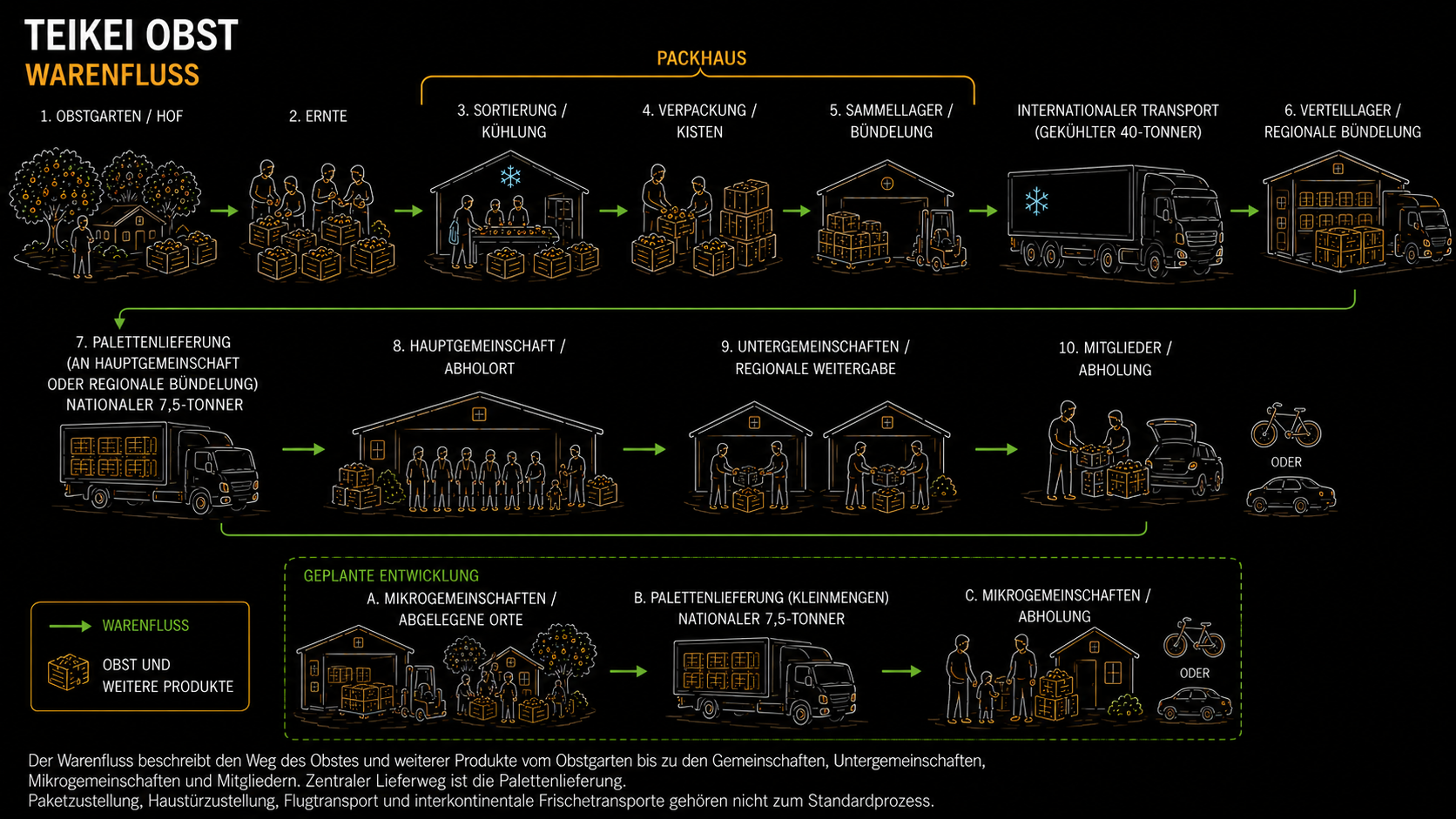
The goods flow in TEIKEI Fruit describes the path of fruit from the orchard to the communities and members.
It makes visible the stages the fruit passes through before it is distributed and picked up locally.
This page describes only the goods flow.
The other flows are described on separate subpages:
¶ Classification
TEIKEI Fruit is a product circle within the TEIKEI network.
The goods flow begins with the producers and leads through harvesting, sorting, cooling, packaging, bundling, and pallet delivery to the communities and members.
Fruit is sensitive in terms of fresh logistics.
Therefore, ripeness, harvest timing, sorting, cooling, packaging, and reliable handover to communities are particularly important.
The goods flow is thus not merely a technical delivery movement.
It demonstrates how fresh fruit is collectively supported, bundled, distributed, and picked up locally.
TEIKEI Fruit explicitly understands fruit supply as a regional and European-regional task.
¶ Local First for Fresh Produce
Fresh produce in TEIKEI Fruit is considered according to the Local First principle.
This means:
Fruits that are seasonally available in a region or will soon be available should not be replaced or displaced by produce from distant locations.
It makes no sense to bring fresh produce into a region if comparable fruits can be grown and harvested there seasonally later.
TEIKEI Fruit does not support this practice.
TEIKEI Fruit actively excludes it to protect and promote regional agricultural structures.
This strengthens TEIKEI Fruit:
- regional farms
- seasonal supply
- local harvest cycles
- short and traceable routes
- regional responsibility
- resilient fruit supply
The goal is not to make every fruit available at all times.
The goal is to shape fruit supply in a way that respects origin, season, climate, soil, farms, and communities.
The more detailed access logic is described on the page Access Logic and Local First.
¶ No Intercontinental Fresh Logistics
It is not a goal to import fresh products from other continents or to establish long global fresh chains.
This includes, for example, no avocados from Peru or Chile, no grapes from South America, and no comparable fresh products whose supply relies on long intercontinental transport routes.
TEIKEI Fruit focuses on fruits, farms, and supply areas that are in a traceable, collectively sustainable, and ecologically responsible context.
¶ Logistics Values
The goods flow in TEIKEI Fruit follows the logistics values of the TEIKEI network.
These include:
- reliability
- traceability
- care in handling fresh food
- transparent handovers
- regional and European-regional bundling
- reduction of unnecessary routes
- gradual development of resilient and, as far as possible, fossil-fuel-independent transport routes
- protection of regional agricultural structures
- priority of seasonal and regional availability
For logistics partners, the Charter for Logistics Partners in the TEIKEI Network applies.
TEIKEI Fruit does not use air transport.
Air freight is not part of the goods flow of TEIKEI Fruit and is explicitly not presented, planned, or promoted as a regular transport route in the TEIKEI network.
Likewise, it is not a goal of TEIKEI Fruit to make fresh products available via intercontinental fresh logistics.
Logistics should enable supply without undermining ecological responsibility, origin, relationships, seasonality, and regional anchoring.
¶ Overview of the Goods Flow
The confirmed basic process is as follows:
- Orchard / Farm
- Harvest
- Sorting / Cooling
- Packaging / Crates
- Collection warehouse / Bundling
- Distribution warehouse / regional bundling
- Pallet delivery
- Main community / Pick-up location
- Sub-communities / regional redistribution
- Members / Pick-up
The central delivery route is pallet delivery.
Parcel delivery, doorstep delivery, air transport, and intercontinental fresh transports are not part of the standard process of TEIKEI Fruit.
¶ From Orchard to Packaging
The goods flow begins in the orchard or on the farm.
There, the fruits grow on the producers' land.
After the harvest, the fruit is sorted, cooled if necessary, and prepared for further distribution.
This first section includes:
- Orchard / Farm
- Harvest
- Sorting / Cooling
- Packaging / Crates
¶ Collection and Distribution Warehouses
After packaging, the fruit is bundled.
The collection warehouse consolidates quantities and prepares the handover for further distribution.
The distribution warehouse or regional bundling is the stage where the goods are prepared for the communities.
There, the fruit is made ready for pallet deliveries.
¶ Pallet Delivery to Communities
The central goods route leads from the distribution warehouse or regional bundling via pallet deliveries to the communities.
The process is as follows:
Distribution warehouse / regional bundling → Pallet delivery → Main community / Pick-up location
The main community or pick-up location is the consolidated receiving point.
There, the fruit is accepted and prepared for pick-up.
¶ Redistribution to Sub-Communities
Sub-communities can be part of the regional redistribution.
They receive fruit via a main community or through a confirmed regional redistribution process.
The process is as follows:
Main community / Pick-up location → Sub-communities / regional redistribution → Members / Pick-up
Sub-communities take over part of the distribution on-site when this structure actually exists.
¶ Envisioned Solutions for Micro-Communities and Remote Locations
For TEIKEI Fruit, it is planned to develop suitable logistical solutions for micro-communities and remote locations.
The goal is not only to supply large delivery quantities and large communities.
Smaller associations, more remote locations, and micro-communities should also have access to fruit in the future without needing to reach very large quantities first.
These solutions are part of further development and will only be presented as a concrete goods flow once they have been practically clarified and confirmed.
The following remains important:
- no air freight
- no intercontinental fresh logistics
- no displacement of regional seasonal fruits
- no artificial fragmentation of delivery routes
- best possible bundling
- traceable handovers
- ecological responsibility
- realistic regional or European-regional supply
As long as these solutions are not yet confirmed, they will not be presented as a standard goods flow.
¶ Members / Pick-Up
Members pick up their harvest shares at the pick-up location, in the main community, or via regional redistribution.
The goods flow ends where the fruit is taken over by the members.
¶ Not Part of the Standard Goods Flow
The following routes are not part of the standard process of TEIKEI Fruit:
- parcel delivery
- doorstep delivery
- air transport
- air freight
- intercontinental fresh transports
- fresh products from distant global supply chains
- fresh products that displace regional seasonal fruits
- fixed micro-communities as an already confirmed separate delivery route
Not part of the target vision are, for example, avocados from Peru or Chile, grapes from South America, or comparable fresh products that can only be made available via long global transport chains.
Likewise, it is not part of the target vision to bring goods into a region if comparable fruits are seasonally available there locally or will soon be available.
If smaller redistributions arise, they will be described as sub-communities, regional bundling, or future confirmed micro-community solutions.
¶ Goods Flow Overview
¶ Planned Expansion
The potential supply of micro-communities and remote locations is planned as a development area.
It will only be included in the goods flow once the logistical processes, quantities, handovers, responsibilities, and ecological conditions have been sufficiently clarified.
¶ Further Information
¶ Summary
The goods flow in TEIKEI Fruit leads from the orchard through harvesting, sorting, cooling, packaging, bundling, and pallet delivery to the communities and members.
It shows how fresh fruit can be organized and distributed regionally in a community-based way.
Pallet delivery is the central confirmed delivery route.
Pick-up takes place via main communities, pick-up locations, or confirmed sub-communities.
Air transport is explicitly not part of the goods flow of TEIKEI Fruit.
Intercontinental fresh logistics is also not part of the target vision of TEIKEI Fruit.
Fresh produce is handled according to the Local First principle.
TEIKEI Fruit strengthens regional and European-regional fruit supply, transparent origin, and transport routes that gradually become independent of fossil dependencies.
Suitable solutions are to be examined and developed for micro-communities and remote locations without departing from TEIKEI's logistics values.
One level up: TEIKEI Fruit
Author: Felix Schröder, with the help of AI (ChatGPT)
Creation: written by Felix Schröder › formatted in Markdown by ChatGPT › published by Felix Schröder › layout adjusted by Claude
Created: 2026-05-15 · Last updated: 2026-05-15 · Questions or feedback? support@teikei.us