¶ TEIKEI Olive Goods Flow
TEIKEI Network › Projects › TEIKEI Olive · 5 min read
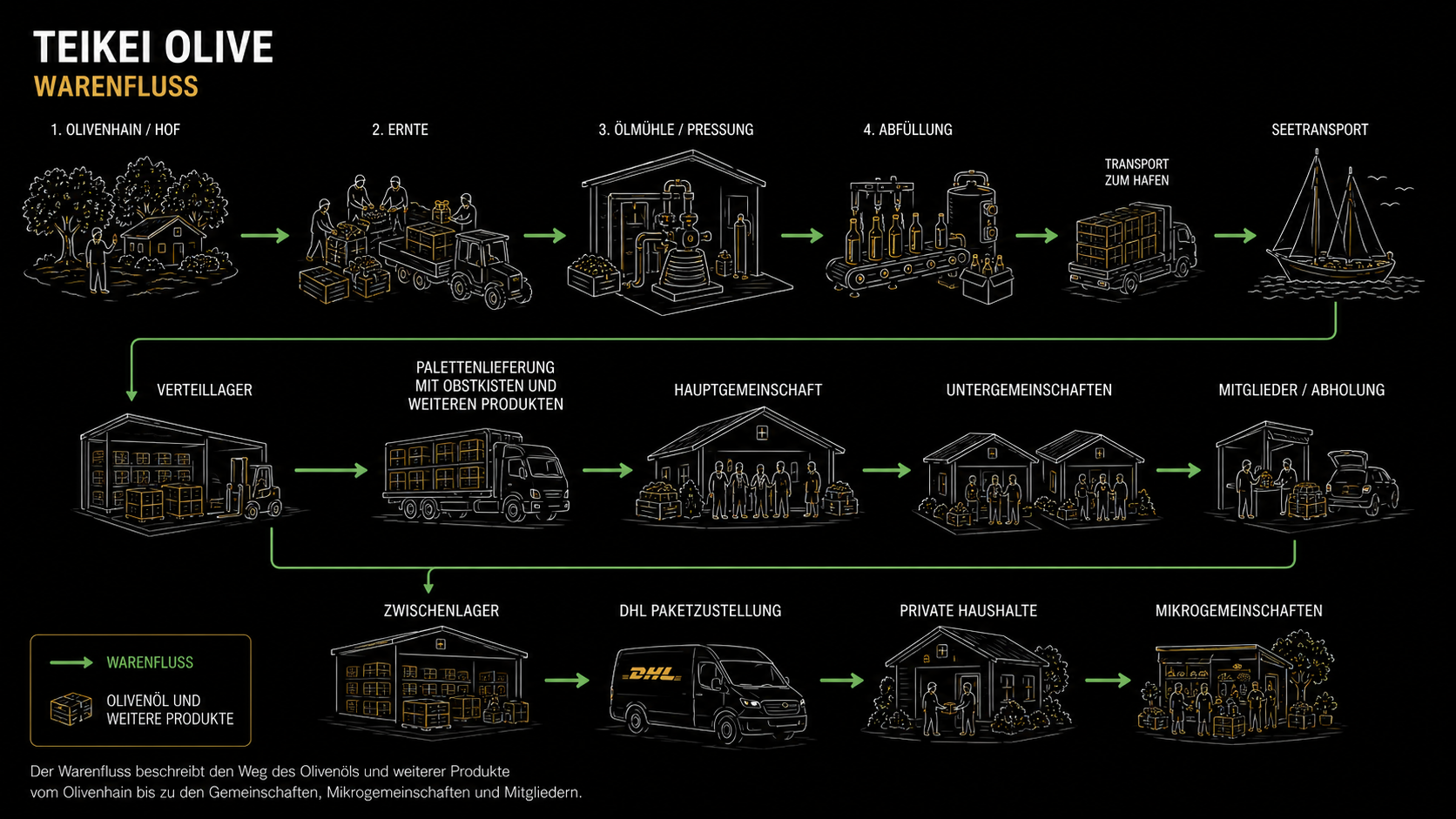
The goods flow in TEIKEI Olive describes the journey of olive oil from the olive grove to communities, micro-communities, and members.
It makes visible the stages the olive oil passes through before it is distributed locally or delivered directly.
This page describes only the goods flow.
The other flows are described on separate subpages:
¶ Classification
TEIKEI Olive is a product circle within the TEIKEI network.
The goods flow begins with the producers and leads through harvesting, pressing, bottling, transport, and storage to the communities and members.
There are different paths:
- Pallet delivery to main communities
- Distribution to sub-communities
- Distribution to micro-communities
- DHL doorstep delivery to private households
The goods flow is therefore not just a technical delivery movement. It shows how olive oil is collectively supported, bundled, passed on, and distributed locally.
An important development direction is the bundling of sufficient quantities for more sustainable transport routes. When at least three Sustainable Transport Units come together in TEIKEI Olive, sailboat transport becomes fundamentally possible.
TEIKEI aims to achieve this bundling through the development of the Agora Marketplace. The Agora Marketplace is intended to help coordinate quantities from communities, micro-communities, and basic cost participations so that viable transport units can be created.
¶ Overview of the Goods Flow
The confirmed basic process is as follows:
- Olive grove / farm
- Harvest
- Oil mill / pressing
- Bottling
- Transport to the port
- Sea transport
- Distribution warehouse
- Redistribution
From the distribution warehouse, the goods flow branches into different paths.
¶ From the Olive Grove to Bottling
The goods flow begins in the olive grove.
There, the olives grow on the producers' land. After the harvest, the olives are taken to the oil mill and pressed.
After pressing, the olive oil is bottled and prepared for further distribution.
This first section includes:
- Olive grove / farm
- Harvest
- Oil mill / pressing
- Bottling
¶ Sea Transport and Distribution Warehouse
After bottling, the olive oil is prepared for transport.
International transport takes place by sea. In the process diagram, a sailboat is shown for this purpose.
Sailboat transport becomes possible when sufficiently bundled quantities come together. As a guideline: With 3 sustainable transport units, such a transport route can be realistically prepared.
The development of the Agora Marketplace supports this bundling. It makes visible which quantities come together from communities, micro-communities, and basic cost participations, and helps organize transports so that more sustainable routes become viable.
After sea transport, the olive oil arrives at the distribution warehouse.
The distribution warehouse is the central station where the goods are prepared for further distribution.
There, the olive oil is made available for different delivery routes:
- Pallet delivery to main communities
- Distribution to sub-communities
- Forwarding to an intermediate storage
- Parcel shipping to private households
- Parcel shipping to micro-communities
¶ Pallet Delivery to Main Communities
An important goods route leads directly from the distribution warehouse to the main communities.
This delivery is made as a pallet delivery.
Here, the olive oil can be delivered together with fruit crates and other products.
The process is as follows:
Distribution warehouse → Pallet delivery with fruit crates and other products → Main community
The main community is thus a bundled receiving location.
From there, the goods can be further distributed to sub-communities or members.
¶ Distribution to Sub-Communities
Sub-communities are smaller structures within or below a main community.
They receive olive oil via the main community or through regional distribution.
The process is as follows:
Main community → Sub-communities → Members / pickup
The sub-communities handle part of the distribution locally.
¶ Intermediate Storage
For certain delivery months, olive oil is stored intermediately.
The intermediate storage is not a separate responsibility level in the process diagram but a station in the goods flow.
The following are stored there:
- Olive oil from the last harvest
- Surpluses
- Olive oil for later delivery months
The process is as follows:
Distribution warehouse → Intermediate storage → Later delivery
¶ DHL Doorstep Delivery
Another goods route leads from the intermediate storage via DHL directly to private households.
This route concerns deliveries that do not go through a main community or sub-community.
The process is as follows:
Intermediate storage → DHL parcel delivery → Private households
Doorstep delivery is thus a separate goods route within TEIKEI Olive.
¶ Micro-Communities
Micro-communities are smaller associations of private households.
They can also be supplied via the parcel route.
The process is as follows:
Intermediate storage → DHL parcel delivery → Micro-communities
The micro-communities organize the further distribution within their small group themselves.
¶ Overview of the Goods Flow
The goods flow in TEIKEI Olive branches out after the distribution warehouse.
¶ Sustainable Transport Units and Agora Marketplace
The goods flow of TEIKEI Olive is closely linked to the question of which quantities can be collectively supported and bundled.
With sufficient bundling, transport units are created that enable different transport routes. Particularly relevant here is sailboat transport.
The threshold is:
3 sustainable transport units → Sailboat transport becomes possible
The Agora Marketplace supports this development by making quantities, harvest shares, communities, and delivery routes visible and coordinable.
This allows TEIKEI to gradually work on organizing international goods flows so that they not only function technically but also align with the ecological and community-supported goals of the network.
↑ One level up: TEIKEI Olive
By Felix Schröder, with support from AI (ChatGPT)
Created on May 14, 2026 · Last updated on October 13, 2026
Questions or feedback? support@teikei.us