¶ Natural Nitrogen Cycle
¶ What this page is about
This page explains the nitrogen cycle in living agricultural systems.
The central question is:
How can nitrogen from the air, organic matter, and soil processes be integrated into the agricultural cycle in such a way that plants can grow without a farm remaining permanently dependent on external nitrogen inputs?
Nitrogen is vital for plants.
But it is not just a fertilizer.
It is part of a living cycle between air, plants, microorganisms, soil, organic matter, animals, and human care.
¶ Basic Understanding
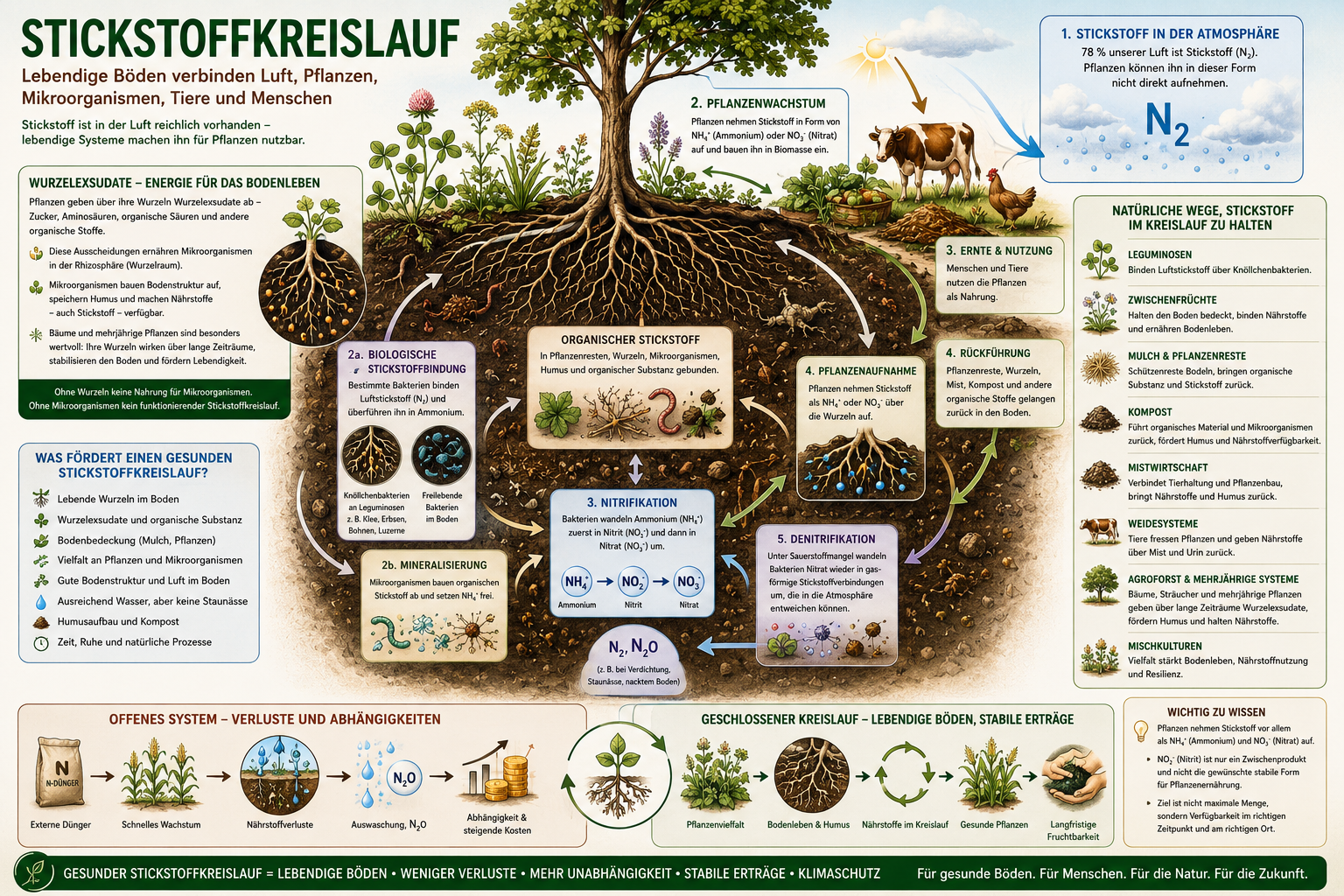
The atmosphere contains very large amounts of nitrogen.
This nitrogen is primarily present as atmospheric nitrogen.
Plants cannot absorb it directly in this form.
For nitrogen to become usable for plants, it must be converted into plant-available forms.
These include primarily:
- Ammonium
- Nitrate
- Organically bound nitrogen, which gradually becomes available in the soil
These conversions occur in living soils through microorganisms, plant roots, organic matter, moisture, oxygen, and time.
¶ Nitrogen is not scarce
The fundamental challenge is not that there is no nitrogen.
Nitrogen is present in the atmosphere in very large quantities.
The crucial question is:
Can a soil integrate this available nitrogen into fertile cycles through living processes?
When soils are biologically active, plants, bacteria, fungi, roots, and organic matter can work together.
Then nitrogen is not only understood as an external input.
It becomes part of a living system.
¶ The Natural Nitrogen Cycle
The nitrogen cycle consists of several interconnected processes.
Simplified, it can be described as follows:
Atmospheric nitrogen is present in the atmosphere.
Certain microorganisms can fix this nitrogen.
Plants grow and build biomass.
Plant residues, roots, mulch, manure, and compost return to the soil.
Soil organisms decompose organic material.
Nitrogen is thereby made available to plants again.
Plants absorb it.
Some of the nitrogen remains in the soil, some is bound in plants, animals, and harvest.
The cycle begins anew.
¶ The Role of Plants
Plants are not just recipients of nutrients.
They actively shape the soil.
Through photosynthesis, plants absorb CO₂ from the air.
Using sunlight and water, they form sugars and other carbon compounds.
Some of this energy is incorporated into leaves, stems, fruits, and roots.
Another part enters the soil through root exudates.
These root exudates are food for microorganisms.
Thus, plants provide the soil life with energy.
¶ Sugar for Bacteria
A central idea of living soils is:
Plants release some of the energy built through photosynthesis via their roots to soil organisms.
This energy is present, among other things, in the form of sugar and other carbon compounds.
Microorganisms use these substances.
In return, they help make nutrients available, build soil structure, and enable nitrogen processes.
This creates an exchange:
- The plant provides energy.
- Microorganisms work in the soil.
- Nutrients are unlocked.
- Soil structure is built.
- Plants can grow more stably.
The nitrogen cycle is therefore not just a chemical reaction.
It is a relationship between plant and soil life.
¶ Root Exudates as Food for Soil Life
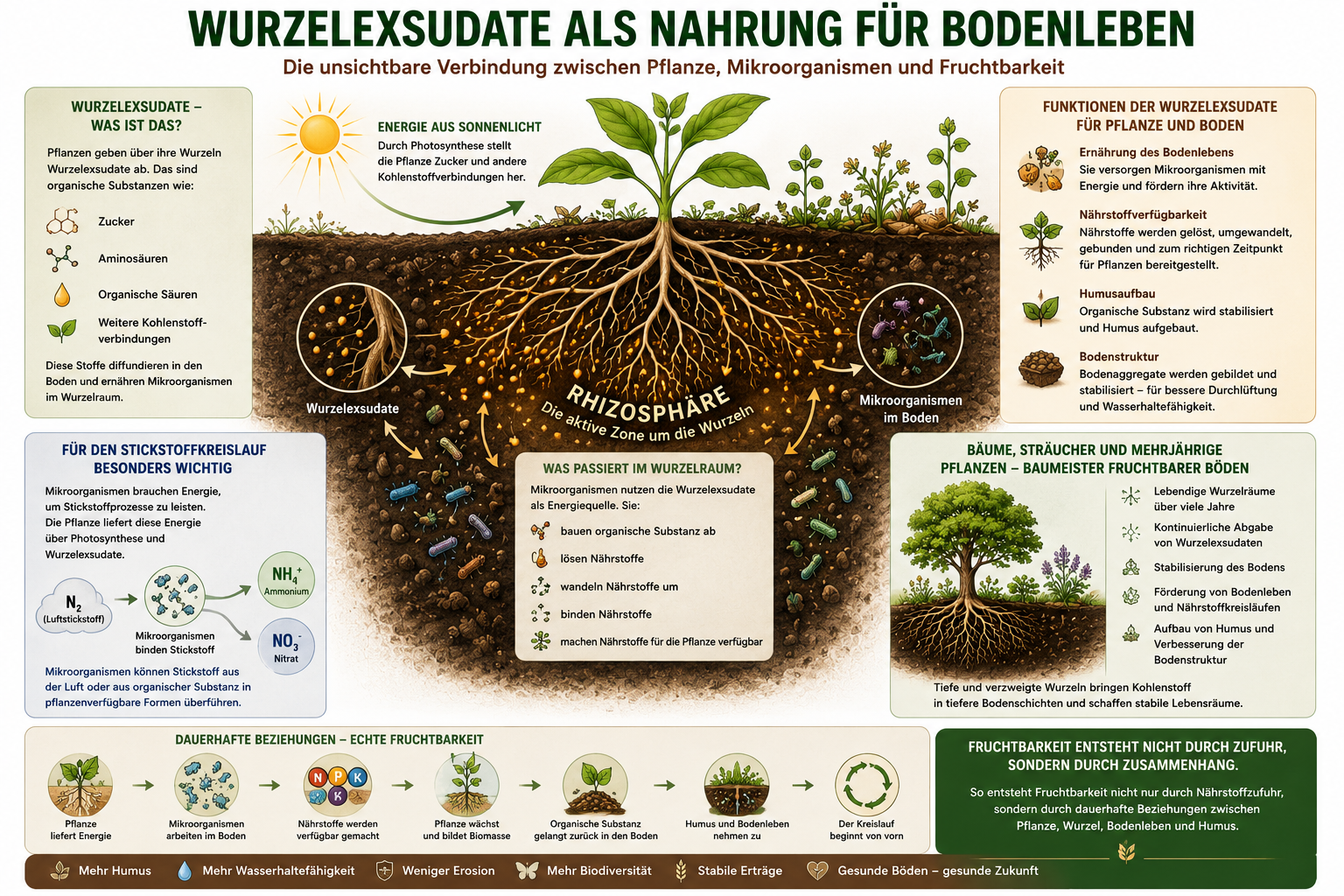
Plants release so-called root exudates through their roots.
These are organic substances such as sugars, amino acids, organic acids, and other carbon compounds.
These substances nourish microorganisms in the root zone.
This creates an active zone around the roots, the rhizosphere.
There, nutrients are transformed, dissolved, bound, and made available to plants.
This is particularly important for the nitrogen cycle.
Microorganisms need energy to perform nitrogen processes.
The plant provides this energy through photosynthesis and root exudates.
In return, microorganisms can help convert nitrogen from the air or organic matter into plant-available forms.
Trees, shrubs, and perennial plants are particularly important because they maintain living root zones over long periods.
Their roots stabilize the soil, nourish microorganisms, promote humus formation, and improve soil structure.
Thus, fertility arises not only through nutrient input but through lasting relationships between plant, root, soil life, and humus.
¶ Bacteria and Atmospheric Nitrogen
Certain bacteria can fix atmospheric nitrogen.
This means:
They can convert nitrogen from the atmosphere into forms that can be integrated into biological cycles.
Particularly well-known is the collaboration between legumes and nodule bacteria.
Legumes include, for example:
- Clover
- Alfalfa
- Peas
- Beans
- Lentils
- Vetches
- Lupins
Nodules can form on their roots.
There, bacteria live that can fix atmospheric nitrogen.
The plant supplies the bacteria with energy.
The bacteria provide nitrogen compounds that can enter the plant system.
¶ Free-Living Microorganisms
Not only nodule bacteria are important.
Free-living bacteria and other soil organisms can also contribute to nitrogen dynamics.
They live in the soil, on roots, in the rhizosphere, or in organic matter.
Their effect depends strongly on:
- Organic material
- Soil moisture
- Oxygen conditions
- pH value
- Soil temperature
- Plant diversity
- Root activity
- Humus
- Soil structure
The more alive and diverse a soil is, the more biological processes can take place.
¶ Organically Bound Nitrogen
Nitrogen is not only present in the air.
It is also bound in organic matter.
This includes:
- Plant residues
- Roots
- Mulch
- Compost
- Manure
- Dead microorganisms
- Harvest residues
- Cover crops
- Humus
When these substances return to the soil, they are decomposed, transformed, and stabilized by soil organisms.
Nitrogen is gradually released in the process.
This process is slower than the application of readily soluble nitrogen fertilizer.
However, it is more integrated into soil life, humus, water retention capacity, and plant needs.
¶ Mineralization
Mineralization means:
Organically bound nitrogen is converted into mineral forms by microorganisms.
This makes it available to plants.
This process requires:
- Living microorganisms
- Warmth
- Moisture
- Oxygen
- Organic matter
- Suitable soil conditions
Mineralization is a natural process.
It connects organic material with plant nutrition.
¶ Nitrification
During nitrification, certain bacteria further convert ammonium.
Simplified, nitrate is formed in the process.
Nitrate is readily absorbable by many plants.
However, it is also highly mobile in the soil.
If nitrate is not absorbed by plants or retained in the system, it can be leached.
Therefore, a healthy nitrogen cycle requires not only nitrogen availability.
It also requires living plant roots, soil cover, humus, water retention capacity, and good timing.
¶ Denitrification
Denitrification is a process in which nitrogen compounds can be converted back into gaseous forms.
This process occurs primarily under oxygen deficiency.
Nitrogen can escape from the soil in the process.
Under unfavorable conditions, nitrous oxide can also be produced.
Nitrous oxide is a potent greenhouse gas.
This shows:
A healthy nitrogen cycle requires not only nutrients.
It also requires good soil structure, air in the soil, water balance, and biologically stable processes.
¶ Living Soils as a Nitrogen System
A living soil can carry nitrogen differently than a depleted or compacted soil.
In a living soil, the following work together:
- Plant roots
- Bacteria
- Fungi
- Earthworms
- Organic matter
- Humus
- Water
- Air
- Minerals
- Soil structure
There, nitrogen is not just quickly dissolved and lost again.
It can be integrated into biomass, microorganisms, humus, and plant growth.
This makes the cycle more stable.
¶ Living Humus Soil
Living humus soil describes a soil space where organic matter, soil life, water, air, plant roots, and mineral components work together.
It is not just a fertilizer.
It is a foundation for fertility.
In living humus soil, nutrients can be better retained, transformed, and made available to plants.
Nitrogen thus becomes more strongly part of a living cycle.
¶ Biocyclic Humus Soil as an Example
Biocyclic Humus Soil is a concrete example of an accompanied process for building living humus soil.
It is created from plant compost that matures further over several years, is planted, and biologically refined.
This results in a stable, fertile substrate that can bind water, carbon, and nutrients in the long term.
The important point is:
The goal is not short-term fertilization.
The goal is long-term fertility.
Biocyclic humus soil shows that fertility does not arise only through the addition of individual nutrients.
It arises through time, plants, microorganisms, carbon, water, air, organic material, and biological stabilization.
¶ From Compost to Humus Soil
The path from compost to humus soil shows how organic material can be refined.
At the beginning are plant residues:
- Green waste
- Harvest residues
- Organic biomass
- Structurally rich plant residues
Through composting, maturation, structuring, and further biological activation, a more stable soil material is created.
In this process, the following are involved:
- Microorganisms
- Oxygen
- Moisture
- Warmth
- Plant roots
- Biological activity
- Stable carbon structures
With increasing maturity, the process shifts.
At the beginning is the decomposition of organic matter.
Later, structure formation, stabilization, and long-term fertility emerge.
¶ Why This Is Important for Nitrogen
Nitrogen needs a supportive soil space.
If nitrogen is only applied as a quickly soluble external input, it can easily be lost.
If nitrogen is created or integrated into a living soil process, it is more strongly connected with:
- Plant needs
- Root activity
- Soil life
- Humus
- Water retention capacity
- Organic matter
- Microbial activity
This changes the logic.
Nitrogen is not just administered.
It is built up, retained, transformed, and made available again in the system.
¶ Natural Nitrogen Sources Without External Fertilization Logic
In addition to biocyclic humus soil, there are various natural ways to integrate nitrogen into agricultural cycles.
These methods are not based on isolated input but on the design of the farm system.
These include:
- Legumes
- Cover crops
- Permanent greening
- Mulch systems
- Composting
- Manure management
- Plant residues
- Root mass
- Agroforestry systems
- Grazing systems
- Mixed cropping
- Soil cover
- Humus formation
These approaches do not automatically replace every form of nutrient supplementation.
But they change the fundamental direction.
The farm becomes less dependent on permanent external nitrogen inputs.
¶ Legumes
Legumes are particularly important for the nitrogen cycle.
They can live in symbiosis with nodule bacteria and biologically fix atmospheric nitrogen.
They can be used as:
- Main crop
- Cover crop
- Undersown crop
- Clover grass
- Forage plant
- Green manure
- Ground cover
Legumes do not bring nitrogen to the farm as a bagged product.
They incorporate it into the cycle through living plant-bacteria relationships.
¶ Cover Crops
Cover crops keep the soil covered and alive.
They can:
- Absorb nutrients
- Bind residual nitrogen
- Bring roots into the soil
- Nourish soil life
- Reduce erosion
- Support humus formation
- Reduce nitrogen losses
Cover crops are important because they bridge periods when the soil would otherwise be bare.
A bare soil loses water, structure, and nutrients more easily.
¶ Permanent Greening
Permanent greening keeps plant roots active in the soil for as long as possible.
This is particularly important in perennial crops such as:
- Fruit cultivation
- Viticulture
- Olive cultivation
- Agroforestry systems
- Mixed systems
Permanent greening nourishes soil life.
It keeps carbon flows active.
It can bind, store, and incorporate nitrogen into organic cycles.
¶ Mulch
Mulch protects the soil.
It can consist of:
- Plant residues
- Prunings
- Leaves
- Straw
- Harvest residues
- Cover crop mass
Mulch works on several levels:
- It covers the soil.
- It reduces evaporation.
- It protects against erosion.
- It nourishes soil organisms.
- It returns organic nitrogen and carbon.
- It supports humus formation.
Mulch is therefore not just a cover.
It is part of the nutrient cycle.
¶ Compost
Compost returns organic matter, carbon, microorganisms, and nutrients to the soil.
Good compost does not only work through nutrient quantities.
It supports soil life, structure, and biological activity.
In the nitrogen cycle, compost can help integrate nitrogen more strongly into organic contexts.
This makes it available more slowly and stably.
¶ Manure Management
Manure is an important component of many farm cycles.
It contains organic material, nitrogen, carbon, and other nutrients.
The crucial point is not just that manure is present.
The crucial point is how it is collected, stored, composted, and applied.
Well-managed manure management can:
- Return nutrients
- Build organic matter
- Nourish soil life
- Support humus formation
- Connect animal husbandry and crop production
Poorly managed manure management, on the other hand, can cause nutrient losses and pollution.
¶ Grazing Systems
In integrated grazing systems, animals can be part of the nitrogen cycle.
Animals eat plants.
They return manure and urine.
Through movement, grazing, and rest periods, plant growth, root formation, and soil life can be influenced.
The key is integration into the farm system.
Grazing systems require:
- Appropriate stocking density
- Good grazing management
- Rest periods for plants
- Soil protection
- Water access
- Landscape context
Then animals can help close nutrient cycles.
¶ Agroforestry and Perennial Systems
Agroforestry systems and perennial crops can stabilize the nitrogen cycle.
They bring permanent roots, shade, leaf fall, biomass, and soil structure to the area.
Depending on the design, they can:
- Unlock nutrients from deeper layers
- Build organic material
- Improve microclimate
- Retain water
- Promote soil life
- Reduce nitrogen losses
When legumes, shrubs, trees, ground covers, and crops are combined, a more layered cycle emerges.
¶ Mixed Cropping
Mixed cropping can make nutrient cycles more stable.
Different plants have different roots, nutrient needs, growth periods, and relationships with soil life.
A diverse plant community can:
- Utilize soil spaces better
- Nourish microorganisms more diversely
- Bind nitrogen more dynamically
- Reduce nutrient losses
- Increase resilience
Mixed cropping shows:
Nitrogen cycles work better when not just one plant and one nutrient are considered.
¶ Difference from External Fertilization
External fertilization means:
Nitrogen is introduced into the system from outside.
This can occur in conventional and organic systems.
Even organic fertilizers can be external inputs if they do not come from the farm's own or regionally closed cycle.
The important question, therefore, is not only:
Is the fertilizer synthetic or biological?
The deeper question is:
Does fertility arise within the system, or is it permanently supplied from outside?
¶ Conventional and Organic Input
Both conventional and organic agriculture can be heavily dependent on external inputs.
Conventionally, this often happens through synthetic nitrogen fertilizers.
Organically, it can happen through purchased organic fertilizers, substrates, composts, feed, or commercial fertilizers.
The difference does not lie solely in the label.
The crucial question is the cycle:
- Where does the nitrogen come from?
- Does it stay in the region?
- Is it retained in the soil?
- Is soil life built up?
- Are dependencies reduced?
- Does long-term fertility arise?
¶ Open and Closed Nitrogen Systems
An open nitrogen system loses many nutrients.
Typical characteristics are:
- High external fertilizer use
- Little organic return
- Bare soils
- Low root mass
- Little humus
- High risk of leaching
- Strong dependence on inputs
A more closed nitrogen cycle, on the other hand, attempts to:
- Biologically bind nitrogen
- Return plant residues
- Sensibly integrate compost and manure
- Promote soil life
- Keep roots active for as long as possible
- Build organic matter
- Reduce nutrient losses
- Strengthen regional cycles
¶ Why There Is No Simple Completeness
No farm is completely closed.
Harvest leaves the farm.
Food is eaten.
Nutrients often end up in households, wastewater, compost streams, or other systems.
Minerals, seeds, machinery, energy, and materials also often come from outside.
A closed nitrogen cycle is therefore not an absolute state.
It is a direction of development.
The question is:
How can losses be reduced, returns improved, and living soil processes strengthened?
¶ TEIKEI Perspective
From the TEIKEI perspective, the nitrogen cycle is not a technical side issue.
It is part of the foundation of community-supported supply.
When a farm builds fertile soils, integrates legumes, develops compost, uses manure sensibly, keeps the soil covered, and strengthens humus, more than just short-term harvest is created.
Long-term supply capacity is created.
This work is part of the farm's reality.
It is part of the foundation from which harvest shares arise.
TEIKEI therefore does not consider such processes as an additional service.
They are part of the jointly supported agricultural reality.
¶ Connection to Biocyclic Humus Soil
Biocyclic humus soil is a concrete reference point for the question of how fertility can be built.
It shows:
- Plant material can be refined.
- Compost can mature further.
- Plants can be integrated during the refinement process.
- Microorganisms, water, air, and sun work together.
- Carbon structures can become more stable.
- Nutrients can be bound in the long term.
- Fertility can be built rather than just consumed.
Thus, biocyclic humus soil is not just a single substitute for nitrogen fertilizer.
It is an example of a different direction:
Soil building instead of permanent input dependency.
¶ Classification
This page does not replace soil analysis or professional advice.
Nitrogen processes are complex.
They depend on climate, soil type, crop, water, temperature, pH value, management, organic matter, soil life, and regional conditions.
For specific decisions, site-specific observation, experience, and professional support are needed.
This page provides a basic understanding.
It explains why nitrogen should not only be understood as a fertilizer question but as a cycle question of living soils.
¶ Key Point
The nitrogen cycle shows how fundamentally living soils are for agriculture.
Nitrogen is abundantly present in the atmosphere.
The real question is whether agricultural systems are designed in such a way that plants, microorganisms, organic matter, water, air, and soil structure can integrate this nitrogen into fertile cycles.
A healthy nitrogen cycle therefore does not begin with the fertilizer bag.
It begins in the living soil.
¶ Further Information & Understanding Contexts
- Basic Nutrients in Agriculture
- Carbon Cycle
- Compost and Manure Management
- Plants, Roots, and Soil Life
- Biocyclic Humus Soil
- From Compost to Humus Soil
One level up: Closed Cycles
Author: Felix Schröder, with the help of AI (ChatGPT)
Created: written by Felix Schröder › formatted in Markdown by ChatGPT › published by Felix Schröder › layout adjusted by Claude
Created: 2026-05-16 · Last updated: 2026-05-16 · Questions or suggestions? support@teikei.us