¶ Carbon Cycle
¶ What This Page Is About
This page explains the carbon cycle in living agricultural systems.
At its core is the question:
How is carbon from the atmosphere brought into the soil by plants, transformed there by microorganisms, and made effective in the long term as a foundation for humus, soil structure, and fertility?
Carbon is not just a climate issue.
It is a central foundation of living soils.
Without carbon, there is:
- no stable humus formation
- no lasting soil structure
- little food for microorganisms
- reduced water retention capacity
- weaker nutrient cycles
- less long-term soil fertility
The carbon cycle connects air, sun, plants, roots, soil life, humus, water, animals, and human management.
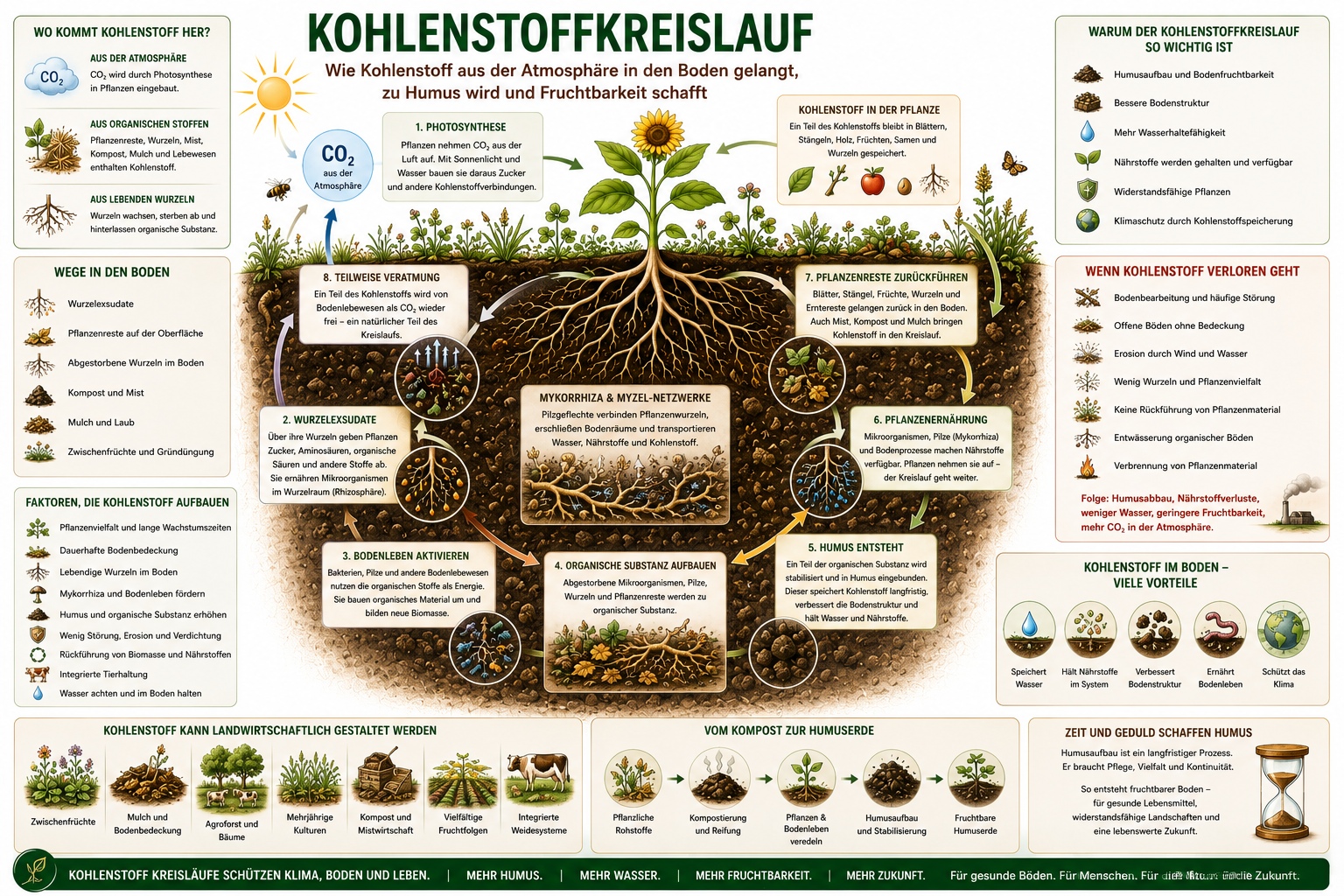
¶ Basic Understanding
Carbon is a fundamental building block of life.
Plants absorb carbon in the form of CO₂ from the air.
With the help of sunlight and water, they build sugars and other carbon compounds.
This process is called photosynthesis.
Some of the carbon becomes visible in the plant:
- Leaves
- Stems
- Wood
- Fruits
- Seeds
- Roots
Another part enters the soil invisibly.
There, it becomes food for microorganisms, organic matter, and, under favorable conditions, humus.
¶ The Central Question
The central question is not just:
How much carbon does a plant bind?
But rather:
- How much carbon enters the soil?
- How long does it remain there?
- Is it quickly respired again?
- Is it incorporated into humus and stable soil structure?
- Are there living roots?
- Are there soil organisms that process organic matter?
- Is the soil covered?
- Are plant residues, compost, and manure returned?
- Is the soil managed in a way that carbon can be retained?
The carbon cycle clearly shows:
Fertility does not arise solely from nutrient input.
Fertility arises from living carbon flows.
¶ Photosynthesis as the Beginning of the Cycle
The carbon cycle begins with photosynthesis.
Plants absorb CO₂ from the air.
They absorb water through their roots.
With the help of sunlight, they form energy-rich carbon compounds.
Simply put:
- CO₂ comes from the air.
- Water comes from the soil.
- Sunlight provides energy.
- The plant forms sugar.
- From sugar, plant tissues, roots, fruits, and organic matter are created.
Photosynthesis is thus the entry point for carbon in agricultural cycles.
¶ Plants as Carbon Bridges
Plants connect the atmosphere and the soil.
They absorb CO₂ through their leaves.
Through their roots, they bring carbon into the soil.
They are therefore a bridge between air and soil life.
A living carbon cycle requires plants that grow actively for as long as possible.
The longer plants perform photosynthesis, the longer carbon flows into the system.
This is why covered soils, cover crops, perennial plants, trees, hedges, and living roots are so important.
¶ Root Exudates
Plants release so-called root exudates through their roots.
These are organic substances such as:
- Sugars
- Amino acids
- Organic acids
- Mucilages
- Other carbon compounds
These substances nourish microorganisms in the root zone.
The area around the roots is called the rhizosphere.
Soil life is particularly active there.
Root exudates are central to the carbon cycle because they show:
Plants do not grow only for themselves.
They also supply soil life with energy.
¶ The Rhizosphere
The rhizosphere is the active zone around the plant root.
Here, the following come together:
- Root exudates
- Bacteria
- Fungi
- Mycorrhizae
- Organic matter
- Water
- Minerals
- Nutrients
- Oxygen
- Plant roots
In this zone, nutrients are dissolved, transformed, bound, and made available.
Carbon is the energy source.
Without carbon from the plant, many microorganisms lack the basis for their activity.
¶ Microorganisms as Processors
Microorganisms process carbon.
They use sugars and other organic substances as an energy source.
They transform organic material.
They form microbial biomass.
They die and become part of the organic matter again.
Some of the carbon is respired back as CO₂.
Another part can transition into more stable soil forms.
This results in constant transformation:
- Plants supply carbon.
- Microorganisms use it.
- Organic matter is built up and transformed.
- Soil structure is created.
- Humus can form.
- Some of the carbon remains in the soil.
¶ Humus
Humus is stabilized organic matter in the soil.
It does not simply arise from placing organic material on the soil.
It is formed through biological processing, transformation, stabilization, and bonding with mineral soil components.
Humus can:
- Store water
- Retain nutrients
- Improve soil structure
- Promote soil life
- Reduce erosion
- Make plants more resilient
- Support long-term fertility
Humus is therefore not just a residual substance.
It is a living reservoir and mediator in the soil.
¶ Organic Matter
Organic matter is the broader term.
It includes:
- Fresh plant residues
- Roots
- Mulch
- Compost
- Manure
- Dead microorganisms
- Root exudates
- Harvest residues
- Cover crop biomass
- Leaves
- Deadwood
- Humus
Not all organic matter is already humus.
Some material decomposes quickly.
Some is transformed slowly.
Some is stabilized long-term.
For the carbon cycle, it is crucial that organic matter regularly enters the soil and can be processed by soil life there.
¶ Retaining Carbon in the Soil
Carbon enters the soil through plants.
For it to remain there, suitable conditions are needed.
Important factors are:
- Living roots
- Permanent soil cover
- Organic matter
- Little erosion
- Good soil structure
- Sufficient water
- Oxygen in the soil
- Diverse soil life
- Mycorrhizae
- Minimal disturbance of soil structure
- Return of plant material, compost, and manure
A soil can absorb carbon.
But it can also lose carbon again.
Therefore, not only carbon sequestration is important.
Carbon stabilization is also crucial.
¶ Carbon Losses
Carbon can be lost from agricultural systems.
Typical loss pathways include:
- Soil cultivation that rapidly decomposes organic matter
- Erosion
- Bare soils
- Lack of plant cover
- Low root mass
- Humus degradation
- Burning of plant material
- Lack of return of harvest residues
- Drainage of organic soils
- Overuse of land
- Monoculture systems
When carbon is lost, the soil loses not only organic matter.
It also loses structure, water retention capacity, and biological activity.
¶ The Forest as a Carbon Cycle
A forest clearly demonstrates how a carbon cycle can function.
Trees absorb CO₂ from the air.
They build leaves, wood, bark, roots, fruits, and seeds.
Some of the carbon remains bound in wood and roots for many years or decades.
Leaves, needles, branches, deadwood, and dead roots fall back to the ground.
Fungi, bacteria, insects, and other soil organisms process the material.
Humus forms.
The soil remains covered.
Carbon is not only absorbed.
It is retained, distributed, transformed, and stabilized within the system.
¶ What Agriculture Can Learn from the Forest
Agriculture is not a forest.
A field, a vegetable farm, a vineyard, an olive grove, or pasture functions differently than a forest.
Nevertheless, agriculture can learn from forest systems.
Important principles are:
- Permanent roots
- Soil cover
- Leaf and plant residue return
- Diverse plants
- Fungal networks
- Little erosion
- Perennial structures
- Organic matter
- Living soil surface
- Water retention
- Closed-loop management
These principles can be implemented differently in various farm systems.
¶ Perennial Plants and Trees
Perennial plants, trees, and shrubs are particularly important for the carbon cycle.
They maintain living root zones over longer periods.
They continuously release root exudates.
They bring leaves, fine roots, and organic matter into the cycle.
They can access deeper soil layers.
They stabilize the soil.
They protect against erosion.
They create microclimates.
In agroforestry systems, hedges, forest gardens, orchards, olive groves, or vineyards, such structures can be consciously utilized.
¶ Roots as a Carbon Pathway
Roots are a particularly important pathway through which carbon enters the soil.
Aboveground plant residues can be decomposed, blown away, burned, or removed.
Roots are located directly in the soil.
They leave organic matter in the soil space.
They nourish microorganisms.
They create pores.
They stabilize soil aggregates.
They bring carbon to where humus and soil structure can form.
Therefore, living roots are a key to the carbon cycle.
¶ Mycorrhizae and Mycelium
Mycorrhizal fungi live in association with plant roots.
The plant provides carbon compounds to the fungi.
The fungi extend the root zone.
They can access water and nutrients.
They contribute to soil structure.
The fine fungal network in the soil is called mycelium.
Mycelium can help bind soil particles and stabilize organic matter.
For the carbon cycle, this means:
Carbon is not only stored as plant mass.
It also flows into fungal networks, microbial biomass, and soil structure.
¶ Soil Structure and Carbon
Good soil structure helps retain carbon in the soil.
When soil particles form stable aggregates, organic matter can be better protected.
Soil structure is created by:
- Roots
- Fungi
- Bacteria
- Earthworms
- Organic matter
- Clay-humus complexes
- Alternating moisture and dryness
- Biological activity
A structured soil can better absorb water.
It can retain air and oxygen in the soil space.
It provides habitats for soil organisms.
It reduces erosion.
As a result, carbon is not only introduced but better retained.
¶ Compost
Compost is an important component of many carbon cycles.
It returns organic matter, microorganisms, structure, and nutrients to the soil.
Good compost is not just a nutrient fertilizer.
It supports soil life and soil building.
Depending on its maturity, compost has different effects.
Fresher material can be processed more quickly.
More mature compost can introduce more stable organic structures.
The key is that compost remains part of a living cycle and is not seen merely as an isolated input.
¶ Manure and Bedding
Manure connects animal husbandry and crop production.
It contains organic matter, carbon, nitrogen, and other nutrients.
Bedding can introduce additional carbon.
When manure is well managed, stored, composted, and applied, it can strengthen the carbon cycle.
It returns organic material to the field.
It nourishes soil life.
It can support humus formation.
If manure is poorly managed, nutrient losses, odors, and pollution can occur.
Here too, the quality of cycle management is decisive.
¶ Plant Residues and Mulch
Plant residues are important carbon carriers.
These include:
- Stems
- Leaves
- Roots
- Harvest residues
- Prunings
- Leaves
- Cover crop biomass
- Mulch
When plant residues remain on the field or are returned, carbon re-enters the soil.
Mulch also protects the soil surface.
It can reduce evaporation.
It can minimize erosion.
It nourishes soil life.
It keeps the soil cooler and moister.
Thus, mulch supports the carbon cycle on multiple levels.
¶ Cover Crops
Cover crops are important because they bridge periods when the soil would otherwise be bare.
They perform photosynthesis.
They form roots.
They provide root exudates.
They absorb nutrients.
They protect against erosion.
They bring organic matter into the soil.
They nourish soil life.
Cover crops are therefore not just gap fillers.
They are active carbon plants in the agricultural cycle.
¶ Permanent Soil Cover
Permanent soil cover keeps the soil alive over longer periods.
It is particularly important in:
- Fruit growing
- Viticulture
- Olive cultivation
- Agroforestry systems
- Pasture systems
- Perennial crops
Permanent soil cover means that plant roots are active in the soil continuously or regularly.
As a result, carbon flows more continuously into soil life.
This strengthens soil structure, water retention capacity, and nutrient cycles.
¶ Animals in the Carbon Cycle
Animals can be part of the carbon cycle.
They eat plants.
They transform plant material.
They return manure and urine.
They can manage pastures.
They can stimulate plant growth.
They can distribute organic matter.
The key is integration into the farm system.
Well-managed pasture can promote root growth, soil cover, and organic return.
Poorly managed or overloaded land can compact the soil, weaken vegetation, and lose carbon.
¶ Open and Closed Carbon Systems
An open carbon system loses organic matter.
Typical characteristics include:
- Bare soils
- Low root mass
- Little plant diversity
- Strong humus degradation
- Lack of return
- Erosion
- Frequent disturbance of soil structure
- Little soil life
A more closed carbon cycle works differently:
- Soil remains covered.
- Plants grow for as long as possible.
- Roots remain active.
- Plant residues are returned.
- Compost and manure are used sensibly.
- Animals are integrated.
- Trees and hedges stabilize landscapes.
- Soil life is promoted.
- Humus can be built up.
¶ Carbon and Water
Carbon and water are closely linked.
Humus-rich soils can store more water.
Good soil structure allows water to infiltrate better.
Soil cover reduces evaporation.
Roots create pores.
Soil life stabilizes aggregate structures.
This means:
A living carbon cycle also strengthens the water balance.
In times of drought, heavy rainfall, and heat, this connection becomes particularly important.
¶ Carbon and Nutrients
Carbon is closely connected to nutrient cycles.
Microorganisms need carbon as an energy source.
Without carbon, many nutrient processes cannot run stably.
Nitrogen, phosphorus, potassium, and trace elements are moved, bound, and made available in the soil through living processes.
Carbon nourishes the soil life that enables these processes.
Therefore, carbon is not a side issue.
It is the energy foundation of many nutrient cycles.
¶ Carbon Sequestration and Climate Protection
Carbon in the soil is also relevant for the climate.
When plants absorb CO₂ from the atmosphere and some of it is stabilized long-term in the soil, soil can become a carbon sink.
How much carbon a soil can store depends on many factors:
- Climate
- Soil type
- Water balance
- Management
- Plant diversity
- Root mass
- Organic return
- Disturbance of soil structure
- Existing humus content
- Time
Therefore, carbon sequestration should not be oversimplified.
Not every measure automatically leads to permanent storage.
But living soils, humus building, and good cycle management can help retain carbon longer in the system.
¶ Difference from Pure CO₂ Compensation
The carbon cycle should not be understood merely as CO₂ compensation.
In the TEIKEI context, it is not about viewing soil as an abstract offset area.
It is about real soil fertility.
Carbon is important because it:
- Builds humus
- Retains water
- Nourishes soil life
- Makes nutrients available
- Strengthens soil structure
- Makes plants more resilient
- Enables long-term supply
Climate effects can arise from this.
However, the foundation remains real agricultural fertility.
¶ Connection to Biocyclic Humus Soil
Biocyclic Humus Soil is a concrete example of an accompanied process for building stable humus soil.
It is created from plant compost that matures over several years, is planted, and biologically refined.
In the process, stable carbon structures, water retention capacity, microbial soil life, and long-term usability develop.
For the carbon cycle, this is important because here, organic material is not just processed in the short term.
It is cared for over time, stabilized, and transformed into a more permanent foundation for fertility.
¶ From Compost to Humus Soil
The process from compost to humus soil shows that carbon is not simply stored.
It is biologically processed.
Plant residues are composted.
The compost matures.
The structure stabilizes.
Plants, microorganisms, oxygen, moisture, warmth, and time work together.
With increasing maturity, the process shifts:
- From rapid decomposition
- Toward structure building
- Biological activation
- Stabilization
- Long-term fertility
Carbon thus becomes more strongly part of a living soil-building process.
¶ Difference from External Input Logic
A farm can purchase organic materials from outside.
This can make sense, especially when soils are severely depleted.
But even organic inputs do not automatically solve the cycle question.
The decisive questions are:
- Where does the organic material come from?
- Is a cycle disrupted elsewhere as a result?
- Does the soil become more alive in the long term?
- Are plant roots and soil life strengthened?
- Does lasting fertility arise?
- Does the farm become more independent or just differently dependent?
A regenerative perspective does not just ask about the input.
It asks about the cycle.
¶ Biological Does Not Automatically Mean Carbon-Stable
Even organic farming can lose carbon.
For example, through:
- Bare soils
- Intensive soil cultivation
- Little plant cover
- Low root input
- Lack of return
- Erosion
- External input dependency without soil building
Organically approved inputs do not automatically replace living carbon cycles.
The decisive factor is whether carbon is built up, retained, and transformed into soil fertility within the system.
¶ Agriculture as Carbon Management
Agriculture shapes carbon flows.
It helps determine:
- How long plants grow
- How much soil is covered
- How deep roots reach
- Whether organic matter is returned
- How much the soil is disturbed
- Whether animals are integrated
- Whether trees, hedges, and perennial plants are present
- Whether water is retained in the soil
- Whether humus is built up or degraded
Carbon cycles do not arise on their own.
They are influenced by design, care, and responsibility.
¶ TEIKEI Perspective
From the TEIKEI perspective, the carbon cycle is part of the foundation of community-supported agriculture.
It is not an additional service.
It is part of the farm reality.
When a farm builds humus, strengthens soil life, retains water, promotes plant diversity, and returns organic matter, long-term supply capacity is created.
This work is part of the foundation from which harvest shares arise.
Members therefore do not only carry the harvest.
They also carry the development of the conditions under which harvest remains possible in the long term.
¶ Connection to Closed Cycles
The carbon cycle is connected to all other cycles.
It links:
- Nitrogen cycle
- Phosphorus and potassium cycle
- Water cycle
- Humus building
- Soil life
- Plant growth
- Animal husbandry
- Composting
- Manure management
Without carbon, many soil processes lack their energy foundation.
Therefore, the carbon cycle is not just an individual topic.
It is a central connecting level of closed cycles.
¶ Classification
This page does not replace soil analysis or professional advice.
Carbon processes are complex.
They depend on:
- Soil type
- Climate
- Water balance
- Crop type
- Management
- Organic matter
- Root mass
- Soil life
- pH value
- Compaction
- Erosion
- Time
- Regional return
For specific decisions, site-specific observation, experience, and professional support are needed.
This page provides a basic understanding.
It shows why carbon should not only be understood as a greenhouse gas but as a foundation of living soil fertility.
¶ Key Takeaway
The carbon cycle shows that soil fertility arises from living relationships.
Plants absorb CO₂ from the air.
They convert solar energy into carbon compounds.
They nourish soil life through roots, plant residues, and organic matter.
Microorganisms, fungi, animals, water, air, and minerals transform this carbon into soil structure, humus, and fertility.
Fertile soils arise where carbon is not just consumed but integrated into living cycles.
¶ Further Information & Understanding Connections
- How Do Closed Cycles Work in Agriculture?
- Basic Nutrients in Agriculture
- Nitrogen Cycle
- Phosphorus and Potassium
- Compost and Manure Management
- Plants, Roots, and Soil Life
- Water in the Agricultural Cycle
- Biocyclic Humus Soil
- From Compost to Humus Soil
One level up: Closed Cycles
Author: Felix Schröder, with the help of AI (ChatGPT)
Creation: written by Felix Schröder › formatted in Markdown by ChatGPT › published by Felix Schröder › layout adjusted by Claude
Created: 2026-05-16 · Last updated: 2026-05-16 · Questions or suggestions? support@teikei.us