¶ Compost and Manure Management
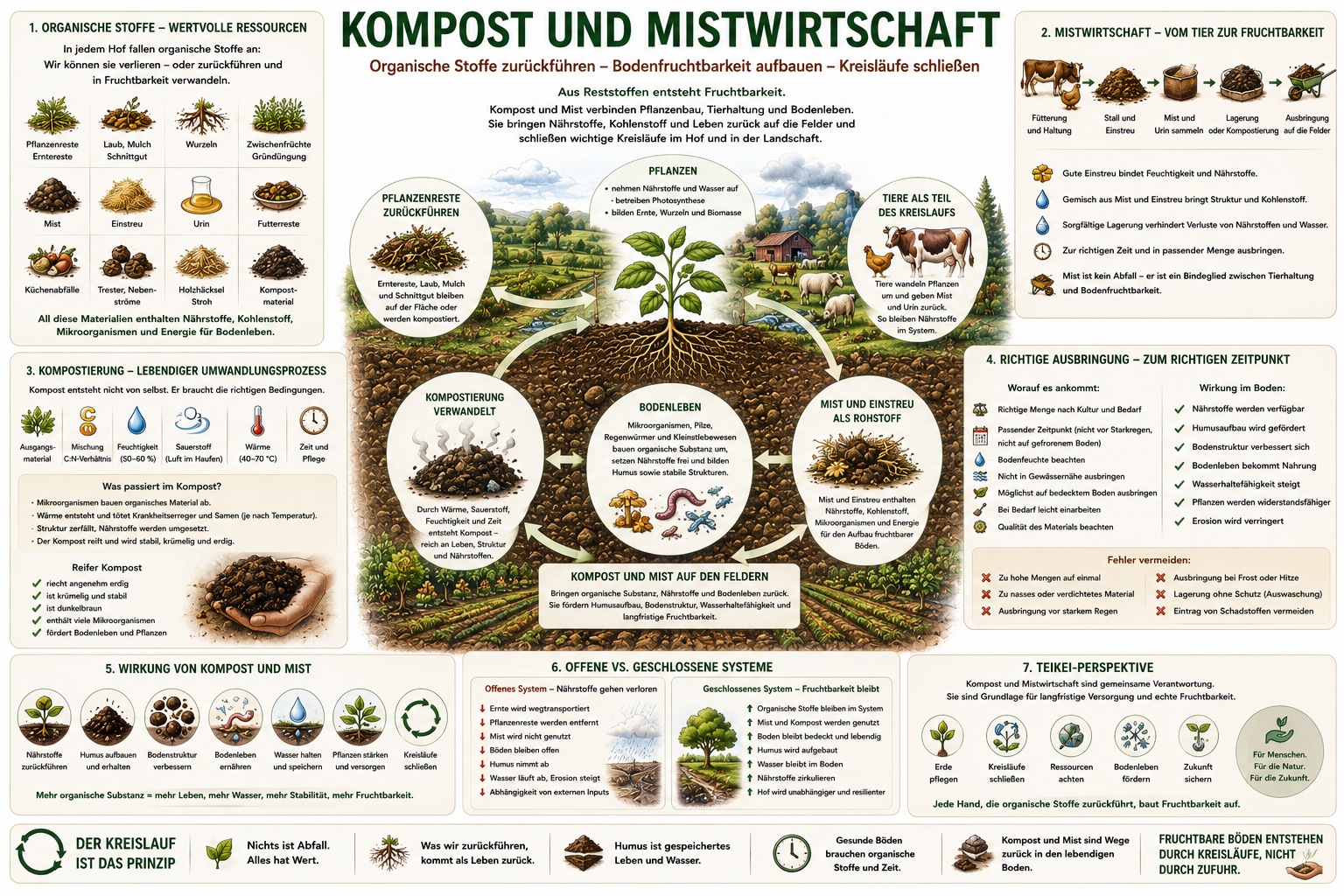
¶ What This Page Covers
This page explains the role of compost and manure management in closed agricultural cycles.
At its core is the question:
How can organic materials, plant residues, manure, bedding, compost, and soil life interact to create soil fertility, humus formation, and stable nutrient cycles?
Compost and manure are not simply waste products.
They are part of living farm systems.
When managed properly, they can:
- Return nutrients
- Feed soil life
- Support humus formation
- Improve water retention
- Strengthen soil structure
- Make plants more resilient
- Close cycles between crop production, animal husbandry, and soil
¶ Basic Understanding
Agriculture always generates organic material flows.
These include:
- Plant residues
- Harvest residues
- Prunings
- Leaves
- Roots
- Cover crop biomass
- Mulch
- Manure
- Urine
- Bedding
- Feed residues
- Compost material
- Organic by-products from processing and storage
These materials can be lost.
Or they can be returned, processed, and transformed into new fertility.
Compost and manure management describe precisely this transition:
From waste materials to building processes.
¶ Compost Is More Than Fertilizer
Compost is often understood as fertilizer.
This is only part of the truth.
Compost returns nutrients to the soil.
But good compost provides even more:
- Organic matter
- Carbon
- Microorganisms
- Structure
- Moisture
- Biological activity
- Buffering capacity
- Foundation for humus formation
Compost therefore does not only work through individual nutrient values.
It functions as part of the living soil.
¶ Manure Is More Than Waste
Manure is produced where animals are part of a farm system.
It contains:
- Organic matter
- Nitrogen
- Phosphorus
- Potassium
- Carbon
- Trace elements
- Microorganisms
- Bedding
- Moisture
- Energy for soil life
Manure is not waste when managed sensibly.
It is a link between animal husbandry, crop production, and soil fertility.
The crucial factor is not just that manure exists.
The crucial factor is how it is collected, stored, composted, managed, and applied.
¶ The Central Question
The central question is not:
How do we dispose of organic material?
Rather:
How can we transform organic material so that it strengthens soil life, humus formation, and nutrient cycles?
This requires considering multiple levels together:
- Material quality
- Moisture
- Oxygen
- Carbon-to-nitrogen ratio
- Temperature
- Structure
- Time
- Microorganisms
- Storage
- Application
- Plant requirements
- Location
- Weather
- Water protection
- Farm cycle
¶ Organic Matter as a Foundation
Compost and manure management return organic matter.
Organic matter is the foundation of many soil processes.
It feeds soil organisms.
It improves soil structure.
It helps retain water.
It binds nutrients.
It forms the foundation for humus.
Without organic return, a farm loses fertility in the long term.
Harvest removes biomass and nutrients.
If nothing is returned, the system becomes open.
¶ The Path from Organic Material to Fertility
Organic material does not automatically become fertile soil.
It must be transformed.
Involved in this process are:
- Bacteria
- Fungi
- Earthworms
- Insects
- Mites
- Springtails
- Nematodes
- Microorganisms
- Oxygen
- Water
- Heat
- Time
These organisms and conditions transform organic material.
This results in:
- Available nutrients
- More stable organic matter
- Humus precursors
- Soil aggregates
- Microbial biomass
- Living soil structure
¶ Composting
Composting is a controlled biological transformation process.
Plant and animal organic materials are decomposed and stabilized by microorganisms, oxygen, moisture, and time.
Good compost requires:
- Sufficient oxygen
- Appropriate moisture
- Structural material
- A mix of carbon-rich and nitrogen-rich materials
- Biological activity
- Temperature development
- Maintenance
- Time
Composting is not just storage.
It is a living refinement process.
¶ Starting Materials for Compost
Compost can be made from various materials.
These include, for example:
- Plant residues
- Green waste
- Leaves
- Straw
- Prunings
- Harvest residues
- Vegetable scraps
- Fruit pomace
- Cover crop biomass
- Manure
- Bedding
- Wood chips
- Compost soil
- Organic by-products from processing
Not all materials behave the same.
Some materials are nitrogen-rich and decompose quickly.
Others are carbon-rich and provide structure.
A good mix is crucial.
¶ Carbon and Nitrogen
The ratio of carbon to nitrogen is important for composting.
Carbon-rich materials include, for example:
- Straw
- Wood chips
- Leaves
- Dry plant residues
- Sawdust
- Bark
More nitrogen-rich materials include, for example:
- Fresh green material
- Manure
- Young plant residues
- Kitchen or vegetable scraps
- Legume growth
Microorganisms need both.
Carbon provides energy and structure.
Nitrogen is needed for growth and protein formation.
If there is too much easily available nitrogen, losses can occur.
If there is too much hard-to-decompose carbon, the process can become very slow.
¶ Oxygen
Composting requires oxygen.
If there is too little oxygen, anaerobic conditions develop.
Then the material can rot.
This can lead to odors, nutrient losses, and undesirable metabolic processes.
Oxygen enters the compost through:
- Structural material
- Loose structure
- Turning
- Pores
- Not too much compaction
- Appropriate moisture
Compost should not dry out.
But it should also not become waterlogged.
¶ Moisture
Moisture is crucial for microorganisms.
If the material is too dry, the process slows down.
If it is too wet, oxygen is lacking.
Good compost is moist but not dripping wet.
It needs water for biological activity.
At the same time, it needs air for stable decomposition.
Moisture is therefore always connected to structure and oxygen.
¶ Heat
Heat can develop during composting.
This heat is a sign of microbial activity.
In hot phases, pathogens and germinable seeds can be reduced.
However, not every composting process needs to be equally hot.
What is important is that the process remains controlled, active, and stable.
Temperature shows how active the transformation process is.
But it does not replace observation, smell, structure, moisture, and maturity.
¶ Maturity
Compost changes over time.
Initially, the starting materials are still clearly recognizable.
Later, the structure becomes finer.
Smell, color, stability, and biological activity change.
Mature compost is more stable.
It smells earthy.
It is better integrated into the soil.
It acts less as quickly decomposable material and more as a soil-building element.
Maturity is important because immature compost can stress plants or bind nitrogen.
¶ From Compost to Humus Soil
Compost can be an intermediate step on the way to more stable humus soil.
When compost continues to mature, is planted, biologically activated, and stabilized, it can develop into a long-term soil-building material.
In this context, there is also Bio-cyclic Humus Soil.
It describes an accompanied refinement process from plant compost to stable, fertile humus soil.
This path shows:
Fertility does not arise just from collecting organic materials.
It arises through time, care, biological activity, and stabilization.
¶ Manure Management in the Farm System
Manure management describes the handling of manure within the entire farm system.
This includes:
- Animal husbandry
- Feeding
- Bedding
- Stall management
- Pasture management
- Collection
- Storage
- Composting
- Application
- Return to fields
- Plant requirements
- Water protection
- Soil building
Manure management does not begin at the manure pile.
It begins with the question of how animals are integrated into the farm system.
¶ Bedding
Bedding plays an important role.
It binds moisture.
It absorbs urine.
It brings carbon into the manure.
It improves structure.
It influences odor, decomposition, and nutrient losses.
Typical bedding materials include:
- Straw
- Sawdust
- Wood chips
- Leaves
- Chopped material
- Plant residues
Bedding connects animal husbandry with carbon cycles.
It can help make manure more compostable, structurally rich, and effective for the soil.
¶ Urine and Nitrogen
Urine contains easily available nitrogen compounds.
If it is not bound, losses can occur.
Nitrogen can volatilize, leach, or cause odors.
Bedding, composting, and good storage help reduce these losses.
The goal is:
Do not lose nitrogen.
Incorporate nitrogen into organic cycles.
Manage nitrogen so that it can later serve plants and soil life.
¶ Storage
The storage of manure and compost is crucial.
Poor storage can lead to losses.
Possible problems include:
- Leaching
- Odor
- Oxygen deficiency
- Excessive drying
- Nutrient losses
- Water pollution
- Uneven decomposition
Good storage pays attention to:
- Location
- Substrate
- Water management
- Covering, if appropriate
- Oxygen
- Moisture
- Structure
- Regular inspection
- Protection from runoff
Manure and compost should not simply be stored.
They should be managed.
¶ Application
Application determines whether compost and manure strengthen soil fertility or cause losses.
Important factors are:
- Timing
- Quantity
- Crop requirements
- Soil moisture
- Weather
- Slope
- Distance to water bodies
- Soil cover
- Incorporation, if necessary and appropriate
- Maturity of the material
Compost and manure should not be applied when the soil cannot absorb them.
For example, losses can increase on frozen, water-saturated, or very dry soil.
¶ Compost and the Nitrogen Cycle
Compost and manure are closely linked to the nitrogen cycle.
They contain organically bound nitrogen.
This is not immediately available.
It is gradually mineralized by soil life.
This allows nitrogen to be incorporated into the cycle over a broader time frame.
This distinguishes organic return from quickly soluble nitrogen applications.
However, compost and manure can also cause losses if poorly managed.
The crucial factor is the quality of the cycle.
¶ Compost and the Carbon Cycle
Compost and manure return carbon to the soil.
Carbon is energy for soil life.
It is the foundation for humus formation.
It supports soil structure.
It helps retain water and nutrients.
Compost and manure management are therefore central elements of the carbon cycle.
They connect plant residues, animals, soil life, and long-term fertility.
¶ Compost, Phosphorus, and Potassium
Compost and manure do not only return nitrogen.
They also contain phosphorus and potassium.
These nutrients can be removed from the farm system through harvest, animal products, or plant material.
Through compost, manure, plant residues, and regional return, they can re-enter the cycle.
Phosphorus and potassium in particular show why return is important.
They cannot be bound from the air like nitrogen.
They must come from soil, rock, organic matter, and return.
¶ Compost and Water
Compost and humus formation improve water management.
Organic matter helps retain water in the soil.
Soil structure improves infiltration.
Soil life creates pores.
Humus can store water.
This makes plants more resistant to drought stress.
At the same time, a well-structured soil can better absorb heavy rainfall.
Compost and manure management are therefore also part of the water cycle.
¶ Compost and Soil Life
Compost brings life to the soil.
It contains microorganisms and organic material.
It provides food for soil organisms.
It can increase biological activity.
It supports:
- Bacteria
- Fungi
- Earthworms
- Microorganisms
- Soil structure
- Humus formation
- Nutrient availability
Compost is particularly effective when the soil itself remains alive.
A dead or heavily disturbed soil can integrate compost less effectively.
¶ Compost Quality
Not all compost is equally good.
Compost quality depends on:
- Starting materials
- Decomposition management
- Oxygen
- Moisture
- Temperature
- Maturity
- Structure
- Absence of contaminants
- Salt content
- Hygiene
- Plant compatibility
- Odor
- Stability
Good compost smells earthy.
It is not putrid.
It is structurally rich.
It is compatible with plants.
It integrates into the soil rather than burdening it.
¶ Risks
Compost and manure can also be problematic if poorly managed.
Possible risks include:
- Nutrient losses
- Odor pollution
- Leaching
- Over-fertilization
- Introduction of undesirable substances
- Pathogens
- Seeds of undesirable plants
- Oxygen deficiency
- Water pollution
- Incorrect application timing
These risks do not mean that compost and manure are problematic.
They show that organic return requires responsibility.
¶ Regional Organic Material Cycles
Not every farm has enough of its own organic material.
Some farms have animals.
Others only have crop production.
Some regions have many organic by-products.
Others have few.
Therefore, regional cycles can become important.
These include:
- Cooperation between farms
- Compost sites
- Manure cooperatives
- Green waste utilization
- Return of harvest residues
- Processing of by-products
- Municipal compost streams, if clean and suitable
- Regional humus hubs
- Community-supported infrastructure
Regional cycles require clear responsibility.
They must be organized in a clean, transparent, and site-appropriate manner.
¶ Open and Closed Systems
An open system loses organic matter.
Typical signs are:
- Plant residues are removed
- Manure is not used sensibly
- Compost is lacking
- Soils remain bare
- Humus decreases
- Soil life weakens
- Nutrients are lost
- External inputs become more important
A more closed cycle works differently:
- Organic materials are returned
- Manure is managed
- Compost is built
- Plant residues remain in the system
- Soil remains covered
- Animals are integrated
- Soil life is fed
- Humus can form
- Nutrients remain available longer
- Water retention increases
¶ Difference from Pure Input Logic
Compost and manure can also be treated like external inputs.
Then they are only purchased, applied, and accounted for.
A regenerative perspective asks deeper questions:
- Where does the material come from?
- Which cycles are closed as a result?
- Are cycles opened elsewhere?
- Is soil life being built?
- Is humus being stabilized?
- Are nutrients being retained?
- Is the farm becoming more sustainable in the long term?
- Is dependency being reduced?
Compost and manure are then not just operating resources.
They are part of cycle design.
¶ Biological Does Not Automatically Mean Cyclable
Even organic farming can be heavily dependent on purchased organic fertilizers.
A fertilizer can be organically certified and still come from a distant, open system.
Therefore, the important question is not only:
Is the input organically permitted?
Rather:
How is fertility built in the farm, in the region, and in the soil?
Cyclability arises through return, soil life, humus formation, good management, and long-term responsibility.
¶ TEIKEI Perspective
From the TEIKEI perspective, compost and manure management are part of the real foundation of community-supported agriculture.
They are not side tasks.
They are part of the farm reality.
When a farm returns plant residues, carefully manages manure, builds compost, feeds soil life, and develops humus, long-term supply capacity is created.
This work is part of the foundation from which harvest shares arise.
Members therefore do not only support the harvest.
They also support the conditions under which harvest remains possible in the long term.
¶ Connection to Closed Cycles
Compost and manure management connect central cycles:
- Carbon cycle
- Nitrogen cycle
- Phosphorus and potassium cycle
- Water cycle
- Plants, roots, and soil life
- Animal husbandry
- Humus formation
- Farm development
- Regional return
Without organic return, many cycles remain open.
With well-managed compost and manure, nutrients, carbon, and water can be kept more strongly within the system.
¶ Classification
This page does not replace professional advice, fertilization planning, or legal review.
Compost and manure management depend on:
- Animal species
- Bedding
- Starting material
- Soil type
- Crop
- Climate
- Water management
- Slope
- Storage
- Application
- Legal requirements
- Farm structure
- Regional material flows
For specific decisions, site-specific observation, experience, analyses, and professional support are needed.
This page provides a basic understanding.
It shows why compost and manure should not only be understood as fertilizers but as part of living cycles.
¶ Key Takeaway
Compost and manure management show that fertility does not simply arise.
It is built.
Plant residues, animals, bedding, microorganisms, water, air, heat, and time transform organic material into new soil fertility.
When these processes are carefully managed, more humus, more soil life, greater water retention, and more stable nutrient cycles emerge.
Compost and manure are then not waste.
They are paths back to the living soil.
¶ Further Information & Understanding Connections
- How Do Closed Cycles Work in Agriculture?
- Basic Nutrients in Agriculture
- Nitrogen Cycle
- Carbon Cycle
- Phosphorus and Potassium
- Plants, Roots, and Soil Life
- Water in the Agricultural Cycle
- Bio-cyclic Humus Soil
One level up: Closed Cycles
Author: Felix Schröder, with the help of AI (ChatGPT)
Created: written by Felix Schröder › formatted in Markdown by ChatGPT › published by Felix Schröder › layout adjusted by Claude
Date: 2026-05-16 · Last updated: 2026-05-16 · Questions or suggestions? support@teikei.us