¶ Essential Nutrients in Agriculture
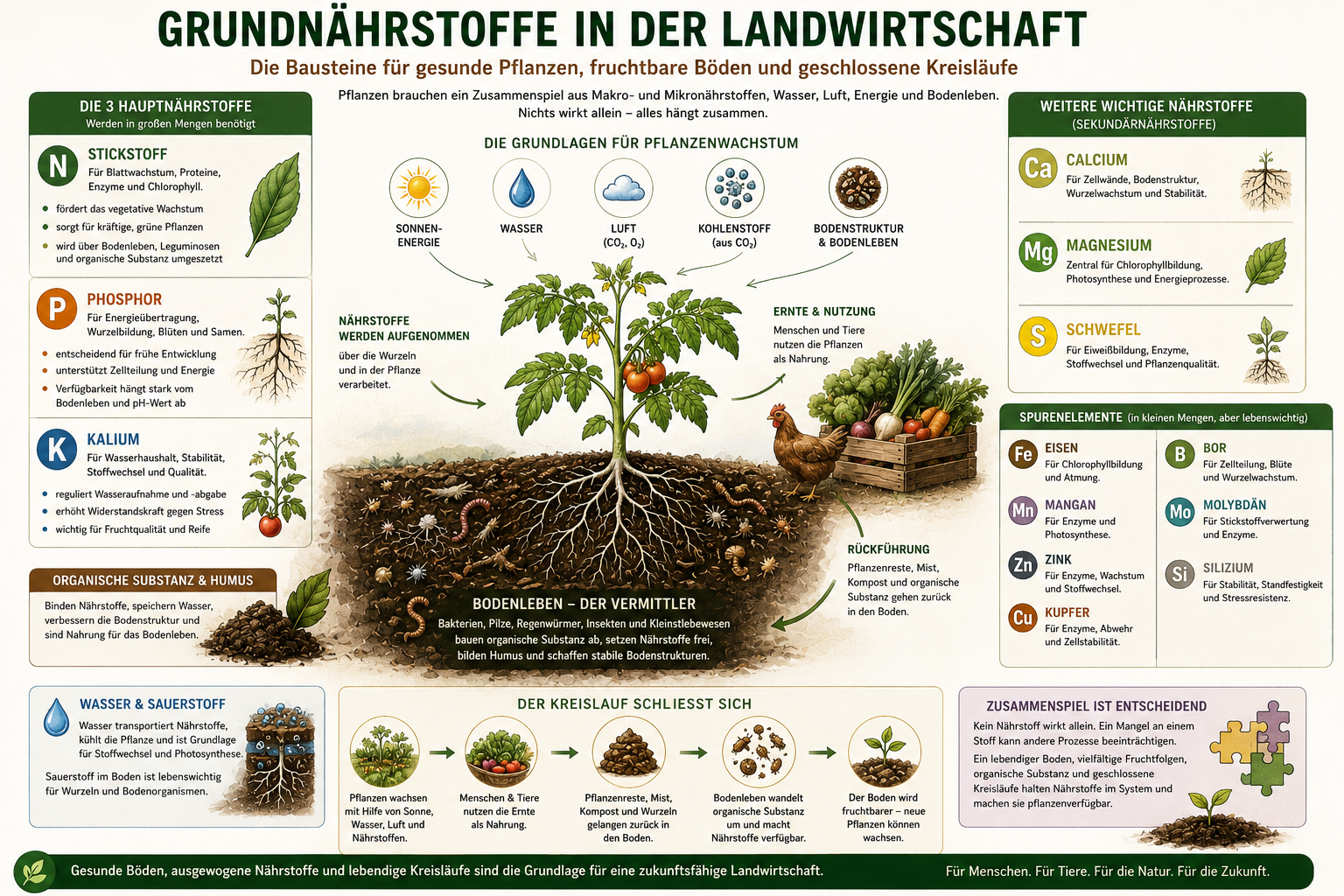
¶ What This Page Covers
This page explains the fundamental nutrients that plants need for growth, health, and yield.
It serves as an introductory page.
It does not provide detailed fertilization recommendations but rather focuses on the basic understanding:
Which substances does agriculture need so that plants can grow, soils remain fertile, and cycles function properly?
Plants do not only need individual nutrients.
They require an interplay of:
- Light
- Water
- Air
- Carbon
- Mineral nutrients
- Organic matter
- Living soil life
- Good soil structure
- Oxygen in the soil
- Stable cycles
A single nutrient cannot replace a living agricultural system.
¶ Basic Understanding
In agriculture, the term "nutrients" is often used.
This refers to substances that plants need for their development.
Plants require some of these in larger quantities.
Others are needed only in very small amounts.
Nevertheless, even small quantities can be crucial.
If an important nutrient is missing or not available to plants, the plant cannot grow healthily.
This is true even if other nutrients are sufficiently present.
¶ Nutrient Availability
The crucial factor is not only whether a nutrient is present in the soil.
What matters is whether plants can absorb it.
Availability depends, among other things, on:
- Soil life
- Water
- pH value
- Oxygen in the soil
- Soil structure
- Organic matter
- Humus
- Temperature
- Root activity
- Fungi and bacteria
- Mineral soil base
A soil can therefore contain nutrients without them being readily available to plants.
This is why soil fertility is more than just a list of chemical substances.
¶ The Three Well-Known Primary Nutrients
The best-known primary nutrients are:
- Nitrogen
- Phosphorus
- Potassium
They are often referred to as N, P, and K.
This stands for:
- N = Nitrogen
- P = Phosphorus
- K = Potassium
These three nutrients are important.
However, they do not explain agriculture in its entirety.
Plants also need additional nutrients, trace elements, water, carbon, light, and a living soil environment.
¶ Nitrogen
Nitrogen is central to growth and protein formation.
Plants need nitrogen for, among other things:
- Leaf growth
- Chlorophyll formation
- Protein formation
- Enzymes
- Vigorous vegetative development
Nitrogen is present in the atmosphere in very large quantities.
However, plants cannot use atmospheric nitrogen directly.
It must first be converted into plant-available forms.
This can happen through:
- Microorganisms
- Legumes
- Soil processes
- Organic matter
- Compost and manure
- Technical processes such as the Haber-Bosch process
An important distinction is:
Plants do not absorb nitrogen as atmospheric nitrogen.
They primarily take it up in forms such as ammonium or nitrate.
Nitrite is not the desired main state of plant nutrition in agriculture. It can occur as an intermediate form in the nitrogen cycle but is not the central stable supply form for plants and soil processes.
¶ Phosphorus
Phosphorus is important for energy processes in plants.
It plays a role in:
- Root formation
- Flower formation
- Seed formation
- Cell division
- Energy transfer
- Early plant development
Phosphorus is often present in the soil but not always available.
It can be fixed in the soil.
Whether plants can absorb it depends largely on:
- Soil life
- pH value
- Root exudates
- Mycorrhizal fungi
- Organic matter
- Soil structure
Phosphorus clearly demonstrates:
Quantity alone is not enough.
What matters is biological and chemical availability.
¶ Potassium
Potassium is important for the plant's water balance.
It supports:
- Water uptake
- Stability of plant cells
- Metabolic processes
- Fruit quality
- Resistance to drought stress
- Regulation of stomata
Potassium helps plants cope with stress.
A good potassium balance is therefore particularly important in:
- Drought
- Heat
- Changing weather conditions
- Fruit formation
- High plant stress
¶ Calcium
Calcium is important for cell walls, soil structure, and stability.
Plants need calcium for, among other things:
- Cell wall formation
- Root development
- Stability of plant tissue
- Nutrient uptake
- Soil structure
Calcium does not only act within the plant.
It also influences the soil.
It can help stabilize soil crumbs and improve soil structure.
¶ Magnesium
Magnesium is a central component of chlorophyll.
It is therefore directly linked to photosynthesis.
Plants need magnesium for:
- Chlorophyll formation
- Photosynthesis
- Energy processes
- Enzyme activity
- Metabolism
If magnesium is lacking, the plant cannot efficiently convert light into growth.
Magnesium thus illustrates the close connection between nutrients, light, and plant energy.
¶ Sulfur
Sulfur is important for protein formation and metabolic processes.
Plants need sulfur for, among other things:
- Protein formation
- Enzymes
- Plant defense
- Metabolism
- Quality and taste of certain crops
Sulfur is often less noticed than nitrogen, phosphorus, and potassium.
Nevertheless, it is important for healthy plant development.
¶ Trace Elements
Trace elements are needed only in small quantities.
Nevertheless, they are vital.
These include, among others:
- Iron
- Manganese
- Zinc
- Copper
- Boron
- Molybdenum
- Silicon
Depending on the crop, soil, and location, other elements may also play a role.
Trace elements often act in enzymes, metabolic processes, flower formation, root development, or plant defense.
A deficiency can weaken plants even if the primary nutrients are present.
¶ Iron
Iron is important for chlorophyll formation and respiration.
Plants need iron for:
- Green leaf formation
- Energy processes
- Enzyme functions
- Metabolism
Iron deficiency often manifests as yellowing of young leaves while leaf veins may remain partially green.
¶ Manganese
Manganese supports enzymes and photosynthesis.
It is involved in:
- Metabolic processes
- Photosynthesis
- Plant defense
- Nutrient conversion
The availability of manganese depends heavily on the soil environment.
¶ Zinc
Zinc is important for growth and metabolism.
It plays a role in:
- Enzymes
- Hormonal processes
- Leaf development
- Root development
- Plant growth
Zinc deficiency can lead to small leaves, weak growth, or shortened shoots.
¶ Copper
Copper is important for enzymes and plant defense.
It supports:
- Metabolism
- Cell wall formation
- Fungal defense
- Stability of plant tissue
Copper is needed only in small quantities.
Too little can be harmful.
Too much can also be problematic.
¶ Boron
Boron is important for cell division, flower formation, and fruit set.
Plants need boron for, among other things:
- Root growth
- Flower development
- Fruit formation
- Cell wall processes
Boron deficiency can become particularly visible in crops that are sensitive to insufficient boron supply.
¶ Molybdenum
Molybdenum is important for nitrogen processes.
It plays a role in:
- Nitrogen utilization
- Enzymes
- Legumes
- Conversion of nitrogen forms
Molybdenum is an important trace element, especially in connection with nitrogen cycles.
¶ Silicon
Silicon is not equally needed by all plants but can support stability and resilience.
It can contribute to:
- More stable plant tissues
- Better lodging resistance
- Defense against stress
- Protection from certain stresses
Silicon is particularly relevant for some grasses and cereal crops.
¶ Carbon
Carbon is often not considered a classic fertilizer in nutrient lists.
Nevertheless, it is fundamental to agriculture.
Plants absorb CO₂ from the air.
With sunlight and water, they build carbon compounds.
These carbon compounds become:
- Leaves
- Stems
- Fruits
- Roots
- Root exudates
- Organic matter
- Humus
Some of the carbon enters the soil via roots, plant residues, mulch, compost, and manure.
There, it forms the basis for:
- Soil life
- Humus formation
- Water retention capacity
- Soil structure
- Nutrient storage
- Long-term fertility
Without carbon, there is no lasting humus formation.
¶ Water, Air, and Oxygen
Plants need water.
Water transports nutrients, cools plants, enables metabolism, and is part of photosynthesis.
Plants also need air.
Through their leaves, they absorb CO₂.
In the soil, roots and soil organisms need oxygen.
A compacted, oxygen-poor soil can contain nutrients and still function poorly.
Therefore, water, air, and soil structure are directly part of the nutrient question.
¶ Organic Matter and Humus
Organic matter is the foundation of many living soil processes.
It is formed from:
- Plant residues
- Roots
- Mulch
- Compost
- Manure
- Dead soil organisms
- Harvest residues
- Cover crops
Soil organisms transform organic matter.
This creates nutrient availability, humus, stable soil structure, and biological activity.
Humus can store water and nutrients.
It is a central component of long-term soil fertility.
¶ Soil Life as an Intermediary
Nutrients do not act in isolation.
In the soil, they are made available, bound, transported, and transformed through living processes.
Involved in this are, among others:
- Bacteria
- Fungi
- Mycorrhizae
- Earthworms
- Insects
- Microorganisms
- Plant roots
Soil life is the intermediary between minerals, organic matter, water, air, and plants.
Without soil life, agriculture quickly becomes dependent on external, easily soluble nutrient inputs.
With active soil life, nutrients can be kept more strongly in cycles and made available as needed.
¶ Nutrients in the Cycle
In closed cycles, nutrients are not only added.
They are moved, absorbed, transformed, and returned.
A simple cycle looks like this:
Plants absorb nutrients.
Humans and animals feed on plants.
Plant residues, manure, compost, roots, and organic matter return to the soil.
Microorganisms break down these materials.
Nutrients become available to plants again.
New plants grow.
The cycle begins anew.
¶ Why Individual Nutrients Are Not Enough
A nutrient can only be effective if the entire system can support it.
An example:
Nitrogen can promote leaf growth.
If water, soil structure, potassium, trace elements, or soil life are lacking, this does not result in a stable plant system.
Another example:
Phosphorus can be present in the soil.
If soil life, root activity, or pH are not suitable, it remains difficult for plants to access.
Therefore, the most important question is not only:
What is missing?
But also:
Why is it not available?
And:
How can the system be strengthened so that nutrients circulate in a living way?
¶ TEIKEI Perspective
From the TEIKEI perspective, nutrients are part of the real foundation of community-supported agriculture.
Harvest does not only arise from work in the field.
It arises from soil fertility, water, light, plants, soil life, organic matter, landscape, animals, people, and long-term care.
When members share in the harvest, they also support the foundations from which harvest can emerge.
These include:
- Living soils
- Humus formation
- Regional nutrient cycles
- Composting
- Manure management
- Water retention capacity
- Biodiversity
- Long-term farm development
Nutrients are therefore not isolated operating resources.
They are part of the collectively supported agricultural reality.
¶ Classification
This page does not replace soil analysis or professional advice.
Every soil is different.
Every crop has its own needs.
Every farm has different conditions.
For specific decisions, observation, experience, soil analyses, and site-specific knowledge are required.
This page provides the foundation for better understanding the most important terms and connections.
¶ Key Point
Agriculture needs nutrients.
But nutrients alone do not create fertility.
Fertility arises when nutrients, water, light, carbon, soil life, organic matter, and human care work together.
Closed cycles help preserve these connections.
They make it clear that the foundation of healthy plants lies not only in individual substances but in living soil.
¶ Further Information & Understanding Connections
- How do closed cycles work in agriculture?
- Nitrogen cycle
- Carbon cycle
- Phosphorus and potassium
- Compost and manure management
- Plants, roots, and soil life
One level up: Closed Cycles
Author: Felix Schröder, with the help of AI (ChatGPT)
Created: written by Felix Schröder › formatted in Markdown by ChatGPT › published by Felix Schröder › layout adjusted by Claude
Date: 2026-05-16 · Last updated: 2026-05-16 · Questions or suggestions? support@teikei.us