¶ Phosphorus and Potassium
¶ What This Page Is About
This page explains the role of phosphorus and potassium in closed agricultural cycles.
Both nutrients are fundamentally important for plants.
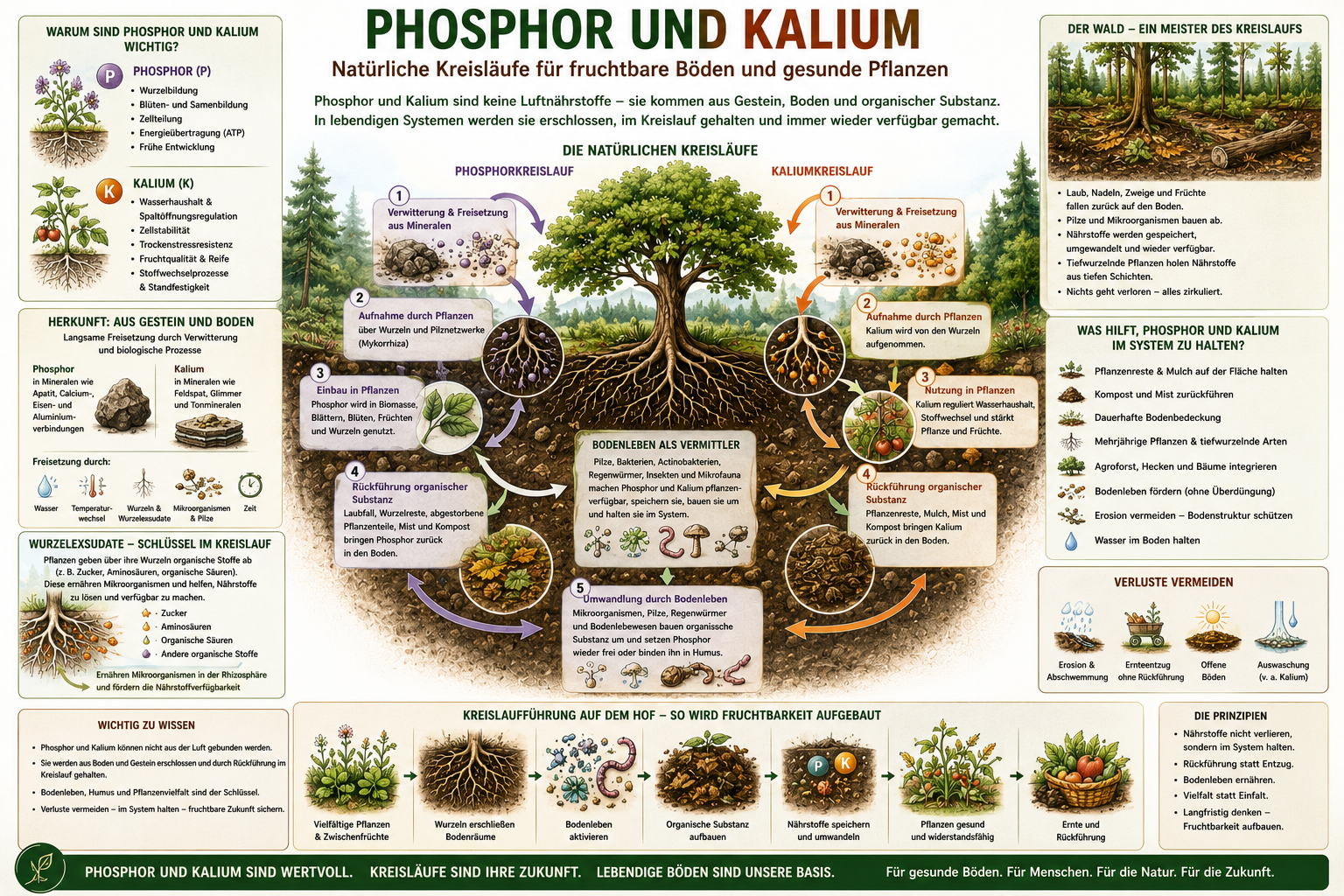
Phosphorus supports root development, flowering, seed formation, and energy processes.
Potassium strengthens water balance, cell stability, fruit quality, and resilience.
In many of today’s agricultural systems, phosphorus and potassium are primarily viewed as external inputs.
They are analyzed, purchased, applied, and managed as part of nutrient balances.
This page takes a different perspective.
It asks:
How do phosphorus and potassium cycles function in living soils, forests, farm systems, and regenerative landscapes?
¶ Basic Understanding
Phosphorus and potassium differ significantly from nitrogen.
Nitrogen is present in very large quantities in the atmosphere.
Phosphorus and potassium, on the other hand, primarily come from rock, minerals, soil components, organic matter, and biological cycles.
They cannot simply be fixed from the air.
Therefore, their cycling is particularly important.
If phosphorus and potassium are removed from a system, they must either be returned, supplemented mineralically, or made available again through deeper biological mobilization.
¶ The Central Question
The central question is not just:
How much phosphorus and potassium are present in the soil?
But rather:
- Are these nutrients plant-available?
- Are they retained in the system?
- Are they mobilized by soil life?
- Are they lost through harvest, erosion, or leaching?
- Do plant residues, compost, manure, and organic matter return to the soil?
- Can roots, fungi, and microorganisms release minerals?
- Is the soil alive enough for nutrients to circulate?
Phosphorus and potassium clearly demonstrate:
Fertility is not just about quantity.
Fertility arises from availability, storage, return, and living mediation.
¶ Phosphorus
Phosphorus is a key nutrient for energy processes in plants.
Plants need phosphorus for, among other things:
- Root formation
- Flower formation
- Seed formation
- Cell division
- Energy transfer
- Early plant development
- Stable development of young crops
Phosphorus is often present in the soil.
However, it is not always plant-available.
It can be bound to:
- Calcium
- Iron
- Aluminum
- Clay minerals
- Organic matter
- Mineral soil components
Therefore, a soil may contain phosphorus, yet plants can still show phosphorus deficiency.
The issue is not necessarily the absolute amount.
The issue is availability.
¶ Potassium
Potassium is important for the plant’s water balance.
Plants need potassium for, among other things:
- Water uptake
- Regulation of stomata
- Cell stability
- Drought stress resistance
- Fruit quality
- Metabolic processes
- Stability
- Ripening processes
Potassium helps plants regulate water more effectively.
In times of heat, drought, and fluctuating weather conditions, potassium therefore becomes particularly important.
Potassium is often present in the soil in mineral form.
Part of it is plant-available.
Part of it is bound to clay minerals or rock components.
Here, too, the following applies:
It is not just the quantity that counts.
What matters is whether potassium becomes accessible to plants at the right moment.
¶ Where Do Phosphorus and Potassium Occur in the Soil?
Phosphorus and potassium are not uniformly available in all soils.
Their availability depends heavily on the parent rock, soil type, humus content, pH value, water balance, and soil life.
Phosphorus often occurs in mineral phosphates.
It can be contained in apatite and other phosphate-bearing minerals.
In the soil, it can also be bound to calcium, iron, aluminum, clay minerals, and organic matter.
Potassium often occurs in potassium-bearing minerals.
These include, for example, feldspars, micas, biotite, muscovite, illite, and certain clay minerals.
Part of the potassium is directly plant-available.
Another part is exchangeably bound.
A very large portion is firmly incorporated into mineral structures and is only slowly made available through weathering.
¶ Which Soils Contain More Potassium?
Potassium is often found in soils derived from potassium-bearing minerals.
These often include:
- Clayey soils
- Loamy soils
- Soils with mica
- Soils with feldspar
- Soils with illite or other clay minerals
- Young, mineral-rich soils
- Certain volcanic or mica-rich soils
Potassium can be more easily leached from light, sandy soils.
Soils with little clay and little humus retain potassium poorly.
Therefore, the return of plant material, compost, manure, and organic matter is particularly important in such soils.
¶ Which Soils Contain More Phosphorus?
Phosphorus depends heavily on the parent rock and its binding form in the soil.
Phosphorus can occur in soils derived from phosphate-bearing rock.
It can also be enriched in soils through organic matter, manure, compost, plant residues, and long-term return.
At the same time, phosphorus can be difficult to access despite sufficient total amounts.
In calcareous soils, it can be bound to calcium.
In acidic soils, it can be bound to iron and aluminum.
This means:
A soil may contain phosphorus yet provide little plant-available phosphorus.
This is precisely where roots, mycorrhiza, mycelium, microorganisms, and root exudates become important.
¶ The Natural Phosphorus Cycle
In the natural phosphorus cycle, phosphorus primarily comes from mineral parent rock and organic matter.
Rock weathers slowly.
Roots, fungi, microorganisms, water, and organic acids help release phosphorus from mineral compounds.
Plants take up phosphorus.
Phosphorus is incorporated into plant tissue.
Leaves, roots, fruits, seeds, and plant residues return to the soil.
Soil organisms decompose this organic matter.
Phosphorus becomes available again or is incorporated into humus and soil structure.
The cycle begins anew.
¶ The Natural Potassium Cycle
Potassium also comes from mineral soil components, rocks, and organic material.
Through weathering, potassium is slowly released.
Plants take up potassium.
It is used in leaves, stems, fruits, roots, and seeds.
When plant material returns to the soil, potassium also returns.
Since potassium is relatively mobile in plants, it can return to the soil comparatively quickly from plant residues.
The cycle works particularly well when:
- Plant residues remain on the field
- Mulch is used
- Leaves are returned
- Soil remains covered
- Erosion is avoided
- Organic matter is built up
- Water is retained in the soil
- Soil life is active
¶ How Does This Work in the Forest?
A forest clearly demonstrates how nutrient cycles can function without regular external fertilization.
Trees take up nutrients from the soil.
They build leaves, wood, roots, seeds, and fruits.
Every year, leaves, needles, branches, fruits, and roots fall.
This material remains in the system.
Fungi, bacteria, insects, earthworms, and other soil organisms decompose it.
Humus is formed.
Nutrients are stored, transformed, and gradually made available again.
The forest does not live on constant external fertilizer input.
It lives on nutrients being retained, mobilized, and returned within the system.
¶ The Forest as a Cycle Model
In the forest, many processes occur simultaneously:
- Roots access deeper soil layers.
- Fungi connect plants with nutrient sources.
- Leaves fall back to the ground.
- Deadwood decomposes slowly.
- Animals distribute organic material.
- Microorganisms transform nutrients.
- Humus stores water and nutrients.
- The soil remains covered.
- Erosion is reduced.
- Nutrients circulate over long periods.
This is not a closed machine.
It is a living network.
This is precisely what agriculture can learn from.
¶ Can Living Soils Mobilize Phosphorus and Potassium from Rock?
Yes.
Living soils can partially mobilize phosphorus and potassium from mineral bonds.
This does not happen immediately or without limits.
It occurs through slow biological and chemical processes.
Roots release root exudates.
These include sugars, amino acids, organic acids, and other carbon compounds.
These substances feed microorganisms and can simultaneously help release mineral-bound nutrients.
Mycorrhizal fungi extend the root zone of the plant.
They can access soil areas that plant roots alone cannot reach.
This plant-fungus relationship is particularly important for phosphorus because phosphorus is often present in the soil but is immobile and chemically bound.
Potassium can also be made more available through root activity, organic acids, microorganisms, and weathering processes from potassium-bearing minerals such as feldspar, mica, or clay minerals.
However, a healthy soil does not create phosphorus and potassium out of nothing.
It can only mobilize what is present in rock, soil, organic matter, or return flows.
Therefore, agriculture needs not only soil life.
It also needs cycling.
If harvest, plant material, and animal products permanently leave the system, phosphorus and potassium also leave the field.
Living soils can reduce these losses, retain nutrients better, and mobilize existing reserves.
But they do not replace the question of whether a farm or region returns enough nutrients in the long term.

¶ Mycorrhiza and Phosphorus
Mycorrhizal fungi are particularly important for phosphorus.
They live in association with plant roots.
The plant provides carbon compounds to the fungi.
In return, the fungi access soil spaces that roots alone can hardly reach.
They can make phosphorus more available in the soil and transport it to the plant.
This creates an exchange:
- The plant supplies energy.
- The fungus extends the root zone.
- Phosphorus is better mobilized.
- The plant grows more stably.
- The soil becomes biologically more active.
Phosphorus supply is therefore not just a fertilization question.
It is also a question of root health, fungal networks, and soil life.
¶ Mycelium as a Nutrient Network
Mycelium is the fine filamentous network of fungi in the soil.
It can permeate soil spaces that plant roots alone cannot reach.
This network can mediate water, nutrients, and organic signals between soil, fungi, and plants.
For phosphorus, mycelium is particularly important because phosphorus is relatively immobile in the soil.
Fungal filaments can grow close to bound phosphorus sources and help make phosphorus more plant-available.
The interplay of mycelium, bacteria, roots, organic acids, and weathering can also play a role in mobilizing mineral potassium sources.
Mycelium is therefore not an add-on.
It is part of the living soil.
¶ Root Exudates and Nutrient Mobilization
Plants release root exudates through their roots.
These are organic substances such as sugars, amino acids, organic acids, and other carbon compounds.
These substances feed microorganisms in the root zone.
At the same time, they can help dissolve nutrients in the soil or make them more available.
This is particularly important for phosphorus because phosphorus is often bound.
Root exudates, microorganisms, and fungi can contribute to gradually making bound phosphorus plant-available.
Potassium can also be better mobilized through root activity, organic acids, microorganisms, and weathering processes.
¶ Soil Life as a Mediator
Phosphorus and potassium do not simply move into the plant on their own.
They are mediated by:
- Roots
- Fungi
- Mycelium
- Bacteria
- Organic matter
- Humus
- Water
- Clay minerals
- Soil structure
- Weathering
- pH value
- Oxygen
- Biological activity
A living soil acts like a mediation space.
It stores, binds, dissolves, retains, transforms, and releases nutrients again.
This is the difference between a mere nutrient storage and a fertile soil.
¶ Organic Matter as Storage
Organic matter is crucial for phosphorus and potassium.
It helps retain nutrients in the soil.
It feeds microorganisms.
It improves soil structure.
It increases water retention capacity.
It ensures that nutrients are not only temporarily available but are integrated into a living cycle.
Plant residues, roots, mulch, compost, and manure are therefore not just "waste."
They are carriers of nutrients and carbon.
¶ Humus and Nutrient Availability
Humus can store nutrients and improve soil structure.
This creates better conditions for roots, microorganisms, and water management.
A humus-rich soil can better integrate phosphorus and potassium into cycles.
It cannot create nutrients arbitrarily.
But it can help retain and make available existing nutrients.
This is an important difference.
Humus does not replace the mineral foundation.
It makes it more dynamically usable.
¶ Return of Plant Material
In natural systems, much plant material remains in place.
Leaves fall.
Roots die off.
Grasses are grazed or decompose.
Branches, fruits, and seeds return to the soil.
Thus, nutrients become part of the system again.
In agricultural systems, however, much biomass is harvested and removed.
This also removes phosphorus and potassium from the field.
Therefore, return is central.
This includes:
- Harvest residues
- Compost
- Manure
- Mulch
- Biochar, when sensibly integrated
- Cover crop biomass
- Leaves
- Prunings
- Organic by-products
- Regional compost cycles
¶ Animals in the Phosphorus and Potassium Cycle
Animals can help move nutrients within the farm system.
They eat plants.
They return manure and urine.
They distribute organic material on fields.
They can manage landscapes and stimulate plant growth.
In doing so, phosphorus and potassium also enter the cycle.
The key is integration.
If feed comes from far away and manure is not sensibly returned, open cycles result.
If animals are integrated into a farm system, they can help retain nutrients and make fields more fertile.
¶ Compost and Manure
Compost and manure are important ways to return phosphorus and potassium.
They contain not only nitrogen.
They also contain mineral nutrients, organic matter, and carbon.
Good compost provides:
- Organic material
- Microorganisms
- Nutrients
- Structure
- Biological activity
- Long-term fertility
Manure provides:
- Nutrients
- Carbon
- Bedding
- Microbial activity
- Connection between animal husbandry and crop production
The key is management quality.
Compost and manure can strengthen cycles.
But they can also cause losses if storage, application, or quantity are not appropriate.
¶ Phosphorus Losses
Phosphorus is less mobile in the soil than nitrate.
Nevertheless, phosphorus can be lost.
Important loss pathways include:
- Erosion
- Runoff
- Soil erosion
- Loss of organic matter
- Sale of harvested products without return
- Poor compost or manure management
- One-sided use without build-up
Erosion is particularly important.
When soil particles are lost, phosphorus is often lost as well.
Therefore, soil cover, roots, hedges, terraces, mulch, and stable soil structure are important phosphorus protection measures.
¶ Potassium Losses
Potassium can be more mobile than phosphorus depending on soil type.
It can be lost through:
- Leaching on light soils
- Harvest removal
- Lack of return of plant material
- Erosion
- Low clay and humus binding
- Open soils
- Weak soil structure
Soils with clay minerals and humus can retain potassium better.
Light, sandy soils require special attention because nutrients can be more easily leached there.
¶ Weathering as a Slow Cycle
Phosphorus and potassium originally come from mineral foundations.
Rock and soil minerals weather slowly.
In the process, nutrients are released.
This process occurs through:
- Water
- Temperature fluctuations
- Root pressure
- Organic acids
- Fungi
- Mycelium
- Bacteria
- Soil respiration
- Time
In a living soil, weathering can be biologically supported.
Roots, fungi, and microorganisms act like a slow, living mobilization of the mineral foundation.
¶ Deep-Rooted Plants and Nutrient Mobilization
Deep-rooted plants can mobilize nutrients from deeper soil layers.
Depending on location and system, these include:
- Trees
- Shrubs
- Alfalfa
- Clover species
- Chicory
- Dock species
- Certain grasses
- Perennial crops
These plants bring nutrients from deeper layers into aboveground biomass.
When leaves, prunings, roots, or mulch remain on the field, these nutrients return to the topsoil.
This creates a vertical cycle.
Nutrients are not only distributed horizontally but are brought up from deeper layers.
¶ Perennial Plants and Tree Structures
Trees, shrubs, and perennial plants are particularly valuable for phosphorus and potassium cycles.
They maintain living root zones over long periods.
They release root exudates.
They feed microorganisms.
They stabilize the soil.
They promote humus build-up.
They improve water retention capacity and soil structure.
They return leaves, fine roots, and organic matter to the cycle.
In agroforestry systems, forest gardens, orchards, olive groves, vineyards, or hedgerow structures, such processes can be consciously designed.
¶ Agroforestry and Forest Garden Logic
Agroforestry systems and forest gardens attempt to transfer elements of natural cycles into agricultural systems.
This is not about copying a forest one-to-one.
It is about utilizing principles:
- Permanent roots
- Soil cover
- Leaf fall
- Biomass build-up
- Mycorrhiza
- Mycelium
- Shade and microclimate
- Water retention
- Nutrient return
- Diverse plant layers
- Less erosion
- More organic matter
Phosphorus and potassium are not created out of nothing in this way.
They are better retained, mobilized, and cycled.
¶ Difference from External Fertilization
External fertilization means:
Nutrients are supplied from outside.
This can be done conventionally or organically.
Even organic farming can depend on external phosphorus and potassium sources.
The crucial question is therefore not just:
Is the fertilizer permitted?
But rather:
Is fertility created within the system, or is it permanently replaced from outside?
A regenerative cycle perspective asks:
- Which nutrients leave the system?
- Which nutrients return?
- Which nutrients can be biologically mobilized?
- Which losses can be avoided?
- How can soil fertility be built up in the long term?
¶ Organic Does Not Automatically Mean Closed
An organic farm can establish closed cycles.
But it can also use external inputs.
For example:
- Purchased organic fertilizers
- External composts
- Commercial fertilizers
- Feed
- Substrates
- Mineral supplements
This is not automatically wrong.
But it is important to make the cycle question visible.
A system does not become cyclical just because an input is organically approved.
It becomes more cyclical when nutrients are retained in the soil, farm, and region, returned, and made dynamically available.
¶ When Supplements Can Be Useful
A cycle perspective does not mean that nothing should ever be supplemented.
Some soils are severely depleted.
Some locations have natural deficiencies.
Some crops remove large amounts.
Some nutrients are indeed insufficiently present.
Then supplements can be useful or necessary.
The key is the direction:
Supplements should not lead to the soil remaining passive.
They should help build living cycles.
The goal is not permanent input dependency.
The goal is a more sustainable system.
¶ The Difference Between Stock and Cycle
A nutrient stock is what is present in the soil.
A nutrient cycle describes how this stock is moved, mobilized, taken up, returned, and stabilized.
A soil can have high stocks yet appear infertile.
Another soil can have lower stocks but be very fertile due to active soil life, humus, water management, and good root zones.
Therefore, agriculture needs both:
- Knowledge of existing nutrients
- Building living cycles
¶ Open and Closed Systems
An open system loses nutrients.
Typical signs are:
- High harvest removal
- Little return
- Open soils
- Erosion
- Low humus
- Low root mass
- Little soil life
- External fertilization logic
A more closed cycle works differently:
- Plant residues remain in the system.
- Compost and manure are used sensibly.
- Roots remain active as long as possible.
- Soil remains covered.
- Animals are integrated.
- Trees and perennial plants stabilize the area.
- Water and nutrients are retained.
- Harvest removals are considered consciously.
- Regional return is built up.
¶ TEIKEI Perspective
From a TEIKEI perspective, phosphorus and potassium cycles are part of the real foundation of community-supported agriculture.
They are not abstract nutrient tables.
They concern the question of whether farms can remain fertile in the long term.
If members share in the harvest, they also share in the foundations from which the harvest can arise.
These include:
- Soil fertility
- Humus build-up
- Root life
- Composting
- Manure management
- Water retention capacity
- Biodiversity
- Tree and hedgerow structures
- Regional return of organic materials
- Long-term farm development
Phosphorus and potassium clearly show:
Fertility does not arise solely from input.
It arises from cycles.
¶ Connection to Closed Cycles
Phosphorus and potassium are central examples of why closed cycles are important.
Nitrogen can be partially biologically fixed from the air.
Phosphorus and potassium must be primarily derived from soil, rock, organic matter, and return flows.
If these nutrients permanently leave the system with the harvest without return or mobilization, the soil will weaken in the long term.
Therefore, regenerative agriculture needs:
- Return
- Soil cover
- Humus build-up
- Deep roots
- Mycorrhiza
- Mycelium
- Weathering
- Compost
- Manure
- Perennial plants
- Regional material cycles
¶ Classification
This page does not replace soil analysis or professional advice.
Phosphorus and potassium processes depend heavily on:
- Soil type
- Parent rock
- pH value
- Climate
- Water
- Humus
- Clay minerals
- Soil life
- Crop type
- Management
- Harvest removal
- Regional return
Site-specific knowledge is needed for concrete decisions.
This page provides a basic understanding.
It shows why phosphorus and potassium should not only be understood as external nutrients but as part of living cycles.
¶ Key Point
Phosphorus and potassium show that agriculture does not live solely on input.
It lives on retaining, mobilizing, and returning nutrients.
In the forest, this happens through leaves, roots, fungi, mycelium, animals, humus, water, rock, and time.
In agriculture, this connection must be consciously designed.
Fertile soils arise where nutrients are not only taken but returned to living cycles and mobilized from the existing mineral foundation.
¶ Further Information & Understanding Connections
- How Do Closed Cycles Work in Agriculture?
- Basic Nutrients in Agriculture
- Nitrogen Cycle
- Carbon Cycle
- Compost and Manure Management
- Plants, Roots, and Soil Life
One level up: Closed Cycles
Author: Felix Schröder, with the help of AI (ChatGPT)
Creation: written by Felix Schröder › formatted in Markdown by ChatGPT › published by Felix Schröder › layout adjusted by Claude
Created: 2026-05-16 · Last updated: 2026-05-16 · Questions or suggestions? support@teikei.us