¶ Animals in Farm Cycles
¶ What This Page Is About
This page explains the role of animals in agricultural farm cycles.
At its core is the question:
How can animals be integrated into agricultural systems in a way that strengthens soil fertility, nutrient cycles, landscape management, and long-term supply?
Animals in agriculture are not just a separate production branch.
They can be part of a living farm system.
When well integrated, they connect:
- Plant growth
- Pastures
- Feed
- Manure
- Urine
- Bedding
- Soil life
- Compost
- Nutrient cycles
- Landscape management
- Humus formation
- Human nutrition
The key factor is not just whether animals are present on a farm.
The key factor is how they are integrated.
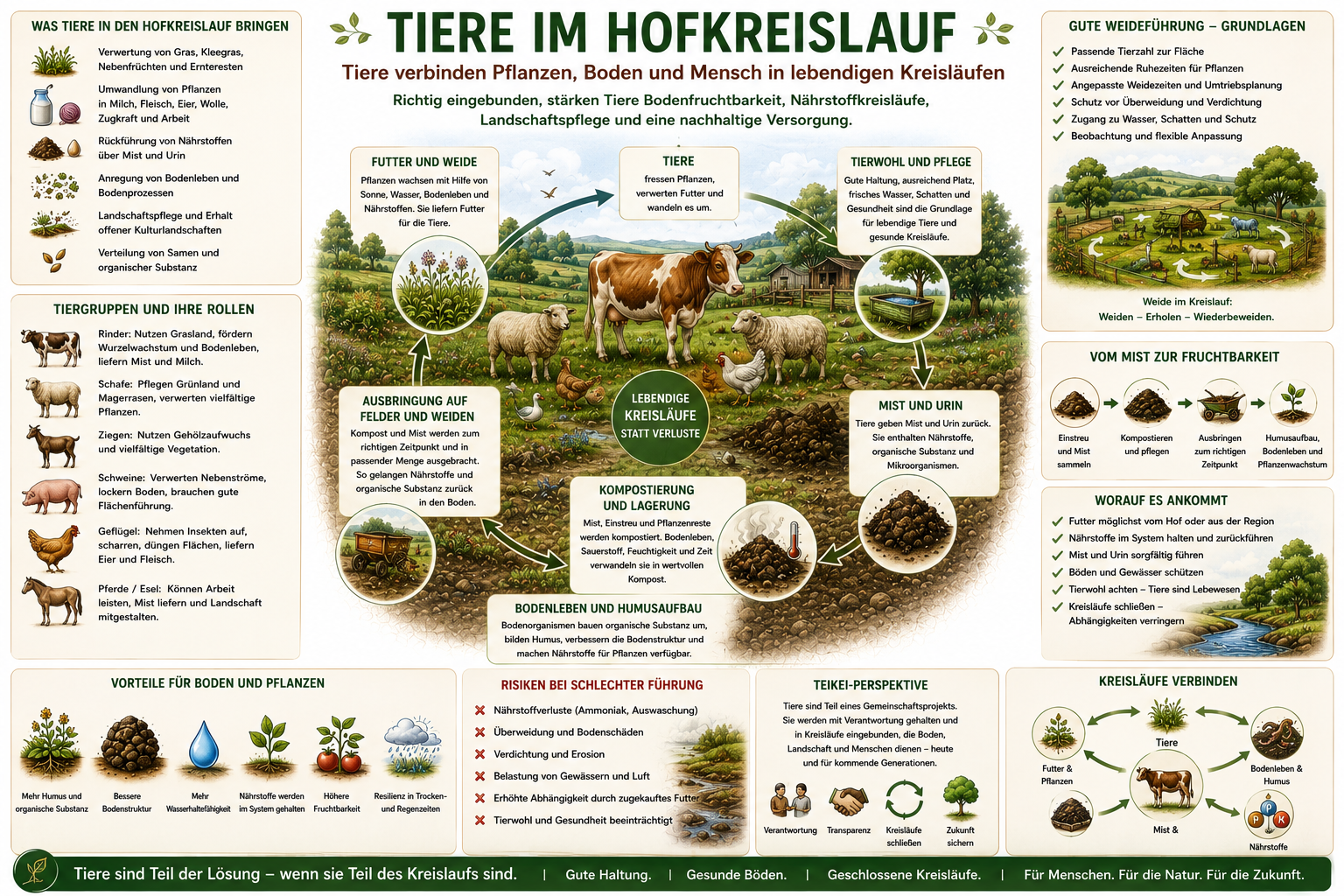
¶ Basic Understanding
Animals eat plants.
They convert plant material.
They return manure and urine.
They move across areas.
They influence vegetation, soil, nutrients, and landscapes.
In a well-designed farm cycle, animals can help retain substances within the system and build fertility.
In a poorly integrated system, however, animals can also create burdens.
These include:
- Nutrient surpluses
- Compaction
- Erosion
- Overgrazing
- Feed dependency
- Odor
- Water pollution
- Open cycles
Therefore, animal husbandry requires responsibility, moderation, and integration.
¶ The Central Question
The central question is not:
How many animals can a farm keep?
Rather:
What role can animals meaningfully play in the specific farm and landscape system?
This includes further questions:
- Where does the feed come from?
- Where do manure and urine go?
- Are nutrients returned?
- Is soil built up or burdened?
- Are animals integrated into pasture, compost, crop production, and landscape management?
- Does the number of animals match the available land?
- Are rest periods for plants observed?
- Are water, shade, and animal welfare considered?
- Are cycles closed, or are new dependencies created?
Animals in farm cycles are therefore not a simple solution.
They are a design challenge.
¶ Animals as Part of Living Agriculture
Animals can connect agricultural cycles in unique ways.
They utilize plants that humans cannot eat directly.
They process grass, clover, cover crops, crop residues, or by-products.
They return nutrients through manure and urine.
They can maintain pastures.
They can spread seeds.
They can stimulate soil processes.
They can keep landscapes open.
They can be part of a diverse farm system.
However, it is important to remember:
Animals are not machines for nutrient production.
They are living beings with needs.
A farm cycle must therefore always consider animal welfare, landscape, soil, and supply together.
¶ Feed as a Starting Point
Every animal husbandry system begins with feed.
Feed can come from the farm’s own system or be purchased externally.
Feed includes, for example:
- Grass
- Hay
- Silage
- Clover grass
- Alfalfa
- Cover crops
- Grain
- Legumes
- Crop residues
- By-products from processing
- Foliage or woody material in certain systems
- Pasture growth
The origin of the feed largely determines whether animal husbandry is part of a closed cycle.
If feed comes from far away, nutrients from other regions are transferred into the farm system.
If manure is not meaningfully returned, imbalances arise.
¶ Feed from the Farm
Feed from the farm itself or the immediate region can strengthen cycles.
It connects animal husbandry with land, crop production, and landscape.
Clover grass, alfalfa, pastures, and cover crops can:
- Cover the soil
- Build roots
- Fix nitrogen
- Nourish soil life
- Provide feed
- Support humus formation
- Supply animals
This creates a connection between plant production, animal nutrition, and soil fertility.
¶ Animals and Crop Production
Animals can complement crop production.
They can utilize cover crops.
They can process crop residues.
They can convert clover grass into manure and milk, meat, eggs, or draft power.
They can return nutrients through manure and urine.
In mixed farm systems, animals can therefore form a bridge between:
- Arable farming
- Vegetable cultivation
- Pasture
- Perennial crops
- Composting
- Manure management
- Soil building
However, this connection does not happen automatically.
It must be planned and maintained.
¶ Manure and Urine
Manure and urine are central components of the animal-farm cycle.
They contain:
- Nitrogen
- Phosphorus
- Potassium
- Carbon
- Sulfur
- Trace elements
- Organic matter
- Microorganisms
- Moisture
Manure and urine can strengthen soil fertility.
However, they can also be lost or cause burdens.
Key factors are:
- Bedding
- Collection
- Storage
- Composting
- Application
- Timing
- Quantity
- Soil conditions
- Plant requirements
- Protection of water bodies
Manure management is therefore a distinct aspect of responsible animal husbandry.
¶ Bedding as a Carbon Carrier
Bedding connects animal husbandry with the carbon cycle.
It absorbs moisture and urine.
It binds nutrients.
It provides structure to manure.
It supplies carbon for composting and soil life.
Typical bedding materials include:
- Straw
- Wood chips
- Sawdust
- Leaves
- Chopped material
- Plant residues
Good bedding can help reduce nutrient losses and turn manure into a valuable soil-building material.
¶ Manure as a Connection Between Animals and Soil
Manure is not waste.
It is a connection between animal husbandry and soil.
Well-managed manure can:
- Return organic matter
- Nourish soil life
- Promote humus formation
- Store nutrients
- Improve soil structure
- Enhance water retention
- Support plant growth
Poorly managed manure, on the other hand, can lead to losses and burdens.
These include:
- Leaching
- Ammonia losses
- Odor
- Over-fertilization
- Nutrient inputs into water bodies
- Uneven effects
- Compaction from improper application
Therefore, manure is not just material.
It is a responsibility.
¶ Pasture as a Living Cycle
Pasture is a direct connection between animals, plants, soil, and landscape.
Animals eat plants.
Plants respond with new growth.
Roots grow, partially die back, and renew themselves.
Manure and urine return to the land.
Soil life is nourished.
Plants cover the soil.
Water can be better retained.
This cycle, however, only works with good pasture management.
¶ Good Pasture Management
Good pasture management pays attention to the relationship between animal, plant, soil, and time.
Important factors are:
- Appropriate stocking density
- Sufficient rest periods for plants
- Avoiding overgrazing
- Protection against compaction
- Access to water
- Shade and weather protection
- Appropriate pasture size
- Regular observation
- Adaptation to season and weather
- Protection of sensitive soils
Pasture is not just land plus animals.
Pasture is a dynamic process.
¶ Overgrazing
Overgrazing occurs when plants are grazed too heavily or too frequently and have no time to recover.
Consequences can include:
- Weak root growth
- Bare soil patches
- Erosion
- Reduced soil cover
- Poorer water absorption
- Less humus formation
- Weaker soil life
- Reduced plant diversity
Overgrazing shows that animals do not automatically have a regenerative effect.
Their impact depends on management, time, density, location, and recovery.
¶ Undergrazing and Bush Encroachment
Too little grazing can also change certain landscapes.
Some cultural landscapes were created through grazing.
If grazing ceases, areas can become overgrown with bushes or their species composition can change.
This is not inherently bad.
But it alters the landscape, biodiversity, feed base, and management needs.
In some regions, adapted grazing can help maintain open landscapes, orchards, dry grasslands, or wood pastures.
Here, too, the principle applies:
It is not about general rules.
It is about appropriate integration into the specific location.
¶ Animals and Landscape Management
Animals can maintain landscapes.
Depending on the species and system, they can:
- Keep grass short
- Maintain open areas
- Regulate woody growth
- Maintain orchards
- Spread seeds
- Distribute organic material
- Promote biodiversity
- Support fire prevention in dry regions
- Keep difficult-to-manage areas usable
However, landscape management through animals requires good planning.
Animal welfare, soil protection, vegetation, water, and regional conditions must align.
¶ Different Animals, Different Roles
Not every animal has the same effect.
Cattle, sheep, goats, pigs, chickens, ducks, horses, or donkeys have different functions, needs, and impacts.
Cattle can utilize grassland and influence soil processes through grazing management.
Sheep can maintain poor soils, orchards, or open landscapes.
Goats can utilize woody growth but require careful management.
Chickens can consume insects, scratch, distribute manure, and be integrated into mobile systems.
Pigs can significantly disturb soil and require particularly good management to avoid damage.
Ducks can regulate snails and insects in certain systems.
The appropriate animal species always depends on the farm, the landscape, and the goal.
¶ Ruminants in the Farm Cycle
Ruminants such as cattle, sheep, and goats can utilize fibrous plant material.
They process grass, hay, clover grass, and other plants that humans cannot eat directly.
This allows them to produce food and manure from permanent grassland, pastures, or clover grass areas.
Ruminants are particularly well integrated where:
- Grassland is not suitable for arable farming
- Clover grass is part of the crop rotation
- Pasture landscapes are to be maintained
- Manure is needed for crop production
- Landscape management plays a role
- Animal numbers and land area match
¶ Poultry in the Farm Cycle
Poultry can be integrated into farm cycles.
Chickens, ducks, or geese can:
- Consume insects and snails
- Utilize plant residues
- Fertilize areas through mobile systems
- Superficially disturb soil
- Provide eggs
- Be integrated into fruit or agroforestry systems
Poultry also requires good management.
Excessive densities can burden soil, vegetation, and nutrient balance.
Mobile systems can help distribute the load and integrate animals into land cycles.
¶ Pigs in the Farm Cycle
Pigs can utilize certain by-products and work the land.
They root, search, loosen, and disturb soil.
This can be useful in certain situations.
However, it can also cause significant damage.
Pigs therefore require clear land management.
Important factors are:
- Short usage periods
- Sufficient land rotation
- Protection against erosion
- Soil protection in wet conditions
- Good feed base
- Nutrient return
- Animal welfare
Pigs are not a simple soil improver.
Their impact strongly depends on management and context.
¶ Animals and Biodiversity
Well-integrated animals can promote biodiversity.
They create different vegetation heights.
They open spaces for germination.
They distribute seeds.
They promote insects through manure and structurally rich pastures.
They can create landscape mosaics.
At the same time, animals can harm biodiversity if they are used too intensively, for too long, or in the wrong place.
Biodiversity arises through appropriate use, rest, structure, and diversity.
¶ Animals and Water
Animals influence the water balance.
They need drinking water, shade, and access to clean water.
They can compact soils if areas are too wet or overloaded.
They can damage shorelines if water bodies are not protected.
However, through good pasture management, they can also promote soil cover, root growth, and water retention.
Water must therefore always be considered in animal husbandry.
¶ Animals and Carbon
Animals are part of the carbon cycle.
They consume plant carbon.
They return organic material.
They can stimulate plant growth through grazing.
They can bring manure and bedding into compost cycles.
They can maintain pastureland.
At the same time, animal husbandry and feed production can also cause carbon losses if poorly managed.
The key is integration:
Animals should strengthen carbon cycles, not open them.
¶ Animals and Nitrogen
Animals move nitrogen through the farm system.
Nitrogen is contained in feed.
Some is converted into milk, meat, eggs, wool, offspring, or work.
A large portion returns via manure and urine.
If this nitrogen is well bound and returned, it can serve plants and soil life.
If it is lost, burdens arise.
These include:
- Ammonia losses
- Leaching
- Odor
- Nutrient surpluses
- Water pollution
- Nitrous oxide formation under unfavorable conditions
Animal husbandry is therefore also nitrogen responsibility.
¶ Animals, Phosphorus, and Potassium
Animals also move phosphorus and potassium.
These nutrients enter the animal cycle through feed.
Some are incorporated into animal products.
Some remain in manure and urine.
If manure is meaningfully returned, phosphorus and potassium can be reapplied to the land.
However, if animal products are sold, nutrients also leave the farm system.
Therefore, animal husbandry requires a conscious nutrient balance and return.
¶ Animals and Compost
Manure, bedding, and feed residues can be composted.
Composting helps stabilize organic material.
It can reduce nutrient losses.
It makes the material more soil-compatible.
It can reduce pathogens and viable seeds if the process is well managed.
Composted manure can strengthen soil life, humus formation, and nutrient cycles.
¶ Animals and Labor
Animals can also be part of the work on the farm system.
Historically, draft animals were central in many landscapes.
Today, they only play a role on a few farms.
Nevertheless, this aspect shows:
Animals were not always just product suppliers.
They were part of energy, labor, landscape management, fertilization, and farm organization.
In some contexts, animal labor can play a role again.
However, this must be considered in a site-specific manner.
¶ Animals and Ethical Responsibility
Animals in farm cycles must not be viewed solely in functional terms.
They are sentient beings.
A TEIKEI perspective must therefore also ask:
- Do the animals live in a species-appropriate manner?
- Can they move freely?
- Do they have access to light, air, water, and suitable feed?
- Are their social needs considered?
- Is the number of animals appropriate?
- Is the husbandry transparent?
- Is there responsibility for the animals' entire lives?
A farm cycle is only sustainable if it does not reduce animals to their nutrient function.
¶ Open and Closed Animal Husbandry Systems
An open animal husbandry system is heavily dependent on external inputs.
Typical characteristics include:
- Large amounts of purchased feed
- Little own feed area
- Nutrient surpluses
- Manure is not meaningfully returned
- High animal densities
- Regional decoupling of animal husbandry and crop production
- Burden on soils, water, and air
A more closed animal-farm cycle operates differently:
- Feed comes as much as possible from the farm or region.
- Animal numbers match the available land.
- Manure and urine are carefully managed.
- Bedding binds nutrients.
- Composting strengthens soil building.
- Pasture is appropriately managed.
- Crop production and animal husbandry are connected.
- Nutrients are returned.
- Animal welfare is part of the design.
¶ Organic Does Not Automatically Mean Cyclical
Even organic animal husbandry can have open cycles.
For example, if a lot of feed is purchased externally or manure is not meaningfully returned to regional soil fertility.
Organic standards can set important minimum requirements.
But they do not replace the cycle question.
The key factors are:
- Where does the feed come from?
- Where do the nutrients go?
- How is manure managed?
- Does the number of animals match the land?
- Is soil being built up?
- Is water protected?
- Are animals kept well?
- Does the region become more fertile or more dependent?
¶ Regional Animal-Farm Cycles
Not every farm needs its own animals.
And not every farm can keep animals meaningfully.
Cycles can also be thought of regionally.
A crop farm can collaborate with an animal farm.
Manure can be returned to fields.
Feed can come from the region.
Compost sites can connect multiple farms.
Pastureland can be used jointly.
Such regional cycles require:
- Clear agreements
- Transparent material flows
- Appropriate distances
- Quality assurance
- Responsibility
- Documentation
- Mutual trust
¶ Animals in Perennial Crops
Animals can also play a role in perennial crops.
For example, in:
- Orchards
- Olive groves
- Vineyards
- Agroforestry systems
- Forest gardens
- Nut crops
- Orchards
There, animals can keep grass short, return nutrients, regulate insects, or maintain areas.
Integration must be done carefully.
Young trees, soil, irrigation, harvest timing, and animal behavior must be considered.
¶ Animals in Arable and Vegetable Farming Systems
Arable and vegetable farming systems can also be connected with animals.
Possible forms include:
- Clover grass in the crop rotation
- Mobile chickens after harvest
- Grazing of cover crops
- Manure compost for vegetable fields
- Collaboration with animal farms
- Composting of plant residues and manure
- Regional feed-manure cycles
Especially in intensive vegetable farming systems, nutrient return is important because a lot of biomass is harvested.
¶ Limits
Animals are not suitable everywhere.
There are limits due to:
- Land area
- Water
- Climate
- Feed base
- Labor capacity
- Infrastructure
- Animal welfare
- Legal requirements
- Neighborhood
- Marketing
- Transport
- Slaughter
- Experience
- Regional conditions
A cycle perspective does not mean introducing animals everywhere.
It means honestly assessing where animals can be meaningfully, sustainably, and responsibly integrated.
¶ Difference from Pure Production Logic
In a pure production logic, animals are often viewed in terms of output:
- Milk
- Meat
- Eggs
- Wool
- Performance
- Growth
- Efficiency
In a farm cycle perspective, further questions are asked:
- What role do animals play for the soil?
- What role do they play for the landscape?
- What role do they play for nutrients?
- What role do they play for crop rotation?
- What role do they play for regional cycles?
- How is responsibility taken for their lives?
Animals are not romanticized in this way.
They are considered in their full significance for the farm.
¶ TEIKEI Perspective
From a TEIKEI perspective, animals, when part of a farm, belong to the real farm reality.
They are not just product carriers.
They can be part of soil building, landscape management, nutrient cycles, and long-term fertility.
At the same time, farms bear responsibility for their well-being.
If members share in the harvest, they also share in the conditions under which agriculture takes place.
For farms with animals, this includes:
- Feed base
- Pasture management
- Manure management
- Animal welfare
- Soil fertility
- Water
- Labor time
- Infrastructure
- Long-term farm development
Animal husbandry is therefore not just a question of individual products.
It is part of the entire farm system.
¶ Connection to Closed Cycles
Animals connect multiple cycles:
- Plant cycle
- Feed cycle
- Nitrogen cycle
- Phosphorus and potassium cycle
- Carbon cycle
- Water cycle
- Compost and manure management
- Soil life
- Landscape management
When animals are well integrated, they can help close these cycles more tightly.
When poorly integrated, they can open cycles and increase burdens.
Therefore, animal husbandry in farm cycles is always a question of balance, relationship, and responsibility.
¶ Classification
This page does not replace professional advice, animal husbandry planning, or legal review.
Animal husbandry depends on:
- Animal species
- Breed
- Land area
- Feed base
- Water
- Climate
- Soil
- Barn and pasture systems
- Labor capacity
- Animal welfare
- Manure management
- Regional conditions
- Legal requirements
For specific decisions, site-specific observation, experience, and professional support are needed.
This page provides a basic understanding.
It shows why animals should not be viewed in isolation but as potential parts of living farm cycles.
¶ Key Takeaway
Animals can bring farm cycles to life.
They eat plants, move nutrients, maintain landscapes, and return organic matter to the soil.
They can strengthen soil fertility if their husbandry matches the land, feed, water, labor, and landscape.
They can create burdens if cycles remain open or responsibility is lacking.
Animals in farm cycles therefore mean:
not just animal husbandry,
but a relationship between animal, soil, plant, human, and landscape.
¶ Further Information & Understanding Connections
- How do closed cycles work in agriculture?
- Basic nutrients in agriculture
- Nitrogen cycle
- Carbon cycle
- Phosphorus and potassium
- Plants, roots, and soil life
- Compost and manure management
- Water in the agricultural cycle
One level up: Closed Cycles
Author: Felix Schröder, with the help of AI (ChatGPT)
Created: written by Felix Schröder › formatted in Markdown by ChatGPT › published by Felix Schröder › layout adjusted by Claude
Date: 2026-05-16 · Last updated: 2026-05-16 · Questions or suggestions? support@teikei.us